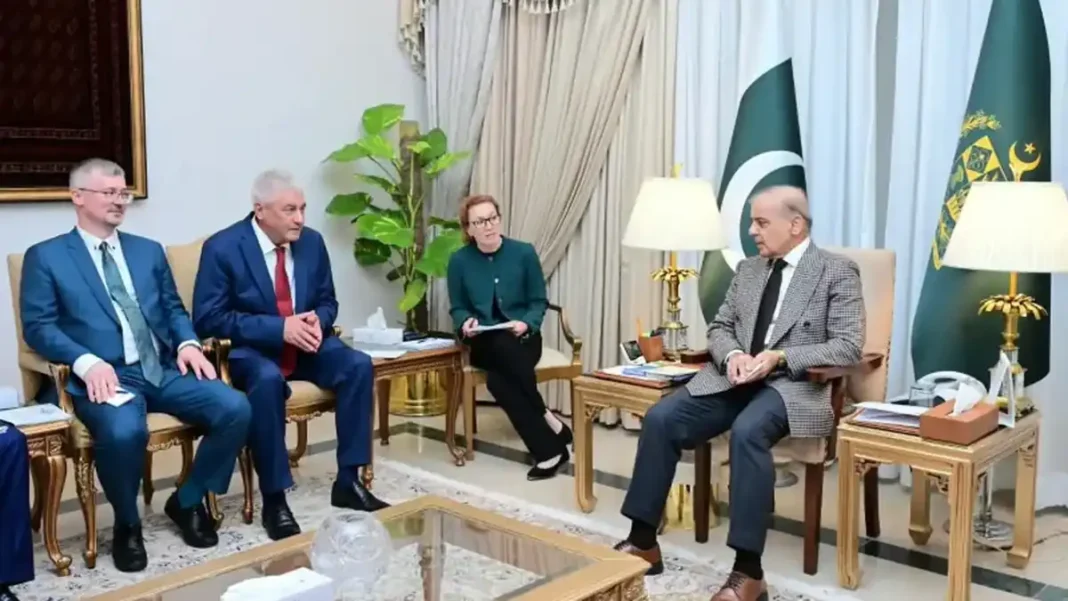
Russian Interior Minister Vladimir Kolokoltsev called on Chief of Defence Forces and Chief of Army Staff Field Marshal Asim Munir at GHQ in Rawalpindi on Wednesday, where both sides stressed stronger defence cooperation between Islamabad and Moscow.
The meeting came two days after Kolokoltsev arrived in Pakistan on a four-day visit at the invitation of Interior Minister Mohsin Naqvi, the first by a Russian interior minister.
Security cooperation tops the agenda
According to the military’s media wing, the Inter-Services Public Relations, the two leaders discussed matters of mutual interest and the regional security landscape, with the focus on strengthening bilateral security cooperation.
The ISPR said both sides “underscored the importance of closer institutional linkages and improved coordination between the security institutions of Pakistan and Russia”.
Field Marshal Munir reaffirmed Pakistan’s resolve to deepen its longstanding relations with Russia and expand tangible cooperation, particularly in the security domain. Kolokoltsev, for his part, appreciated Pakistan’s contributions to regional peace and stability and acknowledged the professionalism and sacrifices of Pakistani forces in the fight against terrorism.
Extradition treaty and anti-crime MoU agreed
Earlier the same day, Pakistan and Russia agreed to finalise an extradition treaty and to sign a memorandum of understanding on preventing organised crime and exchanging information. The understanding was reached during a meeting between Naqvi and Kolokoltsev in Islamabad, followed by delegation-level talks.
Naqvi said the proposed MoU on prevention of organised crime would be an important milestone in cooperation between the two countries. Both sides pledged to enhance mutual cooperation in areas of shared interest and decided to ensure early implementation of a readmission agreement. They also agreed to enhance cooperation between the Anti-Narcotics Force and relevant Russian institutions, and to have working groups from the two interior ministries visit each other soon.
The two sides discussed sending skilled manpower from Pakistan to Russia, visa facilitation for tourists and the business community, and cybercrime cooperation between their police academies. Naqvi said easing the visa regime would increase people-to-people contact and noted that 1,300 Pakistani students were currently studying in Russia.
Kolokoltsev said joint measures were essential against organised crime, including terrorism, drug smuggling and illegal migration.
A partnership warming for years
The security discussions build on a relationship that has warmed steadily in recent years. In January, Russian President Vladimir Putin said Moscow’s relations with Pakistan were “genuinely mutually beneficial”. In July, Deputy Prime Minister Alexei Overchuk called the two countries “natural allies”. After Western sanctions tied to the Ukraine conflict, Moscow turned toward new energy outlets while Islamabad sought cheaper fuel, a shift that culminated in 2023 when Pakistan brought Russian crude oil into its energy portfolio.
The meeting matters because Pakistan faces a demanding security environment. With the Centre and the KP government locked in a standoff over counterterrorism policy, the Centre’s move toward emergency rule in KP and the parliamentary debate it triggered have made counterterrorism the defining national issue, and Munir’s direct engagement with Russia’s interior minister signals that Islamabad is widening its security partnerships to match. The GHQ meeting is the latest in a string of high-level engagements for the CDF, from Guterres’s GHQ visit to his address at the Lahore garrison.
Frequently asked questions
Who did the Russian interior minister meet in Pakistan?
Vladimir Kolokoltsev met Field Marshal Asim Munir, Chief of Defence Forces and Chief of Army Staff, at GHQ Rawalpindi on October 14. He also held delegation-level talks with Interior Minister Mohsin Naqvi in Islamabad.
What agreements did Pakistan and Russia reach?
Pakistan and Russia agreed to finalise an extradition treaty and an MoU on preventing organised crime and exchanging information, along with a readmission agreement and Anti-Narcotics Force cooperation.
Why is this visit significant?
It is the first visit to Pakistan by a Russian interior minister, and it extends a warming trend that began with energy cooperation in 2023 into counterterrorism and organised-crime coordination.
How have Pakistan-Russia relations evolved?
Putin has described the relationship as genuinely mutually beneficial and Deputy PM Overchuk has called the two countries natural allies. The shift, driven by sanctions on Moscow and Pakistan’s search for affordable fuel, led to Pakistan importing Russian crude oil from 2023.