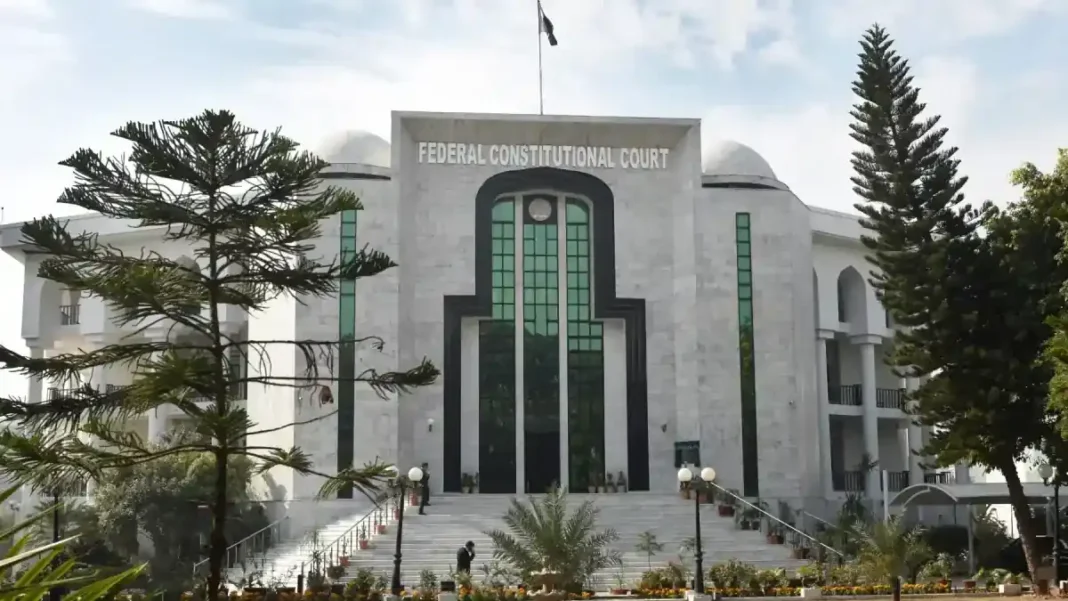
FCC Says Its Observations Bind Supreme Court
FCC observations binding on all courts, including the Supreme Court, is the position the Federal Constitutional Court has now set out in a written judgment. The court held that any observation in its judgments or orders which decides a question of law, or states a legal principle, carries binding effect under Article 189 of the Constitution.
The 16-page judgment was written by Justice Aamer Farooq, sitting on a three-member bench headed by Chief Justice Amin-ud-Din Khan. The bench decided a matter about two permanent appointments in the Islamabad Capital Territory Private Educational Institutions Regulatory Authority (ICT-PEIRA), and used that case to settle a wider question about the status of its own observations.
FCC observations binding: what the judgment says
The judgment quotes its own rule in plain terms. It says that when an observation made by the court in any judgment or order has the effect of deciding a question of law, or is based on or states a principle of law, it shall be binding on all courts, including the Supreme Court. The court grounded that reading in Article 189(1), as amended by the 27th Constitutional Amendment, which it said clearly states that its judgments are binding on all other courts in Pakistan, including the Supreme Court, to the extent that they decide questions of law or state principles of law.
The judgment goes one step further. It says the binding effect is not confined to the ratio decidendi, the core reason that decides a case, but also covers obiter dicta, the observations a court makes along the way. That is the part of the ruling most likely to be argued over, because it extends binding force beyond the deciding reason to the court’s wider legal reasoning.
The ruling arrives while the relationship between the two top courts is still unsettled after the 27th Amendment. Tribune reported that the FCC has repeatedly asserted that its judgments bind the Supreme Court, while also maintaining that Supreme Court judgments are not binding on it, though they may carry persuasive value. The latest judgment fits that pattern, and it comes against a live example: the FCC summoned the record of a case about the transfer of former prime minister Imran Khan to Shifa International Hospital while hearing the three-prisoners case, a Supreme Court bench then raised questions over the FCC decision and adjourned for three weeks, and neither court has since resumed the matter. A senior law officer believes the Supreme Court has yet to hand over the relevant record in compliance with the FCC order.
The appointments case behind the ruling
The case itself concerned the legal status of appointments made under the Islamabad Capital Territory Private Educational Institutions Ordinance, 2009, after that ordinance was repealed and replaced by the Islamabad Capital Territory Private Educational Institutions (Registration and Regulation) Act, 2013, which did not expressly save actions taken under the old ordinance. The court had to decide whether appointments made under the repealed ordinance stayed valid under the new law.
To answer that, the judgment walked through the life of an ordinance. Under Article 89, a presidential ordinance stays in force for 120 days unless a house of Parliament passes a resolution against it first. It can be extended once, for another 120 days, by resolution, and the president can withdraw it at any time. The judgment also relied on Section 6 of the General Clauses Act, 1897, which provides that repealing a law does not ordinarily destroy rights already acquired under it.
The court also discussed a 2018 Supreme Court judgment by former chief justice Mian Saqib Nisar, which held that amendments made through an amending ordinance last only 120 days, or 240 days at most if extended, unless Parliament later gives them permanent effect through an Act.
Why this ruling matters beyond one case
For lawyers and litigants, the practical question is now sharper. If FCC observations on questions of law bind the Supreme Court, then arguments in future cases will need to reckon with FCC reasoning even where it appears outside the deciding reason of a judgment. For the two courts themselves, the judgment is a public statement of the FCC’s view of its own place in the constitutional order, made while the Shifa record dispute remains unresolved.
Frequently asked questions
What did the FCC decide about its observations?
It held that any observation in its judgments or orders which decides a question of law or states a legal principle is binding on all courts, including the Supreme Court, under Article 189.
Who wrote the judgment?
Justice Aamer Farooq wrote the 16-page judgment, on a three-member bench headed by Chief Justice Amin-ud-Din Khan.
What case was the bench deciding?
A matter about two permanent appointments in the Islamabad Capital Territory Private Educational Institutions Regulatory Authority, and whether appointments under a repealed 2009 ordinance stayed valid under the 2013 Act.
Does the ruling cover obiter dicta as well as the deciding reason?
Yes. The judgment says the binding effect is not confined to the ratio decidendi but also covers obiter dicta.
Why is the ruling controversial?
It comes while the relationship between the FCC and the Supreme Court is unclear, and while a dispute over the record in the Imran Khan Shifa transfer case remains unresolved between the two courts.