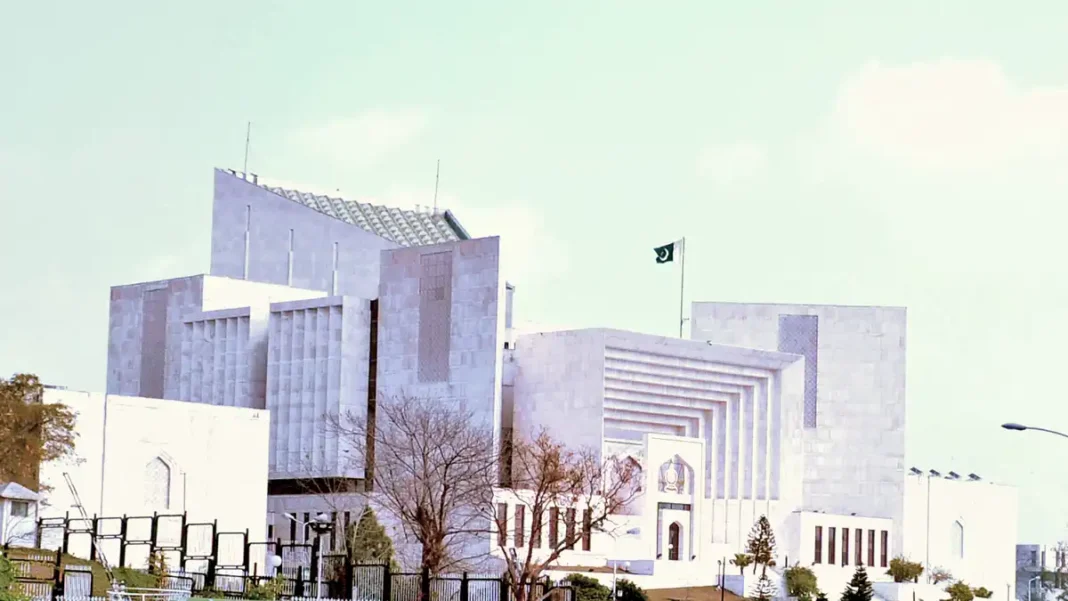
The Federal Constitutional Court (FCC) has reserved its ruling on a set of petitions seeking a review of its January 27 judgment upholding the Super Tax. The FCC Super Tax review hearing took place on Monday before a three-judge bench headed by Chief Justice Aminuddin Khan, with Justice Syed Hasan Azhar Rizvi and Justice Syed Arshad Hussain Shah.
The bench also noted that Sections 4B and 4C of the Income Tax Ordinance, 2001, would apply from the dates on which they were levied. That point matters because much of the review case turns on dates: when the tax was imposed, when income was earned, and whether a later charge can reach back to an earlier tax year.
In the January 27 judgment, the court had declared that the legislature was fully competent to impose, abolish, remit, alter or regulate such a tax through a Finance Act as part of a Money Bill under Article 73(2)(a) of the Constitution. The review petitions ask the court to revisit that judgment. Dawn reported the hearing and the arguments made by senior counsel.
A long list of companies filed review petitions. They include Fauji Fertiliser Company Ltd, Fauji Fertiliser Bin Qasim (Pvt) Ltd, Thar Power Company Ltd, M/s Pacific Exim (Pvt) Limited, Agven (Pvt) Limited, Jubilee Corporation, Colgate-Palmolive Pakistan Limited, M/s Chawla International, Karachi, The Searle Company Limited, JS Bank Ltd, Karachi, Total Parco Pakistan Limited, JWD Sugar Mills Ltd, Gas and Oil Pakistan Ltd, Defence Housing Authority, Lahore, Hoechst Pakistan Limited, Arif Habib Corporation Limited, Habib Metro Pakistan (Pvt) Ltd, Pak Arab Fertilizer Limited, Pakistan Refinery Limited and Engro Corporation Ltd, along with several others.
The breadth of that list is part of the story. The Super Tax reaches across fertiliser, banking, power, sugar, refining and consumer goods. A ruling that changes its scope would therefore touch many sectors at once, not a single industry.
On Monday, several senior counsel presented arguments, including Dr Farogh Nasim, Khalid Javed Khan, Sardar Ahmed Jamal Sukhera, Rashid Anwar and Imtiaz Ali Siddiqui. Sukhera, who represented Fauji Fertilisers, told Dawn after the day-long hearing that the bench had reserved its ruling on the review petitions.
The review petition argues that the FCC overlooked the fact that retrospective imposition of a fresh tax charge is constitutionally barred under Articles 10A, 18, 23 and 24 of the Constitution, which place restrictions on Parliament’s legislative powers. That is the constitutional core of the case.
Sukhera urged the court to strike down Section 4C of the Income Tax Ordinance as unconstitutional, arguing that no reasons had been given for upholding the provision in the January 27 judgment. In the alternative, he asked the court to declare that Section 4C did not apply to tax year 2022 and did not extend to income subject to final tax. It should also exclude brought-forward losses, depreciation and amortisation, he argued.
The timing argument was put in plain terms. The Finance Act, 2022, took effect on July 2, 2022, and imposed a tax charge on income earned in a tax year that had already closed. By then, taxpayers had closed their accounts, held their annual general meetings and distributed dividends under the prevailing law. A liability that could not have been foreseen when the income was earned and applied was arbitrary and wholly unreasonable, Sukhera argued.
The petition also argued that denying the right to carry forward losses, depreciation and amortisation amounted to imposing income tax on expenses or losses. That, it said, was impermissible under Entry 47, which allows the federation to tax income only.
The Super Tax was introduced by the PML-N government in 2015. It applies to wealthy individuals, associations of persons and companies earning more than Rs500 million. It imposes a tax rate of 4 per cent on the income of banking companies and 3 per cent on other sectors, with the stated aim of funding the rehabilitation of temporarily displaced persons.
Sukhera highlighted the stated objective behind the levy, saying it was intended to raise about Rs215 billion. He then set that figure against other fiscal numbers cited in the hearing, including large annual losses at state-owned enterprises and from electricity theft. Those comparisons do not decide the legal question, but they show the scale of the argument.
Frequently asked questions
What did the FCC do on Monday?
The Federal Constitutional Court heard review petitions against its January 27 judgment upholding the Super Tax, then reserved its ruling. The bench was headed by Chief Justice Aminuddin Khan, with Justice Syed Hasan Azhar Rizvi and Justice Syed Arshad Hussain Shah.
What is the Super Tax?
Introduced in 2015, the Super Tax applies to wealthy individuals, associations of persons and companies earning more than Rs500 million. It charges 4 per cent on banking companies and 3 per cent on other sectors, to fund rehabilitation of temporarily displaced persons.
What do the petitioners argue?
They argue the retrospective charge is constitutionally barred under Articles 10A, 18, 23 and 24. They ask the court to strike down Section 4C, or at least to exclude tax year 2022, final-tax income, and brought-forward losses, depreciation and amortisation.
Which companies filed review petitions?
Fauji Fertiliser, Fauji Fertiliser Bin Qasim, Thar Power, Colgate-Palmolive, Searle, JS Bank, Total Parco, JWD Sugar, Gas and Oil Pakistan, Defence Housing Authority Lahore, Hoechst, Arif Habib Corporation, Habib Metro, Pak Arab Fertilizer, Pakistan Refinery and Engro are among the petitioners, along with several others.
When will the ruling come?
No date was reported. A reserved ruling means the bench will deliver its decision later in writing. Until then, the January 27 judgment upholding the Super Tax remains in place.