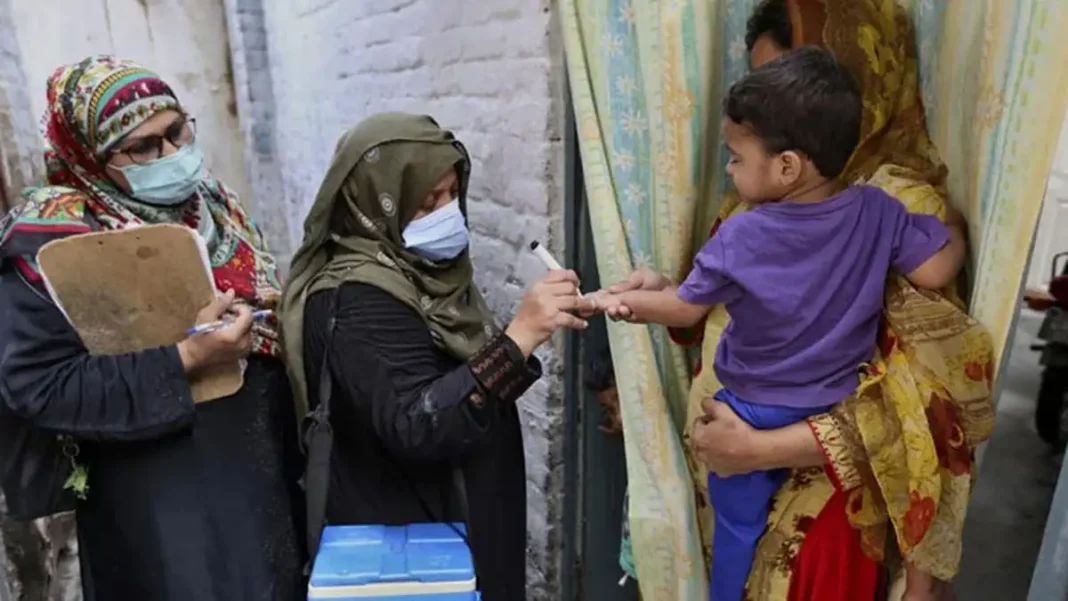
Balochistan has started its fifth seven-day anti-polio campaign of the year, targeting more than 2.2 million children across 31 districts. The Balochistan polio drive began on Monday, with health teams going door to door to vaccinate children under five.
Balochistan Health Secretary Mujeebur Rehman announced the launch at the campaign inauguration in Quetta. He said more than 8,880 vaccination teams had been deployed across the province. Emergency Operations Centre Balochistan Coordinator Inamul Haq and Quetta District Health Officer Dr Aimal Mandokhail were also present.
The campaign runs for seven days. Its scale is the headline figure: 2.2 million children, 31 districts, and close to 9,000 teams. That is an average of about 250 children per team over the week, a workload that leaves little room for missed streets or closed doors.
The immediate worry is cross-border transmission from Afghanistan. Rehman warned that more than 50 polio cases reported in Afghanistan this year had raised the risk for Balochistan, with particular concern for Chaman and Qila Abdullah. Both districts sit on the Afghan border, and frequent movement of people between the two countries can carry the virus with it.
Special attention is being given to districts bordering Afghanistan and to sensitive areas adjoining Punjab. Health officials argue that stronger surveillance and targeted vaccination are essential where movement is heaviest. A campaign that covers Quetta well but misses border settlements would leave the main risk untouched.
The province has a record to protect. Balochistan has reported no polio cases in the past 24 months, and environmental samples collected last month also tested negative. Rehman credited sustained work by health authorities and vaccination teams, but he cautioned against complacency. Two quiet years can end with a single imported case if coverage slips.
He also warned that children suffering from malnutrition and other health problems could be particularly vulnerable if the virus re-entered the province. That warning links the campaign to routine health care, not just to a week of drops. A child who is already weak faces a higher risk from a preventable disease.
Rehman directed vaccination teams to perform their duties diligently and to ensure that no eligible child was missed. He stressed the need to strengthen routine immunisation alongside special campaigns, so that protection lasts after the seven days end. Routine services depend on the wider health system, including court-set standards for medical care such as the Supreme Court’s gross negligence test for doctors. He urged parents, teachers, religious scholars and community leaders to support the campaign and to encourage families to get all children under five vaccinated.
That appeal matters because polio campaigns in Pakistan have faced two linked problems: access and trust. Access is a logistics task, and 8,880 teams is the province’s answer to it. Trust is a community task, and it depends on parents, teachers and religious scholars backing the teams at the door. Without both, coverage figures stay high on paper and low in the streets that matter most.
The risks to teams are real, and they were visible elsewhere in the country only days ago. Feature Pakistan has reported on four polio workers abducted in Tank district. That incident, in Khyber-Pakhtunkhwa, is a reminder that vaccination work can carry personal risk for the teams doing it. Balochistan’s campaign has not reported such an incident, but the security of teams in border and sensitive areas will shape whether the seven days run their full course.
The campaign also fits a national pattern of large drives. Feature Pakistan has reported on a Rawalpindi polio drive targeting 990,000 children. Balochistan’s target is more than twice that figure, spread across a far larger and harder terrain. Health workers elsewhere have faced pressure too, as shown by Karachi doctors protesting over FIRs and harassment.
Five campaigns in one year may sound like repetition. In polio control, it is the method. Each campaign aims to reach children missed in the last round, children born since it, and children who moved between rounds. Border movement makes that task continuous in Balochistan, because the population at risk changes with every crossing.
Environmental sampling is the other half of the method. Negative samples last month are good news, but they describe the past month, not the next seven days. A campaign launched now is a response to the risk ahead, driven by cases across the border.
Frequently asked questions
How many children does the Balochistan polio drive target?
The drive targets more than 2.2 million children under five across 31 districts. It is the province’s fifth seven-day campaign of the year.
How many vaccination teams are deployed?
More than 8,880 vaccination teams have been deployed. They will work door to door for seven days, with special attention to border districts and sensitive areas adjoining Punjab.
Why is Afghanistan mentioned in the campaign?
More than 50 polio cases reported in Afghanistan this year have raised the risk of cross-border transmission, particularly in Chaman and Qila Abdullah. Frequent movement across the border can carry the virus into Balochistan.
Has Balochistan reported polio cases recently?
Balochistan has reported no polio cases in the past 24 months, and environmental samples collected last month tested negative. Officials still warn against complacency because of the cross-border risk.
What should parents do during the campaign?
Parents should ensure all children under five receive polio drops when teams visit, even if the child received drops in an earlier round. Officials also urge families to keep up routine immunisation after the campaign ends.