



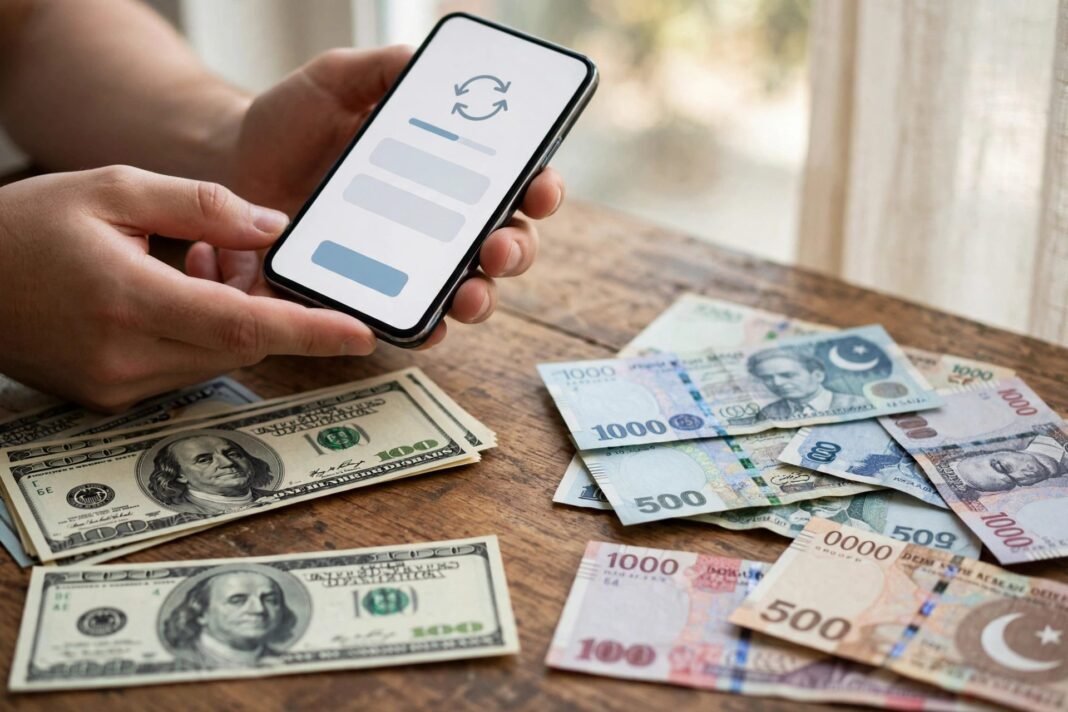
Every month, millions of dollars travel from the United States to Pakistan. In October 2026 alone, overseas Pakistanis sent home $3.89 billion, and $329 million of that came from the US. If you send money from US to Pakistan, the way you send it decides how much your family actually receives.
The difference between providers can be thousands of rupees on a single transfer. In mid-November 2026, a live-quote comparison found a gap of more than Rs 13,000 on a $1,000 transfer. This guide shows you how to compare the real cost, pick the right service, and send money safely.
The Two Costs of Every Transfer
Every transfer has two costs, not one. The first is the transfer fee, which the provider shows you upfront. The second is the exchange-rate margin, which is the gap between the rate you get and the real mid-market rate.
The mid-market rate is the true rate banks use with each other. In mid-November 2026, it sat near 277 rupees per dollar. If a provider offers you 270 rupees per dollar, it keeps the difference. That hidden margin often costs more than the fee itself.
For example, a “zero fee” transfer at a poor rate can cost more than a $5 fee at a good rate. So always judge a transfer by one number: how many rupees your family receives. That number tells you the true cost.
How to Send Money From US to Pakistan: Compare the Total
Before you send money from US to Pakistan, compare at least two providers. Check the live mid-market rate first on Google or XE, then see what each provider offers. The closer the offered rate is to the mid-market rate, the better the deal.
Also check how you pay, because the funding method changes the price. Bank transfers (ACH) are usually the cheapest way to fund a transfer. Debit cards cost a little more, and credit cards are the most expensive because providers treat the payment as a cash advance.
Finally, look at the total, not the headline. Add the fee to the rate margin to find the real cost. Fees and rates change often, so check the live figures on the provider’s own site before every transfer.
Wise: Best for Bank Transfers at the Real Rate
Wise is the strongest choice when your family has a Pakistani bank account. It converts dollars to rupees at the real mid-market rate, then adds a clear fee on top. A November 2026 comparison of providers put that fee at roughly 0.33% to 0.60% of the amount sent.
Once the money reaches Pakistan, it is credited through the local bank transfer system. In many cases, Raast, Pakistan’s instant payment system, settles it within minutes. Wise works well for larger or monthly transfers, such as regular family support.
The main limit is that Wise does not offer cash pickup. Your family needs a bank account to receive the money. If they have one, Wise is hard to beat on price.
Remitly: Best for JazzCash and Easypaisa Wallets
Remitly is a good fit when your family uses a mobile wallet instead of a bank account. It delivers directly to JazzCash and Easypaisa, and the money often lands within minutes. It also offers bank deposits and cash pickup.
Remitly has two speeds: Economy, which is cheaper and slower, and Express, which costs a little more and arrives fast. A November 2026 comparison listed fees from $0 to $3.99, with free first transfers for new users.
The trade-off is the exchange rate. Promo rates for new users are strong, but standard rates include a small markup. So compare the rupees received, not just the fee, before you choose.
Western Union and MoneyGram: Best for Cash Pickup
Western Union and MoneyGram are the best options when your family needs cash in hand. Both have thousands of agent locations across Pakistan, including small towns where banks are scarce. Cash is often ready for pickup within minutes.
Western Union also delivers to bank accounts and JazzCash wallets. MoneyGram offers bank deposits, cash pickup, and mobile wallet transfers too. Both are useful when speed matters more than price.
However, both cost more than Wise or Remitly for bank transfers. A November 2026 comparison listed Western Union fees of $4 to $12 per $1,000 with a rate markup of 1% to 3%, and MoneyGram fees of $3 to $10 with a similar markup. Use them for urgent cash, not for routine transfers.
Xoom and Bank Wires: When They Make Sense
Xoom, a PayPal service, suits people who already use PayPal. You can fund a transfer from your PayPal balance or a linked bank account. It offers bank deposits and cash pickup, and money usually arrives within minutes to one business day.
A November 2026 comparison listed Xoom fees from $2.99 to $9.99, with a rate markup of roughly 1% to 2%. It is a solid backup option, but its rates are rarely the cheapest.
Bank wires make sense only for very large sums, such as property payments. Banks charge a flat wire fee plus a rate margin, so small transfers cost too much. And note that Zelle and Venmo cannot send money abroad at all.
How Your Family Receives the Money in Pakistan
Your family can receive money in three main ways. The first is a bank deposit, which needs their full name and 24-character IBAN. Raast now settles many deposits within minutes.
The second is cash pickup, which needs their original CNIC or passport at the agent counter. They should count the cash before they leave. The third is a mobile wallet, which needs only their registered JazzCash or Easypaisa number.
Mobile wallets suit families without a bank account. However, the wallet must be in the receiver’s own name, and wallet limits apply. Ask your family which method suits them best before you send.
Send Money From US to Pakistan Safely: What You Need
To send money from US to Pakistan, you need a US government-issued ID to verify your account. US anti-money-laundering rules require this for all transfers. You also need your receiver’s exact details, spelled as they appear on their CNIC.
Use licensed providers only. In the US, money transfer firms must be licensed at the federal level and in each state. In Pakistan, payouts run through banks and licensed exchange companies. A licensed provider gives you a receipt and a tracking number.
Keep that receipt, because it proves the money travelled through banking channels. Never share one-time codes or PINs with anyone, and beware of calls claiming your transfer is “held” until you pay a fee. No real provider works that way.
Also, set up your own safety net first. Before you send extra money home, make sure you have an emergency fund of your own, so a surprise bill does not force you into debt. And pay yourself first each month, so your own savings grow alongside the support you send.
Why You Should Never Use Hawala or Hundi
Hawala, also called hundi, is an informal way to move money through brokers instead of banks. It may promise a better rate, but it is illegal in Pakistan. Only banks and State Bank-licensed exchange companies may deal in foreign currency.
The risks are serious. If the broker disappears, your money is gone, because there is no receipt and no regulator to complain to. The Federal Investigation Agency also raids hawala operators, and in November 2026 an Islamabad court sentenced one operator to ten years in prison.
Formal channels are safer, traceable, and often just as fast. They also protect your family, because money received through banking channels comes with a clear record. There is no good reason to risk an illegal channel.
Send Money From US to Pakistan: A Quick Checklist
Use this checklist each time you send money from US to Pakistan. Firstly, check the live mid-market rate. Secondly, compare the rupees received across at least two providers. Thirdly, pick the delivery method your family prefers.
Also confirm the fee, the rate, and the arrival time before you pay. Keep your receipt and share the tracking number with your family. And review your choice every few months, because fees and rates change.
Which service do you use to send money home, and what matters most to you — price, speed, or cash pickup? Share your experience in the comments.
This article is for general information only. It is not financial advice.