Abbottabad has many claims to fame — its cool climate, its colonial-era cantonment, its gateway position to the northern areas. But the place that locals mention first, with unmistakable pride, is a gleaming white mosque tucked against the hills of Nawan Shehr, with cold mountain water bubbling up beneath its marble floors. The Ilyasi Masjid is the oldest and largest mosque of Abbottabad, built between 1927 and 1932, and it is one of those rare destinations where history, architecture, nature, and everyday life blend into a single experience. This ilyasi masjid travel guide will help you decide why it deserves a stop on your next trip north — and exactly how to plan it.
Quick Facts
- Location: Nawan Shehr, Abbottabad District, Khyber Pakhtunkhwa, Pakistan — about 5 kilometers from Abbottabad city center, at the foot of a hill.
- Altitude: Over 1,250 meters above sea level.
- Famous For: The oldest and largest mosque in Abbottabad (completed 1932); built directly over a natural mountain spring whose cold water flows through ponds and spouts beneath and around the mosque; famous pakoras sold outside; a blend of Islamic, British, and Sikh architectural influences.
- Nearest City: Abbottabad (5 km).
- Accessibility: Road — a winding drive from Abbottabad city center along the boundary of the Kakul Academy area to Nawan Shehr. Easily reachable by car, taxi, or rickshaw.
- Known Landmarks: The mosque’s tall minaret, the twin water ponds, the surrounding hills of Nawan Shehr.
- Best For: Families, spiritual travelers, architecture lovers, photographers, and anyone passing through Abbottabad on the way to the northern areas.
Why Visit Ilyasi Masjid
Most mosques impress you with size or ornament. The Ilyasi Masjid impresses you with something rarer: water. A natural stream comes down from the hill above and flows beneath the mosque itself, gushing out from two ponds in the front section and channeled through more than two dozen open spouts that run for most of the year. On a hot summer day, the cold mountain water keeps the glistening white marble floor cool under your feet — a piece of engineering that was ingenious in 1932 and is still delightful today. Locals believe the water has curative properties for skin, muscle, and respiratory ailments, and visitors come from across Pakistan just to drink it.
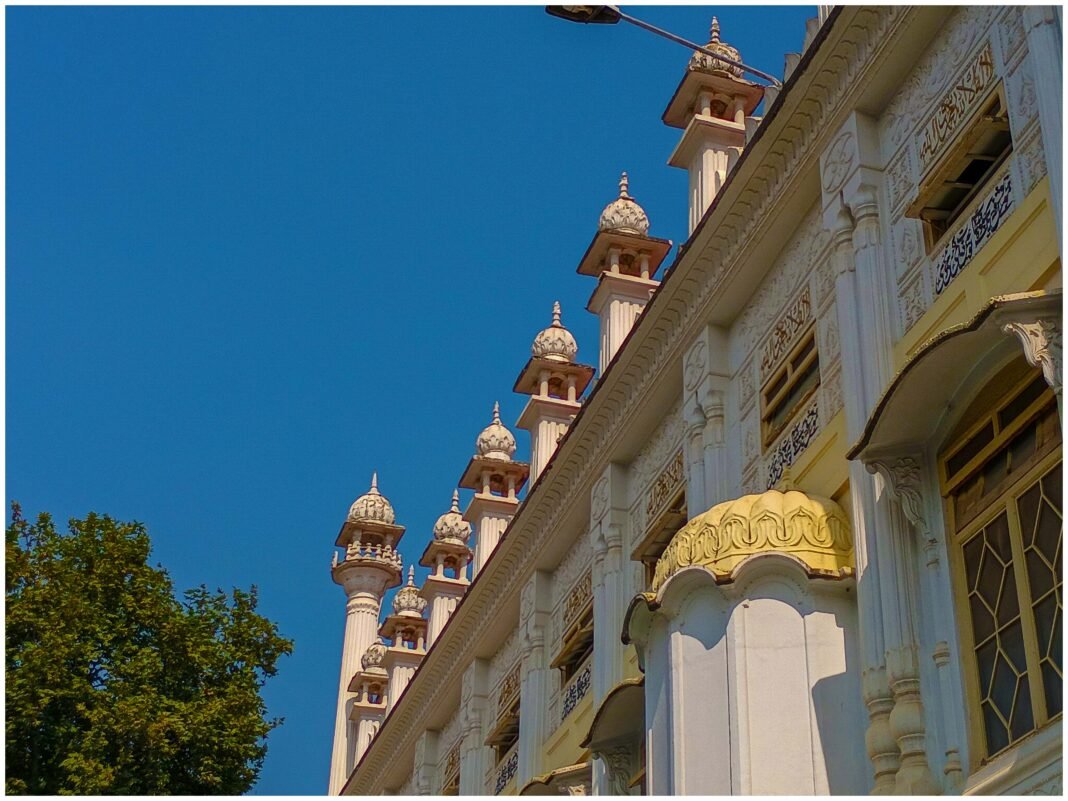
The mosque is also genuinely beautiful. The ivory-white structure rises against the lush green hills of Abbottabad in a style that blends Islamic, British, and Sikh influences — a tall, instantly recognizable minaret, a graceful dome, a vast open courtyard, and walls adorned with Quranic verses and devotional Persian couplets. Bright natural light filters through the geometric cement mesh of the side columns, giving the interior a soft, almost mystical glow. With a capacity of around 10,000 worshippers, it is a grand space that somehow still feels peaceful.
Then there is the part that travel writers have loved for years: the pakoras. As The Express Tribune once put it, the mosque is a “picnic spot of triple delight” — spiritual solace, the cool stream water, and the spicy pakoras sold by vendors outside, whose stalls have fed generations of visitors. It is the kind of place where a family outing, a moment of prayer, a cold drink of spring water, and a plate of hot pakoras all happen in the same afternoon. That is the Ilyasi experience, and it is unlike anywhere else in Pakistan.
Finally, it is effortless to visit. Unlike remote mountain destinations that demand days of planning, the Ilyasi Masjid is a short drive from Abbottabad’s city center, open and active every day, and free to enter. It fits perfectly into a Galiyat or Naran trip as a morning or evening stop — or as the centerpiece of a relaxed Abbottabad day. If you are choosing between destinations, choose this one for the rare combination of heritage, nature, and living local culture.
History of Ilyasi Masjid
The Ilyasi Masjid was built between 1927 and 1932, during the British colonial period, and completed in 1932 — making it the oldest and largest mosque in Abbottabad city, a distinction confirmed by research from professors of Bahauddin Zakaria University. The mosque was constructed directly on top of a stream coming out of the mountain, a bold engineering choice that defines its character to this day.
The story of the site, as told by elderly locals, reaches back before Partition. One long-time resident recalled that initially some Christians wanted to build a church on the spot, but the local population resisted the plan and instead built the Ilyasi mosque. The mosque began on a small piece of land, but the devotion of the people — and the draw of the spring water, said to have curative properties — made it grow in grandeur over time. It now sprawls over about five kanals at the foot of the hill, commanding a fine view of Abbottabad city.
The mosque’s setting in Abbottabad is itself historic. The city was founded in 1853 and named after Major James Abbott, the first British deputy commissioner of the region, who famously wrote in his parting ode that he had “adored the place from the first sight.” After the creation of Pakistan, Abbottabad retained its distinction as a military town — the Pakistan Army’s primary training academy sits in the nearby Kakul area, along whose boundary the winding road to the mosque runs. The mosque administration notes that the natural stream once flowed far more abundantly; locals remember swimming in the water ponds as children, while in dry spells today the flow can lessen, and at the peak of summer the stream sometimes dries up. The mosque and its surroundings are administered locally, with a Jadoon family historically associated with its care.
Through nearly a century of prayer, renovation, and community life, the Ilyasi Masjid has remained what it was built to be: the spiritual heart of Abbottabad, where the mountain itself seems to participate in worship through the water it sends down.
Top Things to Do in Ilyasi Masjid
Admire the Architecture
Walk the courtyard slowly and take in the details: the tall minaret that dominates the Abbottabad skyline from Nawan Shehr, the adjoining dome, the row of smaller cupolas balancing the roofline, and the prayer hall on one side with the madrassa on the other. Look for the Quranic verses and Persian devotional couplets adorning the walls, and notice how daylight streams through the geometric cement mesh of the side columns. The fusion of Islamic, British, and Sikh design elements rewards a careful eye — this is not a generic modern mosque, but a 1930s building with a distinct colonial-era personality.
Experience the Spring Water
The heart of the Ilyasi visit. Watch the cold water gush from the two front ponds and flow through the open spouts — locals fill bottles to take home, believing in its curative properties for skin and respiratory troubles. Wash your hands and face in it on a warm day; the chill is startling and wonderful. Remember that the stream is a natural mountain spring, so its flow varies with rainfall — it is most abundant after the rains and can thin out in dry spells.
Taste the Famous Pakoras
No visit is complete without the pakoras. Vendors outside the mosque have been frying them for decades, and they are genuinely famous — crisp, spicy, and best eaten hot with a sip of the cold spring water to “sweeten the bite,” as generations of visitors have done. Visitors from Lahore and Gujranwala have told reporters they plan whole family trips around this combination. Buy a plate, find a spot in the surrounding area, and join one of Abbottabad’s most beloved food traditions.
Climb the Hill for the View
The narrow flight of stairs leads up past the water ponds toward the hill at whose foot the mosque sits. The higher you go, the better the panorama of Abbottabad spread out below — on a clear day the view of the city against its green valley is superb, and photographers love the mosque framed from above with the hills behind.
Combine with a Nawan Shehr Stroll
The small hamlet of Nawan Shehr itself is worth a wander: rustic bazaars, tea stalls, and the everyday rhythm of a Hazara town. It is a gentle, family-friendly outing, and the drive here — the long winding road from Abbottabad’s city center, past the Kakul Academy boundary — is part of the pleasure.
Famous Places In and Around Ilyasi Masjid
- Abbottabad City Center — 5 km away; colonial-era bazaars, food streets, and the famous Jinnahabad and Supply markets.
- Shimla Hills — a popular viewpoint and picnic spot above Abbottabad city.
- Thandiani — a cool hill station about 30 km from Abbottabad, great for a day trip.
- Nathiagali & Galiyat — the famous hill resorts begin about 35 km away; see our Galiyat travel guide for the full area.
- Pakistan Military Academy, Kakul — the prestigious training academy near Nawan Shehr (viewable from outside; entry restricted).
- Mansehra Road & Harnoi — riverside picnic spots on the way toward Mansehra.
How to Reach Ilyasi Masjid
The mosque is one of the easiest heritage destinations in northern Pakistan to reach — a short, scenic drive from Abbottabad, which is itself well connected to the rest of the country via the Hazara Motorway (M-15).
- From Islamabad: About 120 km via the Hazara Motorway (M-15), roughly 2 to 2.5 hours’ drive. Take the Abbottabad exit, drive into the city center, then follow the winding road toward Nawan Shehr along the Kakul side. Local taxis and rickshaws know the mosque well.
- From Lahore: About 480 km via the M-1/M-15 motorways through Islamabad — roughly 7 to 8 hours’ drive. Most travelers overnight in Islamabad or Abbottabad.
- From Karachi: Fly to Islamabad (about 2 hours), then drive 2 to 2.5 hours to Abbottabad and on to the mosque. Direct Karachi–Abbottabad road travel is over 1,400 km and not practical for a short trip.
- Nearest airport: Islamabad International Airport, about 140 km away. There is no commercial airport in Abbottabad.
Road conditions are good year-round: the Hazara Motorway is a modern, well-maintained road, and the city road to Nawan Shehr is paved but winding and narrow in places — drive carefully, especially after rain. Public transport options include wagons and Suzuki pickups from Abbottabad’s city center to Nawan Shehr; a private taxi or Careem/InDrive ride is more comfortable for families. Parking is available near the mosque, though it fills up on weekends and holidays.
Route Details
Islamabad → Hazara Motorway (M-15) → Abbottabad interchange → Jinnahabad/Supply Road → city center → Nawan Shehr Road (past Kakul Academy boundary) → Ilyasi Masjid. From the city center, the drive to the mosque takes about 20–30 minutes. The route passes through rustic bazaars before reaching the hamlet of Nawan Shehr, where the white mosque appears at the foot of the hill. If you are combining it with Galiyat, visit the mosque first in the morning, then continue up to Nathiagali.
Where to Stay in Ilyasi Masjid
The mosque is a day-visit site, so you will stay in Abbottabad city, which has one of the best ranges of accommodation in the Hazara region.
Mid-range hotels: Abbottabad’s main roads (Mansehra Road, Jinnahabad, Supply) are lined with comfortable mid-range hotels offering clean rooms, hot water, and in-house restaurants — the standard choice for families. Budget options: numerous budget hotels and guesthouses in the city center cater to students and backpackers at very reasonable rates. Upscale: a few well-known higher-end hotels and resorts sit on the city’s outskirts and toward Thandiani, with lawns and mountain views. Alternative: many visitors stay in Nathiagali or the Galiyat resorts (35–80 minutes away) and visit the mosque as part of an Abbottabad day. Book ahead on summer weekends and public holidays, when Abbottabad fills up. We do not name specific properties because quality and availability change — check recent reviews before booking.
Where to Eat: Local Foods of Ilyasi Masjid
Start with the obvious: the pakoras outside the mosque. Then explore Abbottabad’s wider food scene, which reflects Hazara and Pashtun influences. Local favorites include chapli kebab, seekh kebab, sajji, hearty dal and karahi at the city’s famous dhabas, and sweet kheer and gulab jamun for dessert. The bazaars around Jinnahabad and Supply Road have food streets where a full meal is genuinely budget-friendly. In summer, roadside stalls sell fresh fruit from the surrounding orchards — plums, apricots, and loquats. A family meal at a local dhaba is inexpensive; mid-range restaurants in the city center cost modestly more. Carry water for the hill climb, though the mosque’s spring water is the traditional refreshment.
Weather in Ilyasi Masjid
Abbottabad sits at about 1,250 meters, giving it one of the most pleasant climates in the plains-adjacent regions of Pakistan — mild summers, cool winters, and monsoon rains in between. Approximate seasonal ranges:
| Season | Temperature Range | Conditions |
|---|---|---|
| Winter (Dec–Feb) | 0°C to 12°C | Cold and crisp; occasional frost; rare light snow in the city, more in surrounding hills. |
| Spring (Mar–May) | 10°C to 25°C | Pleasant and green; blossoms in the valley; ideal for sightseeing. |
| Summer (Jun–Aug) | 18°C to 32°C | Warm but far milder than the plains; monsoon rains July–August; peak visitor season. |
| Autumn (Sep–Nov) | 8°C to 25°C | Clear skies, golden light, comfortable days; excellent for photography and the mosque visit. |
Language and Culture of Ilyasi Masjid
Abbottabad is the heart of the Hazara region, and the main local language is Hindko, spoken widely in the city and villages including Nawan Shehr. Urdu is universally understood, English is common in hotels and among educated locals, and Pashto is spoken by many residents with roots in neighboring areas. The population is a mix of Hindko-speaking Hazarawals, Pashtuns, and Kashmiri-origin families, known for hospitality and a strong sense of community — the mosque’s community-built history reflects that spirit.
As an active place of worship, the mosque asks for standard respectful behavior: dress modestly (cover shoulders and knees; women should carry a headscarf for the prayer areas), remove shoes before entering the prayer hall, keep voices low during prayer times, and ask before photographing worshippers. Non-Muslim visitors are welcome to view the architecture and the spring from the courtyard areas but should avoid entering the prayer hall during congregational prayers. Friday afternoons are the busiest; visit mid-morning on a weekday for the calmest experience.
Shopping in Ilyasi Masjid
There are no malls at the mosque — and none needed. The small shops around Nawan Shehr and the drive back through Abbottabad’s bazaars offer the real souvenirs: dry fruits (walnuts, almonds, apricots) from Hazara’s orchards, Peshawari-style shawls and woolens, local honey, and traditional pakora masala mixes to recreate the famous snack at home. Abbottabad’s main bazaars (Jinnahabad, Supply, Cantonment Board market) have a good range of clothing, handicrafts, and everyday goods at reasonable prices. Bargaining is normal in the bazaars but keep it friendly.
Travel Tips for Ilyasi Masjid
Packing Essentials
Comfortable walking shoes for the mosque courtyard and the hill stairs; a light jacket even in summer for the cool spring breeze at 1,250 meters; sun protection; and a reusable bottle to fill with the famous spring water. In winter, bring a warm coat, gloves, and a cap — Abbottabad mornings can be near freezing. Carry small cash for pakoras, parking, and bazaar shopping.
Safety Tips
Nawan Shehr and Abbottabad are generally safe and family-friendly. The hill stairs behind the mosque can be slippery after rain — wear grippy shoes and supervise children. The spring water is beloved by locals, but if you have a sensitive stomach, stick to bottled water for drinking and enjoy the spring for washing. Keep valuables secure in crowded bazaar areas, and avoid the mosque area during the peak Friday prayer rush if you prefer a quiet visit.
Money & Connectivity
ATMs are plentiful in Abbottabad city center, and most hotels and larger restaurants accept cards — but carry cash for the mosque-area vendors, rickshaws, and small shops. All major mobile networks (Jazz, Telenor, Zong, Ufone) have good coverage in Abbottabad and Nawan Shehr, and 4G data works well. Free Wi-Fi is common in city hotels and cafes.
Best Time to Visit Ilyasi Masjid
Spring (March–May) — Lovely and Green
Mild temperatures, blossoming valley, and the spring at a good flow after winter rains. Ideal for combining the mosque with Thandiani or Galiyat.
Summer (June–August) — Peak Season
The famous escape-from-the-heat months: Abbottabad is far cooler than the plains, the spring water is at its most refreshing, and the pakora stalls are in full swing. Expect crowds on weekends; monsoon rain is heaviest in July–August.
Autumn (September–November) — Clear and Calm
Arguably the best time: clear skies, comfortable days, fewer crowds, and beautiful light for photographing the white mosque against the hills.
Winter (December–February) — Quiet and Crisp
Cold but atmospheric; the mosque is peaceful and the surrounding hills may carry snow. The spring flow can be at its lowest — still worth visiting if you are in Abbottabad, but bundle up.
Final Thoughts
The Ilyasi Masjid is proof that a great destination does not need to be remote or difficult. A century-old mosque, a mountain spring running beneath marble floors, a skyline minaret, and the best pakoras in Hazara — all of it a 20-minute drive from Abbottabad’s city center. It works as a spiritual visit, a family picnic, an architecture walk, and a food stop, all in one afternoon.
If your travels take you toward the northern areas, build in the detour. Go in the morning, drink the cold spring water, eat the hot pakoras, climb the hill for the view of the city — and you will understand why Abbottabad’s people speak of this place with such pride. For more northern inspiration, explore our Explore Pakistan collection.
FAQs
Where is the Ilyasi Masjid located?
It is in Nawan Shehr, about 5 kilometers from Abbottabad city center in Khyber Pakhtunkhwa, reached by a winding road along the Kakul Academy boundary.
When was the Ilyasi Masjid built?
It was built between 1927 and 1932 and completed in 1932, during the British colonial period — making it the oldest and largest mosque in Abbottabad.
What is special about the water at Ilyasi Masjid?
The mosque is built over a natural mountain spring. Cold water gushes from two ponds and flows through more than two dozen spouts, cooling the marble floor. Locals believe it has curative properties and visit from across Pakistan to drink it.
What is the best time to visit Ilyasi Masjid?
March to November is ideal. Summer (June–August) is peak season for escaping the plains heat; autumn (September–November) offers the clearest skies and fewest crowds.
How do I reach Ilyasi Masjid from Islamabad?
Drive the Hazara Motorway (M-15) to Abbottabad — about 120 km, 2 to 2.5 hours — then 20–30 minutes to Nawan Shehr. Taxis and rickshaws in Abbottabad know the mosque well.
Is the mosque suitable for families?
Very much so. It is a popular family picnic spot — children enjoy the water ponds and the hill view, and the famous pakora stalls make it a relaxed outing.
Where can I stay near Ilyasi Masjid?
Stay in Abbottabad city, 5 km away, which has mid-range hotels, budget guesthouses, and a few upscale options. Nathiagali and Galiyat resorts are 35–80 minutes away for a hill-station stay.
What food should I try near the mosque?
The famous pakoras sold outside the mosque are unmissable. In Abbottabad city, try chapli kebab, seekh kebab, sajji, and local dhaba karahi — all budget-friendly.