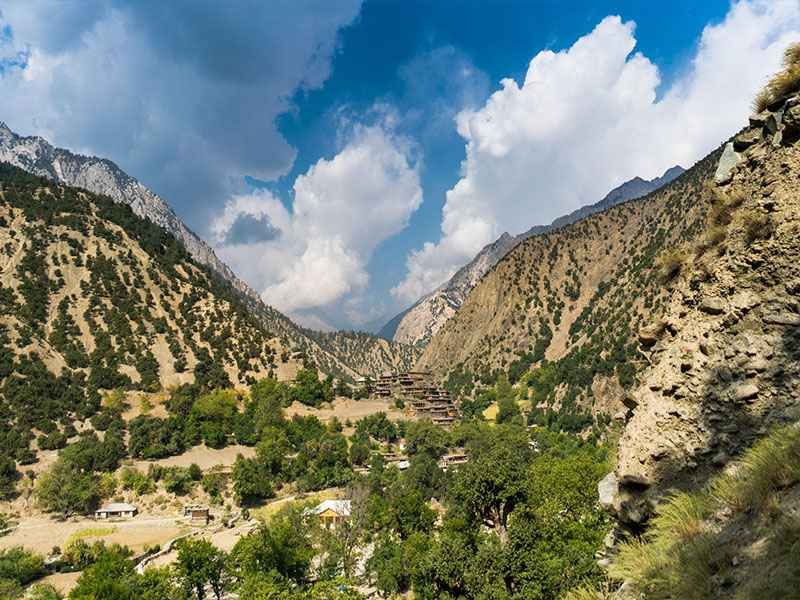
Climate Change Threatens Kalash Life in Chitral’s Valleys
Pakistan’s indigenous Kalash community, 3,000 to 5,000 people in the three valleys of Bumburet, Rumbur and Birir in Chitral district, is struggling as the climate around it changes faster than it can adapt. The Kalash climate change crisis combines shorter winters and drying springs with excessive deforestation, putting the community’s agriculture and its centuries-old culture under pressure.
The Kalash have thrived for centuries in the valleys of Khyber Pakhtunkhwa’s far north, known for their colourful festivals and polytheist traditions. According to The Third Pole, which reported from the valleys, the impacts of global warming have accelerated in the past decade, made worse by deforestation in these very valleys.
Floods and heat: the Kalash climate change reality
Chitral was hit by flash floods in 2010, 2011, 2013, 2015, 2020, 2022 and 2023. Each disaster washed away the terraced fields on the valley floors on which the Kalash depend.
Noor Shahidin, 60, lost two acres of fertile land in Bumburet, including 40 walnut trees, to the 2015 floods.
“We used to have enough dry fruit, wheat and corn for the whole year. Now, I buy all these things,” he said.
The Pakistan Meteorological Department reports that the annual mean temperature in Chitral rose by 0.9 degrees Celsius between 1991 and 2022. Afsar Khan, deputy director of the KP Environmental Protection Agency, said early snowmelt now challenges farmers and has brought new threats such as grasshoppers preying on ripening grain.
“The interplay of heatwaves and droughts has led to the parching of sun-exposed slopes due to deforestation,” Khan said, warning of faster soil erosion and greater landslide risk.
Forests felled, slopes exposed
Deforestation in these valleys is widespread. Around 150,000 permits are issued annually for tree cutting, a practice environmental activist Saifullah Jan Kalash calls a “curse” on the forests. In October 2011 a forest patrol that challenged illegal loggers was violently attacked, held hostage for days, “beaten black and blue” and released only after the district government intervened.
Dr Naveed Anjum, assistant professor of geology at the University of Peshawar, said deforestation is exposing the slopes of Chitral’s valleys to rain-induced erosion and landslides.
A community that refuses to give up
With government help hard to come by, the Kalasha are protecting themselves: self-governed committees patrol the forests and report logging to the police and forest department.
Their methods are precise. Dwellings are deliberately built at a distance from streams. Trees are considered sacred, and only wind-fallen dry wood is used for construction and burning, which is why Chitral’s slow-growing holly oaks survive in the Kalash valleys.
Without early-warning systems, Kalash wisdom fills the gap: they read the sound and scent of approaching floods from distant valleys and practise Suri Jagek, observing the sun, to plan harvests and livestock.
Yet official neglect persists: the Kalash and their religion are not officially recognised in Pakistan’s national database, so they must mark themselves as “other” on identity documents, excluding them from disaster-relief programmes.
What comes next
The Kalash live by a rule passed down from their ancestors, as Noor Shahidin put it: “never mess with nature”. The question now is whether the state, the timber trade and the climate will give them a chance to keep that promise.
Frequently asked questions
Who are the Kalash?
The Kalash are an indigenous community of 3,000 to 5,000 people living in the Bumburet, Rumbur and Birir valleys of Chitral district, Khyber Pakhtunkhwa, known for their colourful festivals and polytheist traditions.
How is climate change affecting the Kalash valleys?
Annual mean temperatures in Chitral rose 0.9°C between 1991 and 2022. Flash floods have repeatedly destroyed terraced farmland since 2010, winters have shortened, and deforestation has left slopes exposed to erosion and landslides.
Why is deforestation a problem in the Kalash valleys?
Around 150,000 tree-cutting permits are issued annually in Chitral, and illegal logging is widespread. Geologists warn that deforestation exposes slopes to erosion and landslides, compounding flood damage in valleys where farming clings to narrow terraces.