Makkah defence pact binds Pakistan, Saudi Arabia and Turkiye for a decade
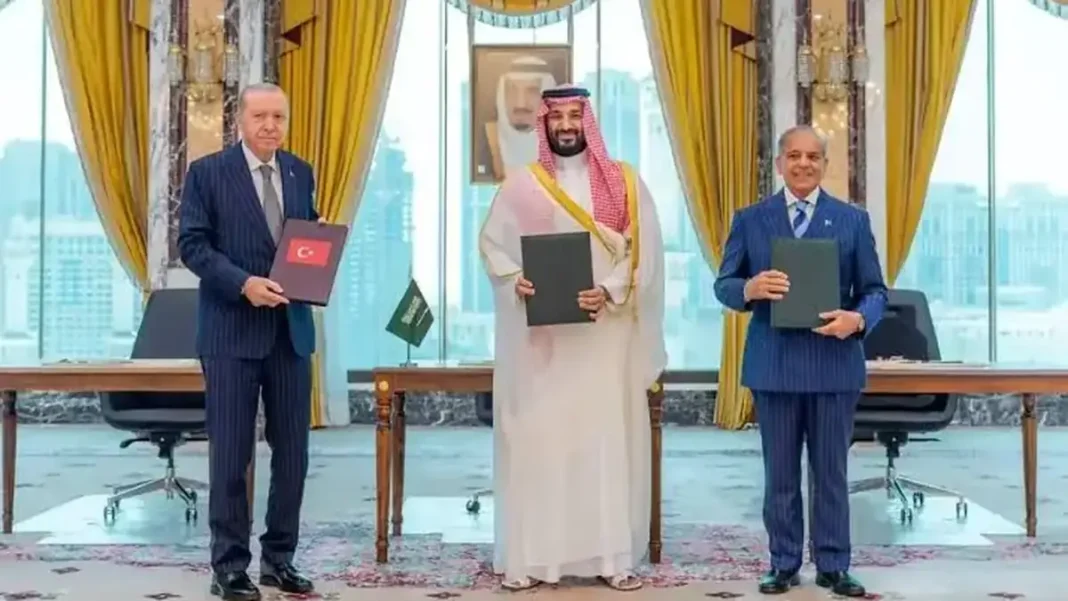
The Makkah Joint Defence Agreement signed by Pakistan, Saudi Arabia and Turkiye will stop its members from withdrawing for the first ten years after the treaty enters into force, according to the newly published text of the pact.
The agreement has no fixed expiry date. A member can leave only after ten years have passed from the date the treaty enters into force, and only by giving written notice through diplomatic channels at least three months in advance.
The terms set up a long-term commitment among the three countries. Turkiye has now submitted the agreement to its parliament for ratification, moving closer to formalising its mutual defence commitment with Pakistan and Saudi Arabia.
What the Makkah defence pact includes
The full text of the agreement, carried in an unofficial English translation, lays out sixteen articles. The central ones are:
An attack on one concerns all three. Article 2 states that an externally originating armed attack against any member will be treated as an attack against all members. The other countries must immediately assist the attacked member using available means of mutual assistance, including military capabilities.
Assistance will be assessed, not automatic. The treaty does not demand an identical military response in every situation. The countries will decide the scope and nature of assistance after an objective assessment of requirements and within the limits of their available resources.
Sovereignty is protected. Article 1 commits the three countries to safeguarding one another’s independence, sovereignty, territorial integrity and internationally recognised borders.
Defence industry cooperation. Article 3 calls for closer cooperation in defence, defence industries and security. Article 7 provides for technology sharing, joint research and development, defence equipment production and the exchange of technical expertise.
Joint training and exercises. Article 6 encourages personnel exchanges between defence institutions, joint training programmes, exercises and deployments to improve coordination among the armed forces in peacetime and wartime.
A strategic committee. Article 8 sets up a Strategic Political and Defence Committee comprising the foreign ministers, defence ministers and chiefs of general staff of the member countries. It will meet twice a year, with the host country rotating among the members.
A secretariat in Saudi Arabia. The agreement provides for a secretariat headquartered in Saudi Arabia. Its secretary general will serve a three-year term on a rotating basis among the members, with Pakistan supplying the first secretary general.
Intelligence sharing. Article 9 requires the members to exchange intelligence through mutually agreed secure channels, with strict rules on information security and confidentiality.
Logistical support. Article 10 provides for mutual logistical support in peacetime, wartime and other emergencies, covering weapons, ammunition, fuel, spare parts and other equipment.
Ratification decides the start. Article 16 states that the agreement will enter into force when the final instrument of ratification is deposited with the secretariat.
Turkiye seeks parliamentary approval
Turkiye’s submission of the agreement to parliament is a required step under its treaty procedures. Separate parliamentary authorisation is needed for deployments of Turkish troops abroad.
A Turkish official told Reuters that Ankara’s contribution under the agreement could be limited to weapons systems, military equipment and intelligence sharing. Turkish Foreign Minister Hakan Fidan has described the pact as defensive rather than offensive, saying Turkiye would not send troops to another country to conduct attacks from its territory.
Pakistan has already ratified the agreement, according to the report. The pact was signed in Makkah on August 7, 2026.
Regional context
The pact has been developing in public view for months. Pakistan’s foreign office has earlier described the Makkah alliance as defensive, while Defence Minister Khawaja Asif has addressed questions about direct involvement under the pact. A rapid force deployment plan was discussed in Riyadh, and the DG ISPR has noted that Pakistani troops have served in Saudi Arabia for decades.
Egypt, which is not a member of the pact, is expected to hold a parliamentary vote on October 26 to authorise potential military support for Saudi Arabia.
Separately, Pakistan, Turkiye, Qatar and Indonesia are expected to sign a defence industry cooperation memorandum in Doha. That proposed four-country arrangement is separate from the Makkah Joint Defence Agreement and will focus on cooperation in the defence industry.
Why it matters
For Pakistan, the pact formalises a security relationship with Saudi Arabia that has existed informally for decades, and adds Turkiye as a third pillar. The ten-year lock-in is the strongest signal yet that the three capitals see this as a permanent arrangement rather than a temporary alignment.
The “attack on one is an attack on all” clause mirrors the collective defence language of alliances such as NATO, though the pact leaves each member to judge what assistance it can offer. That flexibility matters, because the three countries have very different military capacities and regional concerns.
Frequently asked questions
What is the Makkah defence pact?
It is a joint defence agreement signed by Pakistan, Saudi Arabia and Turkiye in Makkah on August 7, 2026. Its newly published text sets out collective defence commitments, defence industry cooperation and a joint strategic committee.
Can a member leave the pact?
Not for the first ten years. After a decade from the date the treaty enters into force, a member can withdraw by giving written notice through diplomatic channels at least three months in advance.
What happens if one member is attacked?
Article 2 treats an externally originating armed attack against any member as an attack against all members. The other countries must immediately assist the attacked member, though they decide the scope of assistance after assessing requirements and their available resources.
Has Pakistan ratified the agreement?
Yes. Pakistan has already ratified the agreement, according to the report. Turkiye has submitted it to parliament for ratification.