Why Pakistan’s Gen Z Feels Left Behind Despite Being More Educated
Pakistan’s Gen Z may be the most digitally connected and educationally ambitious generation the country has seen. They have university degrees, online certifications, access to global knowledge and skills their parents could hardly imagine at the same age.
Yet many young Pakistanis feel they are moving forward on paper while falling behind in real life.
A university degree no longer guarantees a good job. Entry-level salaries often fail to match expectations. Education costs continue to rise, while employers increasingly demand practical skills and experience from fresh graduates.
This creates a painful question for young Pakistanis: if education was supposed to create a better future, why does that future still feel so difficult to reach?
The answer is more complicated than simply saying that young people need to work harder.
Pakistan’s economy, education system, employment market and rapidly changing digital economy are creating a new reality for Gen Z.
Who Is Pakistan’s Gen Z?
Generation Z generally refers to people born between 1997 and 2012.
The oldest members of this generation are now approaching their late twenties, while the youngest are still in their early teens.
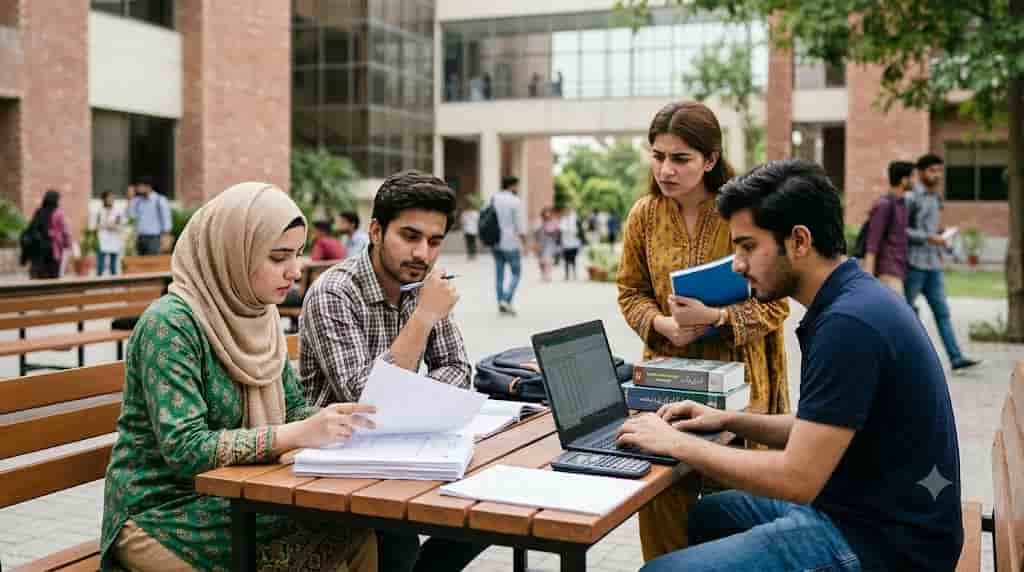
That means a large part of Pakistan’s Gen Z is currently passing through some of the most important stages of life: university, first jobs, career building and financial independence.
Unlike previous generations, they grew up with smartphones, social media and easy access to global information.
A university student in Faisalabad can watch lectures from leading international universities.
A graphic designer in Multan can work for a client in Europe.
A software developer in Lahore can apply for a remote position at an international company.
This access has expanded opportunities.
However, it has also changed expectations.
Young Pakistanis can see how people of the same age live, study and work around the world. They compare salaries, workplaces, lifestyles and career opportunities.
The result is a generation that knows what is possible but often struggles to access those possibilities at home.
Our broader guide to Pakistan’s Gen Z and the pressures shaping their future explores how employment, education, finances and changing social expectations are affecting young Pakistanis.
More Education Does Not Automatically Mean More Opportunity
For decades, Pakistani families followed a relatively simple formula.
Study hard.
Get good grades.
Earn a university degree.
Find a respectable job.
Build a stable life.
For many Gen Z Pakistanis, that formula no longer works as predictably.
Pakistan Bureau of Statistics data from the Labour Force Survey 2024–25 highlights an uncomfortable reality.
Unemployment does not simply disappear as educational attainment rises.
The survey reported unemployment of around 10.9% among degree holders and 11.7% among people with Master, MPhil or PhD qualifications.
That creates a strange situation.
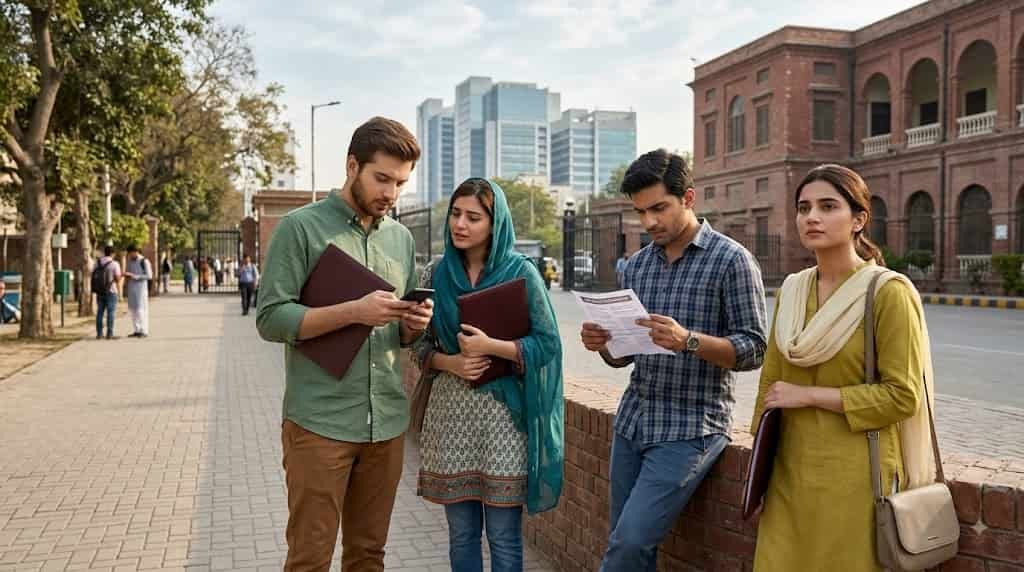
A young Pakistani can spend sixteen or eighteen years studying and still enter a difficult employment market.
Education remains extremely valuable, but the relationship between having a degree and securing a strong career has weakened.
That gap between expectation and reality is one major reason Pakistan’s Gen Z feels left behind.
The Degree-to-Job Gap Is Getting Harder to Ignore
Imagine spending four years earning a degree.
Your family pays university fees, transport costs, books, internet bills and other expenses.
You graduate expecting to begin your professional life.
Then the job search starts.
One employer asks for two years of experience.
Another offers a salary that barely covers commuting and daily expenses.
Another position receives hundreds of applications.
Some employers want technical abilities that your university programme barely covered.
Months pass.
The degree that once represented security suddenly feels like only the first step in another long competition.
This experience is increasingly familiar to young Pakistanis.
We examined this problem in detail in our report on the Pakistan Gen Z unemployment crisis, where the struggle to move from education into meaningful employment becomes particularly clear.
Universities and Employers Are Often Speaking Different Languages
One of Pakistan’s biggest challenges is not simply education.
It is the connection between education and employment.
A student may spend years studying theories, textbooks and examination material.
Employers, meanwhile, may be looking for completely different capabilities.
They want communication skills.
They want problem solving.
They want digital literacy.
They want confidence.
They want practical experience.
Increasingly, they also want familiarity with artificial intelligence, data, digital platforms and modern workplace tools.
This creates a skills mismatch.
The student may technically be educated but still not be immediately ready for the workplace.
That does not necessarily mean the student failed.
It may mean the system did not adequately connect classroom learning with changing labour-market requirements.
A Degree Is Becoming More Expensive at the Same Time
The situation becomes even more frustrating because education itself is becoming harder to afford.
University fees are only one part of the cost.
Students may also need to pay for transport, accommodation, laptops, internet access, books, printing, projects and professional certifications.
Families can spend significant amounts of money supporting one child through university.
Naturally, that creates expectations.
Parents expect education to lead to stability.
Students expect their investment to improve their earning potential.
When graduation instead leads to months of job applications or a low-paying position, disappointment can become intense.
We explored this pressure separately in our article on why education is becoming more expensive for Pakistan’s Gen Z.
The issue is therefore not simply the price of education.
It is the return young people receive from that investment.
The First Salary Can Be a Reality Check
Graduation creates expectations of independence.
A young professional may imagine helping their parents, buying a car, saving money or eventually purchasing a home.
Then the first salary arrives.
Transport takes a share.
Food takes another.
Mobile and internet bills continue.
Professional clothing and workplace expenses add up.
If the person lives away from their family, rent can transform the entire financial equation.
Suddenly, financial independence looks much further away than expected.
This can be particularly difficult emotionally because many young people have spent years hearing that education is the path to a secure future.
The problem is not necessarily that education has lost its value.
Rather, the economy may not create enough high-quality opportunities to absorb educated young workers at the speed they enter the labour market.
Women Can Face an Even Tougher Transition
The education-to-employment gap can become especially difficult for young Pakistani women.
Latest labour-market data show substantial gender differences among highly educated job seekers.
A woman may complete a bachelor’s, master’s or even higher degree but still face additional barriers when entering employment.
Transport concerns can restrict where she works.
Family expectations may limit working hours or relocation.
Some workplaces may not offer the environment or flexibility she needs.
Marriage and caregiving expectations can further influence career decisions.
Therefore, increasing female education alone cannot unlock its full economic value.
Pakistan also needs workplaces and employment systems that allow educated women to participate meaningfully.
Otherwise, the country invests in human capital that remains underused.
Gen Z Is Responding by Learning Skills Outside University
Young Pakistanis are not simply waiting for institutions to solve the problem.
Many have started building a second education outside formal education.
A business student learns digital marketing.
An engineering graduate studies Python.
A literature student learns content writing.
A commerce graduate studies e-commerce.
Someone studying computer science explores artificial intelligence tools beyond the university curriculum.
YouTube, online courses and professional communities have effectively created an alternative learning ecosystem.
For many young people, the new formula has become:
Degree + practical skills + experience + networking.
The degree still matters.
But Gen Z increasingly understands that a degree alone may not be enough.
Freelancing Has Become an Alternative Route
This helps explain why freelancing has become so attractive to young Pakistanis.
Traditional employment says:
Get the qualification, apply for a vacancy and wait for an employer to select you.
Freelancing changes the equation.
Learn a marketable skill, build a portfolio and find clients.
That possibility can feel incredibly empowering.
A freelancer may work in graphic design, software development, digital marketing, writing, video editing, virtual assistance, e-commerce or many other areas.
International clients can also expose Pakistani freelancers to a much larger market than their local city.
Our article on the rise of freelancing among Pakistan’s Gen Z explains why more young Pakistanis are considering digital careers rather than depending entirely on conventional employment.
However, freelancing is not an automatic solution.
Competition is intense.
Income can fluctuate.
Finding the first clients can take time.
Successful freelancers still need discipline, communication skills and continuous learning.
Nevertheless, freelancing gives Gen Z something extremely important: another route.
Social Media Makes the Feeling of Falling Behind Stronger
Previous generations mostly compared themselves with relatives, neighbours and colleagues.
Gen Z compares itself with the world.
Open Instagram, TikTok, YouTube or LinkedIn and you may see someone your age announcing a new job.
Someone else has moved abroad.
Another person has launched a business.
Another appears to earn thousands of dollars online.
Someone is travelling.
Someone has bought a car.
Someone is celebrating admission to an international university.
Even when people understand that social media shows a selective version of life, constant comparison can affect how they judge their own progress.
A 24-year-old graduate earning a modest salary may feel unsuccessful after watching another 24-year-old creator display an expensive lifestyle.
The comparison is often unfair.
But emotionally, it can still feel real.
LinkedIn Creates Its Own Kind of Pressure
Instagram is not the only platform influencing Gen Z.
Professional social media can create another form of comparison.
LinkedIn feeds are filled with promotions, scholarships, certifications, awards, new jobs and professional achievements.
These posts can inspire people.
They can also create the impression that everyone else is progressing faster.
What rarely appears on the feed are the rejected applications, failed interviews, months without work and uncertainty behind many successful announcements.
For a struggling graduate, this constant stream of achievement can turn career development into a race.
The Global Internet Changed Expectations Faster Than Local Opportunities
This may be one of the most important reasons Pakistan’s Gen Z feels different from previous generations.
Their expectations are global.
Their opportunities are still partly local.
A Pakistani software student knows what developers earn internationally.
A designer knows global project rates.
A marketing graduate can see international job descriptions.
Young workers know about remote work, flexible workplaces, startup cultures and global career paths.
That knowledge is valuable.
But it can also make local limitations much more visible.
Gen Z does not evaluate a job only against what their parents earned at the same age.
They may compare it with what someone doing similar work earns internationally.
This completely changes how young people think about careers.
Sleep Problems Can Become Part of the Pressure Cycle
Career and education pressures do not disappear when the working day ends.
A student may study during the day and learn digital skills at night.
A freelancer may work late because clients live in another time zone.
A job seeker may spend hours searching vacancies and preparing applications.
Then social media fills whatever time remains.
The result can be irregular routines and poor sleep.
Our article on why sleep problems are increasing among Pakistan’s Gen Z explores how changing digital habits, routines and pressures can affect young people’s sleep.
This matters because exhaustion can make every other challenge feel harder.
Poor concentration affects learning.
Low energy affects productivity.
And constant tiredness makes career uncertainty even more difficult to manage.
Pakistan Has Educated Ambition but Limited Absorption
Pakistan does not lack ambitious young people.
The bigger question is whether the economy can create enough productive opportunities for them.
Recent labour-market discussions have emphasized the need for stronger links between training and actual employment demand.
This is crucial.
Producing more graduates without expanding industries and productive employment can create frustration rather than prosperity.
A university system cannot operate separately from the labour market.
Universities need stronger relationships with employers.
Students need internships.
Industries need to communicate changing skill requirements.
Career counselling needs to start before graduation.
Technical and vocational pathways also need greater respect.
Not every successful career requires the same academic route.
Employers Also Need to Rethink the “Experience” Problem
Fresh graduates often encounter one of the strangest contradictions in the job market.
They need experience to get a job.
But they need a job to get experience.
Employers can help break this cycle.
Structured internships, graduate programmes, apprenticeships and genuine entry-level positions can give young workers their first opportunity.
Universities can also integrate real projects into degree programmes.
Students should graduate with more than transcripts.
They should leave university with evidence of what they can actually do.
That could include portfolios, research, internships, presentations, practical projects or entrepreneurial experience.
The Education System Needs to Teach Adaptability
The world of work is changing too quickly for education to focus only on memorizing information.
Artificial intelligence makes this even more urgent.
Some tasks that companies hired junior employees to perform only a few years ago can now be accelerated by AI tools.
That does not mean young people have no future.
It means their skills must evolve.
Communication, critical thinking, creativity, problem solving, digital literacy and the ability to work alongside AI will become increasingly valuable.
The most successful Gen Z professionals may not necessarily be those who know the most facts.
They may be those who can learn, unlearn and adapt fastest.
Being More Educated Still Matters
It would be wrong to conclude that education is useless.
Education can improve knowledge, reasoning, communication and access to professional opportunities.
Many careers still require formal qualifications.
Higher education can also create networks and exposure that become valuable later.
The problem arises when society treats the degree itself as the final destination.
A degree should be a foundation.
Skills must be built on top of it.
Experience must be added.
Professional relationships must develop.
Learning must continue after graduation.
This is a more demanding formula than previous generations were often promised.
But it reflects the modern labour market more accurately.
Pakistan’s Gen Z Is Not Simply “Impatient”
Older generations sometimes describe younger people as impatient.
That explanation is too simple.
Gen Z grew up during extraordinarily rapid technological and economic change.
They watched entirely new professions emerge within a few years.
Content creators became businesses.
Freelancers built international careers from bedrooms.
Artificial intelligence changed workplaces.
Remote employment connected workers with companies thousands of kilometres away.
At the same time, young Pakistanis face difficult local employment conditions and rising education expenses.
Naturally, their expectations and frustrations are different.
They do not necessarily expect success without effort.
Many simply question whether the traditional path still delivers what they were told it would.
What Can Young Pakistanis Do Differently?
Structural problems require structural solutions, but individuals still need strategies for navigating the current environment.
Students should begin thinking about employability before their final semester.
Build practical skills alongside your degree.
Take internships seriously.
Create a portfolio.
Learn professional communication.
Improve digital literacy.
Understand how AI is changing your field.
Build genuine professional relationships rather than collecting random LinkedIn connections.
Most importantly, do not wait until graduation to discover what employers in your industry actually want.
Read job descriptions while you are still studying.
Notice which skills repeatedly appear.
Then start building them.
What Pakistan Needs to Do
Pakistan cannot afford to waste an educated generation.
Universities, businesses and policymakers need stronger coordination.
Curricula need more frequent updates.
Industry partnerships should become a normal part of higher education.
Internships need to provide real experience instead of certificates alone.
Career counselling should help students understand emerging fields.
Entrepreneurship and freelancing support should complement traditional employment rather than being treated as emergency alternatives.
Pakistan also needs an economy capable of creating productive jobs at scale.
Education can prepare young people for opportunity.
It cannot replace the opportunity itself.
A Generation Caught Between Two Systems
Pakistan’s Gen Z stands between two different worlds.
One is the traditional world their families prepared them for.
Study hard, earn a degree, find a job and gradually build a stable life.
The other is the emerging digital world.
Learn constantly, build skills, create multiple income opportunities, work remotely and compete globally.
Neither world has completely disappeared.
That is what makes this generation’s transition so difficult.
Young Pakistanis still need qualifications, but they increasingly need practical skills too.
They still look for jobs, but many also build freelance careers.
They want stability, but they live in an economy and labour market that demand adaptability.
Final Thoughts
Pakistan’s Gen Z feels left behind despite being more educated because education and opportunity are not moving forward at the same speed.
Young Pakistanis have greater access to knowledge, technology and global information than previous generations.
But many still struggle to convert that advantage into stable employment and financial independence.
The answer is not to abandon education.
Nor is it fair to blame young people for every difficulty they face.
Pakistan needs a stronger bridge between classrooms and careers.
Universities must prepare students for changing workplaces.
Employers need pathways for young people to gain experience.
Young people themselves need to combine qualifications with practical skills and lifelong learning.
Pakistan’s Gen Z has ambition.
It has access to information.
It has digital potential.
What it needs now is an environment where education, skills and opportunity finally meet.
If Pakistan can create that connection, the generation that currently feels left behind could become one of the strongest drivers of the country’s future.