Pakistan Needs Middle-Power Alliances, Says German Professor
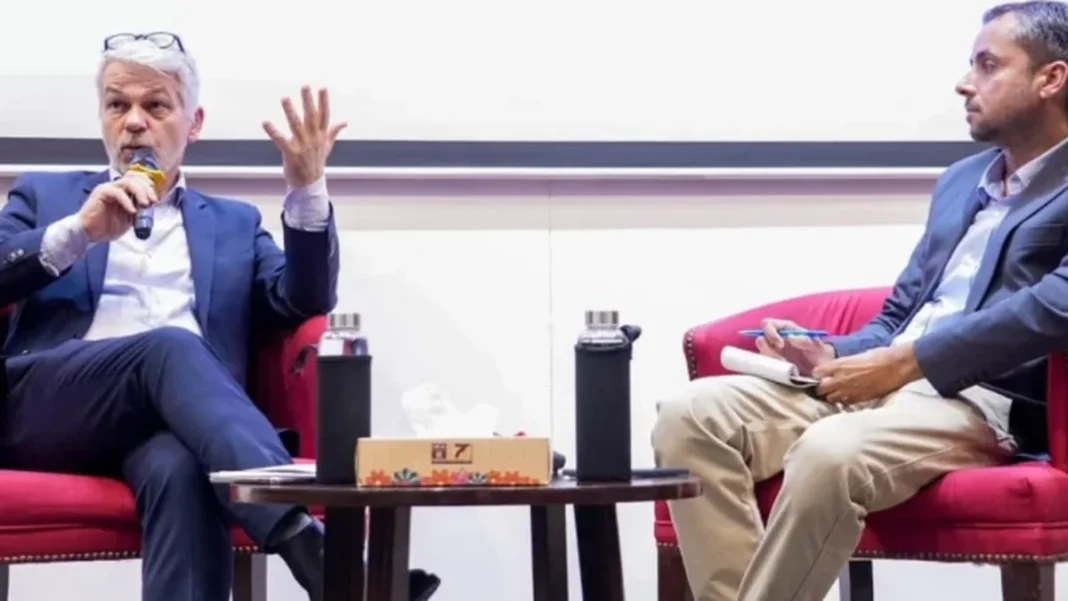
Pakistan must build middle-power alliances to resist pressure to pick a side in the US-China rivalry, a German security professor told a seminar at IBA Karachi on Friday.
Professor Carlos Masala, who teaches security and defence policy at the University of the Federal Armed Forces in Munich, said the world was heading for bipolarity, not multipolarity, and that most states were now hedging their bets between Washington and Beijing.
Why middle-power alliances matter for Pakistan
Masala argued that in an increasingly bipolar system, with China and the United States as the two superpowers, the pressure on Pakistan to pick a side would be extremely high, because great powers had tools of coercion for dragging countries into their orbit.
“The only way out for Pakistan to withstand this pressure,” he argued, “was to create as many alliances and partnerships with middle powers that did not want to be pressured to side with either Beijing or Washington on a permanent basis.”
He said Pakistan needed to form alliances with like-minded countries to withstand pressure from great powers. He pointed to the recent Makkah pact as a case in point, saying Pakistan saw a strategic vacuum there that could lift it out of the squeeze between India and China. “Now, Pakistan hopes to play a more independent role in the Persian Gulf and the Middle East.”
Masala was speaking at a seminar titled “The Evolution of the International Order and Current Structural Changes” at the Institute of Business Administration’s City Campus in Karachi. He is the author of the 2025 book “If Russia Wins: A Scenario”.
The tragedy of geography
Masala spoke about Pakistan’s “tragedy of geography”. With a population of around 260 million, Pakistan would have been a superpower if it had been situated somewhere in Europe, he said. Sandwiched between much larger neighbours, India and China, Pakistan was unfortunately only a middle power.
Describing himself as a structural realist, Masala said the dividing line today was between status quo powers defending the liberal world order and revisionist powers seeking to crush it.
On polarity, Masala said multipolarity was an illusion, because no other state matched the two superpowers in economic and military capability. China’s rise could only be delayed, not prevented, so the future system would be bipolar or a weakened unipolarity.
He made the point with an analogy: the United States was an 800-pound gorilla, China a 720-pound gorilla aiming for 780, and all other states 50-pound monkeys.
A new bipolarity, not a Cold War repeat
Masala argued the new bipolarity would not resemble the Cold War. Instead of a nuclear arms race, geoeconomic rivalry and technological innovation would drive the competition between the United States and China.
Unlike the Cold War, where countries fell neatly into one camp or another, most countries in the current bipolar system were hedging their bets and looking for a better offer from either side.
“If the best offer comes from Beijing, they go to Beijing. And if the better offer comes from Washington, they go to Washington,” he said.
Speaking about the Asia-Pacific Economic Cooperation summit on November 18 and 19 in Shenzhen, Masala said the common idea of Russia, China and the United States was to establish spheres of influence, drawing a parallel to the Yalta Conference of 1945. A historic meeting of the three countries’ leaders is also set for Shenzhen next week, and China and the United States have been discussing tariffs and farm trade ahead of talks between their leaders.
In such a scenario, Masala argued, middle powers like Pakistan needed to “gang up”, echoing Canadian Prime Minister Mark Carney at Davos in January 2026, to resist pressure to join a great power’s sphere of influence.
Russia’s shadow war in Europe
Asked whether hoax bomb threats and supermarket attacks across Europe were part of a Russian destabilisation campaign, Masala said Russia was waging a “shadow war” to dilute support for Ukraine, although attribution remained difficult. He also rejected the claim that NATO’s eastward expansion caused the Ukraine crisis, saying Russia’s imperial ambitions and territorial claims were driving the war.
For Pakistan, the message was plain: in a world of two giants, a middle power survives by finding partners of its own size. The Makkah pact showed how that could work in the Gulf.
Frequently asked questions
What did Professor Carlos Masala say about Pakistan?
He said Pakistan needs to form alliances with like-minded middle powers to withstand pressure from the United States and China to pick a side in their rivalry.
Who is Carlos Masala?
He is a professor of security and defence policy at the University of the Federal Armed Forces in Munich, Germany, and the author of the 2025 book “If Russia Wins: A Scenario”.
Where did he speak?
He delivered a seminar titled “The Evolution of the International Order and Current Structural Changes” at the Institute of Business Administration’s City Campus in Karachi on Friday.
Why does Masala say the world is bipolar, not multipolar?
He argues multipolarity is an illusion because no other state matches the United States and China in overall economic and military capability. The future system, he says, will be bipolar or a weakened unipolarity.
What did he say about the Makkah pact?
He said Pakistan saw a strategic vacuum in the pact that could lift it out of the squeeze between India and China and help it play a more independent role in the Persian Gulf and the Middle East.