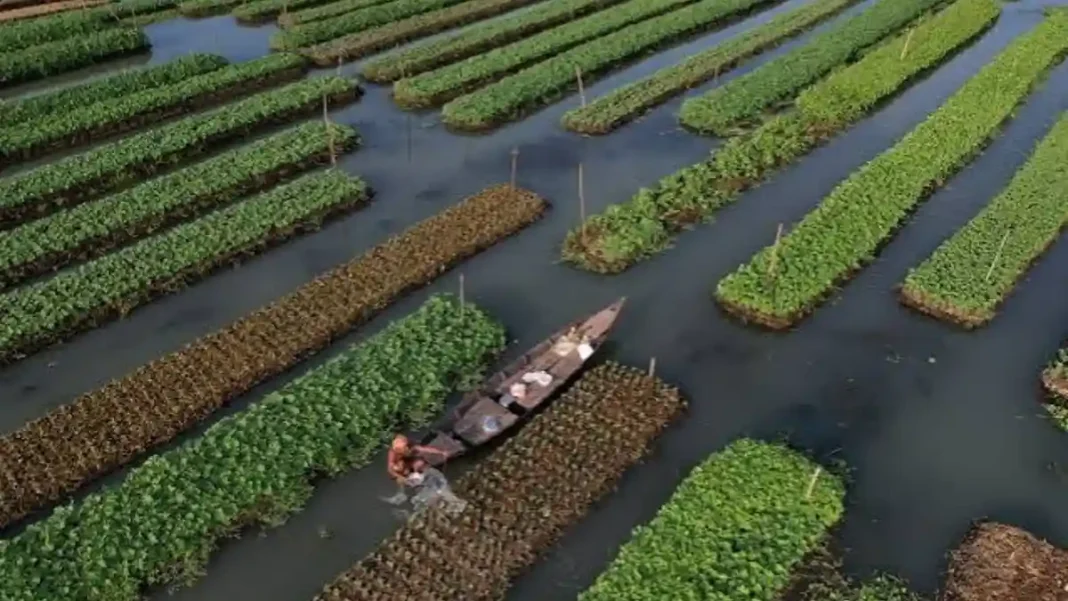
The Sindh floating agriculture project has been proposed at $9.15 million, according to official documents. The plan would develop 400 hectares of flood-resilient cropland in 100 waterlogged and flood-prone villages of lower Sindh by 2029. It is designed for land where standing water rules out normal cultivation for much of the year.
The project carries the title Climate Resilient Floating Agriculture Systems for Waterlogged and Flood Prone Areas of Lower Sindh. Its stated aims are to improve food security by 30 per cent and to train 10,000 farmers. Officials expect it to benefit 12,500 people directly and a further 50,000 indirectly.
How the Sindh floating agriculture project would work
The method grows crops on floating beds rather than in flooded soil. Farmers build organic rafts on the water and plant vegetables, herbs and grains on them. Because the beds rise and fall with the water level, a crop can survive periods when the same land would be unusable under conventional farming.
The plan has three main parts. First, it would establish floating cultivation systems in the selected villages. Second, it would promote climate-resilient farming practices more widely among local growers. Third, it would give targeted support to vulnerable farming communities whose livelihoods depend on that land.
Training sits at the centre of the design. The 10,000 farmers would learn floating agriculture alongside other climate-smart, flood-resilient methods. Women are expected to make up 20 to 30 per cent of the trainees. Women-led farmer groups would also receive training and seed capital, which is meant to support household food security as well as incomes.
Who would run it, and where it stands
The Environment, Climate Change and Coastal Development Department has been named as the executing agency. Support would come from the United Nations Development Programme, the National Agricultural Research Centre, Sindh Agriculture University Tandojam and the Sindh Agriculture Department.
The proposal is not yet a funded programme. It is among the projects being considered for inclusion in the World Bank Country Partnership Framework for Pakistan for fiscal years 2026 to 2035. That status matters for readers in lower Sindh: the targets are real on paper, but money and a start date depend on the framework process.
The logic behind the proposal is easy to follow. Pakistan sits among the countries worst hit by climate change, and lower Sindh’s flat farmland holds floodwater long after rivers fall. Our guide to floods in Pakistan sets out how that waterlogging forms, and the monsoon guide explains the seasonal pattern behind it.
If the project is approved, its test will be practical. Four hundred hectares across 100 villages is a pilot at provincial scale, not a full answer. But for farming families who lose sowing seasons to standing water, even a working pilot would show whether crops on rafts can turn flooded land from a loss into a living. (Source: ProPakistani)
Frequently asked questions
What is the Sindh floating agriculture project?
It is a proposed $9.15 million project to create 400 hectares of flood-resilient cropland in 100 waterlogged villages of lower Sindh by 2029. Crops would be grown on floating organic rafts instead of flooded soil.
How many people would the project benefit?
Official documents put direct beneficiaries at 12,500 people, with 50,000 more benefiting indirectly. The plan also aims to train 10,000 farmers and improve food security by 30 per cent.
Who would execute the project?
The Environment, Climate Change and Coastal Development Department is the named executing agency. The UNDP, the National Agricultural Research Centre, Sindh Agriculture University Tandojam and the Sindh Agriculture Department would support it.