US Naval Presence Middle East Exceeds Iran War Peak
The US naval presence Middle East build-up now exceeds the level at the peak of the February-March US-Israeli war on Iran, an Israeli security institute said on Tuesday. The Institute for National Security Studies (INSS) based the finding on open-source data.
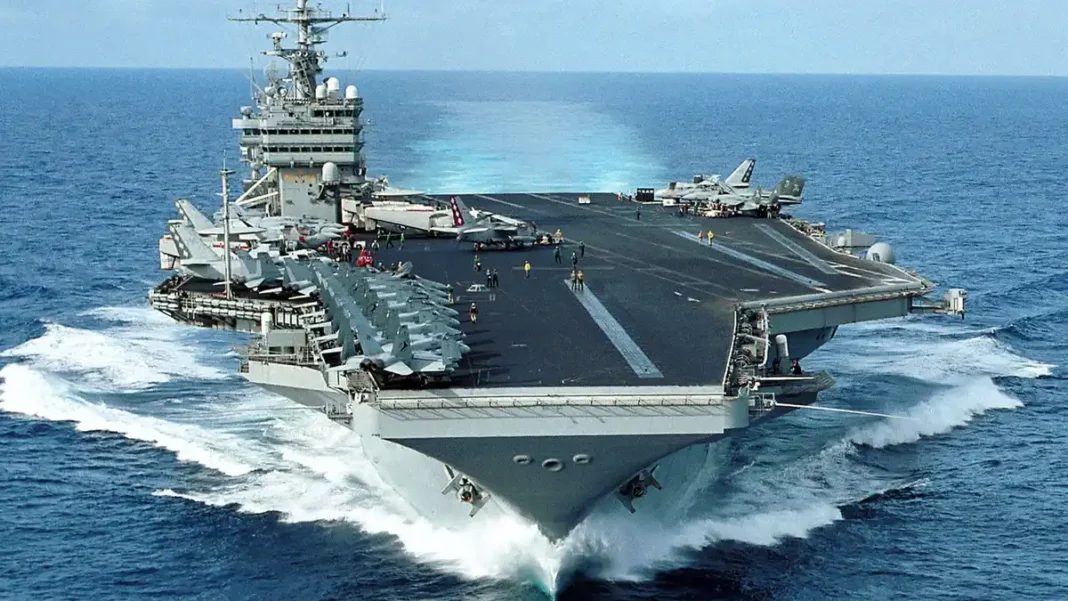
“The current US naval presence exceeds the size of the forces deployed during Operation Epic Fury, providing greater offensive capabilities and broader missile-interception capacity,” the institute said, without giving a figure for the current number of forces or vessels.
Three carriers named in the region
The institute’s interactive map shows three aircraft carriers now in the region, the George Washington, the George H.W. Bush and the Theodore Roosevelt, along with several other military vessels.
Three carriers in one region at the same time is a heavy deployment, signalling that Washington wants the ability to strike hard and defend allies against missile attacks.
The United States and Israel launched a war against Iran on 28 February, and Tehran responded with attacks on Israel and on what it says are US military facilities in Arab countries.
Why the US naval presence Middle East build-up matters
Ships can stay at sea for months and move fast when orders change, while planes on land bases need runways, fuel and host-country permission. A carrier brings its own runway with it.
The same logic applies to missile defence: a carrier group can shoot down incoming missiles over a wide area, and the INSS said the current force offers broader interception capacity than the force used during Operation Epic Fury.
For Pakistan, the build-up matters through oil: much of its crude passes through the Strait of Hormuz, between Iran and Oman, and any clash in the Gulf can push up prices and disrupt supplies. Oil prices have fallen as Middle East exports recover, which shows how quickly regional tension feeds into the price Pakistan pays for fuel.
Air power sits below March levels
The picture on land looks different: despite more than 200 aerial refuelling aircraft in the region, US air power stationed at land bases remains below March levels.
“Aircraft have been repositioned farther west within the Middle East or transferred to Europe, reflecting the vulnerability of forward bases to Iranian attacks,” the INSS said. “However, aircraft can be redeployed much more quickly than naval forces, so the balance of air power could change rapidly.”
Trump says the war is over, but the blockade stays
On 9 November, US President Donald Trump said the war in Iran “militarily is effectively over”, adding that the “history’s greatest Naval Blockade” would remain in place to keep economic pressure on Tehran.
The president says the fighting has ended, yet the navy keeps growing and the blockade stays.
Washington and Tehran signed a memorandum of understanding in June, but work stalled over disagreements about freedom of navigation in the Strait of Hormuz. Since July, confrontations between the US and Iran have resumed from time to time despite diplomatic efforts. Pakistan has kept its own channels open with Tehran, and the Economic Cooperation Organization has backed Pakistan’s peace push.
What happens next
Washington and Tel Aviv accuse Tehran of keeping nuclear programmes that threaten Israel and regional countries; Iran says its programme is peaceful.
The build-up gives the US options, but it also raises the stakes: a larger force can deter an attack, yet it can also become a target if talks fail. The Houthis have closed in on Aden after a shake-up in the Saudi command.
Frequently asked questions
How large is the current US naval presence in the Middle East?
The Institute for National Security Studies said the current presence exceeds the force deployed during Operation Epic Fury at the peak of the February-March war on Iran, but gave no figure for the current number of forces or vessels.
Which aircraft carriers are in the region?
The institute’s interactive map names three carriers, the George Washington, the George H.W. Bush and the Theodore Roosevelt, along with several other military vessels.
Why does the build-up matter for Pakistan?
Much of Pakistan’s crude oil passes through the Strait of Hormuz, so Gulf tension can push up oil prices and disrupt supplies, feeding into fuel costs and the import bill at home.
Is US air power in the region also at a peak?
No. Despite more than 200 aerial refuelling aircraft in the region, US air power at land bases remains below March levels, as aircraft were moved farther west or to Europe because forward bases are exposed to Iranian attacks.
What did President Trump say about the war in Iran?
On 9 November, Trump said the war in Iran “militarily is effectively over”, but the naval blockade would remain in place to keep economic pressure on Tehran.