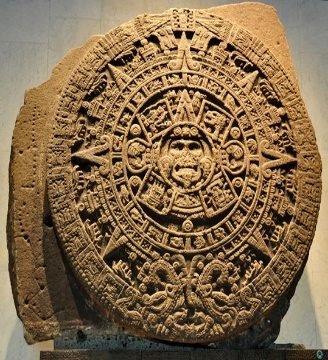
Acalendar is a system of organizing units of time for the purpose of reckoning time over extended periods. In modern age, calendars are explicit schemes used for timekeeping using astronomical cycles. Natural units for timekeeping used by most historical societies are the day, the solar year and the moon months. Archaeologists have developed various methods of timekeeping that go back to prehistoric times and as old as the stone age.
In short: The calendar has been invented many times: the Sumerians were organising months by 3100 BC, Omar Khayyam’s astronomers built the observation-based Jalali calendar, and Britain’s switch to the Gregorian system in September 1752 deleted eleven days at a stroke. M. Irfan traces how civilisations created, corrected and standardised the way we count time.
Calendar Etymology:
The word is derived from the Latin calendarium, meaning “interest register” or “account book,” itself a derivation from calendae (or kalendae), the first day of the month in the Roman republican calendar, the day on which future market days, feasts and other occasions were proclaimed.
History of Calendars Timeline:
The history of calendar is as old as human, people always create and use different methods for keeping track of days and larger divisions of time from ancient times.
In 3100 BC, the Sumerians were the first to use calendars in Mesopotamia. Each month on this calendar had 29 or 30 days, depending on whether or not the first day had a full moon.
In 2500 BC, The Egyptians created their own calendar, which used the moon’s cycles and a star named Sirius to keep track of time known as lunar calendar.
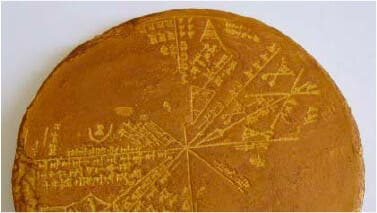
The list is long as larger number of calendar systems were appeared over the time i.e. Stone & iron age societies calendars and that of Sumerians, Egyptian, Persian & Roman times calendars etc.
Lunar to Solar calendar evolution:
Initially lunar calendar was of 10 months of length 29 or 30 days.
Then Egyptians invented a schematized year of 365 days divided into three seasons, each of which consisted of four months of 30 days each. To complete the year, five intercalary days were added at its end, so that the 12 months were equal to 360 days plus five extra days.
In ancient Romans era; Roman people usually relied on superstitious things and they thought that even numbers bring bad lucks; So, they changed the things and their months were only of 29 days. This caused the seasons to be out of sync year after year like shifting of "winter" in “Summer”.
To solve this problem, Romans modified the lunar calendar. 12 months of 29.5 days each (354 days a year) were considered but this was still 11 days short of solar year. To resolve this discrepancy, a group of religious people nominated to decide the 11 days addition in months to keep the calendar synchronized with seasons.
Lunar calendar was complicated based on moon phases and calendar quickly goes out of synch with the actual phases of the Moon. So, to mitigate these inaccuracies and correct the time lapses it was the need of time to develop a more accurate and standardized calendar.
Julian Calendar:
In 40 BC, Roman dictator Julius Caesar consulted an Alexandrian astronomer named Sosigenes and created a more regulated civil calendar, a solar calendar based entirely on Earth's revolutions around the Sun, also called a tropical year.
As per Astronomers; The time that Earth takes in actual to complete one full orbit around the Sun is 365 days, 5 hours, 48 minutes and 45 seconds (365.242189 days).
To meet the above earth cycle: Caesar established a sequence of 12-months in a year of 365.25 days and each month having 31 or 30 days except for February which has 28 in normal and 29 days in leap year.
Means Julian calendar has two types of years: a normal year of 365 days and a leap year of 366 days (leap year is a year divisible by 4). They followed a cycle of three normal years and one leap year, giving an average year that is 365.25 days.
Julian formula =365 +1/4= 365.25 days
In Julian calendar each day is 11 min and 15 sec larger than actual day as actual solar year is of 365.24219 days, this means Julian calendar gains one day after every 128 years.
By the 16th century, it became too noticeable that the Julian calendar has started falling out of sync with the seasons and important religious holidays were out of sync with the fixed dates. For example, in 1582 Easter was shifted 10 days ahead from Caesar time. Orthodox are still using this calendar and their easter and other festivals are linked with this calendar.
Gregorian calendar:
The 226th roman catholic church pope, Pope Gregory XIII wasn’t a huge fan of the Julian calendar and he wanted the calendar to reflect Catholic ideas. Moreover, he wanted to celebrate the Easter on actual dates.
So, in 1582, with minor modifications in Julian calendar, he developed a calendar called Gregorian calendar also known as western or Christian calendar.
Average length of the year in Gregorian calendar reduced from 365.25 to 365.2425 days. That means three out of every four centuries, years evenly divisible by 4 are not leap years but it also to be divisible of 100 & 400. For example, 1700, 1800, and 1900 were not leap years, but 2000 was, and 2100, 2200, and 2300 are not leap years, but 2400 will be.
Gregorian formula = 365 +1/4 -1/100 +1/400 = 365.2425 days
This removal of three days from every 400 years brought down the average length of a calendar year to 365.2425 days, reducing Julian calendar one day gain after every 128 years to every 3300 years but each day is still 27 sec larger than actual day.
Worldwide adoption of this revised Gregorian calendar, took place over the subsequent centuries, first in Catholic countries and subsequently in Protestant Western countries & then worldwide.
The Julian calendar is still used in parts of the Eastern Orthodox Church (Russia, Cyprus, Georgia) and in parts of Oriental Orthodoxy as well as by the Berbers.
Interesting Facts:
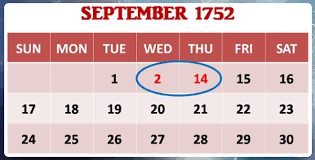
While shifting from Julian to Gregorian calendar; people living in Britain, America and other English colonies went to sleep on the night of September 2nd, 1752 and when they woke up in the next morning, it was September 14th, 1752. People thought the government was trying to cheat them out of 11 days of their lives. Afterwards; there were riots in villages. Eleven days from 03rd to 13th September were deleted forever. These days simply never existed – no births, no marriages, no deaths.
Julian Vs Gregorian Calendar:
The difference in the average length of the year between Julian (365.25 days) and Gregorian (365.2425 days) is 0.002%, making Gregorian 10 times more accurate than Julian.
Both calendars still have discrepancy, As in year 2100 Julian calendar is 14 days ahead from actual time while Gorgerin calendar will be 01 day ahead of time in year 4909.
Islamic (Hijri) calendar:
Arabic already had a system of lunar months before Islam. Many of the month names used today are actually pre-Islamic Arabic names.
However, the pre-Islamic Arabs appear to have used mechanisms of intercalation (نسء / nasīʾ) to keep their calendar broadly aligned with the seasons.
In simple terms:
Lunar year ≈ 354 daysSolar year ≈ 365.24 days
So if you simply follow the Moon, the calendar moves backward through the seasons by roughly 11 days every year.
Intercalation involved inserting an additional period/month or manipulating the placement of months to reconcile the lunar calendar with the solar cycle.
The Qur'an refers to this practice in Qur'an 9:36–37, and the Islamic system subsequently established a calendar in which the months follow a lunar cycle without seasonal intercalation.
The calendar was established later, but its starting point is the Hijrah.
The Prophet Muhammad ﷺ migrated from Makkah to Madinah in 622 CE.
This event Hijrah was selected as the epoch from which the Islamic era is numbered.
However, the formal establishment of the Hijri calendar as an administrative dating system occurred during the caliphate of ʿUmar ibn al-Khattab (RA), traditionally around 17 AH / 638 CE.
The year in which the Prophet ﷺ made the Hijrah became:
1 AH — Anno Hegirae
The important point is that 1 AH does not mean the calendar was formally created in 622 CE. Rather, the Hijrah was chosen retrospectively as the starting point for numbering the years.
The Hijri calendar is a lunar calendar consisting of 12 months. A month begins with the appearance/establishment of the new lunar crescent and a normal Hijri year contains:
354 days in a common year
355 days in a leap year
Thus, an Islamic year is approximately 10–12 days shorter than the Gregorian solar year.
Jalali calendar:
The Jalali calendar is one of the most remarkable calendars in history.
The Jalali calendar was commissioned by the Seljuk Sultan Jalal al-Din Malik Shah I in the 11th century. A group of astronomers and mathematicians, including Omar Khayyam, worked on reforming the existing Persian calendar.
It was introduced around 1079 CE.
The name Jalali comes from Jalal al-Din Malik Shah.
The principal objective was to create a calendar that would keep the calendar year accurately synchronized with the solar year and the seasons, particularly for administrative and agricultural purposes.
The earlier Persian calendar had accumulated inaccuracies, so the Seljuk administration commissioned astronomers to develop a more accurate system.
The calendar was based on actual astronomical observations of the Sun's passage through the vernal equinox, rather than simply using a fixed mathematical rule.
The year began at Nowruz, the Persian New Year, around the spring equinox.
The Jalali system therefore kept:
The Gregorian calendar also follows the solar year but it uses a mathematical leap-year rule. The historical Jalali system was remarkable because of its strong connection to astronomical observation.
There is an important distinction between the historical Jalali calendar of Omar Khayyam's era and the modern Iranian Solar Hijri calendar.
The modern Iranian calendar is a descendant of the Persian/Jalali tradition but it is not simply identical to the original 11th-century Jalali calendar.
The Bottom Line:
The way we tell time has evolved over the years and no culture seemed to think of it in the same way. The calendar is still not perfect but it’s so steeped in history and tradition, we don’t bother questioning its inaccuracies. No matter what, appreciate every moment and use your calendar to stay organized! You’ll be happy you did.
'Time is something we take for granted. It just exists but that it not the case. As Shakespeare once said “Make use of time, let not advantage slip”.
World calendars and Accuracy:
Frequently Asked Questions
Who invented the first calendar?
The Sumerians were among the first to use calendars, in Mesopotamia around 3100 BC, organising time into months mainly for administrative and agricultural purposes. Many civilisations then developed their own systems independently.
Why did September 1752 have only 19 days in Britain?
Britain adopted the Gregorian calendar in 1752 to correct the Julian calendar’s drift. Wednesday 2 September was followed directly by Thursday 14 September, deleting eleven days so the calendar realigned with the solar year.
What was the Jalali calendar?
Commissioned under the Seljuk administration and associated with Omar Khayyam, the Jalali calendar was based on actual astronomical observation of the Sun’s passage through the vernal equinox, with the year beginning at Nowruz. The modern Iranian Solar Hijri calendar descends from this tradition.