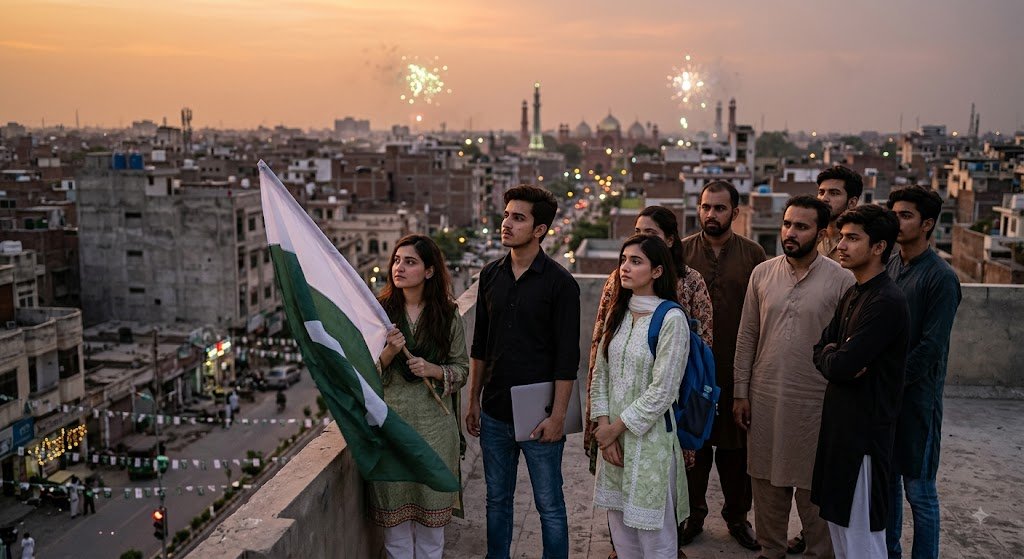
14 August 2026: Does Pakistan’s Gen Z Still Feel Free?
Every August, Pakistan turns green and white.
Flags appear on rooftops, patriotic songs return to television and social media, and families prepare for Independence Day celebrations. Streets light up, children buy badges and flags, while major cities prepare concerts, parades and fireworks.
But behind the celebrations of 14 August 2026, Pakistan’s younger generation is asking a much deeper question.
Does Pakistan’s Gen Z still feel free?
For many young Pakistanis, the answer is complicated.
They can love Pakistan while worrying about its future. They can respect the sacrifices that created the country while questioning whether today’s economic and political environment gives them enough opportunities to build the lives they want.
They can celebrate Independence Day while still demanding change.
That contradiction tells us a great deal about what independence means to Pakistan’s Gen Z in 2026.
These concerns also form part of a much bigger story. Our detailed analysis of Pakistan’s Gen Z and the pressures shaping their lives explores how economic uncertainty, career pressure and changing social expectations are affecting this generation.
Independence Means Something Different to Gen Z
For older generations, August 14 carries memories passed down through families about Partition, migration and the struggle that led to Pakistan’s creation in 1947.
Gen Z understands that history too.
However, young Pakistanis increasingly define freedom through their everyday lives.
They ask different questions.
Can I find a good job after university?
Can I afford to live independently?
Can I start a business?
Will my talent matter more than my connections?
Can I express my opinion?
Can I earn enough to support a family?
Can I buy a home one day?
Most importantly, can I build the future I want without leaving Pakistan?
For Gen Z, independence therefore goes beyond having an independent country.
It also means having the freedom and opportunity to build a future inside that country.
Pakistan Has Millions of Young People — But Where Are the Jobs?
Pakistan’s young population should represent one of the country’s greatest economic advantages.
But a large young population only becomes an advantage when people have education, skills and opportunities.
Recent labour-market figures explain why employment has become such a major Gen Z concern.
The International Labour Organization highlighted in July 2026 that Pakistan has an estimated 46.3 million people between the ages of 15 and 24.
Around 20.6 million participate in the labour force, while approximately 2.6 million remain unemployed.
The youth unemployment rate stands at around 12.8%, compared with an overall unemployment rate of 7.1%.
Even more concerning, around 28.4% of young people aged 15–24 are outside employment, education or training.
These figures do not cover every member of Gen Z, but they reveal the difficult environment facing millions of young Pakistanis.
For a graduate, unemployment does not feel like an economic statistic.
It means another rejected application.
Another month of depending on parents.
Another interview that leads nowhere.
Another postponed marriage.
Another plan that cannot move forward.
Another conversation about going abroad.
Our detailed report on the Pakistan Gen Z unemployment crisis explores why even educated young Pakistanis are struggling to convert qualifications into stable careers.
And that struggle inevitably affects how some young people think about freedom.
Education Is Becoming Expensive Before Careers Even Begin
Pakistan’s Gen Z grew up hearing a simple formula:
Study hard, get a degree and build a successful life.
Millions of families believed in that promise.
Parents invested in schools, academies, universities, transport, books, technology and professional qualifications.
However, education itself has become increasingly expensive.
University tuition is only one part of the cost.
Students also need transport, accommodation, internet access, laptops, books, food and sometimes private coaching.
For middle-income and lower-income families, these expenses can become overwhelming.
The pressure becomes even more frustrating when students complete expensive degrees but cannot find suitable employment.
Our analysis of why education is becoming more expensive for Pakistan’s Gen Z looks more closely at how rising educational expenses are affecting students and their families.
Education should create independence.
But when a student finishes university carrying financial pressure and then struggles to find employment, that promised independence can feel increasingly distant.
Inflation Has Changed the Meaning of Financial Freedom
Getting a job does not necessarily solve everything.
A young professional may finally find employment but still struggle to save money.
Transport costs money.
Food costs money.
Rent costs money.
Electricity costs money.
Internet and mobile services cost money.
Marriage and housing require even more.
As everyday expenses rise, young Pakistanis increasingly measure success differently.
For earlier generations, adulthood often followed a predictable path.
Finish education.
Get a job.
Get married.
Build or buy a home.
Raise a family.
For many members of Gen Z, those milestones now feel harder to reach.
A salary may provide employment without providing financial independence.
That distinction matters.
For a young Pakistani in 2026, economic freedom may feel almost as important as political freedom.
Politics Has Become Impossible for Gen Z to Ignore
Economic anxiety is only one part of the Independence Day conversation.
Politics also plays a major role.
Pakistan’s Gen Z has grown up during years of intense political competition, changing governments, protests, court battles and institutional controversies.
However, this generation experiences politics differently.
Their political world lives inside their smartphones.
A politician’s statement can become a viral clip within minutes.
A protest can appear live on TikTok, YouTube or X.
A political controversy can generate thousands of comments before the evening television bulletin begins.
Young Pakistanis therefore receive an extraordinary amount of political information.
But more information does not always produce more confidence.
Sometimes it produces exhaustion.
Some young Pakistanis become highly politically engaged.
Others distrust almost everyone.
And some simply stop paying attention because the constant political conflict becomes overwhelming.
Yet underneath these different reactions sits one basic expectation.
Young citizens want to believe that their voice and participation matter.
Social Media Has Changed Pakistani Patriotism
Gen Z did not invent patriotism.
But it has changed how patriotism gets expressed.
Previous generations experienced national celebrations mainly through television, radio, newspapers, schools and public events.
Today, Independence Day also takes place on TikTok, Instagram, YouTube, Facebook, WhatsApp and X.
A young Pakistani can post a Pakistan flag in the morning, criticize an economic policy in the afternoon and upload an Independence Day reel at night.
To some older observers, that may look contradictory.
To Gen Z, it often isn’t.
Many young Pakistanis distinguish between Pakistan as their homeland and the governments or institutions responsible for running it.
Someone can love Pakistan’s people, culture, landscapes, languages, food, cricket and history while strongly criticizing governance.
That distinction is essential when discussing whether Gen Z remains patriotic.
Criticism does not automatically equal rejection.
Does Pakistan’s Gen Z Still Feel Patriotic?
There is no single answer.
A timely online discussion among Pakistani Gen Z users just before Independence Day 2026 captured this divide.
Some participants expressed frustration and disappointment.
Others strongly separated their dissatisfaction with governments from their love for Pakistan.
Some still wanted to celebrate August 14 enthusiastically.
Others questioned what exactly they were celebrating.
Online discussions cannot scientifically represent millions of Pakistani young people.
However, they reveal something important.
Pakistan’s Gen Z does not speak with one voice.
There is patriotism.
There is frustration.
There is hope.
There is anger.
There is ambition.
And sometimes all those emotions exist inside the same person.
Why Do So Many Young Pakistanis Think About Leaving?
Perhaps nothing explains Gen Z’s complicated relationship with Pakistan better than migration.
Talk to university students or young professionals about their five-year plans and foreign destinations often enter the conversation.
The UAE.
Saudi Arabia.
Australia.
Canada.
Germany.
The United Kingdom.
The United States.
For many young Pakistanis, leaving the country does not mean they dislike Pakistan.
It means they are searching for opportunity.
Doctors may seek better career pathways.
Researchers may want stronger laboratories and research funding.
Technology professionals may want access to international companies.
Students may want better universities.
Entrepreneurs may seek stronger markets and investment opportunities.
Young professionals may simply want salaries that allow them to build independent lives.
This creates one of the most painful contradictions facing Pakistan today.
A young person can love Pakistan deeply while believing that their future lies somewhere else.
The challenge is not stopping young Pakistanis from exploring the world.
The real challenge is making Pakistan a country they would willingly choose to return to.
Freelancing Is Giving Gen Z a New Kind of Freedom
Not every part of Pakistan’s Gen Z story is negative.
In fact, one of the most interesting changes is happening online.
When traditional employment failed to provide enough opportunities, many young Pakistanis created alternatives.
They started freelancing.
They learned digital marketing.
They became graphic designers.
They entered software development.
They started YouTube channels.
They learned video editing.
They created e-commerce businesses.
They started working remotely for international companies.
This represents a completely different form of independence.
A young Pakistani no longer necessarily needs to wait for a traditional employer in Lahore, Karachi or Islamabad.
Someone living in a smaller Pakistani city can potentially work for clients in Dubai, London, New York or Sydney.
Our detailed feature on the rise of freelancing among Pakistan’s Gen Z explains why digital careers are becoming increasingly attractive to young Pakistanis.
Freelancing does not solve the entire unemployment problem.
Internet reliability, payment systems, international competition and skills gaps remain significant obstacles.
However, digital work proves something important.
When traditional doors remain closed, Gen Z often tries to build another door.
AI Could Create Another Opportunity for Pakistan’s Youth
Artificial intelligence is adding another dimension to this transformation.
Young Pakistanis now have access to AI tools for writing, coding, designing, researching, marketing, video production and business automation.
A student with an ordinary laptop and internet connection can access technology that would have required expensive professional infrastructure only a few years ago.
That creates opportunity.
But it also creates competition.
Young Pakistanis are no longer competing only with other Pakistani graduates.
Digital workers increasingly compete globally.
The winners will often be those who combine education with practical skills, creativity, communication and technology.
Pakistan therefore faces an important choice.
It can treat AI simply as another technology trend.
Or it can train millions of young people to use it productively and turn the country’s demographic strength into digital economic strength.
Economic Pressure Is Also Affecting Gen Z’s Well-Being
The pressure does not disappear when young people close their laptops at night.
Career uncertainty, financial stress, university pressure and constant digital connectivity can follow them into bed.
Many young people spend hours switching between study, work, social media and entertainment on the same screen.
Meanwhile, worries about careers and finances can make it difficult to mentally disconnect.
Our feature on why sleep problems are increasing among Pakistan’s Gen Z explores how modern lifestyles and everyday pressures may be affecting young people’s sleep.
This matters because economic progress means little if a generation becomes permanently exhausted while chasing it.
Pakistan needs productive young people.
But it also needs healthy young people.
Gen Z Is Not Simply a Hopeless Generation
It would be easy to describe Pakistan’s youth using only negative words.
Unemployed.
Frustrated.
Stressed.
Disappointed.
Leaving.
But that would tell only half the story.
Pakistan’s Gen Z is also remarkably adaptive.
Young people are launching startups.
They are building online businesses.
They are learning AI.
They are freelancing.
They are creating educational content.
They are producing podcasts.
They are learning programming.
They are developing personal brands.
They are earning from global clients.
They are finding opportunities that barely existed for their parents.
A teenager with internet access can learn graphic design, coding, digital marketing, video editing or another marketable skill from international teachers.
Knowledge has become dramatically more accessible.
That itself represents a form of freedom.
The bigger question is whether Pakistan can create an environment where young people can turn that knowledge into sustainable careers.
Does Criticizing Pakistan Make Someone Less Patriotic?
This is where the Independence Day conversation becomes particularly important.
Criticism and patriotism are not necessarily opposites.
Sometimes people criticize their country precisely because they care about what it could become.
A young Pakistani asking why schools are not better may want Pakistan to improve.
Someone demanding merit in recruitment may want stronger institutions.
A citizen questioning corruption may want public money used more responsibly.
A graduate demanding better employment opportunities may want to build a future in Pakistan instead of leaving it.
Pretending that problems do not exist is not necessarily patriotism.
But believing that nothing can ever improve is not helpful either.
Pakistan’s Gen Z has to navigate between those two extremes.
Gen Z May Be Redefining Patriotism
Perhaps Gen Z is not becoming less patriotic.
Perhaps its definition of patriotism is changing.
Flying the Pakistan flag matters.
But so does refusing corruption.
Singing patriotic songs matters.
But so does respecting public spaces.
Watching Independence Day fireworks can express national pride.
But building a business that employs ten Pakistanis can express it too.
A teacher improving children’s education contributes to Pakistan.
A freelancer bringing foreign earnings into the economy contributes.
A researcher solving a local problem contributes.
A doctor serving patients contributes.
A programmer building Pakistani technology contributes.
A responsible citizen contributes.
Perhaps the future of Pakistani patriotism should depend less on how loudly people say they love Pakistan and more on what they actually do to improve it.
What Does Freedom Mean to Gen Z in 2026?
For Pakistan’s young generation, freedom increasingly has several dimensions.
Economic freedom means earning enough to make independent life decisions.
Educational freedom means accessing quality education regardless of family income.
Professional freedom means building a career based on ability rather than connections.
Entrepreneurial freedom means being able to start and grow a legitimate business.
Digital freedom means accessing technology and information required to compete in the modern economy.
Political freedom means believing that peaceful participation and civic engagement have value.
Social mobility means believing that someone from an ordinary family can still rise through hard work and talent.
These ideas do not reduce the importance of Pakistan’s independence in 1947.
They show how each generation expands the meaning of freedom.
What Does Pakistan’s Gen Z Actually Want?
Behind political arguments and viral social-media debates, the basic aspirations of young Pakistanis are surprisingly straightforward.
They want opportunity.
They want dignity.
They want stability.
They want good education.
They want meaningful employment.
They want safety.
They want merit.
They want financial independence.
They want institutions they can trust.
And perhaps most importantly, they want to believe that working hard in Pakistan can actually lead somewhere.
If Pakistan can provide that belief, patriotism will not need to be manufactured through slogans.
Young people will feel it through their own lives.
Should Gen Z Celebrate 14 August 2026?
Every Pakistani will answer differently.
Some young people will decorate their homes.
Some will attend concerts.
Some will watch fireworks.
Some will wear green and white.
Some will post Independence Day messages online.
Others may spend August 14 quietly.
And some may not feel like celebrating at all.
None of those choices alone defines someone’s relationship with Pakistan.
Independence Day can be both a celebration and a moment of reflection.
Pakistan achieved political independence in 1947.
Every generation since then has inherited the responsibility of deciding what to build with that independence.
For Gen Z, that responsibility now includes economic opportunity, technological change, education reform, entrepreneurship, stronger institutions and creating reasons for talented young Pakistanis to stay.
Pakistan Cannot Afford to Waste Gen Z
Pakistan’s youth population offers enormous potential.
But demographics alone do not guarantee progress.
Young people need skills.
Skills need jobs.
Entrepreneurs need markets.
Students need education connected to real economic demand.
Young women need meaningful pathways into professional life.
Researchers need resources.
Businesses need stability.
And talented young Pakistanis need reasons to invest their ambitions at home.
With youth unemployment around 12.8% and more than one in four people aged 15–24 outside employment, education or training, Pakistan cannot afford to waste another generation’s potential.
Pakistan needs Gen Z’s energy.
But Gen Z also needs a Pakistan capable of turning that energy into progress.
The Question Pakistan Should Ask This 14 August
Perhaps we are asking the wrong question when we ask:
“Does Gen Z still love Pakistan?”
A much more important question is:
“What kind of Pakistan would make Gen Z want to stay, build and believe?”
That question changes everything.
Young Pakistanis do not have to choose between patriotism and criticism.
They can celebrate Pakistan while demanding better from it.
They can respect the sacrifices of 1947 while questioning what freedom should mean in 2026.
They can criticize institutions without rejecting their homeland.
They can explore international opportunities while still hoping Pakistan succeeds.
And they can acknowledge the country’s problems while working to solve them.
That may actually represent a more mature form of patriotism.
On 14 August 2026, Pakistan will once again glow green and white.
Flags will cover streets.
Patriotic songs will play.
Families will celebrate.
Fireworks will fill the night sky.
But behind those celebrations, millions of young Pakistanis will continue thinking about education, jobs, inflation, careers, politics, technology, migration and their future.
That does not necessarily make them less patriotic.
It means their definition of independence has evolved.
Pakistan’s Gen Z wants more than citizenship in an independent country.
It wants the freedom to build a dignified and successful life within that country.
Some young Pakistanis remain intensely patriotic.
Others feel disappointed or frustrated.
Some dream of leaving.
Others are building businesses and careers here.
Many probably feel several of those emotions at the same time.
That complexity is exactly why we should listen to them.
The dream of 1947 gave Pakistan’s future generations an independent homeland.
The challenge of 14 August 2026 is different.
Pakistan now needs to give its young generation enough opportunity, trust and hope to believe that its future can still be built here.
Gen Z does not only want to inherit an independent Pakistan. It wants the freedom and opportunity to improve it.