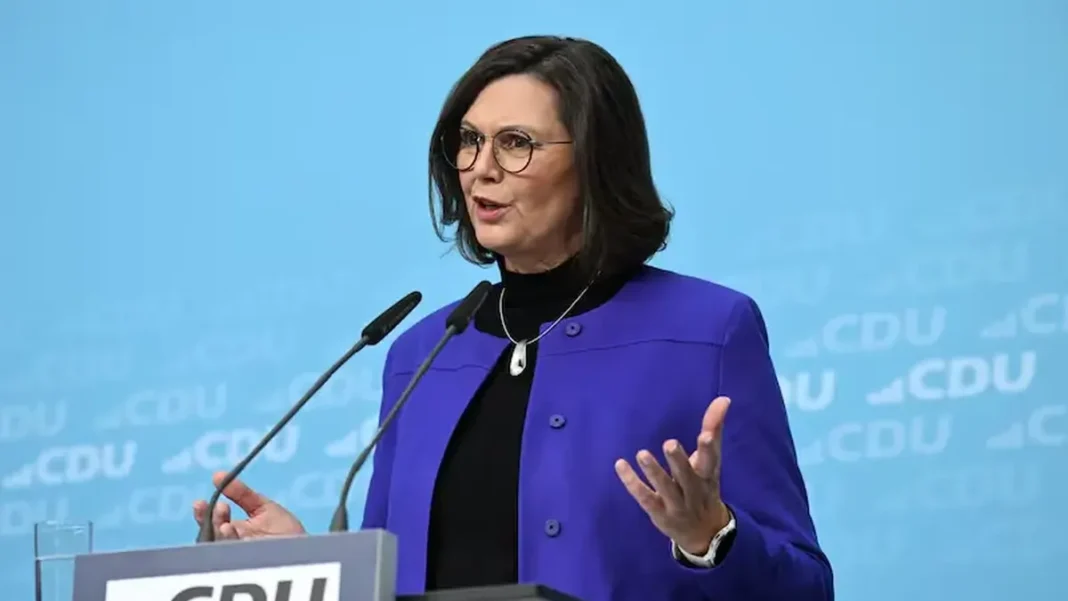
Germany Set for First Woman President as Aigner Picked
Germany looks set to get its first woman president after Chancellor Friedrich Merz nominated Ilse Aigner on Monday to succeed Frank-Walter Steinmeier. Aigner, 61, leads the Bavarian state parliament and would become the first woman, and the first politician from Bavaria’s Christian Social Union, to hold the largely ceremonial office.
With backing from Merz’s conservatives, their Social Democrat partners in the ruling coalition and the Greens, Aigner is very likely to be elected when the Federal Convention meets in January. Steinmeier’s term ends in March.
Germany first woman president: how the election works
Germany’s president is not chosen by voters directly. The Federal Convention, a body that meets only to elect the head of state, will vote on January 30, 2027. It has 1,260 members: half from the Bundestag, the lower house of parliament, and half chosen by the parliaments of Germany’s 16 federal states.
The ruling coalition holds a majority in the convention, which is why Aigner’s election is seen as all but certain. If elected, she will take office in March 2027. Steinmeier, a Social Democrat, has served as president since March 2017 and is finishing his second five-year term.
The German president’s role is largely ceremonial. The president signs laws, appoints the chancellor after an election, and represents the country abroad, but day-to-day government rests with the chancellor. The office still carries weight as a moral voice in German public life.
Who is Ilse Aigner?
Aigner was born on December 7, 1964, in Feldkirchen-Westerham, near Rosenheim in Upper Bavaria. She trained first as a radio and television technician and later qualified as an electrical engineer, and worked on electrical systems for helicopter maker Eurocopter before entering politics.
She entered the Bundestag in 1998 and served as federal minister for food, agriculture and consumer protection from 2008 to 2013 in Angela Merkel’s cabinet. She then returned to Bavaria, where she served as deputy minister-president and economy minister from 2013 to 2018. She has led the Bavarian state parliament since 2018.
Aigner was proposed by Markus Söder, leader of the CSU and Bavaria’s minister-president. Merz announced his support over the weekend and formally nominated her on Monday, November 9, after a meeting of the CDU leadership in Berlin. Dawn reported the nomination on Tuesday.
A warning about division
Standing beside Merz, Aigner said she would work to overcome divisions in German society if elected. “Our country and our democracy yes, they are under attack from within and without,” she said. “Extremists are celebrating their triumphs, and ideologies are on the rise. Division is being fuelled, and consensus is being disparaged,” she added.
Germany’s mainstream parties face the rise of the far-right Alternative for Germany (AfD). Opinion polls suggest the AfD could become the biggest party after the next federal elections, due in early 2029. Aigner’s warning spoke directly to that challenge, and to the task of holding the country’s democratic consensus together.
Why the nomination matters
No woman has held Germany’s presidency in the 77-year history of the Federal Republic. Aigner’s election would end that run, and it would also put a CSU politician in the office for the first time. The cross-party backing for her candidacy, from conservatives, Social Democrats and Greens, is itself unusual in a country where the presidency is normally decided by broad agreement.
US tanker aircraft left RAF Mildenhall as tensions with Iran rose. G7 foreign ministers met in Paris to discuss Iran and Ukraine. Donald Trump nominated Natalie Baker as the next US ambassador to Pakistan. UNICEF warned that Israel is blocking repairs to a Gaza sewage basin.
Frequently asked questions
Who is Ilse Aigner?
A 61-year-old CSU politician who leads the Bavarian state parliament. She was Germany’s federal agriculture minister from 2008 to 2013 under Angela Merkel.
When will Germany elect its next president?
The Federal Convention will vote on January 30, 2027.
Why is Aigner likely to win?
She has the backing of the CDU/CSU, the SPD and the Greens, who hold a majority in the convention.
What did Aigner say after the nomination?
She said German democracy was under attack from within and without, and that division was being fuelled while consensus was disparaged.
When does President Steinmeier’s term end?
In March 2027, after two five-year terms that began in March 2017.