The Spain train collision toll has risen to 68 after two high-speed trains collided near Urda in central Spain. More than 100 people were injured, and 15 of them are in a very serious condition, according to regional authorities and Spain’s health minister.
Castilla-La Mancha regional leader Emiliano Garcia-Page confirmed the death toll had risen to 68. Emergency workers continued searching carriage by carriage for survivors and additional victims, while injured passengers were evacuated from the scene.
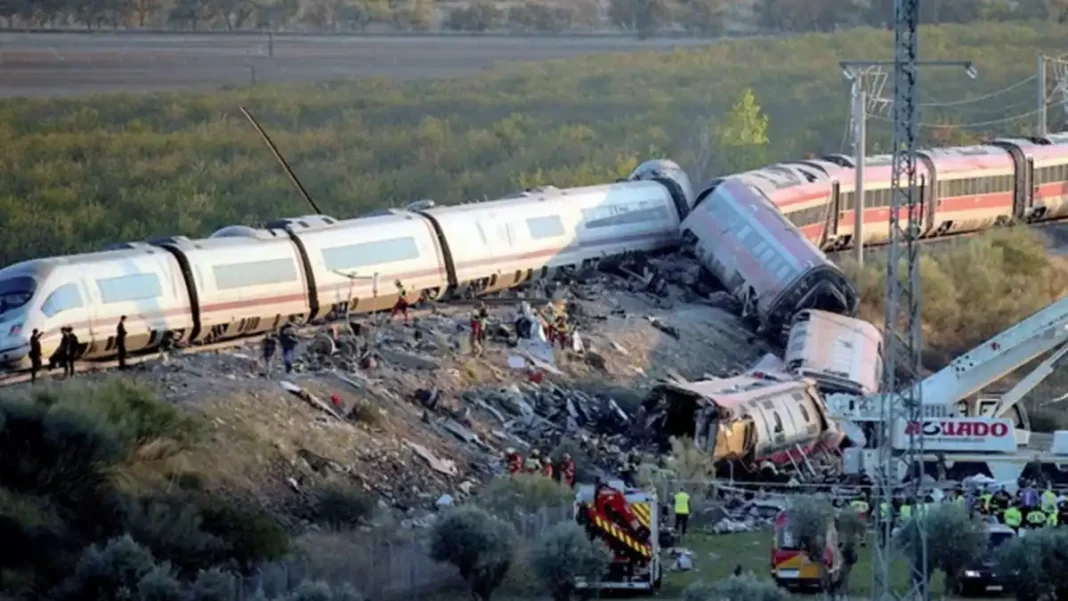
The collision occurred near Urda, south of Madrid, where several carriages derailed and plunged down an embankment. Twisted metal and wreckage lay scattered across the site. The crash involved a train operated by state railway company Renfe and another run by private operator Iryo. Renfe said the main high-speed line connecting Madrid with southern Spain had been suspended after the collision, which occurred at around 9am local time.
Spain train collision toll: a red signal and an erroneous restart
Transport Minister Oscar Puente said a Renfe train had been authorised to continue despite a red signal triggered by a technical failure in the automatic control system. The failure had halted services along a 69-kilometre stretch of track, but an erroneous decision was made to resume the train’s journey, he said.
Puente said the Renfe train travelled about 25 kilometres before striking the stationary Iryo train. The speed at impact could have reached 200 kilometres per hour, he added. He questioned why the control centre had failed to identify and correct the error before allowing traffic to resume.
Passengers described scenes of panic inside the trains. People were thrown from their seats, luggage was scattered, and some travellers were trapped among damaged seats. Survivor Salvador Arriza said passengers were breaking windows to escape, while others were unable to move because they were pinned beneath the wreckage.
Prime Minister Pedro Sanchez said the tragedy would be investigated and pledged to address any failures uncovered. Announcing three days of national mourning from Thursday, he said it was unacceptable for Spain to suffer two high-speed rail accidents in the same year. He added that the causes of the two crashes appeared to be unrelated.
The opposition People’s Party also suspended its election campaign ahead of next month’s general election. Its leader, Alberto Nunez Feijoo, said Spain had the right to know what was happening with its infrastructure, as condolences poured in from across the country and Europe.
A second disaster in one year
The disaster follows a collision between two high-speed trains near Adamuz in southern Spain in January that killed 46 people. It is now Europe’s deadliest rail crash since 2013.
Spain has invested heavily in its high-speed railway network, the world’s second-largest after China’s. Data from Spain’s railway safety authority showed that accidents, including derailments and collisions, rose from 45 in 2016 to 57 in 2024 and 69 last year. The latest crash is likely to intensify scrutiny of the country’s rail safety arrangements as investigators work to establish precisely how the collision occurred.
This report updates our earlier coverage of the crash. The toll first stood at 30 dead, as reported here: At Least 30 Dead in Spain Train Collision Near Madrid. It then rose to 64, covered here: Spain Train Collision Toll Rises to 64. The figure has now reached 68, with the minister’s account of the red signal failure adding the first official explanation of how the crash happened.
What happens next
Investigators will examine the control centre’s decision to restart the Renfe train, the failure in the automatic control system, and the safety procedures that should have kept the train stopped. Their findings will shape the debate over whether Spain’s high-speed network needs stronger safeguards.
For the families of the 68 dead, the questions are more immediate. Rescue teams are still working through the wreckage, and officials have not ruled out further victims being found once the carriages are moved.
How many people died in the Spain train collision?
At least 68 people died, and more than 100 were injured, with 15 in a very serious condition.
What caused the crash?
Transport Minister Oscar Puente said the Renfe train was authorised to continue despite a red signal caused by a technical failure in the automatic control system, and an erroneous decision was made to restart it.