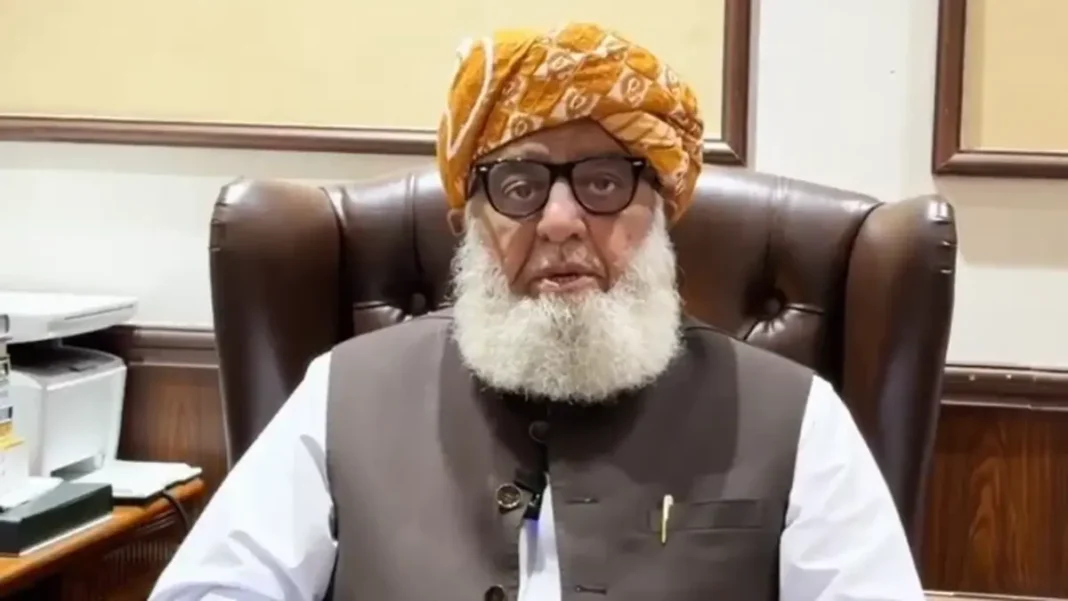
Fazl Questions Ex-FATA Merger and Governor’s Rule
Jamiat Ulema-e-Islam-Fazl (JUI-F) chief Maulana Fazlur Rehman has said the former tribal districts have long been treated as experimental grounds. Speaking to the media in Peshawar on Monday, he added that a debate was under way in the power corridors about reversing the ex-FATA merger with Khyber-Pakhtunkhwa (K-P).
Fazl said nearly a decade had passed since the merger of the former Federally Administered Tribal Areas (Fata) with K-P. However, the promised administrative and governance arrangements had yet to be put in place. He claimed he had been told at a high level that the merger was a mistake, and he asked who had originally approved the decision and who was now pushing proposals to reverse it.
Fazl ex-FATA merger criticism: resources at the centre
Fazl argued that the real issue was not constitutional. “The issue today is not constitutional; it is about the resources of the tribal areas,” he said. He added that he had repeatedly raised concerns about mineral reserves in the region even before governor’s rule and emergency measures were imposed last month.
His party, he said, had no objection to the exploration and development of mineral resources. However, he insisted that all agreements concerning the region’s natural wealth should be made public. That demand puts transparency at the heart of his criticism. If contracts stay private, he argued in effect, the people of the tribal districts cannot judge whether they benefit from their own resources.
The mineral question has wider resonance. Pakistan is preparing a major push on minerals, and Feature Pakistan has reported on the government’s mineral incentive package for copper and gold reserves. The package covers tax breaks and incentives for investors. Fazl’s remarks connect that national debate to the tribal districts, where the reserves lie and where residents have long complained of receiving little in return.
Fazl also claimed that the United States was showing growing interest in the region’s precious stones. He alleged that gemstones had been presented at American offices and that US officials had acknowledged the development. Those claims remain his own account, and no independent confirmation was offered in his remarks.
CPEC, governor’s rule, and the terrorism argument
Fazl widened his criticism to the China-Pakistan Economic Corridor (CPEC). He said China had been disappointed, while the United States was now taking its place, according to him. The remark reflects his party’s long-standing argument that Pakistan’s foreign partnerships should be balanced and transparent.
He then questioned the rationale behind governor’s rule and emergency measures in parts of K-P. Those decisions, he noted, had been justified on the grounds of terrorism. However, the narrative surrounding terrorism had subsided after the measures were introduced on 11 October, he said.
The governor’s rule debate has dominated K-P politics for weeks. Feature Pakistan has covered the court warrants upheld against KP Chief Minister Sohail Afridi in Islamabad and the Senate panel’s scrutiny of FATA and PATA tax exemptions. The tax panel’s work shows that the former tribal areas still operate under distinct fiscal arrangements, years after the merger.
Fazl’s intervention adds a further strand to that debate. He is not only questioning governor’s rule. He is questioning whether the merger itself delivered what was promised to the tribal districts, and whether the current constitutional arrangement serves their people.
Why the merger debate still matters
The 2018 merger ended a separate administrative system for the tribal areas and brought them under K-P’s provincial government, courts, and police. Supporters presented it as a step towards equal citizenship and development. Critics warned that the transition would need sustained funding, administrative capacity, and political will.
Eight years on, Fazl’s complaint is that the second half of that bargain never arrived. Governance arrangements remain incomplete, he says, while decisions about resources are made elsewhere. His demand that mineral agreements be made public is therefore linked to a broader claim: that the tribal districts contribute wealth but do not control it.
The governance gap also shows up in everyday administration. Feature Pakistan has reported on allegations of illegal occupation of government houses in Islamabad, a separate case that illustrates how weak record-keeping undermines public trust. In the tribal districts, the equivalent complaint is that promises of development and representation have not been matched by delivery.
Whether the merger debate moves from speeches to policy will depend on the federal and provincial governments. Reversing a constitutional merger would be a far larger step than adjusting its implementation. Fazl has not proposed a formal reversal plan. He has, however, put the question back on the table: who decided the merger, who benefits from it now, and who is pushing to undo it.
Frequently asked questions
What did Fazl say about the ex-FATA merger?
Fazl said the former tribal districts have long been treated as experimental grounds. He said nearly a decade after the 2018 merger with K-P, the promised administrative and governance arrangements had yet to be put in place.
Does Fazl want the merger reversed?
He said a debate was under way in the power corridors about reversing the merger, and he claimed he had been told at a high level that the merger was a mistake. He asked who approved it originally and who is now pushing to reverse it, but he did not present a formal reversal plan.
What is his demand on minerals?
Fazl said his party has no objection to exploring and developing mineral resources, but insisted that all agreements on the region’s natural wealth should be made public. He also claimed the United States was showing growing interest in the region’s precious stones.
What did he say about governor’s rule?
Fazl questioned the rationale behind governor’s rule and emergency measures in parts of K-P. He said those decisions were justified on terrorism grounds, but the terrorism narrative had subsided after the measures were introduced on 11 October.
When did the Fata-KP merger take place?
The merger of the former Federally Administered Tribal Areas with Khyber-Pakhtunkhwa took place in 2018, during the PML-N’s rule, according to Fazl’s remarks.