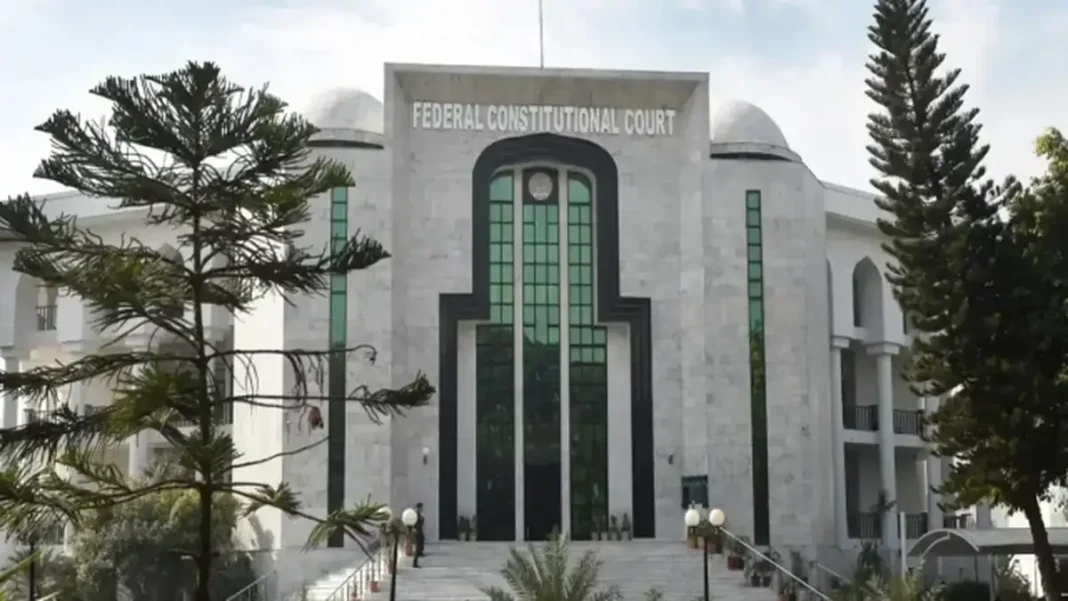
FCC: FIR Cannot Bar Public Employment
The Federal Constitutional Court has ruled that an FIR cannot bar public employment on its own, because the registration of a criminal case is an accusation, not proof of guilt. A division bench led by Chief Justice Amin-ud-Din Khan issued the ruling in a 10-page judgment authored by the chief justice, and it laid down guidelines for public-sector recruitment across the country.
The judgment directs federal and provincial governments, administrative authorities and law enforcement agencies to follow uniform, transparent and constitutionally compliant standards when they verify the antecedents of candidates for public jobs. Tribune reported that the court drew a firm line between an accusation and judicially established culpability, and it said that line must shape every recruitment decision.
Why an FIR cannot bar public employment
The core of the judgment is a simple distinction. “An FIR is merely an accusatory instrument and constitutes neither proof nor presumption of guilt,” the court observed. That means an appointing authority cannot treat a first information report as if a court had already found the candidate guilty.
The same logic applies after an acquittal. Once a competent court has acquitted an accused person, the appointing authority cannot disregard that judicial determination or treat the underlying accusation as established misconduct. The court said judicial acquittal must receive due recognition, subject to an objective assessment of a candidate’s antecedents and suitability.
Character verification, the court added, must rest on authentic and independently verifiable material rather than conjecture or suspicion. A vague adverse note, a rumour, or an unverified allegation does not meet that test. The judgment also stressed process: no candidate should ordinarily be excluded from recruitment without a meaningful opportunity of hearing and a reasoned determination.
What changes for job applicants
For applicants, the ruling changes how police character certificates and background checks should work in practice. Where a candidate has been acquitted, the criminal case should not be reflected adversely in the certificate. Where proceedings are still pending, only their pendency can be disclosed, without any presumption of guilt.
Recruitment decisions must also conform to prescribed statutory criteria, merit, proportionality and constitutional guarantees of fairness and equality. In plain terms, a hiring body must apply the rules that govern the post, judge the candidate on relevant material, and keep its decision proportionate to the facts before it.
The guidelines reach every level of the hiring system. They cover federal and provincial governments, the administrative authorities that run recruitment, and the law enforcement agencies that carry out character verification. The aim is one standard, applied the same way, instead of different practices in different departments.
The constitutional basis of the ruling
The court examined the matter in the context of Articles 4, 10A, 18 and 25 of the Constitution. Together, those articles safeguard legality, due process, equality before the law, and protection against arbitrary exclusion from lawful employment.
Article 4 required executive authorities to act within the law and on relevant considerations, the judgment said. Article 25 prohibited discriminatory treatment that lacked a reasonable basis and a connection with a legitimate statutory objective. Article 18, although it does not guarantee an absolute right to a public appointment, protected eligible citizens against arbitrary impediments to lawful employment.
That framework explains why the court framed the issue as a rights question, not a mere hiring technicality. A public job is a lawful livelihood, and the Constitution guards the path to it against arbitrary barriers.
What happens next
Governments and hiring authorities will now have to align their verification practices with the guidelines. Character certificates that still carry acquitted cases as adverse entries, and recruitment rejections built on a bare FIR, sit uneasily with the judgment. Candidates who face such treatment can point to the court’s reasoning: an accusation is not proof, an acquittal counts, and a rejection needs a hearing and reasons.
The ruling also connects with the court’s wider recent work on recruitment and fair process. Feature Pakistan has reported on the Federal Constitutional Court taking up the challenge to the Peshawar High Court’s PTI order, on the Lahore High Court being asked to dismiss a petition by Hassaan Niazi, and on an anti-terrorism court granting bail to four PTI leaders. The FIR judgment adds a practical rule that reaches far beyond any single case: in public hiring, guilt must be proved, not presumed.
Frequently asked questions
What has the Federal Constitutional Court ruled?
The court has ruled that the mere registration of an FIR cannot disqualify a person from public employment, because an accusation is neither proof nor presumption of guilt.
Who issued the judgment?
A division bench led by Chief Justice Amin-ud-Din Khan issued the ruling, in a 10-page judgment authored by the chief justice.
What happens if a candidate has been acquitted?
Once a candidate has been acquitted by a competent court, the appointing authority cannot treat the accusation as established misconduct, and the case should not be reflected adversely in a police character certificate.
What if criminal proceedings are still pending?
If proceedings are pending, only their pendency can be disclosed in verification, without any presumption of guilt, and the candidate should ordinarily receive a hearing and a reasoned decision before any exclusion.
Which constitutional articles did the court rely on?
The court relied on Articles 4, 10A, 18 and 25 of the Constitution, covering legality, due process, protection against arbitrary barriers to lawful employment, and equality before the law.