France Trade Unions Strike as Protests Sweep Nation
Hundreds of thousands of people were expected to take to the streets across France on Thursday, as unions held strikes alongside student-led demonstrations that have gripped the country for weeks. The France trade unions strike brings together workers and students in a joint protest over pay, the cost of living, and conditions in schools.
Authorities estimated that 500,000 to 700,000 people would protest across the country, with as many as 80,000 marching in Paris. The high school student movement began over poor learning conditions, and it has since joined wider anger over the cost of living and inequality.
The protests follow the worst rioting France has seen in years, which erupted on 17 October. Dawn reported the strike on Thursday. That unrest has shaped the mood of the current demonstrations, and the government has responded with a heavy police presence.
Who is striking and what they want
Public and private education unions have called for strike action, along with unions representing rail workers, public hospitals, and postal services. The breadth of the strike means disruption could reach schools, trains, hospitals, and mail delivery on the same day.
The unions want an increase in the minimum wage, which has not received any discretionary boost since 2012, along with across-the-board wage raises, tax reforms, and better learning conditions for young people.
“It is going to be a strong mobilisation,” said Marylise Leon of the CFDT union. She anticipated a turnout comparable to France’s pension reform protests in 2023, when over one million people marched.
A heavy police response
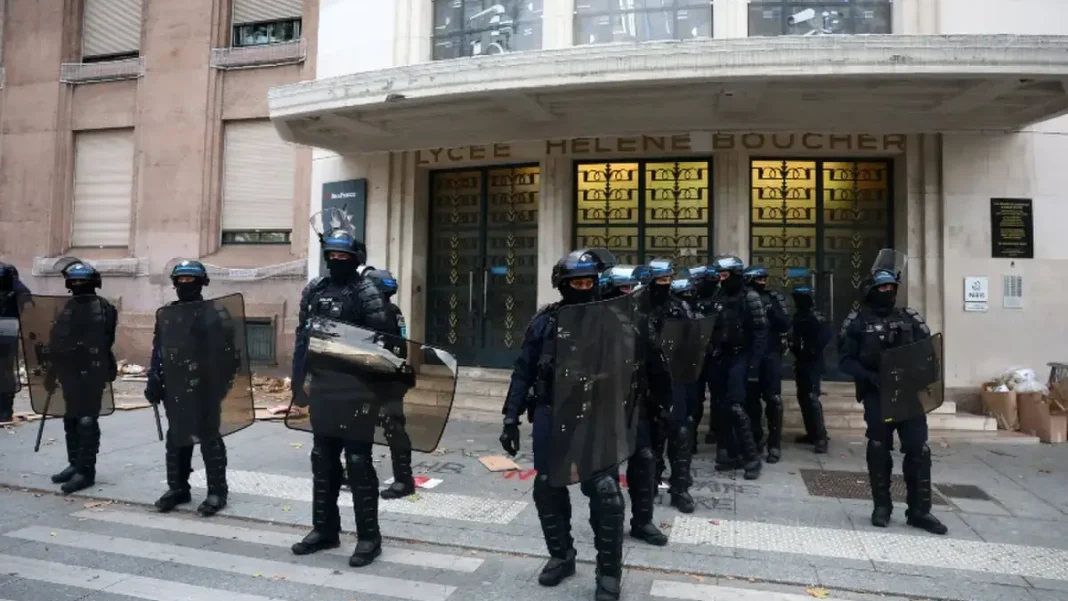
Interior Minister Laurent Nunez announced on Wednesday that 70,000 police officers and security forces would be deployed, promising “an extremely firm response” to any “acts of violence” or disorder.
On Wednesday, the Paris prefecture banned a major protest route between Place de la Bastille and Place de la Concorde, and replaced it with an authorised route moving eastward.
Several unions have denounced the route bans as a move to repress freedom of demonstration, and some have filed last-minute appeals.
“We can feel a cumulative effect: public sympathy for the high school and university students’ movement is not waning, and people are questioning restrictions on liberties, especially bans on demonstrations,” Fabrice Fort of the CGT union explained. “This has sparked a wake-up call among people who usually do not speak out much,” he added.
Why the France trade unions strike matters
The strike comes after weeks of tension. Although student-led protests were largely peaceful, some saw clashes with police erupt, with tear gas and water cannon fired to disperse crowds. An attempted murder investigation has been launched after petrol bombs were thrown at security forces in Paris on Saturday. Several teenage protesters have been seriously wounded, and thousands have been arrested. Authorities have admitted to security and intelligence failures that paved the way for the clashes and looting that erupted on 17 October.
Similar youth-led protests have appeared in Denmark, Germany, and Italy in recent weeks, driven by the same pressures.
For Pakistan, events in Europe carry a direct interest. Europe is a key market for Pakistani exports, and Feature Pakistan has reported that Pakistan’s exports to Europe dipped despite GSP+ status. Strikes in France can slow trade and delay shipments for exporters. Europe has also faced other shocks this year, including a cyberattack on supermarket fridges.
What happens next
The turnout will shape what follows. A large, peaceful march would strengthen the unions’ hand in talks, while violence would deepen the dispute.
The government has not signalled any move on the minimum wage, and the unions have not set a date for further action. Both sides will read the day’s numbers before deciding their next step. For now, the streets of Paris and cities across France will carry the argument.
Frequently asked questions
How many people are expected to protest in France?
Authorities estimated 500,000 to 700,000 people across the country, with as many as 80,000 marching in Paris, on Thursday, 5 November 2026.
Who is on strike in France?
Education unions in public and private schools, along with unions for rail workers, public hospitals, and postal services. Student-led demonstrations are running alongside the strike.
What are the unions demanding?
An increase in the minimum wage, which has not received a discretionary boost since 2012, across-the-board wage raises, tax reforms, and better learning conditions for young people.
Why is there a heavy police presence?
Interior Minister Laurent Nunez deployed 70,000 police officers and security forces, promising a firm response to violence or disorder. The move follows rioting on 17 October and clashes at recent student protests.
Why was a Paris protest route banned?
The Paris prefecture banned a route from Place de la Bastille to Place de la Concorde and replaced it with an authorised route moving eastward. Unions have denounced the ban and filed appeals to have the route reinstated.