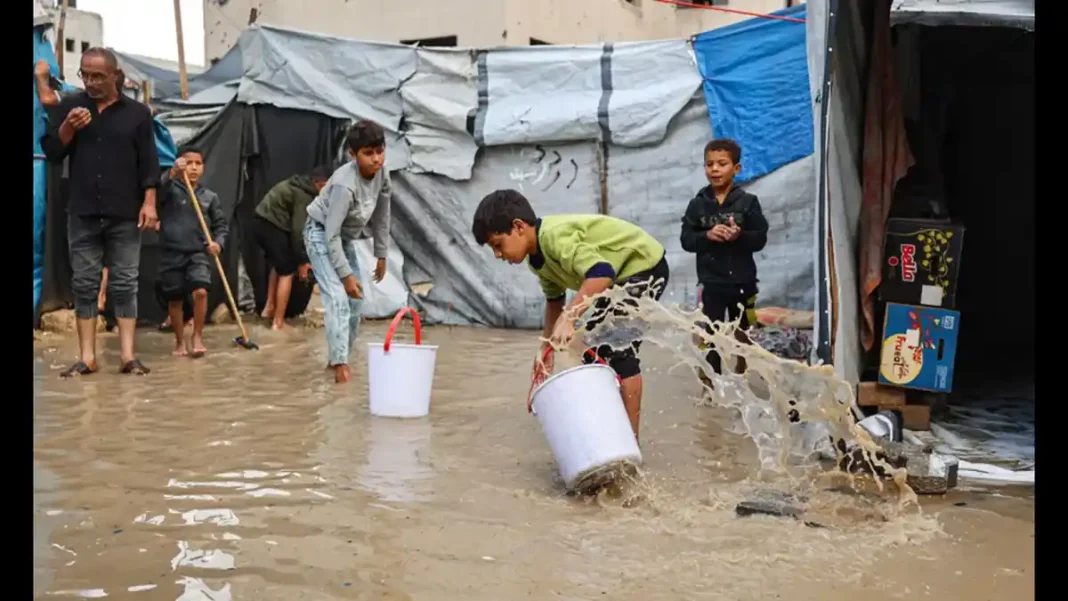
Heavy rain on Saturday left Gaza tents flooded, with about 70,000 tents sheltering displaced people under water on the first day of the rains, the Hamas-run government media office said. Many families were left without shelter.
The flooding also brought down dozens of cracked walls and roofs, which caused injuries, some of them critical, in various areas of the tiny territory. Civil defence spokesman Mahmoud Bassal said his teams received more than 1,500 calls during the night from residents asking for urgent help after their tents flooded. He said the agency was “operating without any equipment or capabilities”.
“We have issued an urgent distress call to the international community and humanitarian organisations to intervene immediately to save hundreds of thousands of displaced people from the flooding of their tents. We cannot face the consequences of this storm on our own,” Mr Bassal said.
Disease fears as Gaza tents flooded
A coalition of Palestinian civil society organisations warned of “the catastrophe that has come to threaten the lives of hundreds of thousands of residents”. It pointed to the risk of disease and epidemics spreading through the flooded camps. The coalition, which includes dozens of local institutions, called for pressure on Israel to allow humanitarian aid to enter without restrictions.
The warning is grounded in the state of Gaza’s infrastructure. The territory is buried under 68 million tonnes of rubble from two years of war, as Feature Pakistan reported on November 6. With much of the territory in ruins, rainwater has nowhere to drain. It pools in the camps where displaced families live, turning tents into ponds within hours.
That is why the flooding is not a one-day problem. Each storm adds to the damage, and each time families must dry out bedding, salvage what they can and wait for the next rain.
A ceasefire that has not brought shelter
A fragile ceasefire came into effect on October 10, 2025, after two years of war. However, despite the agreement reached with Egyptian, Qatari and American mediation, the Israeli army continued air strikes and ground operations on an almost daily basis.
Mustafa Qazzaat, a member of the Gaza city council and an official in the Strip’s emergency committee, said Israel did not allow prefabricated homes to shelter the displaced even after the announcement of the truce. Only limited numbers of tents were permitted to enter. He said Gaza needs 200,000 prefabricated homes urgently, along with heavy machinery to remove rubble, open main roads, and provide electricity and heating.
The numbers explain the scale of the gap. Around 70,000 tents flooded on the first day of rain, and officials say 200,000 prefabricated homes are needed. Tents were meant to be a stopgap, yet more than a year after the ceasefire they remain the main shelter for hundreds of thousands of people.
Israeli strikes have continued across Gaza despite the ceasefire, as Feature Pakistan reported earlier this month. The United Nations Security Council has also taken up the situation, adopting a statement shaped by Pakistan’s diplomacy. Attacks in the occupied West Bank have added to the pressure on Palestinians across the territory.
Dawn reported the flooding. The immediate need is shelter, drainage and medical help for the flooded camps. The longer need is the one Mr Qazzaat named: homes, machinery and power, so that the next storm does not leave the same families bailing water from the same tents.
Frequently asked questions
How many tents were flooded in Gaza?
About 70,000 tents sheltering displaced people were flooded on the first day of heavy rain, according to the Hamas-run government media office.
What help have residents asked for?
Civil defence teams received more than 1,500 calls overnight from residents seeking urgent assistance. Officials issued a distress call to the international community and humanitarian organisations.
Why are people still living in tents?
Israel did not allow prefabricated homes into Gaza even after the October 2025 ceasefire, and only limited numbers of tents were permitted. Officials say Gaza urgently needs 200,000 prefabricated homes.
What is the main health risk from the flooding?
Civil society groups have warned of disease and epidemic outbreaks as floodwater mixes with sewage and debris in camps where sanitation has already collapsed.