A map circulating on social media claims that radiation from a strike on Iran’s nuclear facilities would blanket Pakistan and Afghanistan. The claim has no scientific backing, according to an assessment published by Dawn on Saturday. That is the Iran strike Pakistan risk in question.
The map shows a blast radius reaching Khyber Pakhtunkhwa, Balochistan and parts of Afghanistan, claiming the countries “would be blanketed by the fallout of radiation if nuclear facilities in Iran are attacked”.
The assessment calls that conclusion a product of an incomplete understanding of Iran’s nuclear facilities, presented without real data, calculations, or a plausible scenario. The Iran strike Pakistan risk cannot be judged from a coloured circle on a map.
Iran’s facilities are not all the same. Some hold uranium and enriched uranium. Others hold irradiated fuel with far larger amounts of radioactive material. The consequences depend on which facility is hit, with what weapon, and how badly it is damaged.
Iran strike Pakistan risk: what the facilities hold
Natanz is the principal uranium enrichment complex, with underground and above-ground infrastructure. The United States has hit it and destroyed its above-ground structures. Fordow is an underground enrichment facility near Qom, reportedly struck repeatedly, with no firm confirmation of the American claim that it was destroyed.
Isfahan handles uranium conversion and fuel fabrication. The Tehran Research Complex runs a 5MW research reactor on 20 per cent enriched uranium. The Khondab Heavy Water Reactor and uranium mining sites do not carry fissionable materials.
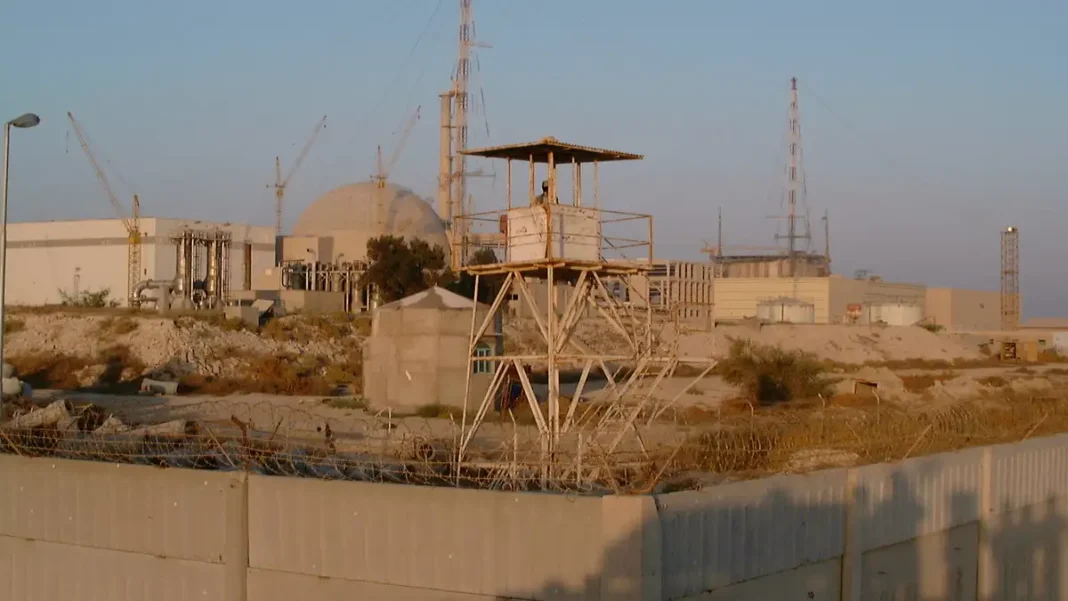
Only one site stands apart. The Bushehr Nuclear Power Plant is a commercial VVER-1000 reactor on the Gulf coast, holding large amounts of radioactive fission products and irradiated fuel. A severe accident there could cause serious transboundary fallout across the Gulf, including Saudi Arabia. Chernobyl showed fallout can be detected more than 1,000km away.
American and Israeli attacks in June 2025 hit several of these facilities, so the list above is not proof that all of them are still running.
Why enrichment plants pose little risk beyond their walls
An attack on Natanz or Fordow would not necessarily release large amounts of radiation. Uranium and enriched uranium do not hold the large inventory of fission products found in irradiated reactor fuel.
Serious contamination inside a damaged facility is possible. But a major release affecting Saudi Arabia, Kuwait, Bahrain, Qatar or the UAE should not be treated as a reasonable default.
The IAEA has stated that radiation levels outside the affected facilities remained normal after the June 2025 attacks. Claims about consequences for neighbours should not rest on unsupported assumptions.
Research reactors pose a smaller risk, with consequences generally staying within a few kilometres.
The picture changes only at a working nuclear power plant on the coast. Its location and prevailing wind patterns could spread fallout further than a strike on an inland facility. Even there, a hit does not automatically release enough radioactive material to cause a major accident. The outcome would depend on how badly the reactor and its safety and cooling systems were damaged.
Trump is weighing his next move on Iran after the midterm elections, while Vance has held almost-daily talks with Pakistan’s army chief over the crisis. Vance has also been building his own political brand since the Republican midterm rout.
Nuclear weapons use is judged extremely unlikely
Another scenario sometimes discussed is the use of nuclear weapons against Iran. The assessment calls this highly speculative and extremely unlikely. They have been used in warfare only once, in 1945.
Their use would not necessarily bring the United States victory, and it could cause a complete loss of control over the Strait of Hormuz. Bushehr is not a significant military target. It has sat under IAEA safeguards for decades.
Attacks on civilian nuclear plants also raise serious issues under international humanitarian law.
It is scientifically wrong to assume that damage to Iranian enrichment facilities would expose neighbours to heavy radiation. Serious fallout cannot be presumed. It would need a credible assessment built on facility-specific data and dispersion modelling.
A Houthi missile was intercepted over the Riyadh region this week, a reminder that the wider confrontation reaches across the Gulf.
Frequently asked questions
Would a strike on Iran’s nuclear sites blanket Pakistan in radiation?
No, according to the assessment. The viral map has no scientific backing. Enrichment plants such as Natanz and Fordow hold uranium, not the large fission-product inventory of irradiated reactor fuel.
Which Iranian facility could cause serious fallout?
The Bushehr Nuclear Power Plant on the Gulf coast. It is a working VVER-1000 reactor holding large amounts of irradiated fuel. A severe accident there could cause serious transboundary fallout.
What did the IAEA say after the June 2025 strikes?
Radiation levels outside the affected facilities remained normal after the June 2025 US and Israeli attacks, the IAEA stated.
Could a nuclear weapon be used against Iran?
The assessment calls that highly speculative and extremely unlikely. Nuclear weapons have been used in warfare only once, in 1945.