Federal Constitutional Court Marks First Anniversary
The Federal Constitutional Court marked its first anniversary in Islamabad on Friday, a year after the institution was established. Chief Justice Justice Amin-ud-Din Khan said the first year had passed so swiftly that the passage of time had scarcely been felt.
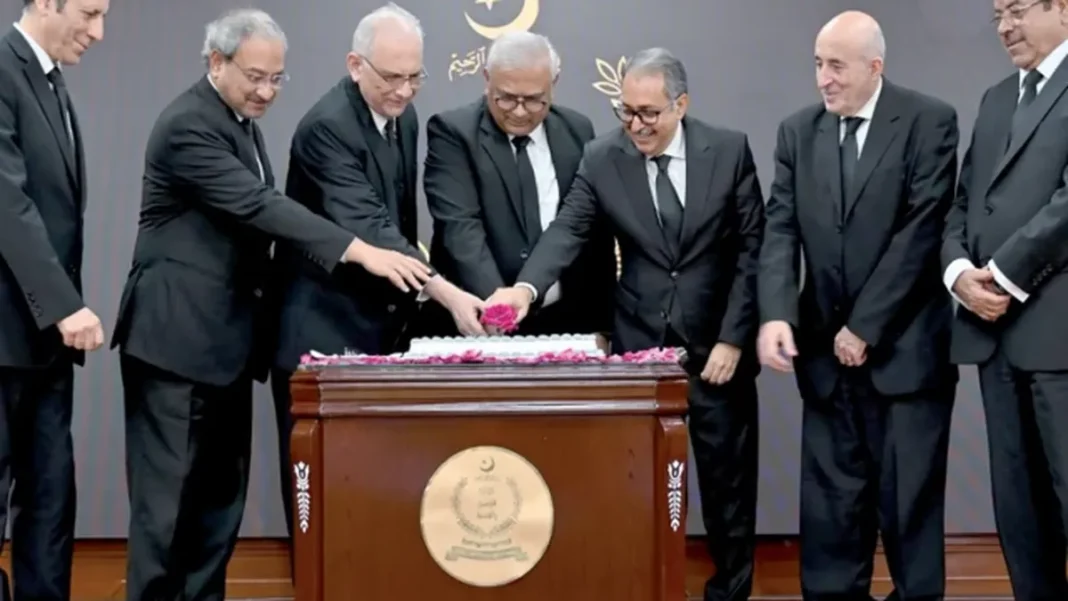
The anniversary was marked with a cake-cutting ceremony attended by the court’s judges. The chief justice used the occasion to issue a commemorative postage stamp, digitally inaugurate the court’s E-Court system and unveil a book.
Federal Constitutional Court: a year in office
Justice Amin-ud-Din Khan presented commemorative postage stamp souvenirs to the court’s judges, its registrar, the secretary to the chief justice and the attorney-general for Pakistan. The stamp marks the court’s first year, while the book records its early work.
The E-Court inauguration was the most practical part of the ceremony. Digital court systems let lawyers file cases and attend hearings online, cutting travel and paperwork. For a new court building its procedures from scratch, a digital system from the start avoids the paper files that older courts still carry.
What the court has done in its first year
In its first year the court has taken up constitutional matters, including a case on land compensation that directed the Capital Development Authority to settle payments within six months. That case showed the court’s role in holding public bodies to account on constitutional questions.
The chief justice told the ceremony the court had disposed of 9,000 cases in its first year, a record he said no other court in Pakistan would have achieved. The figure covers the court’s first twelve months of work, from its creation under the 27th Constitutional Amendment on November 13, 2025. Justice Amin-ud-Din Khan was sworn in as its first chief justice the next day, and the court formally began hearing cases on November 17, 2025, initially from premises at the Islamabad High Court on Constitution Avenue.
The court’s first anniversary comes as it settles into its role in the justice system. Its judges, led by the chief justice, now face the task of building a body of decisions that defines how the new court works in practice.
Why the anniversary matters
A first anniversary is a small milestone, but it matters for a new institution. The Federal Constitutional Court was created to hear constitutional cases, and its first year tested whether it could organise itself, hear cases and deliver decisions.
The stamp, the book and the E-Court launch all point the same way: the court wants its first year on record, and it wants its working methods to be digital from the outset. The coming year will show whether that start turns into a steady caseload and clear judgments. The court was created under the 27th Constitutional Amendment, which redrew Pakistan’s judicial hierarchy, and some lawyers see no cause for celebration in the anniversary.
FCC orders CDA to pay land compensation in six months. IHC suspends Islamabad local government elections. Supreme Court rules inheritance rights have no expiry. Supreme Court disposes of Mazari and Chattha trial appeals. Islamabad to go cashless by year-end.
Frequently asked questions
What is the Federal Constitutional Court?
It is the court established to hear constitutional matters in Pakistan. It marked its first anniversary in Islamabad on Friday, with Chief Justice Justice Amin-ud-Din Khan leading the ceremony.
What happened at the first anniversary?
The chief justice issued a commemorative postage stamp, digitally inaugurated the E-Court system and unveiled a book. He also presented stamp souvenirs to the court’s judges and senior officials.
What is the E-Court?
It is the court’s digital system, inaugurated at the anniversary ceremony. E-Court systems let lawyers file cases and attend hearings online, reducing travel and paperwork.
Who attended the ceremony?
The court’s judges attended, along with the registrar, the secretary to the chief justice and the attorney-general for Pakistan, who received commemorative stamp souvenirs.
What cases has the court heard in its first year?
Its work has included constitutional matters such as a land compensation case in which it directed the Capital Development Authority to settle payments within six months.