Araghchi Meets Munir as Iran, Pakistan Talk Security
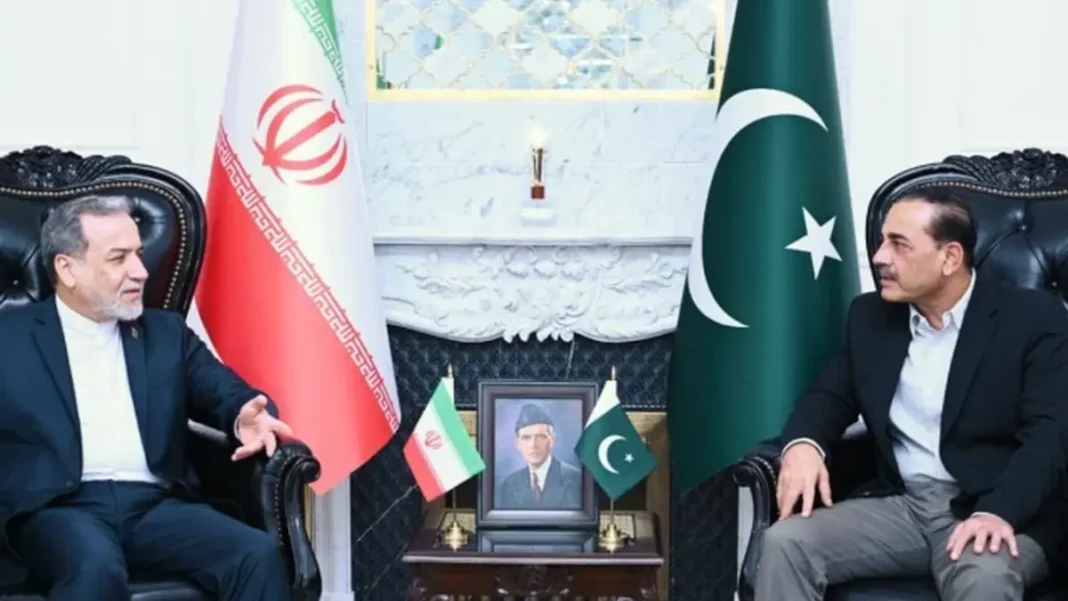
Iranian Foreign Minister Abbas Araghchi meets Munir in Islamabad to discuss regional security, geopolitical developments and bilateral cooperation, the military’s media wing said on Tuesday.
Araghchi led a high-level Iranian delegation to the meeting on Monday with the Chief of Defence Forces and Chief of Army Staff.
According to the ISPR, the two sides discussed matters of mutual interest, regional security dynamics and evolving geopolitical developments. They also exchanged views on ways to address common security challenges.
Field Marshal Munir stressed the importance of sustained engagement, mutual trust and close coordination between the two brotherly countries to promote regional peace and stability, the statement said.
“The Iranian foreign minister praised Pakistan’s constructive role in promoting regional peace and stability and said Iran wants to further strengthen bilateral relations with Pakistan,” the statement added.
Araghchi meets Munir amid Pakistan’s push for US-Iran talks
The meeting took place against the backdrop of Pakistan’s continuing effort to keep the United States and Iran talking. Deputy Prime Minister and Foreign Minister Ishaq Dar said on Monday that Pakistan had not given up on its efforts to promote peace between the United States and Iran and remained committed to dialogue and de-escalation.
Dar spoke at a media briefing after the 30th meeting of the ECO Council of Ministers in Islamabad. He said Pakistan would continue its diplomatic efforts to support dialogue and achieve lasting peace and stability in the region and beyond.
He said regional stability, respect for international law and adherence to treaties were essential for stronger connectivity and shared economic progress. Dar added that Pakistan was still awaiting a response from the United States to its proposal and remained hopeful of a breakthrough.
“We are still waiting for the US response. We have not lost hope and continue to make every effort to resolve the situation,” Dar said.
Araghchi also addressed the ECO meeting on Monday. He said Tehran remained committed to diplomacy and peaceful solutions, but the United States had chosen a different path marked by aggression and economic pressure.
“Unfortunately, the United States chose a completely different path,” he said, accusing Washington of aggression, threats, targeted assassinations, economic pressure and a blockade in violation of international law and the UN Charter.
He thanked Pakistan and the ECO Secretariat for organising the meeting and hosting the Iranian delegation. Araghchi said Tehran sought friendly and constructive relations with its neighbours and had no inherent dispute with countries in the region.
“The territory, airspace and facilities of countries in the region must not become a platform for attacks against one another,” he said.
Why the meeting matters for Pakistan
Pakistan has positioned itself as a mediator since the United States and Israel launched a joint offensive against Iran on February 28. Tehran retaliated with strikes on Israel and other Gulf countries hosting US assets.
Pakistan then helped broker a two-week ceasefire and hosted the highest-level direct talks between the United States and Iran since the 1979 Islamic Revolution. The Islamabad talks ended without agreement, but the ceasefire held and was later extended at Islamabad’s request.
Since then, the two sides have exchanged proposals and counter-proposals in an effort to reach a middle ground and resume a second round of direct talks. The conflict has already disrupted global energy supplies and daily life across the region.
Sources cited in the Tribune report said there was no significant change in Iran’s earlier stance on the nuclear issue in its response to US proposals. That gap is the main obstacle to a second round of talks, and it gives Monday’s meeting in Islamabad added weight: Pakistan is keeping both channels open while it waits for Washington’s reply.
The meeting also carried a message at home. The Foreign Office has rejected reports claiming that Field Marshal Munir visited Iran as a US envoy, calling them misleading and factually incorrect. Monday’s meeting, held openly in Islamabad with an ISPR statement, showed the contact running through normal diplomatic and military channels instead.
For Pakistan, the stakes are direct. Iran is its western neighbour, and any return to open conflict would hit trade, energy supplies and border security. A stable line to Tehran also matters for the ECO agenda that Dar set out in Islamabad, where he linked trade and connectivity to action against terrorism and respect for international law.
The wider region stayed tense as the meeting took place, with Pakistan condemning Israeli attacks in Syria at the UN, Iran rejecting a US reward offer over its nuclear programme and oil prices moving on shipping attacks in the Strait of Hormuz. Islamabad’s message from both the Foreign Office and the military leadership was the same: dialogue first, and no regional platform for attacks on a neighbour.
Frequently asked questions
Who did Abbas Araghchi meet in Islamabad?
Araghchi met Chief of Defence Forces and Chief of Army Staff Field Marshal Asim Munir on Monday, 16 November. He led a high-level Iranian delegation to the meeting.
What did Araghchi and Munir discuss?
They discussed matters of mutual interest, regional security dynamics and evolving geopolitical developments, and exchanged views on ways to address common security challenges, according to the ISPR.
What did Field Marshal Munir say at the meeting?
He stressed the importance of sustained engagement, mutual trust and close coordination between the two brotherly countries to promote regional peace and stability.
What is Pakistan’s role in the US-Iran talks?
Pakistan helped broker a two-week ceasefire after the February 28 offensive and hosted the highest-level direct US-Iran talks since 1979. It is still awaiting a US response to its proposal and says it has not lost hope of a breakthrough.
What did Araghchi say about diplomacy?
Addressing the ECO meeting in Islamabad, he said Tehran remained committed to diplomacy and peaceful solutions, but accused the United States of choosing aggression, threats, targeted assassinations, economic pressure and a blockade.