Lahore Chokes as Air Quality Index Hits 210 ‘Very Unhealthy’
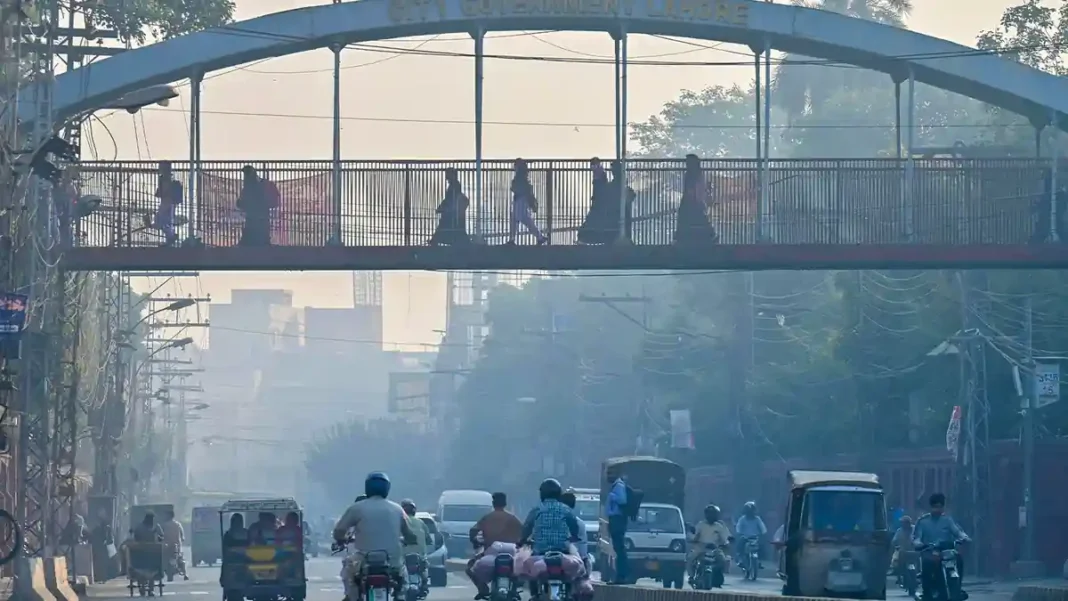
LAHORE: Lahore’s air turned hazardous once again on Wednesday as the city’s average air quality index (AQI) touched 210, placing it firmly in the “very unhealthy” band and among the most polluted cities in the world.
The reading of 210 on the Lahore air quality AQI scale means the air poses a health risk to the general population, not just sensitive groups. Within Punjab, Kot Addu recorded the worst readings of the day, leading a province-wide deterioration that has become a grim seasonal ritual.
What the numbers mean
The AQI scale runs from 0 to 500. Readings between 101 and 150 are “unhealthy for sensitive groups”, 151 to 200 are “unhealthy”, and 201 to 300 fall in the “very unhealthy” band. Above 300, the air is classified as hazardous.
Lahore’s 210 sits well inside the very unhealthy range. The primary pollutant is PM2.5 — fine particulate matter small enough to pass into the bloodstream through the lungs. At these levels, health experts advise residents to avoid outdoor exercise, keep windows closed, run air purifiers indoors, and wear masks when stepping out.
This is not an isolated spike. Earlier this month, Lahore topped the global pollution charts with an AQI of 207, and readings have been oscillating between the unhealthy and very unhealthy bands for several weeks. Smog season in Punjab typically peaks between late October and January, when temperature inversions trap pollutants close to the ground and crop-residue burning adds to the load.
A province-wide problem
While Lahore grabs the headlines, the Express Tribune’s reporting shows the problem extends across Punjab, with Kot Addu recording the day’s worst figures. Industrial emissions, vehicular exhaust, brick kilns and the burning of crop residue all contribute to the toxic mix.
The Punjab government has responded with enforcement measures in recent weeks, including thermal drones to track smog sources and action against brick kilns violating emission rules. Senior provincial minister Marriyum Aurangzeb has said crop-residue burning has declined this year, though the latest readings suggest the overall burden remains severe. The province has also pushed longer-term measures such as the Green Credit Programme, which rewards environmentally friendly actions, and officials have pointed to rain forecasts as a possible source of relief when smog peaks.
Health guidance
Doctors advise that children, the elderly and people with asthma, heart disease or other respiratory conditions are most at risk during high-AQI days. Schools in the worst-affected areas have in past years been closed or shifted to reduced outdoor activity during smog emergencies.
For the general public, the standard guidance at AQI levels above 200 is straightforward: limit time outdoors, wear a well-fitted mask when outside is unavoidable, keep homes sealed as far as possible, and seek medical advice if breathing difficulties develop. Lahore’s smog episodes have repeatedly forced such precautions in recent years, and the Suthra Punjab sanitation drive is one of several provincial efforts aimed at the underlying causes.
The longer view
Lahore’s smog crisis is now a permanent feature of the city’s autumn and winter. Each year, the same cycle repeats: October brings the first warnings, November and December bring emergency measures, and January brings a slow clearing. Long-term solutions — cleaner fuels, stricter industrial controls, an end to crop burning and better public transport — remain works in progress.
Until then, residents can only watch the index and plan their days around it. Wednesday’s 210 is a reminder that the worst of the season may still be ahead.
Tags: Lahore smog, air quality index, AQI Lahore, Punjab smog, air pollution Pakistan, public health