Quick Facts
- Location: On a hillock near the coast in Clifton, Karachi, Sindh — close to Sea View and Clifton Beach.
- Famous For: The tomb of the 8th-century Sufi mystic Abdullah Shah Ghazi, revered as the patron saint and protector of Karachi.
- Nearest City: Karachi itself — the shrine sits in the Clifton neighbourhood, about 30–45 minutes by road from Jinnah International Airport depending on traffic.
- Accessibility: Very easy — paved roads lead directly to the complex, which is open daily. Modest dress and respectful behaviour are expected, as at any shrine.
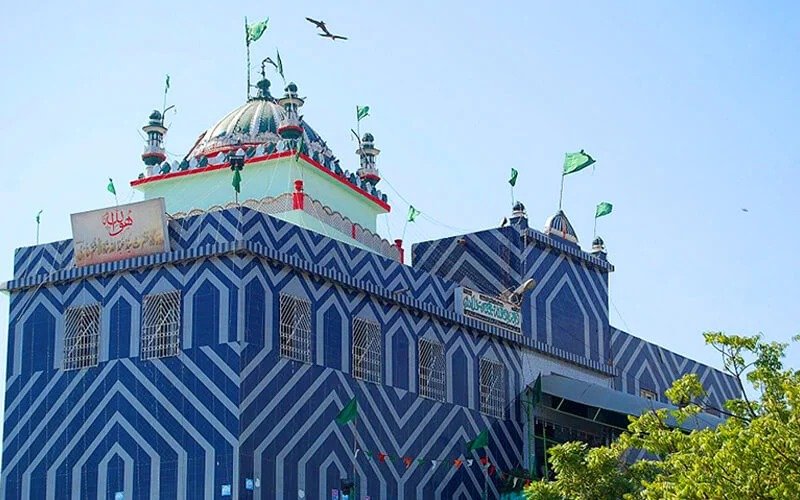
- Known Landmarks: The blue-and-white tiled dome, Sindhi tilework, the silver railing around the tomb, and the subterranean crypt where the saint rests.
- Best For: Religious and spiritual visitors, culture and history lovers, photographers, and families combining the shrine with a Clifton seaside outing.
Why Visit Abdullah Shah Ghazi Shrine
Every great city has a spiritual heart, and for Karachi it is the shrine of Abdullah Shah Ghazi. Perched on a hillock above the Arabian Sea in Clifton, this is the tomb of an eighth-century Sufi saint whom millions regard as the city’s protector. Devotees believe it is his spiritual presence that has turned cyclones away from Karachi for generations — a belief so deeply held that it is part of the city’s folklore. Whether you come as a pilgrim or as a curious traveller, the shrine offers a window into the living Sufi tradition of Sindh.
The shrine is a feast for the senses. The blue-and-white tiled dome gleams against the sea sky, Sindhi tilework and ornamental decoration cover the complex, and inside, the saint’s tomb rests beneath richly embroidered cloths behind a silver railing that devotees touch with reverence. The air carries the scent of rose petals and incense, and on many evenings the sound of qawwali — devotional Sufi music — drifts across the courtyard. It is one of the few places in Karachi where the city’s many communities visibly come together: the shrine has always drawn people of different religions, sects and ethnicities.
What makes the shrine especially moving is its tradition of generosity. Free meals (langar) are distributed to visitors, and the shrine’s management provides two free meals daily to anyone in need — a practice rooted in centuries of Sufi hospitality. Sitting in the courtyard sharing that simple food, watching the sun set over the sea beyond Clifton, you experience Karachi at its most welcoming.
The shrine is also effortlessly combinable with Karachi’s seaside attractions. Clifton Beach and Sea View are minutes away, the upscale Dolmen Mall Clifton is nearby for shopping and dining, and the whole Clifton–Defence corridor is the city’s most visitor-friendly area. A morning or evening at the shrine, followed by the sea breeze at Sea View, makes for one of Karachi’s classic half-days.
History of Abdullah Shah Ghazi Shrine
Abdullah Shah Ghazi (c. 720–773 CE) was an eighth-century Muslim mystic whose life bridges the earliest Islamic history of Sindh. According to longstanding tradition, he was born in Medina in 98 Hijra (around 720 CE) — some accounts say 109 Hijra — as the son of Muhammad al-Nafs al-Zakiyya, a prominent Alid leader, making him a descendant of the Prophet Muhammad through Imam Hasan ibn Ali and thus of the Ahl al-Bayt. His full traditional name is given as Abdullah al-Ashtar al-Hasani.
The saint’s connection with Sindh began in the eighth century. Tradition holds that he migrated to the region in 138 Hijra (around 762 CE), during Umayyad rule, and was initially supported by the Umayyad governor of Sindh, Umar ibn Hafs. But both the Umayyads and the succeeding Abbasids are said to have viewed his Alid lineage and influence as a threat. He was hunted down and martyred with many of his followers in 151 Hijra (around 773 CE), during the caliphate of the Abbasid caliph al-Mansur — killed, in the traditional telling, in a forest in Sindh. His devotees carried his body to a sandy hillock on the coast, the spot where he is said to have first stepped onto Sindh’s shore, and buried him there. That hillock is today’s Clifton. (Historians note other versions too: Sohail Lari suggested he may have been an Arab merchant who came with the first wave of Arab conquerors, while M. Daudpota proposed he arrived as a commander associated with Muhammad ibn al-Qasim’s campaigns — a reminder that eighth-century biography rests on tradition as much as on documents.)
For a thousand years the grave remained a humble place of pilgrimage. Until the early 1950s, the shrine was little more than a small hut on top of a sandy hill in Clifton. Its transformation began in the mid-1950s under Murshid Nadir Ali Shah of Sehwan Sharif, the custodian of the shrine, who built, expanded and beautified it — adding the high square chamber, the green-and-white striped dome decorated with Sindhi tilework, and the facilities for pilgrims. A devotional connection has ever since linked this shrine with Nadir Ali Shah’s following in Sehwan Sharif, home of Lal Shahbaz Qalandar. In 1962 the Auqaf department took administrative control, and in 2011 the exterior was renovated by the construction company M/s Bahria (Bahria Town), giving the shrine its present gleaming blue-and-white face.
Through all these changes, the shrine’s role as Karachi’s spiritual guardian has only grown. Generation after generation of Karachiites — from fishermen to prime ministers, including the late Benazir Bhutto — have climbed the hillock to pay homage. Devotees tell of a miracle from the earliest days: when the hillock was surrounded by sea and no drinking water could be found, a fountain of sweet water emerged from the bottom of the hill and, they say, flows to this day.
Top Things to Do in Abdullah Shah Ghazi Shrine
Pay Your Respects at the Tomb
The heart of the complex is the saint’s tomb, covered in richly embroidered cloths and enclosed by a silver railing that devotees touch and drape with garlands of flowers. The body itself rests in a subterranean crypt beneath the high platform. Whether you come to pray, to make a wish, or simply to observe, approach quietly and follow the lead of those around you — this is an active, deeply felt place of worship.
Admire the Tilework and Dome
Step back and take in the architecture: the blue-and-white tiled dome, the Sindhi-style tilework, Quranic inscriptions and ornamental decoration added through successive renovations, most recently the 2011 exterior renovation. The shrine photographs beautifully in the late-afternoon light, with the sea visible beyond Clifton’s rooftops.
Experience Qawwali and Devotional Gatherings
On many evenings, and especially around the Urs, the courtyard fills with qawwali — the devotional Sufi music that has been the soundtrack of Sindh’s shrines for centuries. Even on ordinary days, the rhythm of daily prayers and the murmur of pilgrims give the complex a contemplative energy. Sit awhile in the courtyard; nobody will hurry you.
Share in the Langar
Free meals are distributed to visitors as part of the shrine’s centuries-old tradition of hospitality, and the management provides two free meals daily to anyone in need. Accepting the simple food — usually rice, daal or a sweet dish — is both a kindness received and a way of participating in the shrine’s culture of charity.
Walk to Clifton Beach and Sea View
The shrine’s hillock is minutes from the sea. Combine your visit with a walk along Clifton Beach or Sea View — Karachi’s beloved seafront promenade — especially at sunset, when families gather, camel rides plod along the sand, and the food stalls fire up. It is the natural second half of a Clifton day.
Visit Nearby Mohatta Palace
A short drive from the shrine stands the Mohatta Palace, the beautiful 1920s stone palace that now serves as a museum and cultural venue with rotating exhibitions. It pairs perfectly with the shrine for a Clifton heritage half-day.
Famous Places In and Around Abdullah Shah Ghazi Shrine
- Clifton Beach / Sea View — Karachi’s famous seafront, minutes from the shrine.
- Dolmen Mall Clifton — one of Karachi’s largest shopping malls, nearby for shopping and dining.
- Mohatta Palace Museum — the 1920s palace-turned-museum, a short drive away.
- Frere Hall — the colonial-era landmark set in gardens, with art exhibitions and a Sunday book bazaar.
- Mazar-e-Quaid — the mausoleum of Muhammad Ali Jinnah, the founder of Pakistan.
- Do Darya — the seaside restaurant strip further along the coast, famous for seafood dinners with a sea view.
- Port Grand — the waterfront food and entertainment enclave near the harbour.
How to Reach Abdullah Shah Ghazi Shrine
The shrine is in Clifton, one of Karachi’s most accessible neighbourhoods, on the hillock near the coast by Sea View. From anywhere in central Karachi — Saddar, PECHS, Gulshan — it is a straightforward drive of 20 to 40 minutes depending on traffic. From Jinnah International Airport, allow 30 to 45 minutes by car or ride-hailing service. The complex is well signposted, and parking is available nearby.
From Islamabad: about 1,360 km by road (roughly 18–20 hours) — realistically a flight. PIA and private airlines operate frequent daily flights from Islamabad to Karachi (about 2 hours).
From Lahore: about 1,200 km by road (roughly 16–18 hours) — again, flying is the practical choice, with frequent daily flights of under two hours.
From within Karachi: ride-hailing apps, taxis and local buses all serve Clifton. If you are staying in Clifton or Defence Phase areas, the shrine may be only 10–15 minutes away.
Nearest airport: Jinnah International Airport, Karachi. From the airport, take the main Shahrah-e-Faisal corridor toward Clifton; your driver will know the shrine.
Tips: Visit early in the morning or in the evening to avoid both the midday heat and the biggest crowds. Thursday evenings and the days of the annual Urs are the busiest — and the most atmospheric. Traffic in Clifton can be heavy on weekend evenings, so allow extra time if you are combining the shrine with Sea View at sunset.
Route Details
- From Jinnah International Airport: Exit onto Shahrah-e-Faisal heading southwest toward the city centre.
- Toward Clifton: Continue via Shahrah-e-Faisal and the Clifton bridge/Abdullah Shah Ghazi road corridor — signposts for Clifton and Sea View will guide you.
- The shrine hillock: Follow signs for the Abdullah Shah Ghazi shrine; the complex sits atop the hillock near the coast, with the blue-and-white dome visible from a distance.
- Parking and entry: Park in the designated area, dress modestly, and enter on foot. Allow at least an hour inside the complex.
Where to Stay in Abdullah Shah Ghazi Shrine
Clifton and the adjoining Defence Housing Authority (DHA) phases are Karachi’s most comfortable base for visiting the shrine — and for most leisure travel in the city. The area offers the full range: upscale hotels with sea views and full amenities, comfortable mid-range business hotels, and serviced apartments that suit families and longer stays. Staying in Clifton puts the shrine, Sea View, Dolmen Mall and Do Darya’s restaurants all within a short drive.
Budget travellers will find simpler guesthouses and lodges in Saddar and PECHS, 20–30 minutes away by car, with easy access to Karachi’s historic core (Empress Market, Frere Hall, the Mazar). Wherever you stay, book ahead during the Urs (20th–22nd Dhu al-Hijjah), when pilgrims fill the city’s hotels.
Karachi is a vast city, so choose your base by what else you plan to see: Clifton/DHA for the shrine, beach and malls; Saddar/PECHS for heritage walks and food streets; the airport corridor for short stopovers.
Where to Eat: Local Foods of Abdullah Shah Ghazi Shrine
Karachi is Pakistan’s food capital, and the Clifton area puts its best within reach. Around the shrine and Sea View you will find everything from bun kebab carts and Sindhi biryani shops to barbecue restaurants and fresh seafood grills. Do Darya, a short drive along the coast, is famous for open-air seafood dinners with the waves beside your table — grilled fish, prawns and crab are the order of the day.
For a deeper dive, head to Burns Road — Karachi’s legendary food street — for nihari, haleem, kebabs and falooda, or try a traditional halwa puri breakfast on a weekend morning. Karachi’s chaat, gol gappay and fresh sugarcane juice are beloved street snacks. Near the shrine itself, small eateries and tea stalls serve pilgrims simple, inexpensive meals, and the shrine’s own free langar meals are available to all.
Food in Karachi spans every budget: satisfying street meals cost very little, while Clifton’s upscale restaurants charge city prices. As everywhere in Pakistan, drink bottled water and eat at busy, freshly cooking stalls.
Weather in Abdullah Shah Ghazi Shrine
Karachi has a hot desert-meets-sea climate: warm year-round, humid in summer, and pleasantly mild in winter. The sea breeze moderates temperatures but brings humidity from May to September, and the monsoon (July–September) can bring heavy showers. Winter — December to February — is Karachi’s beloved season: clear, dry and mild, with cool evenings that make the shrine’s courtyard especially pleasant. Summer afternoons are hot and sticky, so plan shrine visits for early morning or evening.
| Season | Temperature Range | Conditions |
|---|---|---|
| Winter (Dec–Feb) | 12–28°C | Mild, dry and sunny — the best season. Cool evenings; light jacket useful at night. |
| Spring (Mar–Apr) | 20–35°C | Warming up; March pleasant, April hot. Sea breeze picks up. |
| Summer (May–Jun) | 28–36°C | Hot and humid; heatwaves possible in May–June. Visit the shrine early morning or after sunset. |
| Monsoon/Autumn (Jul–Nov) | 26–34°C | Monsoon showers July–September; October–November warm but increasingly comfortable. |
Language and Culture of Abdullah Shah Ghazi Shrine
Urdu is Karachi’s lingua franca and the language you will hear most at the shrine, alongside Sindhi, Punjabi, Pashto, Balochi and English — a reflection of the city’s extraordinary diversity. The shrine itself has always been a meeting place: it is particularly popular with Urdu-speaking and Punjabi devotees, but Christians and Hindus visit too, and politicians of every stripe have paid their respects here.
Shrine etiquette matters. Dress modestly (cover shoulders and legs; women should carry a headscarf), remove your shoes where indicated, and keep your voice low near the tomb. Ask before photographing people at prayer. If you wish to make an offering — flowers, a cloth for the tomb, or a donation to the langar — the shrine’s attendants will guide you.
The Urs (the saint’s death anniversary) is the cultural high point of the shrine’s year: three days of prayers, qawwali, and communal meals that draw thousands of pilgrims. Even outside the Urs, Thursday evenings have a special atmosphere, as many devotees consider Thursday night blessed for shrine visits.
Shopping in Abdullah Shah Ghazi Shrine
Small stalls around the shrine sell the traditional pilgrim’s purchases: flower garlands, embroidered cloths (chadars) for the tomb, prayer beads, caps and inexpensive religious souvenirs. These make meaningful, low-cost mementoes, and buying from the stallholders supports the local economy around the shrine.
For serious shopping, Dolmen Mall Clifton — one of Karachi’s biggest malls — is minutes away, with local and international brands, a food court and cinemas. Tariq Road and the bazaars of Saddar (including the historic Empress Market) offer traditional shopping: fabrics, shoes, jewellery and street food. Bargaining is expected in the street bazaars but not in the malls.
Local Events and Festivals
The Urs of Abdullah Shah Ghazi, observed annually from the 20th to the 22nd of Dhu al-Hijjah (the last month of the Islamic calendar), is the shrine’s great annual gathering. Thousands of pilgrims converge on Clifton for three days of communal prayers, qawwali performances, and free langar meals distributed to all. The complex stays open late, the dome and courtyard are illuminated, and the atmosphere — part festival, part deeply felt devotion — is unlike anything else in Karachi. Because the Islamic calendar is lunar, the Gregorian dates shift each year, so check the dates before planning.
If you visit during the Urs, expect large crowds and allow extra time for everything — parking, entry, and the climb to the tomb. Hotels in Clifton fill up, so book early. Thursday evenings throughout the year also draw larger-than-usual gatherings of devotees. For more ideas on exploring the region, browse our Explore Pakistan guides.
Travel Tips for Abdullah Shah Ghazi Shrine
Packing Essentials
Karachi packing is simple: light, modest clothing, comfortable walking shoes (you will remove them at the shrine), a headscarf, sunscreen and sunglasses. Carry a reusable water bottle — bottled water is cheap and widely available. A small bag for your shoes at the shrine entrance is handy.
Safety Tips
Clifton is one of Karachi’s safer and better-policed areas, and the shrine complex itself is well managed. Still, exercise normal big-city sense: keep valuables discreet, use reputable ride-hailing or hotel transport at night, and stay aware in crowds during the Urs. Drink bottled water and be cautious with street food if you have a sensitive stomach.
Money & Connectivity
ATMs and banks are plentiful in Clifton, and cards are accepted at malls and larger restaurants — but carry cash for the shrine stalls, street food and small purchases. All Pakistani mobile networks have strong coverage in Karachi, and 4G data is cheap and reliable for maps and ride-hailing.
Best Time to Visit Abdullah Shah Ghazi Shrine
Winter (December–February): The Best Season
Karachi’s winter is made for sightseeing: sunny days of 22–28°C, cool evenings, and low humidity. The shrine’s courtyard is at its most pleasant, Sea View is perfect at sunset, and you can comfortably combine the shrine with a full Clifton day.
Spring (March–April): Good
March is still lovely; by April the heat builds. Morning and evening visits work best. Crowds are thinner than in winter.
Summer (May–September): Hot and Humid
Karachi’s summer is hot, humid and occasionally interrupted by monsoon downpours. The shrine remains open and atmospheric — visit early in the morning or after sunset, and pair it with air-conditioned stops (malls, museums) at midday.
Urs (20th–22nd Dhu al-Hijjah): Special but Crowded
If your dates coincide with the Urs, go — it is the shrine’s most powerful experience. Expect big crowds, book hotels early, and arrive with patience and an open heart.
Final Thoughts
The shrine of Abdullah Shah Ghazi is more than a monument; it is a living thread connecting Karachi to its eighth-century beginnings. For over a thousand years, through fishing village and megacity alike, people have climbed this hillock seeking blessings, protection and peace. Standing by the silver railing as the qawwali plays and the sea wind moves through the courtyard, you understand why the saint is called the protector of Karachi — and why the city, in all its chaos and generosity, keeps coming back to him.
Come with respect, stay for the langar, and let the shrine show you the Karachi that guidebooks often miss: devout, musical, charitable and profoundly welcoming. Pair it with Sea View at sunset and you will carry home one of the most complete pictures of the city. For more inspiration, explore our places to visit in Islamabad and Hunza Valley guides.
FAQs
Where is the Abdullah Shah Ghazi shrine located?
The shrine stands on a hillock near the coast in Clifton, Karachi, Sindh — close to Sea View and Clifton Beach, about 30–45 minutes by road from Jinnah International Airport.
Who was Abdullah Shah Ghazi?
An eighth-century (c. 720–773 CE) Sufi mystic, traditionally described as the son of Muhammad al-Nafs al-Zakiyya and a descendant of the Prophet Muhammad through Imam Hasan. He is revered as the patron saint and protector of Karachi.
When is the Urs of Abdullah Shah Ghazi?
The annual Urs is observed from the 20th to the 22nd of Dhu al-Hijjah, the last month of the Islamic calendar. It draws thousands of pilgrims for prayers, qawwali and free communal meals.
What is the best time to visit the shrine?
December to February, when Karachi’s weather is mild and dry (12–28°C). Early mornings and evenings are the most pleasant times of day year-round.
How do I reach the shrine from Islamabad or Lahore?
Fly to Jinnah International Airport, Karachi (about 2 hours from either city), then drive 30–45 minutes to Clifton. The shrine is well signposted near Sea View.
Is the shrine suitable for families and non-Muslim visitors?
Yes. The shrine welcomes everyone — it has always drawn people of different religions, sects and ethnicities. Dress modestly, remove shoes where indicated, and behave respectfully.
Where can I stay near the shrine?
Clifton and DHA offer the widest choice, from upscale sea-view hotels to mid-range options and serviced apartments. Budget guesthouses are available in Saddar and PECHS, 20–30 minutes away.
What food should I try around Clifton?
Try Karachi classics: Sindhi biryani, bun kebab, barbecue, and fresh seafood at Do Darya. The shrine itself serves free langar meals to all visitors, and Burns Road’s food street is worth a dedicated trip.