Quick Facts
- Location: Shahdara Bagh, across the River Ravi, northwest of Lahore’s Walled City, Punjab.
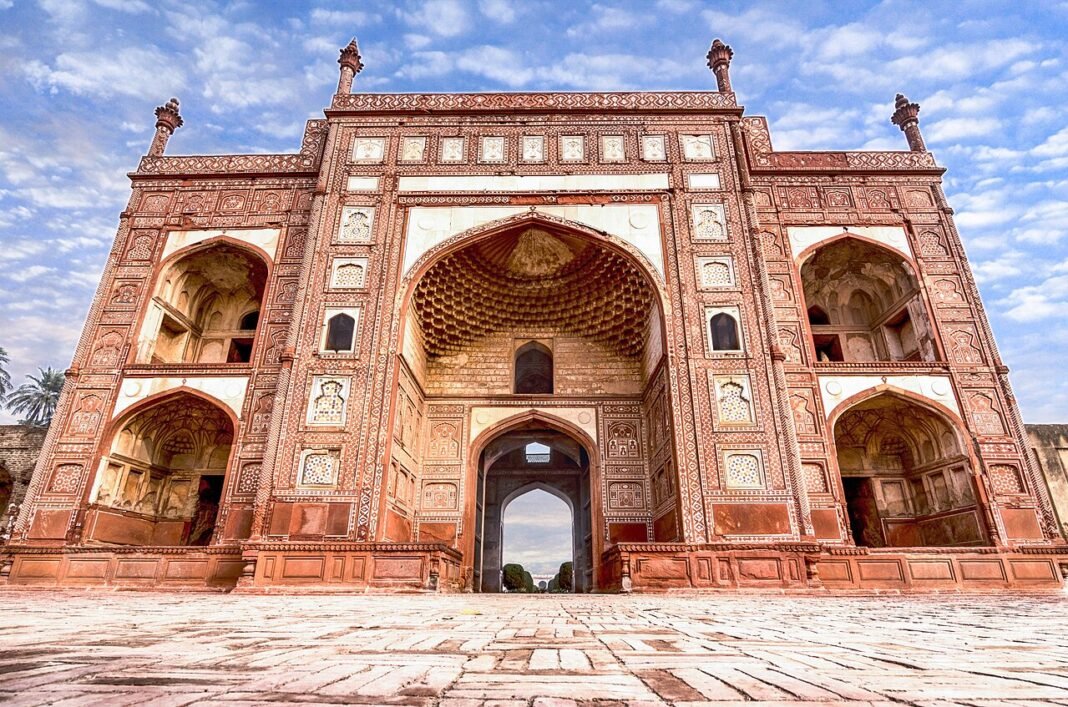
- Famous For: A 1637 Mughal caravanserai — the best-preserved sarai in Pakistan — whose monumental pietra-dura gateway serves as the portal to the Tomb of Jahangir.
- Nearest City: Lahore itself; the complex is a 20–40 minute drive from the city centre depending on traffic.
- Accessibility: Easy — paved roads, flat ground, suitable for all ages. Visitors typically enter the tomb complex through the sarai.
- Known Landmarks: The grand gateway with inlaid mosaic work, the courtyard ringed by 180 cells (hujras), a small mosque, and the neighbouring Tombs of Jahangir and Asif Khan.
- Best For: Mughal history and architecture lovers, photographers, families, and school or study trips.
Why Visit Akbari Sarai, Shahdara
Most visitors to Lahore know the Badshahi Mosque and the Lahore Fort — but across the Ravi, in the historic suburb of Shahdara, stands one of the Mughal era’s most evocative buildings: the Akbari Sarai. Built in 1637, this great caravan inn is the best-preserved sarai in Pakistan, and it is far more than a roadside rest house. Its monumental gateway, richly decorated with pietra dura — the inlaid stone mosaic the Mughals perfected — is the ceremonial entrance to the Tomb of Jahangir, one of the masterpieces of Mughal architecture.
Walking through that gateway is like stepping into the seventeenth century. The vast quadrangle opens before you, ringed by 180 small cells where travellers once slept and stored their goods. You can almost hear the caravans: merchants arriving after the gates of Lahore Fort had closed for the night, caretakers of the emperor’s tomb going about their duties, horses and camels stabled in the outer courts. Few places in Pakistan convey the logistics of the Mughal Empire — how it moved, fed and housed people across a subcontinent — as vividly as this courtyard.
The sarai is also the key to understanding the whole Shahdara ensemble. It sits on an east–west axis between the Tomb of Jahangir to its east and the Tomb of Asif Khan (built 1645) to its west, with the tomb of Nur Jahan nearby — a constellation of imperial Mughal monuments now on UNESCO’s tentative list for World Heritage status. Visiting the sarai first gives you the context that makes the tombs themselves far more meaningful.
And it is wonderfully accessible. Unlike remote forts or mountain sites, Akbari Sarai is inside Lahore, reachable in under an hour from anywhere in the city, with flat paths suitable for children and elderly visitors. Pair it with the tombs in a single morning, and you will have experienced one of the finest — and least crowded — Mughal sites in Pakistan.
History of Akbari Sarai, Shahdara
The name “Akbari Sarai” translates as “Palace of Akbar,” though the building dates from the reign of his grandson Shah Jahan. Completed in 1637, the sarai was built to serve travellers on the imperial highway — and, specifically, the caretakers and visitors of the newly finished Tomb of Jahangir next door. The Mughal court historian Abdul Hamid Lahori, writing in the Padshahnama, referred to the building as the “Jilu Khana-e-Rauza” — the “attached court of the tomb” — which captures its dual purpose exactly: part caravanserai, part forecourt to an imperial mausoleum.
The sarai’s story is inseparable from the emperor it serves. Jahangir — born Nur-ud-din Muhammad Salim, eldest son of Akbar — ruled the Mughal Empire from 1605 to 1627 and was famed as a patron of painting, science and architecture. He died on 28 October 1627 in the foothills of Kashmir near Rajauri, while returning from the valley. A funeral procession carried his body to Lahore, arriving on Friday, 12 November 1627, and he was buried in the Dilkusha Garden — a pleasure garden laid out in 1557 that had been a favourite retreat of Jahangir and his wife Nur Jahan. His son Shah Jahan ordered the construction of the magnificent mausoleum, completed in 1637, famous for interiors covered in frescoes and marble and exteriors richly decorated with pietra dura and marble intarsia of many colours.
The sarai was the practical engine of this memorial landscape. Its 180 hujras — small cells arranged around the great courtyard — provided lodging for travellers and storage for their luggage and merchandise. Contemporary accounts note that the doors of Lahore Fort were closed after sunset, so travellers arriving late spent the night in the sarai before entering the city. After the Mughal period, the building was put to various uses by Sikh and then British rulers, a common fate for Mughal sarais across Punjab.
Today the ensemble — Tomb of Jahangir, Akbari Sarai and Tomb of Asif Khan — is protected under Pakistan’s Federal Antiquities Act of 1975 and stands on UNESCO’s tentative list for World Heritage inscription. The tomb’s national importance was recognised long ago: it appeared on Pakistan’s 1,000-rupee note until 2005 and on a postage stamp issued in 1954. Conservation remains a challenge — severe floods damaged the complex in 1988 and 2010, and encroachments press against its boundaries — but the sarai itself survives as the finest example of its kind in the country.
Top Things to Do in Akbari Sarai, Shahdara
Pass Through the Pietra Dura Gateway
The sarai’s great gateway is its crown jewel: a monumental portal richly embellished with pietra dura, the Mughal art of inlaying semi-precious stone into marble to form floral and geometric patterns. This is the ceremonial entrance through which visitors proceed to the Tomb of Jahangir. Pause here — look up at the inlay work, notice how the patterns frame the arch, and photograph it in the morning light when the colours are at their richest.
Walk the Courtyard of 180 Cells
The vast quadrangle, ringed by 180 small hujra cells, is the heart of the sarai. The cells served as living quarters and storerooms for travellers; walking their arcaded perimeter gives you the scale of Mughal hospitality infrastructure. Imagine the courtyard filled with merchants, pilgrims, horses and cargo — a seventeenth-century transport hub rendered in brick and stone.
Visit the Sarai’s Small Mosque
Within the complex stands a small mosque that served the travellers and caretakers — a reminder that the sarai was a complete, self-sufficient institution with provision for daily prayer. It is a quiet, contemplative corner of the courtyard, worth a few minutes of your time.
Continue to the Tomb of Jahangir
Through the gateway lies the mausoleum itself: a single-storey square structure whose interiors are extensively embellished with Mughal frescoes and whose exterior glows with pietra dura and coloured marble intarsia. Climb to the roof for the classic view over the gardens and the Ravi. Allow at least an hour — the detail repays slow looking.
See the Tomb of Asif Khan
Immediately west of the sarai stands the octagonal tomb of Asif Khan (built 1645), Jahangir’s brother-in-law and the father of Mumtaz Mahal. Its bulbous dome and brick construction contrast interestingly with Jahangir’s marble-clad mausoleum, and it completes the Shahdara ensemble’s east–west axis.
Find the Tomb of Nur Jahan
A little southwest of Asif Khan’s tomb lies the resting place of Nur Jahan, Jahangir’s powerful and remarkable wife — the woman who effectively co-ruled the empire in his later years. It is the quietest of the Shahdara monuments and a poignant end to the visit.
Photograph Mughal Details
Shahdara is a paradise for detail photography: frescoed ceilings, inlaid marble, carved sandstone, ancient trees in the gardens, and the long axial vistas between the monuments. Early morning offers the softest light and the fewest crowds.
Famous Places In and Around Akbari Sarai, Shahdara
- Tomb of Jahangir — the 1637 imperial mausoleum, entered through the sarai’s gateway.
- Tomb of Asif Khan — the 1645 octagonal tomb immediately west of the sarai.
- Tomb of Nur Jahan — the empress’s resting place, southwest of Asif Khan’s tomb.
- Lahore Fort and Badshahi Mosque — across the Ravi, the city’s great Mughal pair (see our places to visit in Islamabad guide for another historic capital, or browse Explore Pakistan).
- Minar-e-Pakistan — in nearby Iqbal Park, the tower marking the 1940 Lahore Resolution.
- Shalimar Gardens — Shah Jahan’s famous terraced gardens, east of the old city.
- Ravi Riverfront — the river that has shaped Shahdara’s history, best seen at sunset.
How to Reach Akbari Sarai, Shahdara
Akbari Sarai is in Shahdara Bagh, across the River Ravi to the northwest of Lahore’s Walled City. From central Lahore (Mall Road, Gulberg, DHA), the drive takes 20 to 40 minutes depending on traffic — cross the Ravi via the Shahdara bridge and follow signs for the Tomb of Jahangir; the sarai is part of the same complex. Ride-hailing apps serve the area reliably, and parking is available at the complex.
From Islamabad: about 370 km via the M2 motorway — roughly 4 to 5 hours of comfortable driving. This makes Shahdara an easy day trip or weekend excursion from the capital.
From Multan: about 340 km (roughly 5 hours) via the M4/M2 corridor.
From Karachi: about 1,200 km by road — fly to Allama Iqbal International Airport, Lahore (under 2 hours), then drive 45–60 minutes to Shahdara.
Nearest airport: Allama Iqbal International Airport, Lahore, with domestic and international connections.
Tips: Visit on a weekday morning to avoid crowds; weekends and public holidays bring school groups and families. Combine the sarai and the two main tombs in one visit (2–3 hours total). The complex is mostly flat and accessible, though some tomb interiors have steps.
Route Details
- From central Lahore: Head northwest toward the Ravi — via the Ring Road or through the old city toward Shahdara.
- Cross the Ravi: Take the Shahdara bridge across the river into Shahdara town.
- To the complex: Follow signs for the Tomb of Jahangir (Maqbara-e-Jahangir). The Akbari Sarai forms the western entrance court of the tomb complex — you pass through it to reach the mausoleum.
- Parking and entry: Park at the complex entrance, buy your ticket, and enter through the sarai’s great gateway. Allow 2–3 hours for the sarai and both neighbouring tombs.
Where to Stay in Akbari Sarai, Shahdara
You do not need to stay in Shahdara itself — the sarai is a half-day excursion from anywhere in Lahore. The city offers the full spectrum: luxury five-star hotels in Gulberg and on the Mall, comfortable mid-range business hotels across Gulberg, DHA and Model Town, and budget guesthouses and lodges near the railway station and in the old city. For the most convenient base, choose Gulberg or the Cantonment area, both well connected to Shahdara by the Ring Road.
If you want to pair Shahdara with the old city’s monuments (Lahore Fort, Badshahi Mosque, Delhi Gate), consider a night in a heritage-style guesthouse in or near the Walled City — the atmosphere is unmatched, though the streets are busier. Book ahead during winter (Lahore’s peak tourist season) and around national holidays.
Where to Eat: Local Foods of Akbari Sarai, Shahdara
Lahore is Pakistan’s most famous food city, and a Shahdara trip deserves a Lahori meal. The classic repertoire — tandoori chicken and kebabs, mutton and chicken karahi, daal, fresh naan from clay ovens, and thick, creamy lassi — is available everywhere from humble dhabas to comfortable family restaurants. Lahoris take breakfast seriously: siri paye, halwa puri and nihari are weekend institutions.
For an atmospheric dinner after your Shahdara visit, head to the Fort Road Food Street near the Badshahi Mosque, where rooftop restaurants serve Lahori specialities with the illuminated fort and mosque as your backdrop. Around Shahdara itself, local eateries serve honest, inexpensive Punjabi food — karahi, daal fry, kebabs and chai — popular with the area’s residents. As always, eat where the food is fresh and the turnover is high, and drink bottled water.
Weather in Akbari Sarai, Shahdara
Lahore’s climate is classic Punjab plains: a short, mild winter; a long, fiercely hot summer; and a monsoon that soaks the city in July and August. For Shahdara’s open courtyards — which offer little shade — the season matters enormously. Winter mornings can be foggy (Lahore’s famous winter smog and fog can delay early starts), while May and June afternoons are genuinely punishing. The sweet spots are October–November and February–March, when the light is golden and the air is clear.
| Season | Temperature Range | Conditions |
|---|---|---|
| Winter (Dec–Feb) | 8–21°C | Mild, pleasant days; cold nights; morning fog possible. The best season for sightseeing. |
| Spring (Mar–Apr) | 16–34°C | Warming quickly; March excellent, April hot by afternoon. Good for visits. |
| Summer (May–Jun) | 26–39°C | Very hot; May–June highs near 39–40°C. Visit only in early morning. |
| Monsoon/Autumn (Jul–Nov) | 20–35°C | Heavy monsoon rain July–August (nearly 190 mm a month); September–November gradually ideal again. |
Language and Culture of Akbari Sarai, Shahdara
Punjabi is the mother tongue of Lahore, and you will hear it everywhere in Shahdara’s bazaars — but Urdu is universally understood, and English works in hotels, restaurants and with guides. A smile and a greeting in either language open every door.
The Shahdara complex is a heritage site rather than an active shrine, but respectful behaviour still applies: dress modestly, do not climb on the monuments, do not deface walls or carvings, and keep noise down inside the tomb chambers. The small mosque in the sarai is a place of worship — remove shoes and dress appropriately if you enter.
Lahoris are famously warm and proud of their city. Guides at the complex can enrich your visit enormously with stories — including the popular legend of Anarkali, the courtesan said to have been entombed alive by Akbar for loving Prince Salim (Jahangir) — though historians treat it as legend rather than documented fact. Accept offered tea, bargain cheerfully in the bazaars, and do not be surprised if strangers help you find your way.
Shopping in Akbari Sarai, Shahdara
Shahdara’s own bazaar serves local daily needs — a good place for snacks, drinks and simple supplies rather than souvenirs. For real shopping, head into Lahore proper: Anarkali Bazaar, one of South Asia’s oldest markets, sells everything from fabrics and traditional shoes to spices and handicrafts; Ichhra Bazaar is famous for affordable clothing and bridal wear; and Liberty Market in Gulberg offers a more modern mix.
Typical Lahori souvenirs include khussa (traditional embroidered shoes), phulkari embroidery, blue Multani pottery (sold in Lahore’s craft shops), and Punjabi sweets like patisa and barfi. There are no shopping malls at Shahdara itself — for malls, Lahore’s Gulberg and DHA districts have several large ones. Bargaining is expected in the traditional bazaars.
Travel Tips for Akbari Sarai, Shahdara
Packing Essentials
Sun protection is essential for the open courtyards: a hat, sunscreen and sunglasses for most of the year; a light jacket for winter mornings (December–January). Comfortable walking shoes, a water bottle, and a camera — the detail work here rewards photography. Carry small change for tickets and the bazaar.
Safety Tips
Shahdara is a busy urban area and the monument complex is well visited and managed. Standard city precautions apply: keep valuables discreet, use reputable transport, and stay hydrated in summer. Do not enter structurally cordoned areas of the old buildings. If visiting in winter fog season, allow extra travel time.
Money & Connectivity
ATMs and banks are plentiful across Lahore, and cards are widely accepted at hotels and larger restaurants — but carry cash for monument tickets, guides, bazaars and street food. All mobile networks have excellent coverage in Lahore with cheap 4G data.
Best Time to Visit Akbari Sarai, Shahdara
Winter (November–February): The Best Season
Mild days of 15–21°C, clear air and soft light make winter ideal for Shahdara’s courtyards and tombs. This is Lahore’s peak season — expect company at the monuments, but the atmosphere is at its best.
Spring (March): Excellent
March offers warm, pleasant weather before the summer heat arrives. Gardens around the tombs are green, and the light is superb for photography.
Summer (April–June): Hot
Temperatures climb past 35°C and toward 40°C. If you visit, go at opening time, stick to the shaded interiors at midday, and carry water. Many travellers skip Lahore sightseeing entirely in June.
Monsoon and Autumn (July–October): Mixed
July–August bring heavy rain that can disrupt plans; September is humid. By October, the weather turns delightful again — clear skies, warm days and cool evenings make it a second mini-peak season.
Final Thoughts
The Akbari Sarai is the rare monument that tells you how an empire worked, not just how it built. Behind the pietra-dura splendour of its gateway lies a profoundly human institution: a place where travellers slept, merchants stored their goods, and the caretakers of an emperor’s tomb went about their daily lives. That combination — imperial art and everyday life, side by side in a single courtyard — is what makes Shahdara special.
Come in winter, walk slowly through the 180 cells, pass beneath the great gateway into Jahangir’s garden of frescoes and inlaid marble, and end the day across the river with Lahori food under the lights of the old city. Few half-days in Pakistan pack in so much history. For more, explore our Hunza Valley travel guide and Malam Jabba travel guide.
FAQs
Where is Akbari Sarai located?
Akbari Sarai is in Shahdara Bagh, across the River Ravi to the northwest of Lahore’s Walled City, Punjab. It forms the entrance court to the Tomb of Jahangir.
When was Akbari Sarai built?
The sarai dates from 1637, built during Shah Jahan’s reign to house travellers and the caretakers of Jahangir’s tomb. Its name means “Palace of Akbar.”
What is the best time to visit Akbari Sarai?
November to February, when Lahore’s weather is mild (8–21°C). March and October are also excellent. Avoid the May–June heat and the July–August monsoon.
How do I reach Akbari Sarai from Islamabad?
Drive about 370 km via the M2 motorway (4–5 hours) to Lahore, then 20–40 minutes across the Ravi to Shahdara. From Karachi, fly to Lahore and drive to the complex.
Is Akbari Sarai a UNESCO World Heritage Site?
Not yet — but the ensemble of the Tomb of Jahangir, Akbari Sarai and the Tomb of Asif Khan is on UNESCO’s tentative list for World Heritage status.
Can families and elderly visitors manage the site?
Yes. The complex is mostly flat with paved paths, making it suitable for children and elderly visitors. The tomb interiors have some steps, but the sarai courtyard itself is fully accessible.
Where can I stay near Akbari Sarai?
Stay anywhere in Lahore — Gulberg, DHA, the Cantonment or Model Town are all 20–40 minutes away and offer hotels for every budget. Shahdara itself is a half-day excursion, not an overnight base.
What food should I try on a Shahdara trip?
Eat Lahori: karahi, kebabs, tandoori items, siri paye or nihari for breakfast, and thick lassi. The Fort Road Food Street near Badshahi Mosque is the classic dinner stop after a day of sightseeing.