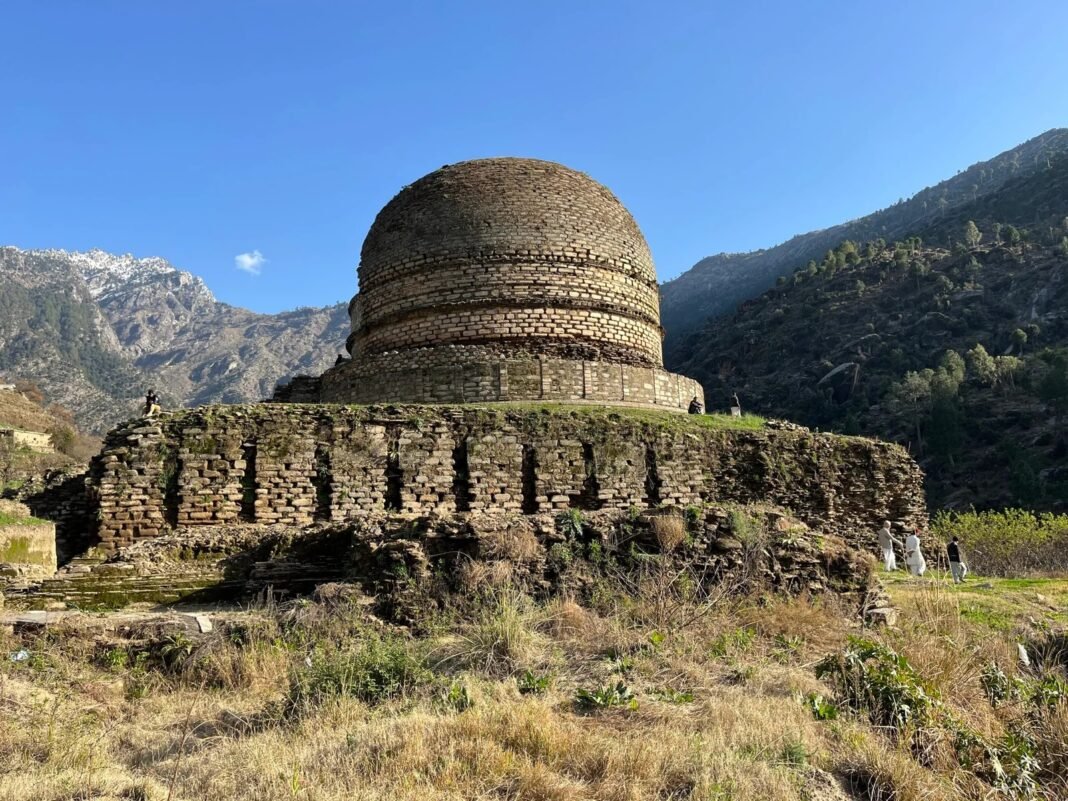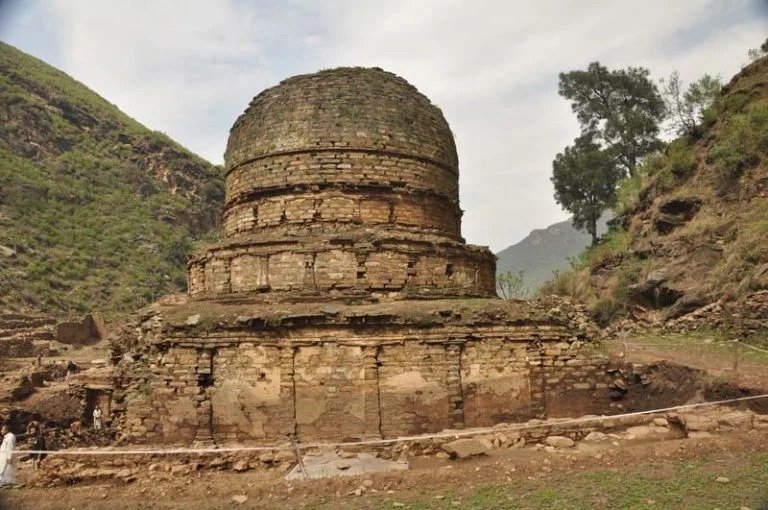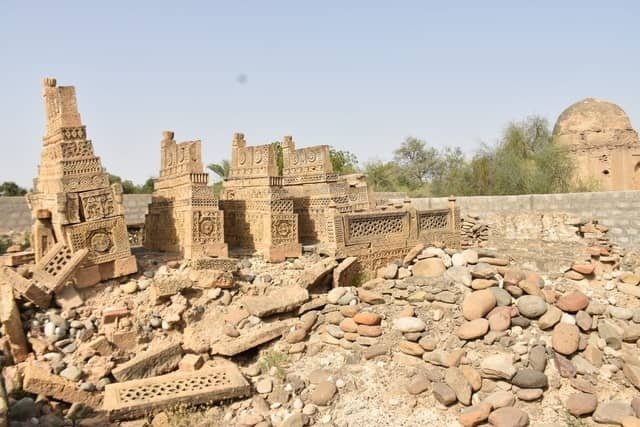
Six and a half kilometres north of Bela town, in the dry hills of Lasbela district, lies a walled enclosure the locals call Tharle, the large garden. Inside it, five groups of graves tell the story of the Koreja Jams, the dynasty that ruled Lasbela for more than two centuries: a burnt-brick tomb, Chaukhandi-style carved graves, a pillared sandstone canopy, lime-plastered graves, and the walled resting place of the Jams’ forefathers. The Ancestral Graveyard of Jam of Lasbela is one of the most evocative heritage sites in coastal Balochistan, and this travel guide covers its history, how to reach it, and how to visit respectfully.
Quick Facts
- Location: About 6.5 km north of Bela town, Lasbela District, Balochistan, Pakistan; locally known as Tharle (the large garden)
- Coordinates: Around 26.27 N, 66.31 E
- Altitude: Around 88 metres (Bela town stands at 289 feet above sea level)
- Famous For: The dynastic burial ground of the Koreja Jams; five distinct grave styles in one 4,000-square-metre enclosure; Chaukhandi-type carved sandstone tombs
- Nearest City: Bela town; Karachi is about 180 km to the southeast
- Accessibility: Motorable road from Karachi via the RCD Highway (N-25) to Bela, then an unmetalled but motorable track north to the graveyard
- Known Landmarks: The pillared buff-sandstone canopy, the burnt-brick tomb, the walled enclosure of the Jams’ forefathers, Bara Bagh Cemetery
- Best For: Heritage and archaeology enthusiasts, photographers of funerary architecture, travellers exploring Balochistan’s historic sites
Why Visit Ancestral Graveyard of Jam of Lasbela
Most travellers know Balochistan for its deserts and its coast, but the province holds some of Pakistan’s finest funerary architecture, and the Ancestral Graveyard of Jam of Lasbela is among its most interesting examples. This is not a single tomb but a whole grammar of burial styles in one enclosure: burnt brick, carved Chaukhandi sandstone, a pillared canopy, and lime plaster, side by side. For anyone interested in how the region’s tribes and dynasties honoured their dead, there is no better classroom.
The graveyard belongs to the Chaukhandi tradition, the carved sandstone funerary architecture that runs along the coast from Karachi into Balochistan, built between roughly the 15th and 18th centuries by the Jokhio, Jam, and Baloch tribes. What makes this site unusual is that it is a dynastic burial ground built in a regional tradition that is otherwise mostly tribal, which is why the different styles sit side by side here. The pillared canopy in buff sandstone is the finest thing in the enclosure and a beautiful example of the carver’s art.
The human story behind the stones is compelling. The Jams of Lasbela claimed descent from the Samma dynasty that ruled Sindh from 1351 to 1524, and their founder, Jam Aali Khathurio, seized Lasbela in 1742 and founded a line that ruled for over two centuries and produced nine rulers. Walking among the graves of Jam Ghulam Shah and his family, dated 1190 AH, you are walking through the history of a princely state that survived into living memory.
The site is also refreshingly uncrowded. Unlike the famous Chaukhandi graveyard near Karachi, the Tharle enclosure sees few visitors, so you can study the carvings and photograph the canopy in peace. Combined with Bela’s ancient history, Alexander the Great campaigned here as Rhambacia in 325 BCE, and Muhammad bin Qasim passed through as Armabil in 711 CE, the graveyard makes a rewarding day trip from Karachi for travellers who want history off the beaten path.
History of Ancestral Graveyard of Jam of Lasbela
The story of this graveyard is the story of the Jams of Lasbela. The Jams were the hereditary rulers of Lasbela, a princely state on the Balochistan coast, and they claimed their ancestry from the Samma of Sindh, who ruled over Sindh from 1351 to 1524. According to tradition, one of their ancestors, Jam Araddin, migrated from Sindh and settled in the Kanrach valley during the reign of the Mughal emperor Jahangir, who ruled from 1605 to 1627.
Legend holds that Jam Aali Korejo, popularly known as Khathurio, attacked Lasbela from his ancestral area of the Kanrach valley and seized it from Mai Chagli, the widow of Malik Pahar Khan Burfat, the cultural hero of the Burfats. Jam Aali laid the foundation of the Jam dynasty of Lasbela in 1742. The family went on to rule for over two centuries, producing nine rulers: Jam Aali Khathurio Korejo (1742 to 1760), Jam Ghulam Shah Korejo (1760 to 1776), Jam Mir Khan Korejo I (1776 to 1830), Jam Aali Khan II, Jam Mir Khan II, Jam Mir Khan III, Jam Kamal Khan, Jam Ghulam Muhammad Khan, and Jam Ghulam Qadir Khan.
The ancestral graveyard at Tharle is dated by the Federal Department of Archaeology and Museums to the 17th century CE, and the graves it holds are closely related to the Chaukhandi graveyards found elsewhere in Sindh and Balochistan, generally dated to the 17th and 18th centuries. The enclosure, spread over about 4,000 square metres, contains five distinct groups. First, an unknown tomb constructed with burnt bricks. Second, a group of four graves in the Chaukhandi manner. Third, a pillared canopy constructed in buff sandstone in the Chaukhandi type, a square canopy carried on eight columns, one at each corner and one in the centre of each side, sheltering the graves of Sakina Bai Azeeza Jam Bijar Jokhia, Bibi Jam Ghulam Shah, and Jam Ghulam Shah Jamot, all dated 1190 AH, which corresponds to the reign of Jam Ghulam Shah. Fourth, a group of two lime-plastered graves. Fifth, in a separate enclosed wall, the graves of the forefathers of the Jam of Lasbela, the ruling line set apart behind its own wall.
The wider necropolis of the Jams continues at Bara Bagh, about 8 km from Bela, which holds more than 100 tombs, of which 40 belong to the royal family of the Koreja Jams, including later rulers such as Ghulam Qadir Khan Korejo (1920 to 1988) and Jam Mohammad Yousaf Korejo (1954 to 2013). Bela itself is an ancient city: it was Rhambacia in the autumn of 325 BCE, when Alexander the Great left Hephaestion behind to build a city there, and Armabil in 711 CE, when it formed part of Muhammad bin Qasim’s campaign. The tombs at Tharle and Bara Bagh are therefore the latest chapter in a very old urban story.
Top Things to Do in Ancestral Graveyard of Jam of Lasbela
Study the Five Grave Groups
Walk the enclosure slowly and identify the five groups the archaeologists describe: the burnt-brick tomb, the four Chaukhandi-style graves, the pillared canopy, the two lime-plastered graves, and the walled enclosure of the forefathers. Seeing five burial styles in one place is the site’s great lesson, and it repays unhurried attention.
Examine the Pillared Canopy
The square canopy in buff sandstone is the masterpiece of the site. Study its eight columns, their bases decorated with floral designs, and imagine the dome that once crowned it, built by overlapping lintels and corner brackets to transform the square into the circular base of the dome before it collapsed long ago. The graves beneath it, dated 1190 AH, connect the architecture to the reign of Jam Ghulam Shah.
Read the Carved Details
The Chaukhandi tradition is famous for its carved sandstone, and the Tharle graves carry the same vocabulary of rosettes, diamonds, petalled flowers, and geometric bands found across the coastal necropolises. Bring a zoom lens and photograph the pillar bases and the canopy’s ornament, which show the carver’s skill at close range.
Visit the Walled Enclosure of the Forefathers
The separate walled enclosure holding the graves of the Jams’ forefathers is the dynastic heart of the site. The fact that the ruling line is set apart behind its own wall tells you how the Jams understood themselves: a dynasty within a tribal tradition, marking its rank even in death.
Combine with Bara Bagh Cemetery
About 8 km from Bela at Bara Bagh lies the larger necropolis of the Jams, with more than 100 tombs, 40 of them royal. Visiting Tharle and Bara Bagh together gives you the full arc of the dynasty, from the 17th and 18th century Chaukhandi-style graves to the tombs of the 20th-century rulers.
Famous Places In and Around Ancestral Graveyard of Jam of Lasbela
- Bara Bagh Cemetery: The larger necropolis of the Jams, 8 km from Bela, with over 100 tombs including 40 royal graves.
- Bela Town: The ancient city itself, once Rhambacia under Alexander and Armabil under Muhammad bin Qasim, ringed by hills.
- Tomb of Muhammad bin Harun: In Bela town, the tomb of the Arab governor of Makran, one of the earliest such tombs in the region.
- Hub Dam: On the road between Karachi and Bela, a popular picnic and birdwatching spot.
- Gadani: Toward Karachi, the famous ship-breaking yard, one of the largest in the world.
- Sonmiani Bay: A coastal stop on the route, known for its beach and fishing boats.
- Hingol National Park: Further west along the coastal highway, Balochistan’s great wilderness park with the Princess of Hope rock formation.
How to Reach Ancestral Graveyard of Jam of Lasbela
The graveyard is reached through Bela town, which lies on the RCD Highway (N-25), about 180 km northwest of Karachi and about 500 km south of Quetta. From Bela, the graveyard is about 6.5 km to the north, approached by an unmetalled but motorable road through hill torrents; note that the Hab river crossing on this route is unbridged, so check conditions after rain.
From Karachi: Drive northwest from Karachi on the RCD Highway (N-25) toward Bela. The distance is about 180 km and the drive takes roughly 3 to 4 hours depending on traffic and road conditions. From Bela town, take the track north about 6.5 km to the graveyard at Tharle. This is the natural and by far the easiest approach, and the site works well as a day trip from Karachi.
From Lahore: Fly from Lahore to Karachi and continue by road to Bela, which is the practical option. The overland drive from Lahore to Bela via the motorway network and Karachi is very long and best broken with an overnight stop.
From Islamabad: Fly from Islamabad to Karachi and drive to Bela. The full road journey from Islamabad to Lasbela is over 1,800 km and takes the better part of two days, so flying to Karachi is strongly recommended.
Nearest airport: Jinnah International Airport, Karachi, about 180 km from Bela by road.
Transport options: Your own car or a rented car with a driver is the best way to reach the graveyard, because the last 6.5 km is an unmetalled track. Buses and coaches run between Karachi and Bela and onward to Quetta along the RCD Highway, but from Bela town you will need a local taxi or jeep for the graveyard track. Hire locally in Bela and confirm the river crossing is passable before setting out.
Route Details
Leave Karachi early on the RCD Highway (N-25), heading northwest past Hub and Gadani toward Bela. The highway is the main Karachi to Quetta road and is generally in reasonable condition. On reaching Bela, ask locally for the track to Tharle, the ancestral graveyard, about 6.5 km north of town. The track is unmetalled but motorable; drive it slowly through the hill torrent beds and check the Hab river crossing, which has no bridge. Allow an hour to ninety minutes at the graveyard to see all five grave groups properly. Combine the visit with Bara Bagh Cemetery, 8 km from Bela in the other direction, and return to Karachi the same evening, or stay overnight in Bela’s basic guesthouses. Do not attempt the track after heavy rain, and carry drinking water, because there are no facilities at the site.
Where to Stay in Ancestral Graveyard of Jam of Lasbela
Bela is a small historic town, and accommodation here is basic. The town has simple guesthouses and budget hotels serving travellers on the Karachi to Quetta highway. Expect clean, simple rooms at very reasonable rates rather than comfort or amenities. For most visitors, Bela works as a day-trip base from Karachi rather than an overnight stop.
The practical plan for most travellers is to stay in Karachi, which has the full range of hotels from budget to luxury, and visit the graveyard as a day excursion. Karachi’s hotels along the routes out of the city make an early start easy. If you are touring Balochistan more widely, the towns along the RCD Highway have basic roadside hotels, but plan your overnights in the larger cities.
Camping at the graveyard is not recommended. The site is an archaeological monument in an exposed, arid landscape with no facilities, and the track’s river crossing makes it impractical. Stay in Bela or return to Karachi.
Where to Eat: Local Foods of Ancestral Graveyard of Jam of Lasbela
The food of Lasbela is Balochi food, shaped by the desert and the nearby coast. The signature dish is sajji, whole lamb roasted slowly over coals, served with rice and enjoyed across Balochistan. Kaak, the famous stone-baked bread of the region, is a staple, and dampukht, meat slow-cooked in its own fat, appears at festive meals. Along the coast toward Sonmiani and Gadani, fresh fish and seafood are excellent and cheap.
In Bela town, the highway dhabas and small hotels serve filling local food: karahi, daal, chana, fresh tandoori bread, and chai. A dhaba meal is very budget-friendly, and the highway restaurants between Karachi and Bela are used to feeding travellers at all hours. Dates from the region’s palms are sold in the bazaars and make the perfect road snack.
There are no food facilities at the graveyard itself, so eat in Bela before or after your visit and carry drinking water. If you are driving from Karachi, the highway dhabas between Hub and Bela are reliable stops for breakfast or lunch.
Weather in Ancestral Graveyard of Jam of Lasbela
Lasbela has a hot, arid climate typical of coastal Balochistan. Summers are intensely hot, with temperatures regularly crossing 40°C, while winters are mild and pleasant. Rain is scarce and falls mostly in the winter months or during the monsoon, and sudden downpours can make the hill torrent beds and the unbridged river crossing impassable, so the dry winter season is by far the best time to visit.
| Season | Temperature Range | Conditions |
|---|---|---|
| Winter (Nov-Mar) | 5 to 25°C | Mild and dry; the best season for visiting; clear skies and comfortable walking weather |
| Spring (Mar-May) | 20 to 35°C | Warming up; still visitable in the early morning; carry water and sun protection |
| Summer (Jun-Aug) | 30 to 42°C | Intensely hot; not recommended for the exposed graveyard site; monsoon showers can flood the track |
| Autumn (Sep-Oct) | 25 to 38°C | Cooling down but still hot; late October becomes comfortable again |
Language and Culture of Ancestral Graveyard of Jam of Lasbela
The people of Bela are predominantly Lasi, and the majority language is Sindhi in its Lasi dialect, with some Brahui speakers as well. Urdu is widely understood and works for travellers. The population is predominantly Muslim, with a small Sindhi Hindu community in Bela town.
The culture is a blend of Sindhi and Baloch traditions, shaped by centuries of coastal trade and tribal life. As a visitor to a graveyard, respect is the first rule: this is a burial place, so keep your voice low, do not sit or stand on graves, do not remove stones or fragments, and dress modestly. Ask before photographing any people you meet, and accept the hospitality that is offered; the people of Lasbela are known for their warmth to guests.
Shopping in Ancestral Graveyard of Jam of Lasbela
Bela’s small bazaar serves the town’s daily needs, and you can buy dates, local produce, and everyday goods there. The highway shops between Karachi and Bela sell the usual traveller supplies. For Balochi handicrafts, including embroidery and traditional textiles, the larger markets of Karachi offer a far wider choice on your way back.
There are no souvenir shops at the graveyard, and no shopping mall anywhere near the site. Buy drinking water and snacks in Bela before heading out to Tharle, and keep your expectations modest: this is a heritage excursion, not a shopping trip.
Travel Tips for Ancestral Graveyard of Jam of Lasbela
Packing Essentials
Sun protection is non-negotiable: a hat, sunglasses, sunscreen, and light, covering clothing. Carry more drinking water than you think you need, because there is no water at the site and the winter sun is still strong. Sturdy shoes handle the uneven ground of the enclosure, and a camera with a zoom lens is ideal for the carved details of the canopy and graves.
Safety Tips
The Karachi to Bela highway is a major road used by travellers daily, but check current travel advice for Balochistan before any trip and travel in daylight. Do not attempt the unmetalled track to the graveyard after rain, when the hill torrents and the unbridged river crossing become dangerous. Travel with a local driver from Bela who knows the track, and let someone know your plans.
Money & Connectivity
Carry cash in Pakistani rupees. Bela has limited banking, so withdraw in Karachi before the trip. Mobile signals from the major networks cover the highway and Bela town, but coverage is unreliable on the track to the graveyard. Download offline maps and save the location before you leave town.
Best Time to Visit Ancestral Graveyard of Jam of Lasbela
Winter (November to March)
Winter is the best and really the only comfortable season for this site. Daytime temperatures are mild, the air is dry and clear, and the track to the graveyard is at its most reliable. Plan your visit for these months.
Spring (March to May)
Early spring is still workable, with warming temperatures. Visit in the morning, carry water, and wear full sun protection. By late spring the heat is already building.
Summer (June to August)
Summer is not recommended. The exposed site offers no shade, temperatures cross 40°C, and monsoon rain can make the track impassable. If you must travel in summer, see Bela town’s sights early in the morning and skip the graveyard track.
Autumn (September to October)
Autumn cools gradually, and by late October the weather is pleasant again. It is a good shoulder season for travellers who cannot come in winter.
Final Thoughts
The Ancestral Graveyard of Jam of Lasbela is a quiet masterpiece of funerary art, and it deserves more visitors than it gets. In one walled enclosure you can read the whole vocabulary of the Chaukhandi tradition and the story of a dynasty that ruled this coast for two centuries. The pillared canopy alone, with its carved columns and its collapsed dome, is worth the drive from Karachi.
Visit in winter, combine it with Bara Bagh and Bela’s ancient streets, and treat the graves with the respect they are owed. For more heritage journeys across the country, browse our Explore Pakistan guides and our collection of places to visit around Islamabad for your next trip.
FAQs
Where is the Ancestral Graveyard of Jam of Lasbela located?
About 6.5 km north of Bela town in Lasbela District, Balochistan, at a place locally called Tharle, the large garden.
What is the best time to visit the Ancestral Graveyard of Jam of Lasbela?
November to March, when the weather is mild and dry and the unmetalled track to the site is most reliable.
How do I reach the Ancestral Graveyard of Jam of Lasbela?
Drive from Karachi to Bela on the RCD Highway (about 180 km, 3 to 4 hours), then take the unmetalled track 6.5 km north of Bela town to Tharle.
Is the Ancestral Graveyard of Jam of Lasbela safe to visit?
The Karachi-Bela highway is well travelled; check current travel advice for Balochistan, travel in daylight, hire a local driver for the track, and avoid it after rain.
Is the Ancestral Graveyard of Jam of Lasbela suitable for families?
Yes for older children interested in history, but the site is exposed with no facilities, so it suits families comfortable with a short off-road excursion better than very young children.
Where can I stay near the Ancestral Graveyard of Jam of Lasbela?
Bela town has basic guesthouses, but most visitors stay in Karachi and visit as a day trip.
What food is available near the Ancestral Graveyard of Jam of Lasbela?
Balochi food in Bela and on the highway: sajji, kaak bread, karahi, daal, fresh fish toward the coast, and local dates. Carry water for the site.
What is special about the graves at Tharle?
Five distinct burial styles stand in one 4,000-square-metre enclosure, including a carved buff-sandstone pillared canopy sheltering graves dated 1190 AH, and a separate walled enclosure for the forefathers of the Jam dynasty.