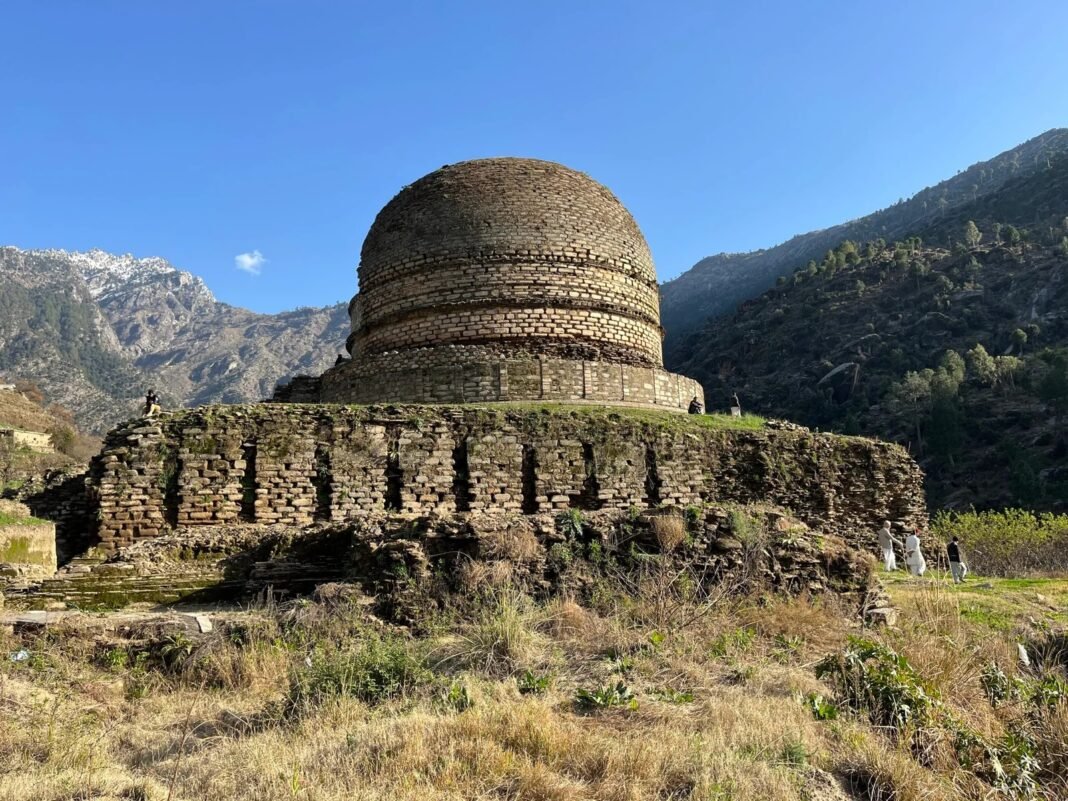
Two kilometres off the Barikot to Buner road, in a green valley sheltered by the sacred Mount Ilam, rises one of the finest Buddhist monuments in Pakistan. The Amluk Dara Stupa, founded in the 3rd century CE, is considered one of the best-preserved stupas of the Gandhara civilisation, and its great dome can be seen from the surrounding mountains. This Amluk Dara Stupa, Swat travel guide covers the monument’s remarkable history, how to reach it, and how to make the most of a visit.
Quick Facts
- Location: Amluk Dara village, about 2 km from the Barikot-Buner road, Swat District, Khyber Pakhtunkhwa, Pakistan
- Coordinates: In the lower Swat Valley, north of Nawagai village, with Mount Ilam as its backdrop
- Altitude: Around 800 to 900 metres in the valley floor setting
- Famous For: One of the best-preserved Gandhara stupas; a 21-metre-wide dome, possibly the largest stupa in the Swat Valley; a monastic complex excavated by the Italian Archaeological Mission
- Nearest City: Mingora and Saidu Sharif, the twin cities of Swat
- Accessibility: Motorable road to near the village, then a walk of roughly 1 km through the village to the site
- Known Landmarks: The main stupa and its sacred precinct, the excavated shrine and monastery complex, Mount Ilam
- Best For: History and archaeology lovers, Buddhist heritage pilgrims, photographers, and families combining heritage with Swat’s scenery
Why Visit Amluk Dara Stupa, Swat
Swat was once the heartland of Gandhara, one of the great Buddhist civilisations of the ancient world, and the Amluk Dara Stupa is its most striking surviving monument. While many of Swat’s Buddhist sites are reduced to foundations, this stupa still stands tall: a massive hemispherical dome on a square plinth, ringed by the remains of a whole sacred complex. It is the closest you can come in Pakistan to seeing a Gandhara stupa as its builders intended it.
The setting is half the experience. The stupa stands in the middle of a circular range of lush green mountains, sheltered by the historic Mount Ilam, which has been a sacred mountain for Hindus and Buddhists for centuries. A stream runs in front of the monument, and the sound of the water and the birds in the surrounding hills give the site a calm that visitors consistently remark on. It is a place that invites you to slow down.
The archaeology here is alive, not finished. The site was first brought to the world’s attention by the Hungarian-British explorer Sir Aurel Stein in 1926, studied by the Italian archaeologists Giuseppe Tucci and Domenico Faccenna, and in 2012 the Italian Archaeological Mission uncovered an entire complex around the stupa that had been hidden for centuries. Visiting now means seeing a site that researchers are still learning from.
Finally, the Amluk Dara Stupa is easy to reach. It lies in lower Swat, a short drive from Mingora and Saidu Sharif, and the walk from the village is gentle. It fits perfectly into a Swat itinerary alongside the Swat Museum, the Butkara stupas, and the valley’s natural attractions, making it an ideal stop for anyone exploring the region’s heritage.
History of Amluk Dara Stupa, Swat
The Amluk Dara Stupa belongs to the Gandhara civilisation, the Buddhist culture that flourished in the Peshawar Valley and Swat between roughly the 1st century BCE and the 10th century CE, reaching its artistic peak under the Kushan Empire. The main stupa and its sacred area were founded around the 3rd century CE, and the site remained in use until the 10th or 11th century, remarkably late: by the time it was finally abandoned, some 90 per cent of the other Buddhist sites in Swat had already been deserted.
The monument itself is a masterwork of Gandhara engineering. The foundation is a square plinth about 4 metres thick, surmounted by a hemispherical dome measuring 7 metres in height and 21 metres in diameter, probably the largest dome in the valley. The total height of the stupa from ground level to the existing top of the dome measures about 20 metres, and the podium on which it stands is some 34 metres wide. A flight of ascending steps on the north side, about 4.26 metres wide, connects the circumambulation path at ground level with the ambulatory passage on top of the plinth. On the eastern and northern sides, the ruins of a monastery, smaller stupas, and miscellaneous remains can still be seen.
The site’s modern history began in 1926, when Sir Aurel Stein visited Swat and reported the ruins, writing that the main stupa was possibly one of the best-preserved pieces of Buddhist architecture he had ever seen in Gandhara, built with remarkably careful masonry. The Italian scholar Giuseppe Tucci documented the stupa in 1956, and the archaeologist Domenico Faccenna carried out research at the site in the 1960s and 1970s. Coins recorded at the site run from the Kushans to the Turki Shahis, spanning the 2nd to the 7th centuries CE.
In 2012, the Italian Archaeological Mission in Pakistan, working with Khyber Pakhtunkhwa’s Directorate of Archaeology and Museums under the Archaeology Community Tourism project, excavated the complex attached to the stupa. The dig revealed the main stupa’s sacred precinct in full, along with a shrine and a pent-roofed shrine at the bottom of the main stupa’s stairway, adding greatly to the site’s importance for researchers and visitors alike. The stupa is also part of the sacred geography of Mount Ilam: the valley of Amluk Dara lies on the route followed by the Hindus of lower Swat on their annual visit to the sacred height of Mount Ilam, and the Chinese pilgrim Xuanzang is believed to have visited the site in the 7th century. Today the stupa is a protected archaeological site under the Khyber Pakhtunkhwa Directorate of Archaeology and Museums.
Top Things to Do in Amluk Dara Stupa, Swat
Walk Around the Great Stupa
The essential experience is the circumambulation of the main stupa. Follow the path around the great dome, studying the stone masonry that so impressed Aurel Stein, and look up at the drum divided by its bold cornice. The scale of the monument only becomes clear when you walk its full circuit: the 21-metre dome and the 34-metre podium make this possibly the largest stupa in the Swat Valley.
Explore the Excavated Sacred Complex
The 2012 excavations revealed the full sacred precinct around the stupa, including shrines and the pent-roofed shrine at the foot of the main stairway. Walk through the complex and look for the remains of the monastery on the eastern and northern sides. Information from the excavations helps you read the ground plan: this was not a lone monument but the centre of a living religious community that lasted eight centuries.
Climb to the Ambulatory Passage
The wide northern stairway leads up to the ambulatory passage on top of the plinth, the elevated walkway where pilgrims once circled the dome. From this height the whole valley opens up, with Mount Ilam rising behind the site. It is the best viewpoint at the monument and the best spot for photographs of the dome against the mountains.
Photograph the Stupa at Golden Hour
The stupa is famously visible from the surrounding mountains, and it photographs best in the soft light of morning or late afternoon, when the stonework glows and the dome throws long shadows. The backdrop of Mount Ilam and the green valley gives you compositions that need no filter. Bring a wide lens for the full monument and a zoom for the masonry details.
Combine with Swat’s Buddhist Circuit
The Amluk Dara Stupa is one stop on Swat’s remarkable Buddhist circuit. Combine it with the Butkara stupas near Saidu Sharif, the Swat Museum’s Gandhara sculpture collection, and the Shingardar Stupa to build a full day of Gandhara heritage. The contrast between the sites, from museum masterpieces to this great standing dome, tells the complete story of Buddhism in the valley.
Famous Places In and Around Amluk Dara Stupa, Swat
- Butkara Stupas: The great Buddhist complex near Saidu Sharif, excavated by the Italian mission, with stupas spanning centuries.
- Swat Museum, Saidu Sharif: The essential museum of Gandhara art in the valley, with sculptures from the region’s excavations.
- Shingardar Stupa: Another fine Gandhara stupa in lower Swat, often visited on the same circuit.
- Mount Ilam: The sacred mountain sheltering the site, a pilgrimage destination with panoramic views.
- Barikot (ancient Bazira): The historic town near the stupa, besieged by Alexander the Great in 327 BCE.
- White Palace, Marghazar: The marble summer palace of the Wali of Swat, set in beautiful gardens.
- Mingora Bazaar: Swat’s main market town, good for food, shopping, and an evening stroll.
- Malam Jabba: Swat’s ski resort and mountain destination, for travellers extending their trip into the upper valley.
How to Reach Amluk Dara Stupa, Swat
The stupa is in lower Swat, about 2 km off the Barikot to Buner road and roughly 2 km north of Nawagai village. The usual gateway is Mingora and Saidu Sharif, the twin cities of Swat, which are well connected to Islamabad and Peshawar by the Swat Motorway (M-16).
From Islamabad: Take the M1 motorway and then the Swat Motorway (M-16), exiting at Chakdara, and drive on to Mingora and Saidu Sharif. The distance from Islamabad to Saidu Sharif is roughly 250 km, taking about 4 to 5 hours by car. From Mingora, drive to Barikot and then take the Barikot-Buner road about 2 km to the turnoff for Amluk Dara village. Walk about 1 km through the village to reach the stupa.
From Lahore: Drive from Lahore to Islamabad via the M2 (about 4 hours), then follow the Islamabad route above. The total journey is a full day of driving, so many travellers break it in Islamabad. Alternatively, fly from Lahore to Islamabad and continue by road.
From Karachi: Fly from Karachi to Islamabad and continue by road to Swat, which is the practical option. The overland journey from Karachi to Swat is extremely long and not recommended for a short trip.
Nearest airport: Saidu Sharif Airport has limited PIA flights from Islamabad, operating a couple of times a week, but schedules are unreliable, so most visitors use Islamabad International Airport and drive.
Transport options: Your own car or a rented car with a driver is the most flexible way to tour Swat’s heritage sites. Comfortable bus services, including Daewoo Express and Faisal Movers, run from Islamabad to Mingora in about 6 to 7 hours. From Mingora, hire a local taxi or Suzuki for the Barikot and Amluk Dara excursion. The final walk from the village to the stupa is easy and suitable for most visitors, but it is most comfortable in dry weather outside the monsoon.
Route Details
Start early from Islamabad and take the M1 to the Swat Motorway interchange, following the M-16 to the Chakdara exit. There is a rest area on the motorway at Katlang. From Chakdara, follow the N95 through to Mingora and Saidu Sharif, crossing the Swat River. If you have time, stop at the Swat Museum in Saidu Sharif first for context on Gandhara art. Then drive to Barikot, about 25 km from Mingora, and turn onto the Barikot-Buner road. About 2 km along this road, look for the turnoff to Amluk Dara village. Park at the village, walk roughly 1 km through the lanes to the site, and allow at least an hour at the stupa and its excavated complex. Return to Mingora or Saidu Sharif for the night. The path is easiest in dry weather, so avoid the walk just after heavy rain.
Where to Stay in Amluk Dara Stupa, Swat
The natural base for the Amluk Dara Stupa is Mingora and Saidu Sharif, which have the widest range of accommodation in Swat. Mid-range hotels cluster around both cities, offering comfortable rooms with restaurants, and many cater specifically to the steady flow of tourists. For a heritage-focused trip, staying in Saidu Sharif puts you close to the Swat Museum and the Butkara stupas as well as the road to Barikot.
Budget travellers will find plenty of guesthouses and economy hotels in Mingora’s bazaar area at very reasonable rates. These are simple but adequate, and the bazaar location means food and transport are always at hand. For more comfort, the better hotels of Saidu Sharif offer a higher standard with gardens and reliable services.
Camping near the stupa itself is not established, and the site is a protected monument, so plan to sleep in the cities. If you are extending your trip into upper Swat, Kalam, Bahrain, and Malam Jabba have their own hotel scenes, from riverside guesthouses to resort hotels, and the drive from Mingora to Kalam takes about 4 hours.
Where to Eat: Local Foods of Amluk Dara Stupa, Swat
Swat’s food is Pashtun food, hearty and generous. In Mingora and Saidu Sharif you will find chapli kebabs, lamb karahi, and chicken dishes at every level from street stalls to hotel restaurants. The valley’s rivers supply fresh trout, served fried or grilled in the restaurants of Mingora and the upper valley, and it is the dish most visitors remember. Rice dishes, daal, and fresh tandoori bread round out the menus.
Do not miss the qahwa, the green tea of the region, served everywhere and offered as a matter of course to guests. Swat’s orchards produce excellent fruit in season: peaches, plums, apricots, and persimmons appear in the bazaars and on hotel tables. A meal at a Mingora dhaba is very budget-friendly, while a dinner at a better hotel restaurant costs more but remains modest. Near the stupa itself there are only village shops, so carry water and snacks for the visit, and plan your main meals in Barikot, Mingora, or Saidu Sharif.
Weather in Amluk Dara Stupa, Swat
Lower Swat has a temperate climate with cold winters and mild summers. The stupa site sits in a sheltered valley, so it avoids the harshest mountain weather, but winter mornings can be frosty and summer afternoons warm. The path from the village is easiest in dry weather, which makes the shoulder seasons of spring and autumn the most comfortable for the walk and the photography.
| Season | Temperature Range | Conditions |
|---|---|---|
| Winter (Dec-Feb) | -2 to 15°C | Cold mornings, occasional frost; clear, crisp air; upper Swat gets heavy snow but lower Swat stays accessible |
| Spring (Mar-May) | 10 to 25°C | Pleasant and green; blossom in the orchards; one of the best seasons for visiting the stupa |
| Summer (Jun-Aug) | 15 to 30°C | Mild and pleasant compared to the plains; monsoon rain possible; the valley at its greenest |
| Autumn (Sep-Nov) | 8 to 25°C | Clear skies, harvest colours, excellent visibility; the other best season for the visit |
Language and Culture of Amluk Dara Stupa, Swat
The language of Swat is Pashto, spoken in the distinctive Swati Yusufzai dialect, and it is the mother tongue of the valley. Urdu is widely understood and works for all practical travel needs, while English is spoken in the hotels. A few words of Pashto, even just a greeting, are warmly received.
Swat’s culture is Pashtun culture, shaped by the code of hospitality for which the region is famous. Guests are honoured, and travellers are routinely offered tea and help. Dress modestly, particularly when visiting villages and religious sites, and ask permission before photographing people. At the stupa itself, remember that this is both an archaeological monument and a sacred Buddhist site: do not climb on the masonry, do not remove stones, and keep the precinct clean. The site’s long survival, eight centuries of continuous use, deserves that respect.
Shopping in Amluk Dara Stupa, Swat
Mingora’s bazaar is the shopping centre for the whole valley and the place to buy Swati handicrafts. Look for the valley’s famous embroidery, woollen shawls and blankets, and traditional caps. Swat is also known for its honey and its dried fruits, and the bazaar’s spice and dry-fruit shops are worth browsing. Fresh and dried fruit from the valley’s orchards makes the best souvenir.
There are no shops at the stupa site itself, so do your buying in Barikot or Mingora. There is no shopping mall in the immediate area of the monument; the charm here is in the traditional bazaars. Bargain politely, and remember that buying directly from local producers supports the valley’s economy.
Travel Tips for Amluk Dara Stupa, Swat
Packing Essentials
Wear comfortable walking shoes for the village path and the uneven ground of the archaeological site. Bring sun protection, a hat, and water, because there is no shade or shops at the monument. A light jacket is useful in spring and autumn, and warm layers are needed in winter. A camera is essential, and binoculars will help you appreciate the stupa’s famous long-distance visibility from the surrounding hills.
Safety Tips
Swat is a well-established tourist destination and the lower valley, including Barikot and the stupa area, is regularly visited by domestic and foreign tourists. The walk from the village is safe and easy, but stick to the path, wear proper footwear on the uneven archaeological ground, and avoid the site in heavy rain when paths turn slippery. As everywhere in the mountains, let your hotel know your day’s plans.
Money & Connectivity
Carry cash. Mingora and Saidu Sharif have ATMs and banks, but the villages around the stupa work on cash only. Mobile signals from the major networks cover Mingora, Saidu Sharif, and the main roads, including the Barikot area, though data speeds vary. Download offline maps before leaving the city.
Best Time to Visit Amluk Dara Stupa, Swat
Spring (April to May)
Spring is one of the two best seasons for the Amluk Dara Stupa. The valley is green, the orchards are in blossom, temperatures are ideal for the village walk, and the light is perfect for photography. Local guides recommend April and May especially.
Summer (June to August)
Summer in lower Swat is mild compared to the plains, and the stupa makes an easy excursion from a Mingora base. Mornings are the best time for the visit; carry water and sun protection. Monsoon showers can make the village path muddy, so check the sky before you set out.
Autumn (Late September to November)
Autumn is the other peak season, with clear skies, harvest colours in the valley, and superb visibility for the stupa’s mountain backdrop. Late September to November is the classic window for heritage touring in Swat.
Winter (December to February)
Winter visits are possible in lower Swat, which stays accessible while the upper valley snows. Mornings are cold and the light is crisp; dress warmly and plan the walk for midday. The site is quiet, and you may have the great dome entirely to yourself.
Final Thoughts
The Amluk Dara Stupa is the kind of monument that changes how you see a place. Before the visit, Swat is rivers and mountains; after it, Swat is also Gandhara, the Buddhist civilisation that made this valley a centre of art and faith for a thousand years. The great dome, the excavated shrines, and the sacred mountain behind them are a complete world, still standing after seventeen centuries.
Give the stupa a full morning, combine it with the Swat Museum and Butkara, and you will leave the valley with a far deeper understanding of it. For more northern heritage and mountain guides, explore our Explore Pakistan section, and for Swat’s mountain resort side, read our Malam Jabba travel guide.
FAQs
Where is the Amluk Dara Stupa located?
The stupa is at Amluk Dara village, about 2 km from the Barikot-Buner road in Swat District, Khyber Pakhtunkhwa, with Mount Ilam as its backdrop.
What is the best time to visit the Amluk Dara Stupa?
April to May and late September to November are the best windows, with pleasant weather, dry walking paths, and clear mountain views.
How do I reach the Amluk Dara Stupa?
Drive from Islamabad to Mingora/Saidu Sharif via the Swat Motorway (about 4 to 5 hours), continue to Barikot, take the Barikot-Buner road 2 km, then walk about 1 km through the village to the site.
Is the Amluk Dara Stupa safe to visit?
Yes. Lower Swat is a well-established tourist area visited regularly by domestic and foreign tourists. The village walk is easy and the site is a protected monument.
Is the Amluk Dara Stupa suitable for families?
Yes. The walk from the village is gentle and the site is open ground, making it suitable for children and elderly visitors who can manage a short walk.
Where can I stay near the Amluk Dara Stupa?
Stay in Mingora or Saidu Sharif, which have the widest choice of hotels and guesthouses in Swat, from budget to comfortable mid-range.
What food is available near the Amluk Dara Stupa?
Pashtun food in Mingora and Saidu Sharif: chapli kebabs, lamb karahi, fresh river trout, and qahwa green tea, plus seasonal orchard fruit. Carry snacks for the site itself.
What makes the Amluk Dara Stupa special?
It is one of the best-preserved Gandhara stupas, founded in the 3rd century CE and in use until the 10th or 11th century. Its 21-metre dome is possibly the largest in Swat, and the 2012 excavations revealed a complete sacred complex around it.