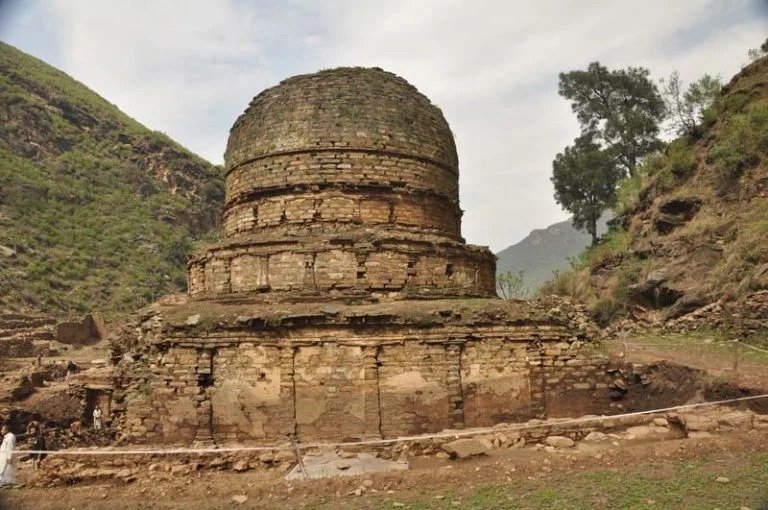
If you are putting together a list of places to see in northern Pakistan, the Andan Dheri Stupa in Lower Dir deserves a spot on it. This is one of the quieter Buddhist archaeological sites of the old Gandhara region — a grassy mound complex with a large ancient stupa and fourteen smaller ones, sitting in the village of Uch near Chakdara in Khyber Pakhtunkhwa. Unlike the famous sites at Taxila or Takht-i-Bahi, Andan Dheri sees very few tourists, which means you can walk around the ruins in near silence and imagine the monks who lived here more than a thousand years ago.
This Andan Dheri Stupa travel guide covers everything a visitor needs: the real history of the site, how to reach it from Islamabad, Lahore and Karachi, the best time to visit Lower Dir, where to stay, what to eat, and which nearby attractions you can combine with the trip. If you are interested in Buddhist heritage travel in Pakistan, start your planning with our Explore Pakistan section, and if mountain resorts are more your style, see our Malam Jabba guide for a very different side of the same province.
Quick Facts
- Location: Village of Uch (Ouch), near Chakdara, Lower Dir district, Khyber Pakhtunkhwa, Pakistan
- Altitude: Low valley floor of the Dir region (exact elevation not officially recorded)
- Famous For: Gandharan Buddhist stupa complex — one large main stupa with a square base plus fourteen smaller stupas
- Nearest City: Chakdara (about 7 km from the Chakdara bridge); Timergara, the district headquarters of Lower Dir, is a short drive further north
- Accessibility: Paved road from Chakdara on the N-45; easily reached by car in any season
- Known Landmarks: Andan Dheri Stupa, Chakdara Fort, the archaeological riches of the Swat valley nearby
- Best For: History lovers, Buddhist heritage travellers, photographers, families on a day trip from Swat or Dir
Why Visit Andan Dheri Stupa, Lower Dir
Pakistan’s north is famous for its mountains, but it was also one of the great centres of Buddhist learning in the ancient world. The Gandhara region, which covers today’s Peshawar valley, Swat, Dir and Taxila, once held hundreds of monasteries, and Andan Dheri is one of the surviving witnesses. Standing in front of the main stupa — five metres high and twelve metres across, built on a square base — you are looking at a monument that was already ancient when the great Mughal emperors were born.
What makes Andan Dheri special is its setting. The name itself means “round hill” in the local speech, and the complex stands on open ground in the Uch valley rather than on a fortified hilltop. Travel writers who have visited describe it as a rare example of a Buddhist site built on a plain, which makes it easy to walk around and photograph. Because the site is not on the main tourist circuit, you will rarely share it with more than a handful of other visitors, and the surrounding fields and poplar trees give the whole place a calm, rural atmosphere.
Andan Dheri also works perfectly as part of a longer heritage route. It lies only about 47 kilometres from the Swat Museum in Saidu Sharif, so you can easily combine it with Mingora, the Butkara stupa remains and the rock carvings of Swat in a single two- or three-day trip. For travellers who want to see the Buddhist side of Pakistan beyond the crowded sites, this quiet stupa in Lower Dir is one of the most rewarding stops.
History of Andan Dheri Stupa, Lower Dir
The history of Andan Dheri belongs to the larger story of Gandhara, the ancient Buddhist civilisation that flourished in what is now northern Pakistan and eastern Afghanistan from roughly the 6th century BCE to the 11th century CE. The Swat and Dir valleys were at the heart of this world. Under the Kushan emperor Kanishka in the 2nd century CE, Buddhism reached its greatest influence in the region, and monasteries multiplied across the valleys. Chinese pilgrims who travelled here centuries later — Fa-Hsien in the 5th century and Hiuen Tsang in the 7th — wrote of Swat as a land thick with monasteries and stupas.
The stupa complex at Andan Dheri dates to this Buddhist period. Its architecture — a large stupa on a square base surrounded by fourteen smaller stupas — follows the classic Gandharan pattern. After Buddhism faded from the region, first with the coming of the Hindu Shahi rulers in the 9th and 10th centuries and then with the Ghaznavid conquests in the early 11th century, the monasteries were abandoned. The Yousafzai Pashtun tribes later settled the Dir valleys, and the region became the princely state of Dir, ruled by the Nawabs of Dir until it merged into Pakistan in 1969.
Modern archaeology reached Andan Dheri in 1966, when the Department of Archaeology and Museums of Pakistan excavated the site. A team led by Dr. Ahmad Hasan Dani of Peshawar University uncovered 534 artefacts, including statues of the Buddha and Bodhisattvas, twelve Kushan and Sasanian coins, ancient jars, earthenware pots and iron tools. These finds confirmed the site’s importance and are now part of the Gandharan collections studied by scholars. The excavation reports describe the main stupa, five metres high and twelve metres in diameter, with its square base, and the fourteen smaller stupas that surrounded it, along with the remains of the monks’ living quarters — much of which has since been lost to surrounding farmland.
Today Andan Dheri is a protected archaeological site, though like many heritage sites in the region it could benefit from more attention. Visitors should treat the ruins with respect: do not climb on the stupa, do not remove stones, and take all litter away with you.
Top Things to Do in Andan Dheri Stupa, Lower Dir
Walk around the main stupa
The centrepiece of the site is the large stupa on its square plinth. Walk slowly around it, as pilgrims once did, and look at the stonework up close. The stupa is about five metres high, and from the top of the mound you get a wide view over the Uch valley’s fields. Early morning or late afternoon light is best for photography, when the low sun brings out the texture of the ancient masonry.
Count the fourteen smaller stupas
Scattered around the main monument are the bases of fourteen smaller stupas, also built on square platforms. These were probably memorial or votive stupas raised by monks and donors over the centuries. Finding all of them is a pleasant way to explore the whole complex, and it gives you a sense of how busy this monastery once was.
Visit the site museum context at Swat Museum
Many of the finest Gandharan sculptures found in this region are displayed at the Swat Museum in Saidu Sharif, about 47 kilometres from Andan Dheri. Pairing your visit to the bare ruins with an hour in the museum is the best way to understand what you have seen — the museum’s Buddha and Bodhisattva statues show the art that once decorated stupas exactly like this one.
Photography and quiet reflection
Andan Dheri is one of the most peaceful heritage sites in Khyber Pakhtunkhwa. Bring a camera, a notebook, or simply sit for a while. The combination of ancient ruins, poplar trees and the mountains of Dir on the horizon makes it a favourite with photographers who want something beyond the usual mountain shots.
Famous Places In and Around Andan Dheri Stupa, Lower Dir
- Chakdara Fort — historic fort on the Swat river, about 7 km from the site
- Swat Museum, Saidu Sharif — the region’s best Gandharan art collection, around 47 km away
- Butkara Stupa remains — another great Buddhist site near Mingora
- Timergara — district headquarters of Lower Dir, with bazaars and the archaeological site of Balambat
- Malam Jabba — ski resort and mountain views, a longer but rewarding day trip (see our Malam Jabba guide)
How to Reach Andan Dheri Stupa, Lower Dir
Andan Dheri is one of the easiest archaeological sites in the north to reach. It sits in the village of Uch, roughly 7 kilometres from the Chakdara bridge on the Nowshera–Chitral road (N-45). Chakdara itself is the gateway town where the Swat valley road meets the Dir road.
From Islamabad: Take the M-1 motorway towards Peshawar, then the Swat Expressway to Chakdara — a drive of around 150–170 km, roughly 3 to 3.5 hours depending on traffic. From Chakdara, cross towards the Uch valley; the site is a short drive on local roads. A private car or hired taxi is the most convenient option, and the route is paved all the way.
From Lahore: Drive via the M-1 and Swat Expressway, around 450–470 km, roughly 7 to 8 hours. Most travellers break the journey in Islamabad or continue straight to Swat, visiting Andan Dheri as a stop on the way to or from Mingora.
From Karachi: Fly to Islamabad (about 2 hours) and continue by road as above. There is no airport near Lower Dir; the nearest practical air link is Islamabad International Airport. Travelling the whole way by road from Karachi is possible but takes two long days.
Nearest airport: Islamabad International Airport, roughly 3.5 to 4 hours’ drive from the site. Road conditions: The motorway and Swat Expressway are in excellent condition year-round. The final approach roads in the Uch valley are paved but narrow in places — drive carefully and ask locals for the exact turn to the stupa. Transport options: Private car is best; alternatively, take a public bus or coaster to Chakdara or Timergara and hire a local taxi or rickshaw for the last stretch.
Route Details
- Islamabad → M-1 Motorway → Swat Expressway → Chakdara interchange.
- Chakdara → cross the Chakdara bridge area towards the Uch (Ouch) valley — about 7 km.
- Ask in Uch village for “Andan Dheri” — locals know the mound well; the stupa complex is on open ground just outside the village.
- Combine with: Chakdara Fort (on the way), then continue to Timergara or turn towards Swat and Mingora.
Where to Stay in Andan Dheri Stupa, Lower Dir
There is no lodging at the archaeological site itself — Andan Dheri is a day-visit destination. The practical bases are Chakdara, Timergara and Mingora/Saidu Sharif, each offering a different range of options.
Mid-range hotels: Cluster in Timergara and Mingora, with clean rooms, attached baths and on-site restaurants serving Pakistani and Chinese dishes. These are the most comfortable choice for families and usually cost a moderate nightly rate typical of small KP cities.
Budget guesthouses: Small hotels and guesthouses line the main roads of Chakdara and Timergara. They are simple but serviceable, and the owners can usually arrange a taxi to the site. Expect basic rooms at budget-friendly rates.
Camping: Not recommended at the stupa itself, which is a protected archaeological site. If you want to camp, do it at an established campsite in Swat rather than at the ruins.
If you are travelling the Buddhist heritage circuit, consider staying in Mingora or Saidu Sharif, which has the widest choice of hotels in the region and puts the Swat Museum, Butkara and Andan Dheri all within easy reach.
Where to Eat: Local Foods of Andan Dheri Stupa, Lower Dir
The food around Chakdara and Lower Dir is classic Pashtun cuisine — hearty, meat-based and served with plenty of green tea. Chapli kebab, the famous flat minced-meat kebab of Khyber Pakhtunkhwa, is available at roadside hotels and is the one dish every visitor should try. Kabuli pulao and chicken karahi are standard at the main bazaar restaurants, along with fresh tandoori naan.
For breakfast, try halwa puri or a simple anda paratha at a local dhaba, followed by doodh patti (milky tea) or qehwa (green tea), which is the traditional drink of the region. In the villages you may be offered makai ki roti (cornflat bread) with sarson ka saag in winter — accept it; village hospitality in Dir is generous and genuine.
Meals at local hotels are budget-friendly by city standards. A filling lunch or dinner at a bazaar restaurant typically costs far less than the same meal in Islamabad or Lahore. Carry some snacks and water for the site visit itself, as there are no food stalls at the stupa.
Weather in Andan Dheri Stupa, Lower Dir
Lower Dir sits at a relatively low altitude for the north, so its climate is closer to the Peshawar valley than to the high mountains. Summers are hot, winters are cool with occasional frost, and the spring months are the most pleasant. The site is open ground with no shade, so plan your visit for the cooler hours of the day in summer.
| Season | Temperature Range | Conditions |
|---|---|---|
| Winter (Dec–Feb) | Around 4–14°C | Cool, dry days; cold nights with occasional frost; clear skies |
| Spring (Mar–May) | Around 18–30°C | The best season — green fields, mild weather, ideal for sightseeing |
| Summer (Jun–Aug) | Around 30–40°C | Hot; visit early morning or late afternoon; monsoon showers possible |
| Autumn (Sep–Nov) | Around 18–32°C | Pleasant and dry; harvest season in the surrounding fields |
Language and Culture of Andan Dheri Stupa, Lower Dir
The people of Lower Dir are Yousafzai Pashtuns, and Pashto is the language of daily life. Urdu is widely understood in the towns and bazaars, and younger people and shopkeepers can usually manage basic English. A greeting of “Assalam-o-Alaikum” and a smile will open every door.
Dir is a conservative, traditional area, and visitors should dress modestly — long trousers or shalwar kameez for men, and covered arms and legs with a headscarf for women, especially in villages. Always ask before photographing people. Hospitality is a point of honour here: if a local family invites you for tea, it is polite to accept. Friday is the weekly holiday, so some shops in the bazaars open late.
Shopping in Andan Dheri Stupa, Lower Dir
There are no souvenir shops at the stupa itself, so do your shopping in Timergara bazaar or Mingora. The region is known for Swati embroidery and woollen shawls, and the bazaars sell practical souvenirs like traditional Peshawari chappals, pakol caps and dry fruits. Honey from the Dir valleys is a popular local purchase. There are no shopping malls in the immediate area — the experience here is the traditional bazaar, with its tea shops and cloth merchants.
Travel Tips for Andan Dheri Stupa, Lower Dir
Packing Essentials
Sun protection (hat, sunscreen, sunglasses) is essential — the site has no shade. Carry drinking water, comfortable walking shoes for uneven ground, and a camera. In winter, bring a warm jacket for the chilly mornings and evenings.
Safety Tips
The Chakdara–Timergara corridor is a settled, populated area and the site visit is straightforward. Keep to daylight hours, stay on the paths around the ruins, and do not climb the stupa. As with travel anywhere in the region, check the current security advice before your trip and register with local authorities if required.
Money & Connectivity
Bring cash — there are ATMs in Chakdara and Timergara but none at the site. Mobile signals from the major networks (Jazz, Telenor, Zong, Ufone) work in the towns and along the main road, though coverage can be patchy in the fields around the stupa. Download offline maps before you go.
Best Time to Visit Andan Dheri Stupa, Lower Dir
Spring (March to May) — Best overall
Mild temperatures, green wheat fields and clear skies make spring the ideal season for this Andan Dheri Stupa travel guide‘s top recommendation. The site is at its most photogenic, and the weather suits slow walking around the ruins.
Autumn (September to November) — Also excellent
Dry, pleasant weather and golden harvest colours in the valley. A very good second choice, with fewer domestic tourists on the roads than in summer.
Winter (December to February) — Good for sightseeing
Cool days are fine for visiting the ruins, though mornings can be frosty. The low sun gives dramatic light for photography.
Summer (June to August) — Visit with care
It gets hot on the open mound, so go early in the morning or after 4 pm. Carry extra water. That said, summer is when most people travel north, and the site pairs well with a cooler Swat valley stay.
Final Thoughts
Andan Dheri Stupa will never be as famous as Taxila or as crowded as the Swat valley resorts — and that is exactly its charm. It is a genuine piece of Gandhara, excavated by Pakistan’s own archaeologists, standing quietly in a Dir valley village while the modern world hurries past on the N-45. For anyone interested in where Buddhism once lived in this land, it is a stop that rewards the detour many times over.
Plan it as part of a heritage weekend: the Swat Museum and Butkara in the morning, Andan Dheri and Chakdara Fort in the afternoon, and a night in Mingora or Timergara. Travel respectfully, tread lightly on the ancient stones, and you will carry home one of the most peaceful memories of northern Pakistan. For more ideas across the country, browse our Explore Pakistan collection and our Hunza Valley guide.
FAQs
Where is Andan Dheri Stupa located?
Andan Dheri Stupa is in the village of Uch (Ouch) near Chakdara, in Lower Dir district of Khyber Pakhtunkhwa — about 7 km from the Chakdara bridge and roughly 47 km from the Swat Museum in Saidu Sharif.
What is the best time to visit Andan Dheri Stupa?
March to May and September to November offer the most pleasant weather. Winter days are also fine for sightseeing; summer visits are best done early morning or late afternoon because of the heat.
How do I reach Andan Dheri Stupa from Islamabad?
Drive the M-1 and Swat Expressway to Chakdara (around 3–3.5 hours), then take local roads about 7 km to Uch village. A private car or a hired taxi from Chakdara is the easiest option.
Is Andan Dheri Stupa safe for tourists?
Yes — it is a quiet archaeological site in a settled, populated valley, and day visits are straightforward. Keep to daylight hours and respect the ruins.
Is Andan Dheri suitable for families?
Yes. The ground is flat and easy to walk, the visit takes one to two hours, and children interested in history enjoy counting the smaller stupas. Bring sun protection and water.
Where can I stay near Andan Dheri Stupa?
There is no lodging at the site. Stay in Chakdara, Timergara or Mingora/Saidu Sharif, which have mid-range hotels and budget guesthouses.
What food is available near Andan Dheri?
Pashtun staples: chapli kebab, chicken karahi, kabuli pulao, fresh naan and qehwa at bazaar restaurants in Chakdara and Timergara. Carry snacks for the site itself.
What does “Andan Dheri” mean?
In the local speech, “Andan” means round and “Dheri” means hill or mound — so the name describes the round mound on which the stupa complex stands.