Quick Facts
- Location: Jamrud, on the Grand Trunk Road, at the mouth of the Khyber Pass, about 18 km west of Peshawar, Khyber Pakhtunkhwa
- Altitude: Foothill setting at the entrance of the pass; the Khyber Pass itself rises to 1,066 metres above sea level
- Famous For: The monumental gate marking the entrance to the historic Khyber Pass; the adjacent Jamrud Fort; two millennia of Silk Road and military history
- Nearest City: Peshawar (around 30 minutes by road)
- Accessibility: On the main GT Road from Peshawar; easy drive, checkpoints along the way; the Torkham border with Afghanistan is about 38 km further on
- Known Landmarks: The gate itself (limestone, early 1960s), Jamrud Fort (1837), the Khyber Pass, local bazaar and fruit market
- Best For: History lovers, photographers, day-trippers from Peshawar, anyone fascinated by the Silk Road
Why Visit Bab-e-Khyber (Khyber Gate)
Few places on earth carry as much history per square metre as the mouth of the Khyber Pass. For over two thousand years, this narrow corridor through the mountains has been the doorway between Central Asia and the Indian subcontinent — the route of Silk Road caravans, of Alexander’s Macedonians, of Mughal armies, of British columns, and of traders who still move goods along it today. Bab-e-Khyber, the monumental gate built at Jamrud in the early 1960s, stands exactly where all of that history funnels through. This bab-e-khyber khyber gate travel guide is about standing in that doorway and feeling the weight of it.
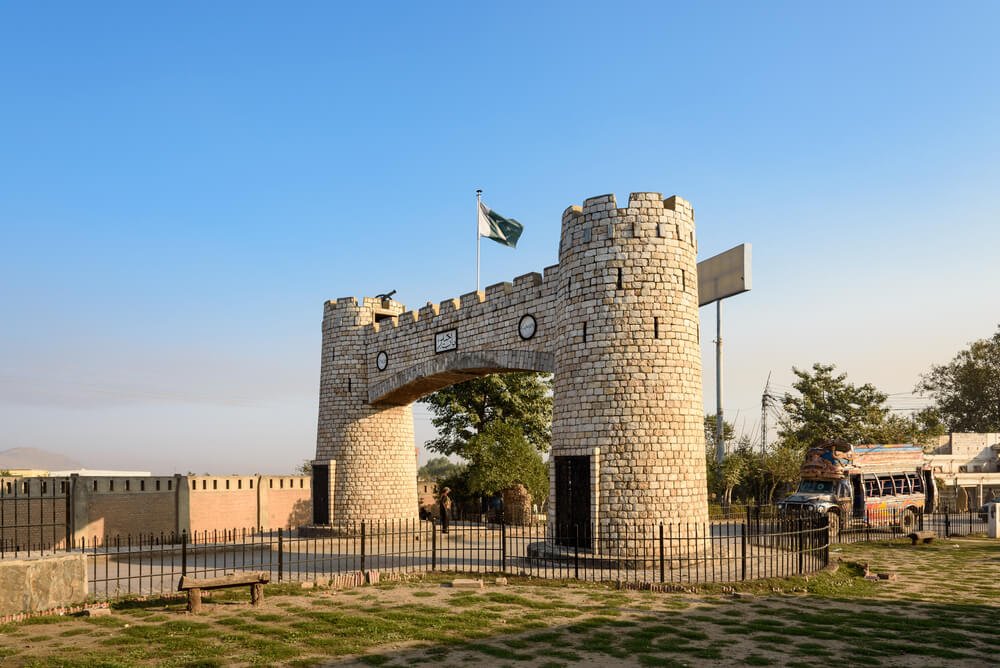
The gate itself is a striking piece of 1960s nation-building: a great limestone arch in grey-brown brick and lime mortar, raised by the government of President Ayub Khan to mark the entrance of the fabled pass and to give Pakistan’s north-western frontier a symbol it could rally around. It has worked. For six decades the gate has appeared in textbooks, on television, and in the photo albums of every school trip from Peshawar. It is, quite simply, one of the most photographed monuments in Khyber Pakhtunkhwa.
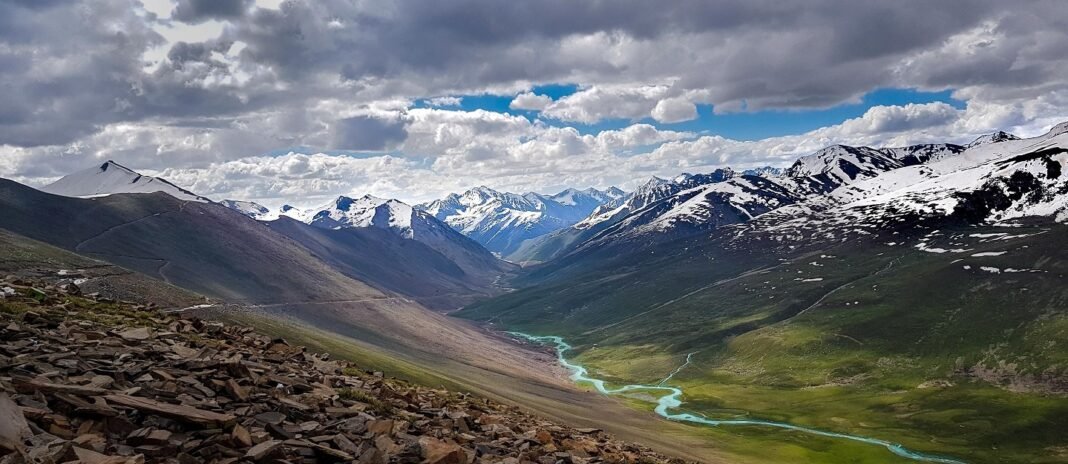
What makes the visit special is the setting. The gate stands in the middle of the GT Road with the 1837 Jamrud Fort beside it, a Sikh-era fortress built by Hari Singh Nalwa under Maharaja Ranjit Singh. Around both, a busy local bazaar and fruit market hum with tribal-area commerce — lorries, tribesmen, vendors, the whole theatre of the frontier. Beyond the gate, the road climbs into the pass itself, rising from the foothills of the Suleiman Range toward the 1,066-metre crest and on to the Torkham border. You do not need to travel deep into the pass to feel its significance; the gate, the fort, and the first ridges tell the story.
And it is easy. From Peshawar the drive is about half an hour, making Bab-e-Khyber the classic Peshawar day trip — combinable with the Peshawar Museum’s Gandhara galleries, the Qissa Khwani Bazaar, and the Bala Hisar Fort. If you have one free day in Peshawar, this is how to spend it.
History of Bab-e-Khyber (Khyber Gate)
To understand the gate, you must first understand the pass. The Khyber Pass has been used as a trade and military route for thousands of years. It was part of the Silk Road network linking China with the West, carrying silk, spices, and precious metals. Armies and conquerors have marched through it since antiquity — Alexander the Great’s Macedonian forces, the forces of Mahmud of Ghazna, Ahmad Shah Abdali, the Mughals, and finally the British, who fought the Pashtun tribes for control of the route through the 19th century. The pass begins about 16 km north of Peshawar, rising from the foothills of the Suleiman Range at Jamrud to an elevation of 1,066 metres.
The modern monument is young by comparison. Bab-e-Khyber was constructed in the early 1960s during the government of Field Marshal Muhammad Ayub Khan, Pakistan’s then-President, as a grand entrance marking the mouth of the pass and a symbol of the region’s heritage. Sources differ slightly on the exact year — one account dates the inauguration to 11 June 1963, while the Directorate of Archaeology and Museums records it as built in 1964 — but all agree it belongs to the Ayub era’s program of national monuments. It was built of limestone with lime mortar, and it stands in the middle of the GT Road from Peshawar to Landi Kotal, right beside the Jamrud Fort.
The fort beside it is far older and tells the other half of the story. Jamrud Fort was built in 1837 by the Sikh general Hari Singh Nalwa during the reign of Maharaja Ranjit Singh, as the Sikh Empire pushed its frontier toward Afghanistan. The British later used the pass and its fortifications to launch expeditions into Afghanistan and to hold the frontier, and the Khyber’s forts — Jamrud, and further up the pass, Shagai and Ali Masjid — became famous outposts of empire.
Since its inauguration, the gate has grown into an icon of the former North-West Frontier Province and its tribal belt, a symbol of Pashtun pride and of Pakistan’s position at the crossroads of South and Central Asia. It is not a legally protected monument, and it shows its age, but its significance has only grown: every discussion of the Khyber Pass, the Silk Road, or the frontier’s history begins, visually, at this gate.
Top Things to Do in Bab-e-Khyber (Khyber Gate)
Photograph the Gate
This is the essential act of the visit. The gate is most photogenic in the morning light or the golden hour before sunset, when the limestone takes on a warm tone against the barren hills. Walk the roadside carefully — this is a working highway — and frame the arch with the hills behind it. The classic shot includes the gate with Jamrud Fort’s walls in the background.
View Jamrud Fort
The 1837 Sikh-era fort stands immediately beside the gate. It is a military installation and not open to tourists, but its massive walls and bastions are impressive from the road, and its history — built by Hari Singh Nalwa, held through the Sikh, British, and Pakistani eras — is worth knowing as you look at it. Photograph it from the public roadside.
Explore the Local Bazaar
The monument is surrounded by a bustling local bazaar and fruit market. Wander the stalls selling fresh fruit, dry fruits, and everyday goods; this is frontier commerce at its most authentic, with tribesmen, truckers, and shopkeepers going about their day. It is excellent for people-watching and for buying fresh fruit at local prices. Bargain politely and keep your camera discreet around people — ask before photographing vendors.
Look Up the Pass
From the gate, the road visibly climbs into the hills toward Ali Masjid, Shagai, Landi Kotal, and eventually the Torkham border about 38 km on. You can appreciate the geography — the narrowing valley, the rising ridges — without traveling far. Deeper travel into the pass has historically been controlled, so treat the gate area as the visit and the pass beyond as the view.
Combine with Peshawar’s Heritage
The gate visit takes an hour or two, leaving the rest of the day for Peshawar. The natural companions are the Peshawar Museum (superb Gandhara sculpture), the Qissa Khwani Bazaar (the old “storytellers’ bazaar”), the Bala Hisar Fort, and the Sethi Mohallah’s merchant mansions. Together they make a full, rich day of frontier history.
Famous Places In and Around Bab-e-Khyber (Khyber Gate)
- Jamrud Fort — 1837 Sikh-era fortress beside the gate; viewable from the road.
- Khyber Pass viewpoints — the climbing road beyond the gate toward Ali Masjid and Shagai.
- Peshawar Museum — one of the world’s great Gandhara collections, in Peshawar city.
- Qissa Khwani Bazaar — Peshawar’s historic bazaar, famous for chapli kebabs and kahwa.
- Bala Hisar Fort — the ancient fort overlooking Peshawar, with layers from multiple empires.
- Torkham border area — about 38 km beyond the gate; the famous crossing into Afghanistan (view from a distance; crossing requires documents and permits).
How to Reach Bab-e-Khyber (Khyber Gate)
Reaching the gate is simple: it stands on the GT Road about 18 km west of Peshawar, and the drive from the city takes roughly 30 minutes. From central Peshawar (for example, from the Pearl Continental area), head west on the GT Road / Jamrud Road; you will pass through two checkposts along the way, where checking is usually light for tourists. The monument appears on the road itself at Jamrud — you cannot miss it. There is no formal parking area or rest area; visitors typically park along the roadside near the bazaar.
From Islamabad, take the M-1 motorway to Peshawar (about a two-hour drive on the motorway), then continue west on the GT Road to Jamrud. From Lahore, the route runs via the M-2 to Islamabad and then the M-1 to Peshawar — a full day’s journey, so plan an overnight stay in Peshawar. From Karachi, fly to Peshawar’s Bacha Khan International Airport and drive or take a taxi to the gate. Tour vans and private drivers in Peshawar all know the route; agree on the fare and waiting time before setting out.
Route Details
- From Peshawar city: West on GT Road / Jamrud Road, about 18 km, roughly 30 minutes. Pass two checkposts; carry your CNIC or passport.
- From Islamabad: M-1 motorway to Peshawar, then GT Road west to Jamrud. The whole trip is roughly three hours of driving.
- At the site: Park along the roadside near the bazaar, visit the gate and the market on foot, and stay clear of the highway’s fast lane.
- Going further: The road continues up the pass toward Ali Masjid, Landi Kotal, and Torkham (about 38 km from the gate). Travel deeper into the former tribal areas is subject to local regulations — check current guidance locally before attempting it.
Where to Stay in Bab-e-Khyber (Khyber Gate)
There is no accommodation at the gate itself — it is a roadside monument, not a resort. Stay in Peshawar, which offers the full range from budget guesthouses to well-known hotels. The area around the Pearl Continental and the cantonment has the city’s most comfortable options, while Saddar and the old city have affordable hotels and guesthouses.
Most visitors see the gate as a half-day trip from a Peshawar base, which also gives you the city’s food and museums in the evening. If you are passing through on a longer journey, Jamrud town has basic local lodging, but Peshawar’s choice and comfort are far better. Book ahead during wedding season and major holidays. For more regional trip ideas, browse the Explore Pakistan section.
Where to Eat: Local Foods of Bab-e-Khyber (Khyber Gate)
Eat at the gate the way locals do: from the bazaar. The fruit market around the monument sells fresh seasonal fruit — pomegranates, melons, and citrus depending on the month — and dry fruit stalls offer almonds, walnuts, and dried apricots from the tribal areas and Afghanistan. Small tea stalls serve doodh patti and kahwa.
For a real meal, drive back toward Peshawar. The city’s food is legendary: chapli kebabs sizzling on huge griddles, namkeen lamb karahi, Kabuli pulao, dumpukht (slow-steamed meat), and Peshawari ice cream (kulfi falooda) for dessert. The Qissa Khwani Bazaar area and Namak Mandi are the classic food streets. Meals at local restaurants are generally budget-friendly, and the quality-to-price ratio is among the best in Pakistan.
Weather in Bab-e-Khyber (Khyber Gate)
The gate sits in the foothills, so its climate follows Peshawar’s: hot summers, mild winters, and pleasant shoulder seasons. The pass behind it is slightly cooler and windier than the city, but the difference at the gate itself is small.
| Season | Temperature Range | Conditions |
|---|---|---|
| Winter (Dec-Feb) | 5-18°C | Cool and clear; excellent for sightseeing. Mornings can be foggy; carry a jacket. |
| Spring (Mar-Apr) | 20-32°C | Warm and pleasant; the hills show a touch of green after rain. A lovely time to visit. |
| Summer (May-Aug) | 32-42°C | Hot, especially June; visit early morning or late afternoon. The bazaar is livelier after sunset. |
| Autumn (Sep-Nov) | 20-33°C | Cooling and comfortable; October-November is arguably the best window. |
Language and Culture of Bab-e-Khyber (Khyber Gate)
Pashto is the language of Jamrud and the surrounding former tribal areas; you will hear it in the bazaar, from the vendors, and at the checkposts. Urdu is widely understood, and most people dealing with visitors — drivers, hotel staff, shopkeepers in Peshawar — speak it fluently. Hindko is also spoken in parts of Peshawar.
The culture is Pashtun and conservative, with a strong code of hospitality. Visitors are welcomed, but modest dress and respectful behavior matter: cover shoulders and knees, keep interactions with local women minimal and formal, and ask before taking photographs of people. Carry identification — checkposts along the Jamrud road may ask for it. Friday afternoons are quiet as the area observes prayer times; plan market visits around them.
Shopping in Bab-e-Khyber (Khyber Gate)
The bazaar around the gate is the shopping experience here, and it is refreshingly un-touristy. Buy fresh and dry fruits — the tribal belt’s almonds, walnuts, pine nuts (chilgoza in season), and dried apricots are excellent and reasonably priced. You will also find traditional caps, shawls, and everyday goods in the market stalls.
For handicrafts, Peshawar’s old city is the better hunting ground: brass and copper work, Peshawari chappals, embroidered waistcoats, and replica Gandhara art near the museum quarter. Haggling is expected in bazaars; start at about two-thirds of the quoted price and settle with good humor.
Travel Tips for Bab-e-Khyber (Khyber Gate)
Packing Essentials
Carry your CNIC or passport — you will pass checkposts. Bring sun protection, a hat, and water; there is no shade at the monument itself. A camera is essential, and a zoom lens helps for the fort and the hills. In winter, a warm jacket; in summer, light clothes and an early start.
Safety Tips
The gate area at Jamrud is a settled, regularly visited spot, and tourists visit it routinely. Still, this is a sensitive border region: stay in the public areas around the gate and bazaar, do not wander toward restricted installations, follow the instructions of security personnel at checkposts, and check current local guidance before traveling deeper into the pass. Keep valuables minimal and stay aware in the busy market.
Money & Connectivity
Carry cash — the bazaar runs on rupees and there are no card machines at the monument. ATMs are available back in Peshawar. Mobile signals from all major networks work at Jamrud, though coverage can thin out as you climb into the pass. Buy any supplies in Peshawar before heading out.
Best Time to Visit Bab-e-Khyber (Khyber Gate)
Autumn (October to November) — Best Overall
Clear skies, comfortable temperatures, and golden light on the hills make this the prime window. The bazaar is active, the air is clean after the monsoon, and photography conditions are superb.
Winter (December to February) — Very Good
Cool, crisp days are excellent for sightseeing and photography, with the hills sometimes dusted in the distance. Mornings can be foggy, so plan the gate visit for late morning. Carry warm layers.
Spring (March to April) — Good
Pleasant temperatures and occasional greenery on the hillsides. A fine time to combine the gate with Peshawar’s gardens and old city.
Summer (May to August) — Visit Early
Heat is the only real drawback. Visit at sunrise or after 5 PM, when the light is also best for photographs, and spend the hot midday hours in Peshawar’s museums and food streets.
Final Thoughts
Bab-e-Khyber is a modest monument with an immodest setting: the doorway of the most famous pass in Asian history. It does not need to be ancient to matter — its power comes from where it stands, at the exact point where Silk Road caravans, conquering armies, and modern trucks have all squeezed through the same hills. An honest bab-e-khyber khyber gate travel guide will tell you the visit is short, the facilities are basic, and the bazaar is the real life of the place — and that none of that diminishes it.
Go from Peshawar, stand under the arch, look up the road as it climbs toward the crest at 1,066 metres, and remember who else has passed this way. Then drive back into the city for chapli kebabs and kahwa, and you will have spent one of the best days the frontier offers.
FAQs
Where is Bab-e-Khyber located?
Bab-e-Khyber stands at Jamrud on the GT Road, about 18 km west of Peshawar, at the mouth of the Khyber Pass. The historic Jamrud Fort (1837) stands right beside it.
When was Bab-e-Khyber built?
The gate was built in the early 1960s during President Ayub Khan’s government — inaugurated in 1963 according to some accounts, dated to 1964 in official archaeology records — to mark the entrance of the Khyber Pass.
How do I reach Bab-e-Khyber from Peshawar?
Drive west on the GT Road / Jamrud Road for about 18 km, roughly 30 minutes. You will pass two checkposts; carry your CNIC or passport. Taxis and tour vans in Peshawar all know the route.
Can I travel deep into the Khyber Pass?
The gate area at Jamrud is freely visitable, but travel deeper into the pass (toward Ali Masjid, Landi Kotal, and Torkham) has historically been regulated. Check current local guidance before attempting it.
What is the best time to visit Bab-e-Khyber?
October-November offers the best weather and light. Winter is also excellent for sightseeing; in summer, visit early in the morning or late in the afternoon.
Is Bab-e-Khyber safe for tourists?
The gate and bazaar at Jamrud are routinely visited by tourists. Stay in public areas, follow checkpost instructions, carry ID, and check local guidance before going further into the pass.
Where can I stay near Bab-e-Khyber?
Stay in Peshawar, which has hotels and guesthouses for every budget, and visit the gate as a half-day trip. There is no tourist accommodation at the monument itself.
What should I buy at Bab-e-Khyber?
The bazaar around the gate is known for fresh and dry fruits — almonds, walnuts, pine nuts in season, and dried apricots from the tribal areas. For handicrafts, shop in Peshawar’s old city instead.