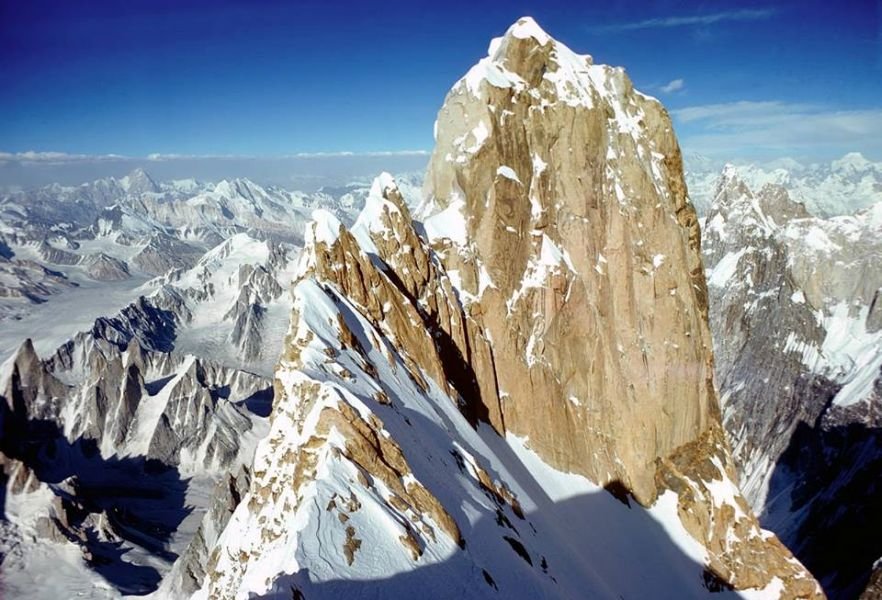
Some mountains are high. Some mountains are hard. Baintha Brakk — known to the climbing world as The Ogre — is both, and it has the most dramatic story in Karakoram mountaineering to prove it. Rising 7,285 metres above the Biafo Glacier in Gilgit-Baltistan, this granite tower waited 24 years between its first and second ascents, and its 1977 first ascent ended with one of the greatest survival epics ever told: a climber with two broken legs crawling down from 7,000 metres through a week-long storm. This Baintha Brakk (The Ogre) travel guide is written for the mountain’s two kinds of visitors — the elite climbers who dream of its walls, and the trekkers and armchair travelers who want to stand at its base camp and look up at one of the hardest peaks on Earth.
Quick Facts
- Location: Panmah Muztagh subrange of the Karakoram, Gilgit-Baltistan, Pakistan — rising above the north side of the Biafo Glacier
- Altitude: 7,285 metres (23,901 feet); topographic prominence around 1,891 metres
- Famous For: Being one of the hardest 7,000-metre peaks in the world; the legendary 1977 first ascent and survival descent of Doug Scott and Chris Bonington
- Nearest City: Skardu (about 75 km south); the roadhead is Askole (about 30 km south of the peak)
- Accessibility: Expedition only — jeep track to Askole, then a multi-day glacier trek to base camp; permits required
- Known Landmarks: The Ogre’s summit tower; Ogre II (6,960 m); the neighbouring Latok peaks; the Biafo Glacier
- Best For: Elite mountaineers; serious trekkers; readers of mountaineering history
Why Visit Baintha Brakk (The Ogre)
Let us be honest about what this destination is. Baintha Brakk is not a place you “visit” the way you visit a valley or a lake. It is one of the most technically difficult mountains on the planet — a steep, craggy granite tower whose south face rises 3,000 metres above the Uzun Brakk Glacier in just 2 km of horizontal distance. Fewer people have stood on its summit than have walked on the Moon. And that is exactly why it fascinates.
For mountaineers, The Ogre is a name spoken with respect bordering on awe. Its statistics only begin the story: 7,285 metres of altitude, nearly 1,900 metres of prominence, more than 40 km of isolation from any higher peak. But numbers do not explain why, after the first ascent in 1977, the mountain waited almost a quarter of a century for a second. The explanation is in the rock itself — massive granite buttresses, exposed ridges, avalanche slopes, and a final summit tower that demands genuine technical rock climbing at an altitude where every movement is an effort. Doug Scott, who made the first ascent, later wrote an entire book about the mountain: The Ogre: Biography of a Mountain.
For trekkers, the Baintha Brakk base camp trek offers something almost no other Karakoram trek can: a front-row view of mountaineering legend. The approach from Askole crosses the Biafo Glacier — one of the longest glaciers outside the polar regions — through a landscape of granite spires that includes the Latok peaks and Ogre II. You do not need to climb anything to feel the scale of the place; standing on the glacier and looking up at The Ogre’s walls is one of the great mountain views of Pakistan.
And for everyone else, the story alone is worth the journey of reading. The 1977 expedition — the alpine-style ascent, the broken legs, the eight-day crawl through a storm, the abandoned base camp — is one of the defining tales of human endurance. Visiting the Karakoram with that story in your head changes how you see every peak.
History of Baintha Brakk (The Ogre)
The recorded history of Baintha Brakk begins with the great surveyors of the Karakoram. The peak was first surveyed by British explorers in the 19th century — Henry Haversham Godwin-Austen in 1861 (during the surveys that measured K2), and William Martin Conway in 1892, whose party gave the mountain its English nickname: The Ogre, for its menacing appearance. Eric Shipton explored the region in the 1930s. For decades it remained a remote, unclimbed tower glimpsed only by explorers crossing the Biafo Glacier.
Serious attempts began in the 1970s. A Japanese expedition reached 6,550 metres in 1976 but was turned back. Then, in the summer of 1977, a six-man British expedition led by Chris Bonington — with Doug Scott, Mo Anthoine, Paul “Tut” Braithwaite, Nick Estcourt, and Clive Rowland — committed to an audacious plan: climb The Ogre in pure alpine style, with no supplemental oxygen and no fixed high camps. After weeks of probing the mountain’s defences, Scott and Bonington climbed the southwest side and west ridge, crossing the west summit at about 7,150 metres, and on the afternoon of 13 July 1977 they stood on the main summit at 7,285 metres — the first humans ever to do so.
What happened next made the ascent immortal. On the first rappel of the descent, just below the summit, Doug Scott slipped on ice and shattered both legs above the ankles. What followed was an eight-day ordeal above 7,000 metres: Scott crawling, sliding, and rappelling down on broken legs while Bonington lowered him metre by metre; a five-day storm; Bonington himself suffering broken ribs and pneumonia; and the heroic support of Anthoine and Rowland, who climbed up to meet them. When the four men finally staggered into base camp, they found it abandoned — the support team had given them up for dead. The story, told in Scott’s book and countless retellings, remains one of the greatest survival epics in mountaineering.
The mountain’s reputation only grew. The second ascent did not come until 21 July 2001 — 24 years later — by Swiss-German climbers Thomas Huber, Iwan Wolf, and Urs Stöcker. The third ascent followed in September 2012, by Americans Kyle Dempster and Hayden Kennedy via a new route on the south face. The neighbouring Ogre II (6,960 m) has been summited only once, by a South Korean expedition in 1983 — and in 2016, Americans Kyle Dempster and Scott Adamson died attempting its north face, their bodies never recovered. As recently as 2026, new expeditions were still being planned for Ogre II’s unclimbed lines. The Ogre does not give up its secrets cheaply.
The human history around the mountain belongs to the Balti people — the Tibetan-descended inhabitants of Baltistan, whose porters have carried every expedition’s loads since the beginning. Askole, the last village before the glaciers, is a Balti settlement where the expedition era meets a centuries-old mountain culture. The region was once Buddhist (Baltistan’s old name connections run deep), later converted to Islam, ruled by local rajas, then by the Dogras in the 19th century, before becoming part of Pakistan’s Northern Areas — today Gilgit-Baltistan.
Top Things to Do in Baintha Brakk (The Ogre)
Trek to Baintha Brakk Base Camp
The classic non-climbing objective: the multi-day trek from Askole onto the Biafo Glacier to the base camp beneath The Ogre’s walls. This is a serious expedition-style trek — glacier travel, high camps, and complete self-sufficiency — but it delivers one of the most dramatic mountain amphitheatres in the Karakoram, with The Ogre, Ogre II, and the Latok group towering above the ice.
Walk the Biafo Glacier
The Biafo is one of the great glaciers of the world, and the approach to The Ogre crosses it. Walking its undulating ice — past seracs, meltwater streams, and lateral moraine camps with names like Namla and Mango — is an experience in itself, with new granite towers appearing around every bend.
See the Latok Peaks and Ogre II
The Ogre does not stand alone. The Latok peaks — a band of savage rock spires to the east — and Ogre II crowd the same skyline. For connoisseurs of mountain architecture, this cluster is arguably the finest collection of unclimbed and barely-climbed big walls anywhere.
Follow the 1977 Story on the Ground
For readers of mountaineering history, standing at the base of the west ridge where Scott and Bonington climbed — and imagining the descent that followed — is a pilgrimage. Bring Doug Scott’s The Ogre and read the relevant chapters in camp; no museum exhibit hits harder.
Photograph the Granite Towers
The Panmah Muztagh is a photographer’s dream: golden granite catching dawn light above white glaciers, with some of the most dramatic big-wall scenery on Earth. The classic shot frames The Ogre’s summit tower against the sky from the upper Biafo.
Famous Places In and Around Baintha Brakk (The Ogre)
- Askole — the last village of the Shigar Valley and the roadhead for all Biafo Glacier expeditions.
- Biafo Glacier — one of the longest non-polar glaciers in the world, the highway to The Ogre.
- Latok I, II, and III — the fearsome granite spires east of The Ogre, among the world’s great unclimbed challenges.
- Ogre II (6,960 m) — The Ogre’s slightly lower neighbour, summited only once (1983).
- Skardu — the expedition capital of Baltistan, with its bazaar, lakes, and the historic Kharpocho Fort.
- Shigar Valley — the beautiful valley below Askole, home to Shigar Fort and the approach road.
How to Reach Baintha Brakk (The Ogre)
Getting to The Ogre is an expedition in itself. The peak lies about 75 km north of Skardu and 30 km north of the roadhead at Askole. Every journey starts with reaching Skardu, the mountaineering capital of Baltistan.
Route Details
From Islamabad to Skardu: Two options. By air: the 45–60 minute flight from Islamabad to Skardu, which is spectacular but frequently cancelled in bad weather — always keep buffer days. By road: the Karakoram Highway to Chilas and then the Skardu road, a gruelling 22–24 hour journey usually split with an overnight stop in Chilas. Most expeditions budget 2–3 days for the road.
From Lahore: Fly or drive to Islamabad first, then follow the Islamabad–Skardu route above. There is no practical direct route.
From Karachi: Fly to Islamabad (about 2 hours), then connect to Skardu as above. The full journey from Karachi to Askole realistically takes 3–5 days.
Skardu to Askole: A full day by 4×4 jeep up the Shigar Valley — rough, dramatic, and unforgettable. Askole is the last settlement; beyond it, everything moves on foot and by porter.
Askole to base camp: Several days of trekking onto and along the Biafo Glacier to reach Baintha Brakk base camp. This is expedition trekking: glacier travel, high-altitude camps, and full support logistics.
Permits and logistics: Climbing Baintha Brakk requires a permit from the Gilgit-Baltistan tourism department (processed with the help of a licensed Pakistani expedition operator), and all expeditions hire local Balti porters and guides through the operator. The trekking season is short — effectively June to August — and even then, Karakoram weather is famously volatile. Do not attempt this independently: use a reputable Skardu-based expedition company, carry satellite communication, and budget generously for porters, food, and contingency days.
Where to Stay in Baintha Brakk (The Ogre)
There are no hotels at Baintha Brakk — accommodation means Skardu’s hotels, then tents. Plan it in two phases.
Skardu (before and after): Skardu has the full range, from budget guesthouses to comfortable mid-range hotels and well-known lakeside resorts at Lower Kachura (Shangrila) and Upper Kachura. Most expeditions spend 2–4 days in Skardu buying supplies, sorting permits, and waiting for porters. Book ahead in the June–August season.
Askole: Basic village guesthouses and camping space. Most expeditions camp here the night before setting out.
On the trek: Expedition tents at staged camps along the Biafo Glacier — your operator handles camp logistics, kitchen tents, and high-altitude equipment. A good sleeping bag rated well below freezing is non-negotiable, even in summer.
No specific operator or hotel is named because the expedition market changes year to year — but any licensed Skardu-based company organising Biafo Glacier expeditions can build a Baintha Brakk base camp trek, and Skardu’s hotel tiers are exactly as described.
Where to Eat: Local Foods of Baintha Brakk (The Ogre)
On the mountain, you eat what the expedition kitchen cooks — high-calorie, high-altitude fuel: lentils, rice, pasta, porridge, and endless chai. But the journey to The Ogre passes through one of Pakistan’s most distinctive food cultures: Balti cuisine.
In Skardu and Shigar, try balay (a hearty hand-pulled noodle soup), momos (steamed dumplings, a legacy of the region’s Tibetan roots), buckwheat pancakes, and apricot-based dishes — Baltistan’s apricots, eaten fresh in summer and dried in winter, are legendary, and apricot oil is a local specialty. Butter tea (salted, churned) is the traditional high-mountain drink; sweet milk chai dominates the bazaars.
Skardu’s bazaar restaurants serve standard Pakistani fare alongside Balti dishes — karahis, kebabs, fresh river trout, and Chinese-influenced mountain food. Stock up here: beyond Askole there are no shops at all, and your operator will arrange all food for the trek. On expedition, appetite fades with altitude — force the calories, hydrate constantly, and never skip the evening soup.
Weather in Baintha Brakk (The Ogre)
The Ogre makes its own weather, and it is severe. At 7,285 metres in the central Karakoram, the mountain is battered by westerly storms even in summer; the 1977 descent was nearly destroyed by a five-day blizzard in July. Base camp sits on the glacier at roughly 4,000 metres, where summer days are manageable but nights freeze year-round. Winters are simply unsurvivable for expeditions: extreme cold, hurricane winds, and total isolation.
| Season | Temperature Range (base camp ~4,000 m) | Conditions |
|---|---|---|
| Winter (Nov–Mar) | −20°C to −35°C and below | Brutal cold, storms, deep snow. No expeditions; the mountain is inaccessible. |
| Spring (Apr–May) | −10°C to 5°C | Still winter at altitude; approach treks not yet feasible. Skardu itself is pleasant. |
| Summer (Jun–Aug) | −5°C to 15°C (days); freezing nights | The only expedition window. Unstable: expect sun, snow, and storms in the same week. |
| Autumn (Sep–Oct) | −10°C to 8°C, falling fast | Short late-season window (the 2012 ascent was September); storms increase rapidly. |
Language and Culture of Baintha Brakk (The Ogre)
The human world of The Ogre is Balti. The Balti people — of Tibetan descent, speaking Balti, a Tibetic language — inhabit the valleys below the mountain, and their porters are the backbone of every Karakoram expedition. In Skardu and Shigar you will also hear Shina and Urdu; expedition operators and hotel staff speak English.
Balti culture is mountain Islam with deep Tibetan roots — visible in the architecture, the food, and the famous warmth of Balti hospitality. For visitors, the key cultural relationship is with the porters: these are professional mountain workers, and the ethical standard set by the best expeditions is clear — fair wages paid through licensed operators, proper equipment and food for high carries, and genuine respect. The 1977 Ogre expedition survived in part because of Balti porters; every expedition since owes them the same debt.
Practical etiquette: dress modestly in villages (Askole is conservative), ask before photographing people, remove shoes where indicated, and accept the endless offers of chai — refusing hospitality is a social misstep. On the glacier, the ethic is Leave No Trace: every expedition must carry out all waste, and the best operators do.
Shopping in Baintha Brakk (The Ogre)
There is nothing to buy at The Ogre — but Skardu’s bazaar, where every expedition starts and ends, is one of the best mountain markets in Pakistan. Look for pashmina and woolen shawls, Balti handicrafts (woodwork, traditional caps, and woven goods), gemstones (the Karakoram produces aquamarine, tourmaline, and topaz — buy from reputable dealers), and dried apricots, apricot oil, and walnuts, which make perfect expedition gifts. Expedition gear — gas canisters, batteries, snacks — is also stocked in Skardu’s mountaineering shops. There are no malls in this world; the bazaar, with the Indus roaring nearby, is the entire commercial universe.
Travel Tips for Baintha Brakk (The Ogre)
Packing Essentials
For the trek: a four-season sleeping bag, insulated jacket, waterproof shell, glacier glasses, high-SPF sunscreen, and broken-in mountaineering boots. For Skardu: layers for big day-night temperature swings. Satellite communicator or phone for emergencies beyond Askole — there is no mobile signal on the glacier. Bring cash in Pakistani rupees; Skardu has ATMs but they fail regularly.
Safety Tips
This is genuine expedition terrain. Altitude sickness, crevasses, rockfall, avalanches, and sudden storms are all real hazards — never travel on the glacier without an experienced guide, rope up where your guide says so, and build acclimatisation days into your itinerary. Helicopter rescue in the Karakoram is weather-dependent and never guaranteed; carry comprehensive rescue insurance and register your expedition properly.
Money & Connectivity
Everything beyond Skardu is cash-only. Mobile networks (SCO, with Jazz/Telenor/Zong in Skardu town) do not reach the Biafo Glacier — plan to be offline for the duration of the trek. Inform family of your itinerary and check-in schedule before leaving Askole.
Best Time to Visit Baintha Brakk (The Ogre)
Summer (June to August) — The Only Real Window
The sole practical season for base camp treks and climbing attempts. Expect daytime temperatures above freezing at base camp, freezing nights, and volatile weather — sun, snow, and storms can cycle within days. July is the classic month (both the 1977 and 2001 ascents were July).
September — Late-Season Gamble
The 2012 third ascent was made in September, proving it can be done — but storms strengthen and temperatures drop fast. Only for experienced, flexible teams.
October to May — Closed
Winter conditions make the mountain and its approaches effectively inaccessible. Skardu itself is worth visiting in autumn for the colours, but The Ogre waits for summer.
Final Thoughts
Baintha Brakk is a mountain that humbles everyone who approaches it — including, nearly, the two men who first climbed it. Its story is the reason it matters: not just a beautiful tower of granite above the Biafo Glacier, but the stage for the most famous week in Karakoram climbing history, when two broken legs and an unbreakable partnership crawled down from 7,000 metres through a storm.
Whether you go as a climber, a trekker, or a reader who simply wants to understand why this peak commands such reverence, The Ogre repays the attention. Stand on the Biafo Glacier, look up at that summit tower, and remember: it waited 24 years for a second ascent. Some mountains are high; some are hard. Few are both — and fewer still have a story like this one.
FAQs
Where is Baintha Brakk located?
Baintha Brakk (The Ogre) is in the Panmah Muztagh subrange of the Karakoram in Gilgit-Baltistan, Pakistan — above the north side of the Biafo Glacier, about 75 km north of Skardu and 30 km north of Askole.
How high is Baintha Brakk?
7,285 metres (23,901 feet), with about 1,891 metres of topographic prominence — an ultra-prominent peak.
Why is it called The Ogre?
The nickname was given by William Martin Conway’s 1892 expedition party because of the mountain’s menacing, craggy appearance. Its local name is Baintha Brakk.
Who first climbed The Ogre?
British climbers Doug Scott and Chris Bonington summited on 13 July 1977, climbing alpine-style (no oxygen, no fixed high camps) via the southwest side and west ridge.
What happened on the 1977 descent?
Scott broke both legs just below the summit; the pair then endured an eight-day descent through a five-day storm, aided by teammates Mo Anthoine and Clive Rowland, before reaching an abandoned base camp. It is one of mountaineering’s greatest survival stories.
How many times has Baintha Brakk been climbed?
Only three ascents are recorded: 1977 (Scott and Bonington), 2001 (Huber, Wolf, and Stöcker), and 2012 (Dempster and Kennedy via a new south-face route).
Can trekkers visit Baintha Brakk base camp?
Yes — the base camp trek from Askole via the Biafo Glacier is the classic non-climbing objective, but it is serious expedition trekking requiring a licensed operator, guides, porters, and full glacier equipment, in the June–August season only.
How do I reach The Ogre from Islamabad?
Fly or drive to Skardu (flight 45–60 min, weather permitting; road 22–24 hours), jeep to Askole (one day), then trek several days up the Biafo Glacier. Permits via a licensed expedition operator are required.
Is it safe to trek near Baintha Brakk?
With a professional operator, proper acclimatisation, and glacier equipment, the base camp trek is a standard (if demanding) Karakoram expedition. The climbing routes themselves are for elite alpinists only.
What is the best time to go?
June to August is the only reliable window for treks and climbs; September is a late-season gamble. October to May is effectively closed by winter.
Drawn to the high Karakoram? Browse our Explore Pakistan guides, read our Malam Jabba travel guide, or explore the Hunza Valley next.