An hour from Karachi, on the quiet shore of Gharo Creek, lie the ruins of one of the oldest cities of South Asia: Banbhore, also known as Sasyunjo Takkar, the mound of Sassui. Three civilisations are stacked on this single site, from the Scytho-Parthian period to the Islamic age, and scholars identify it as Debal, the port conquered by Muhammad bin Qasim in 712 AD, where the written history of Muslim South Asia begins. This Banbhore (Sasyunjo Takkar) travel guide covers the site’s extraordinary past, the legend of Sassui and Punhun, and how to plan your visit.
Quick Facts
- Location: On the shore of Gharo Creek, near Gharo and Dhabeji, about 60 to 64 km east of Karachi, Sindh, Pakistan
- Altitude: Near sea level; the ruins stand on a 10-metre-high mound above the coastal plain
- Famous For: The ancient port of Debal, conquered by Muhammad bin Qasim in 712 AD; one of the earliest mosques in the subcontinent, dated 727 CE; the legendary home of Sassui of the Sassui-Punhun romance
- Nearest City: Karachi (about 2 hours by road); Thatta is the nearest historic town
- Accessibility: Reached by road from Karachi via the National Highway (N-5) toward Gharo and Dhabeji; the final approach road is narrow
- Known Landmarks: The fortified city mound with its 46 bastions, the grand mosque of 727 CE, the on-site museum, Gharo Creek
- Best For: History and archaeology lovers, students of early Islamic history, folklore enthusiasts, photographers, and day-trippers from Karachi
Why Visit Banbhore (Sasyunjo Takkar)
Banbhore is where the history of Muslim South Asia literally begins. In 712 AD, the young Arab general Muhammad bin Qasim defeated the local ruler Raja Dahir and captured the port of Debal, the city that scholars identify with this site. Sixteen years later, in 727 CE, a grand mosque rose here, its inscription still dated, making it one of the earliest mosques in the entire subcontinent. You can stand on the ground where that history happened: the walls, the street grid, and the mosque are all still there to walk through.
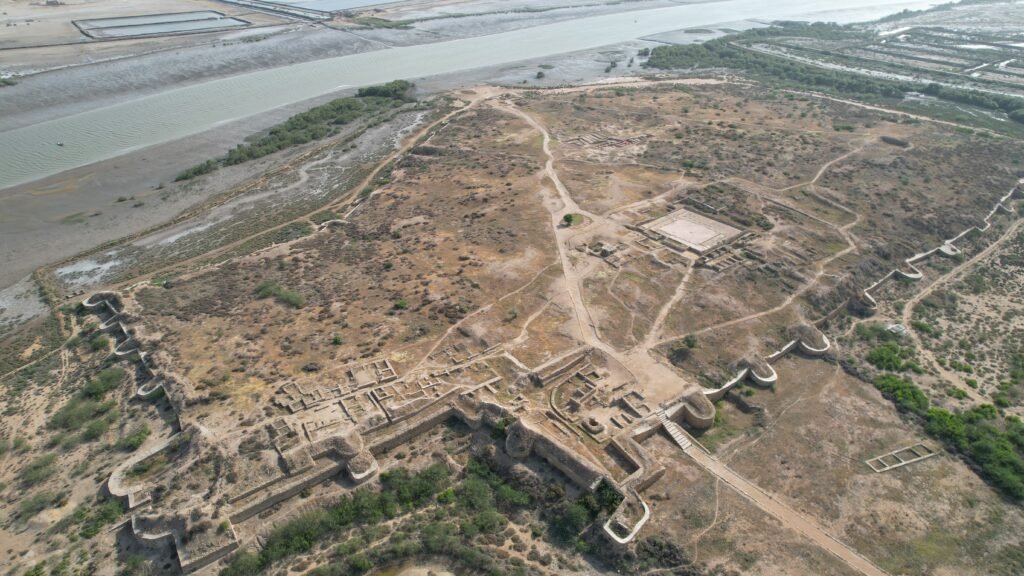
The site is also a marvel of ancient urban planning. The city stands on a 10-metre-high mound ringed by a 3-metre-wide wall with 46 rounded bastions and three gates, and an interior wall divides the mound into two sectors. The residential streets and lanes cut one another at right angles, the mark of a planned city, not an organic one. Three cultures lie side by side here: the Scytho-Parthian, the Hindu-Buddhist, and the Islamic periods, each leaving its layer in the ground.
Then there is the romance. Banbhore is the legendary home of Sassui, the heroine of the Sassui-Punhun love story immortalised by Shah Abdul Latif Bhittai in his Shah Jo Risalo. The site’s other name, Sasyunjo Takkar, means the mound of Sassui, and the first colonial archaeologist to visit, Henry Cousens, found the place still called “Sassui Jo Takro” in 1929. History and legend are woven together here in a way few sites in Pakistan can match.
Finally, Banbhore is one of the easiest major archaeological sites in Pakistan to visit. It lies just 60-odd kilometres from Karachi, making it a perfect day trip from the city, and the serene setting on Gharo Creek, with birds, sea breezes, and wide skies, is a peaceful escape from Karachi’s noise. The on-site museum helps you read the ruins, and nearby Thatta offers the Makli necropolis and the Shah Jahan Mosque for a full heritage day.
History of Banbhore (Sasyunjo Takkar)
The history of Banbhore begins long before Islam. Archaeologists say the original city dates from the Scytho-Parthian era, with some artefacts going back to the 1st century, and the site shows the remains of three civilisations side by side: the Scytho-Parthian period, the Hindu-Buddhist period, and the Islamic period. It was a port city on the edge of the sea, and its economy depended on fishing, shipping, textiles, and trade. Researchers estimate that the port, now more than 35 kilometres from the open sea, was only about 20 kilometres from it in its prime, a reminder of how coastlines shift over centuries.
The city’s great moment in history came in 712 AD, when the forces of the Umayyad governor Hajjaj bin Yusuf, under the command of the young general Muhammad bin Qasim, defeated Raja Dahir and captured Debal, the port scholars identify with Banbhore. The Italian archaeologist Dr. Valeria Piacentini, who has studied the site extensively, confirmed that the city which emerged in the later centuries is definitely Debal. The conquered city became one of the earliest centres of Muslim rule in South Asia, a cosmopolitan port where many languages were spoken and goods, ideas, and people crossed paths. The excavated grand mosque, with its inscription dated 727 CE, just sixteen years after the conquest, is considered among the earliest mosques in the subcontinent.
The excavations reveal a sophisticated city. Within the walls were residential houses on streets and lanes cutting one another at right angles, shops, cisterns for water, and evidence of textile manufacturing and export. The artefacts, from pottery to highly coloured glassware, glass lamps, small perfumery bottles, and beads, point to a place connected to the wider world, with craftsmanship that impressed modern researchers. Carved stones resembling Hindu deities found at the site show that the ancient city was religiously diverse, home to different cultures and faiths.
The city’s end is as debated as its beginning. It is believed that Banbhore was destroyed around 1250 CE, and one widely held theory blames the change in the course of the Indus in the 13th century, which would have strangled the port’s lifeline. Dr. Piacentini’s work suggests the people were also raided by Mongols and fled to seek refuge in the Ranikot area. Whatever the cause, the port faded, the sea retreated, and the city became the sandy mound that Henry Cousens found in 1929. In folklore, though, Banbhore never died: it lives on as the city of Sassui and Punhun, the lovers whose story, first documented in the poetry of Shah Abdul Karim Bulri (1536-1623) and immortalised by Shah Abdul Latif Bhittai (d. 1752), made the mound of Sassui sacred to Sindhi culture.
Top Things to Do in Banbhore (Sasyunjo Takkar)
Walk the Fortified City Mound
Climb the 10-metre-high mound and walk the circuit of the fortification wall with its 46 rounded bastions and three gates. The wall was designed according to the best defensive principles of its age, and from the top you can read the whole plan of the ancient city: the two sectors divided by the interior wall, the grid of streets, and the anchorage by the southern gate where ships once came in from Gharo Creek.
Visit the Grand Mosque of 727 CE
Find the grand mosque first: it is the reason this site matters most. The mosque’s inscription is dated 727 CE, sixteen years after Muhammad bin Qasim’s conquest, and it is considered one of the earliest mosques in the subcontinent. Standing in its remains, you are at the physical beginning of the Islamic architectural tradition in South Asia.
Explore the On-Site Museum
The museum at Banbhore displays the artefacts recovered from the excavations: pottery, glassware, lamps, perfumery bottles, and beads that show the city’s cosmopolitan trade connections. The exhibits help you understand what the bare walls outside once enclosed, and they are the best introduction to the site before you walk the ruins.
Trace the Street Grid
Walk the residential quarters and look for the streets and lanes cutting one another at right angles, the clearest evidence on the ground that Banbhore was a planned city. Imagine the shops, houses, cisterns, and textile workshops that filled these lanes when the port was at its height as a crossroad of the ancient trade routes to China and the Middle East.
Follow the Legend of Sassui and Punhun
Banbhore is the legendary hometown of Sassui, the washerman’s daughter who married the prince Punhun of Kech and, when he was stolen away, walked barefoot across the desert in search of him. The tale, sung by Shah Abdul Latif Bhittai as an allegory of the soul’s search for the divine, is one of the great romances of Sindhi literature. Ask locals about Sasyunjo Takkar, the mound of Sassui, and feel how alive the legend still is in Sindh.
Famous Places In and Around Banbhore (Sasyunjo Takkar)
- Makli Necropolis, Thatta: One of the largest necropolises in the world and a UNESCO World Heritage site since 1981, with the tombs of Sindh’s rulers and Sufi saints.
- Shah Jahan Mosque, Thatta: The magnificent 17th-century Mughal mosque of Thatta, famed for its tile work and acoustics.
- Keenjhar Lake: The great freshwater lake near Thatta, a beloved picnic and birdwatching spot, linked to the legend of Noori Jam Tamachi.
- Haleji Lake: A wildlife sanctuary and winter home of migratory birds, close to the Karachi-Thatta road.
- Gharo Creek: The tidal creek beside the site, where the Indus once flowed near the ancient port.
- Thatta Old City: The historic town with its bazaars, shrines, and crumbling grandeur.
- Chaukhandi Tombs: The distinctive carved sandstone tombs on the Karachi-Thatta route, worth a stop.
How to Reach Banbhore (Sasyunjo Takkar)
Banbhore lies about 60 to 64 kilometres east of Karachi, near Gharo and Dhabeji, and is an easy day trip from the city. The route follows the National Highway (N-5) out of Karachi toward Thatta. Turn off toward Gharo Creek and the archaeological site; the final approach road is narrow, and signage has historically been poor, so ask locals for “Sasyunjo Takkar” or “Banbhore” if you are unsure. The drive from central Karachi takes about two hours.
From Karachi: Drive east on the National Highway (N-5) toward Gharo and Dhabeji, about 60-64 km, roughly two hours. The roads are paved and fine for a normal car. Budget travellers can take the public buses, air-conditioned and non-air-conditioned, that shuttle between Karachi and Thatta throughout the day, then arrange local transport for the last stretch to the site.
From Hyderabad: Travel west toward Thatta and then on toward Gharo and the site, combining it with the Makli necropolis and the Shah Jahan Mosque for a full heritage circuit.
From Lahore and Islamabad: Fly to Karachi and drive to the site, or travel overland to Thatta and approach from the east. Most visitors from upcountry combine Banbhore with a Karachi trip.
Nearest airport: Jinnah International Airport, Karachi. Transport options: private car, ride-hailing, tour vans, and public buses to Thatta with local transport onward. Start early in the day: visitors note that the site is hot with little shade, and you will want the cooler morning hours to explore.
Route Details
The standard route from Karachi: leave the city on the National Highway (N-5) heading east toward Thatta. Pass through the Gharo and Dhabeji area, about 60 km out, and turn toward Gharo Creek and the Banbhore archaeological site. The site sits on its mound near the creek shore; the museum is at the entrance area. Allow half a day for Banbhore alone, or a full day if you combine it with Thatta town and the Makli necropolis, as many travellers do.
Where to Stay in Banbhore (Sasyunjo Takkar)
There is no accommodation at the archaeological site itself, and Banbhore is almost always visited as a day trip. Most travellers stay in Karachi, which has the full range of hotels from luxury to budget, and drive out in the morning and back by evening. This is the most comfortable option, especially in summer when the site offers no shade.
For those combining Banbhore with the full Thatta heritage circuit, Thatta town has simple hotels and guesthouses of a budget to mid-range standard. Keenjhar Lake, nearby, has resort-style accommodation popular with picnickers. If you want the magical experience past visitors describe, staying overnight near the site to watch the sunset and the stars over the silent ruins, arrange it through a local contact and come fully self-sufficient with water, food, and shelter.
Where to Eat: Local Foods of Banbhore (Sasyunjo Takkar)
There are no restaurants at the ruins, so bring water and snacks, and plan your main meal in Gharo, Dhabeji, Thatta, or back in Karachi. The roadside dhabas along the National Highway serve fresh Pakistani staples: kebabs, lentils, rice, and hot chapattis at budget-friendly prices.
The region is Sindh, and Sindhi cuisine is the local food. The signature dishes include sai bhaji (a slow-cooked mix of spinach, lentils, and vegetables), Sindhi biryani with its distinctive tangy flavour, and fresh fish from the creeks and the coast. Thatta’s bazaars have sweet shops and small eateries serving local snacks. As always on the Thatta plain, carry plenty of drinking water: the heat is serious and there is no shade at the site.
Weather in Banbhore (Sasyunjo Takkar)
Banbhore sits on the hot coastal plain of lower Sindh. Summers are severe, with scorching heat and no shade at the ruins, while winters are mild and pleasant. The sea breeze off Gharo Creek helps a little, but plan around the heat: the best visiting season is firmly October to February. The table below gives approximate conditions.
| Season | Temperature Range | Conditions |
|---|---|---|
| Winter (Dec-Feb) | 10°C to 28°C | Mild and pleasant; the best season for exploring the ruins |
| Spring (Mar-May) | 22°C to 40°C | Heating up fast; visit early morning only by May |
| Summer (Jun-Sep) | 28°C to 42°C | Severe heat, humid near the creek; monsoon showers possible; avoid midday visits |
| Autumn (Oct-Nov) | 20°C to 35°C | Cooling down; comfortable for sightseeing from late October |
Language and Culture of Banbhore (Sasyunjo Takkar)
The site lies in Sindh, and the local language is Sindhi, alongside Urdu, which is widely spoken. The culture of the region is deeply shaped by Sindh’s Sufi and mystic traditions, of which the Sassui-Punhun legend is a central part. Shah Abdul Latif Bhittai’s poetry, which immortalised the lovers of Banbhore, is still sung and revered across the province.
Visitors should treat the site as both an archaeological treasure and a place of cultural memory. Do not climb on the ancient walls, do not remove pottery shards or stones, and take all litter away with you. Dress modestly, greet villagers courteously, and if you visit the nearby shrines and mosques of Thatta, follow local customs: remove shoes, dress conservatively, and respect prayer times.
Shopping in Banbhore (Sasyunjo Takkar)
There are no shops at the ruins, so do your shopping in Thatta or Karachi. Thatta’s bazaars sell traditional Sindhi handicrafts: the town is known for its kashi tile work, pottery, and embroidered textiles, all good souvenirs of a heritage trip. You will also find Sindhi caps, ajrak shawls, and local dry fruits in the markets. In Karachi, the old bazaars around Saddar and the handicraft shops of Clifton offer the widest selection of Sindhi crafts. Buy water and snacks before leaving the highway: there is nothing to buy at the site itself.
Travel Tips for Banbhore (Sasyunjo Takkar)
Packing Essentials
Sun protection is the priority: a wide-brimmed hat, sunglasses, high-SPF sunscreen, and light, loose clothing. Carry at least two litres of drinking water per person, since there is no shade and no drinking water at the ruins. Sturdy walking shoes handle the uneven mound, and a camera is essential: the light on the old walls at golden hour is superb.
Safety Tips
The site is remote and quiet: travel in daylight, go with companions, and keep your vehicle locked. The mound’s edges and old walls can be unstable, so do not climb on the ruins. In summer, heatstroke is a real risk: visit at dawn or late afternoon, rest in the museum during the midday heat, and drink water constantly. Let someone know your plans before heading out.
Money & Connectivity
Carry cash in Pakistani rupees: there are no ATMs, banks, or card facilities at the site or in the immediate villages. Mobile signals are generally available along the National Highway and at the site, though data can be patchy. Fuel up and withdraw cash in Karachi or Thatta before driving out.
Best Time to Visit Banbhore (Sasyunjo Takkar)
Winter (December to February)
The best season by far. Mild temperatures, clear skies, and low humidity make it comfortable to spend hours walking the ruins. This is when most visitors and school trips come.
Autumn (October to November)
Cooling down after summer, late October and November are pleasant for sightseeing, with warm days and comfortable evenings by the creek.
Spring (March to May)
March is still agreeable, but by April and May the heat builds rapidly. Visit in the early morning and leave by midday.
Summer (June to September)
The worst season: severe heat, humidity near the creek, and no shade at the site. If you must go, visit at dawn, carry abundant water, and keep the visit short.
Final Thoughts
Banbhore is one of those rare places where history you read about in books is lying open on the ground in front of you: the walls of Debal, the mosque of 727 CE, the planned streets of a cosmopolitan port, and the mound of Sassui where legend and archaeology meet. It is astonishing that a site of this importance sits just an hour or two from Karachi, still quiet, still uncrowded, still waiting for the wider recognition it deserves.
Go in winter, go early in the day, and give the site the unhurried half-day it deserves. Pair it with Makli and the Shah Jahan Mosque in Thatta for one of the finest heritage circuits in Pakistan. For more ideas on exploring the country’s historic places, see our Explore Pakistan section, our Islamabad places to visit, and our Malam Jabba guide.
FAQs
Where is Banbhore (Sasyunjo Takkar) located?
Banbhore is on the shore of Gharo Creek, near Gharo and Dhabeji, about 60 to 64 km east of Karachi in Sindh, Pakistan.
What does Sasyunjo Takkar mean?
It means the mound of Sassui: “Sassui Jo Takro” was the local name recorded by archaeologists in 1929, after Sassui, the heroine of the Sassui-Punhun love legend set in this ancient city.
What is the history of Banbhore?
The city dates from the Scytho-Parthian era (1st century artefacts) and is identified as Debal, the port conquered by Muhammad bin Qasim in 712 AD. Its grand mosque, dated 727 CE, is among the earliest in the subcontinent. The city was destroyed around 1250 CE.
What is the best time to visit Banbhore?
October to February, when the weather on the Thatta plain is mild. Summer is severely hot with no shade at the ruins.
How do I reach Banbhore from Karachi?
Drive east from Karachi on the National Highway (N-5) toward Gharo and Dhabeji, about 60-64 km and two hours, then follow the local road to the site on Gharo Creek.
Is Banbhore suitable for families?
Yes, it is an easy day trip from Karachi and a wonderful educational outing, but go in the cooler months, carry water and sun protection, and keep children from climbing on the old walls.
What is near Banbhore?
The Makli necropolis (UNESCO World Heritage site), the Shah Jahan Mosque in Thatta, Keenjhar Lake, Haleji Lake, and Gharo Creek itself.
What food can I try around Banbhore?
Roadside dhabas on the National Highway serve kebabs, lentils, and chapattis; in the region, try Sindhi dishes like sai bhaji and Sindhi biryani, and fresh fish near the creek. Bring water and snacks, as there is nothing to eat at the ruins.