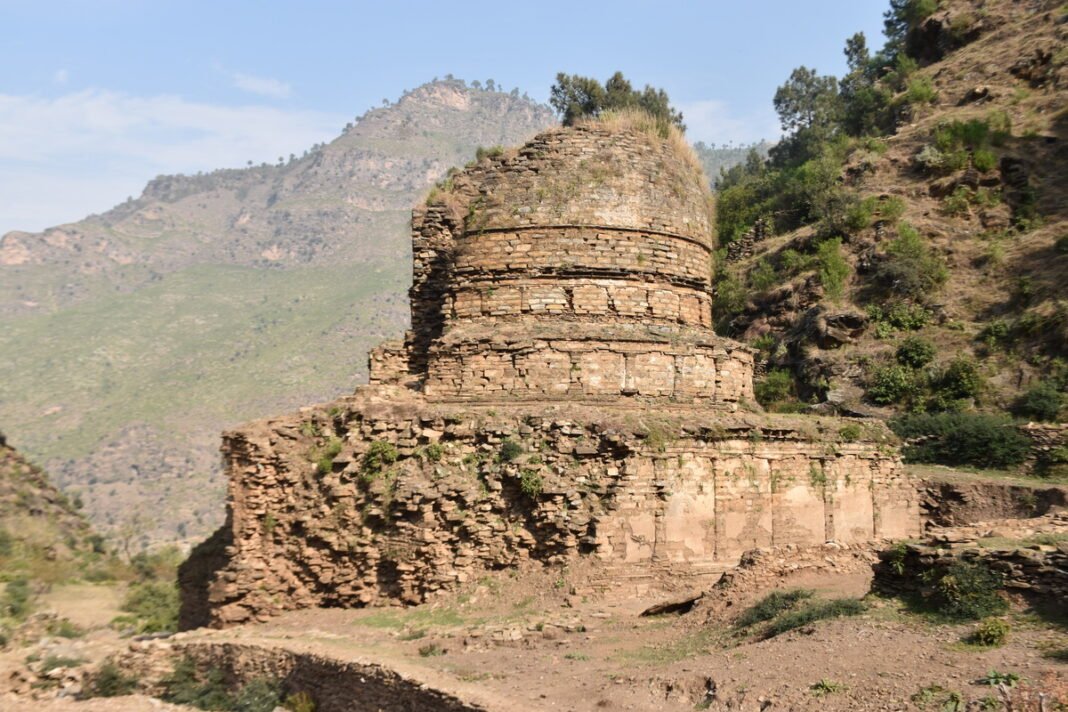
On a ridge nearly 850 metres above sea level, on a southern spur of the Margalla Hills, stands the oldest known historical monument of Pakistan’s capital: the Ban Faqiran Stupa. This Buddhist stupa, dating from the 2nd to the 5th century CE, is the only excavated Buddhist stupa discovered so far in Islamabad, and it links the modern city directly to the ancient Buddhist civilisation of Gandhara. This Ban Faqiran Stupa, Islamabad travel guide covers its remarkable history, the hike to reach it, and how to plan your visit.
Quick Facts
- Location: Southern spur of the Margalla Hills, about 2 km southwest of the Shah Allah Ditta Caves, Islamabad, Pakistan
- Altitude: Around 850 metres above sea level
- Famous For: The only excavated Buddhist stupa in Islamabad; a 2nd to 5th century CE Gandhara monument; its panoramic position between the Taxila and Soan valleys
- Nearest City: Islamabad itself; the site lies within the capital’s limits near Shah Allah Ditta village and the D-12 sector
- Accessibility: Reached on foot via hiking tracks, including Trail 8 from Shah Allah Ditta; also accessible from Golra Sharif and from Giri near Taxila
- Known Landmarks: The main stupa in semi-ashlar and diaper masonry, remains of a Mughal-period mosque, the nearby Shah Allah Ditta Buddhist caves
- Best For: History and archaeology lovers, hikers, Buddhist heritage enthusiasts, photographers, and families on a day trip
Why Visit Ban Faqiran Stupa, Islamabad
Islamabad is often seen as a purely modern city, but the ground it stands on holds one of the oldest continuous human stories in the world. As the late Prof. Ahmad Hasan Dani noted, the Pothohar Plateau preserves an unbroken archaeological sequence from the early Stone Age to the Buddhist height of Gandhara. The Ban Faqiran Stupa is the capital’s own piece of that story: a monastic complex from the age when Gandhara was a centre of Buddhist learning, art, and monastic life, sitting quietly above a city of two million people.
The setting is extraordinary. The complex crowns a ridge overlooking the historic divide between the Taxila and Soan valleys, and from the hilltop you can see the Taxila valley spread out below, with the world heritage site of Dharmarajika about two and a half kilometres away. The stupa was deliberately built in a secluded spot, as Buddhist monks preferred quiet places for meditation, and that seclusion survives: the wind, the stone, and the wide view give the site a calm that is hard to find so close to a capital city.
The archaeology is unusually rich for a single hilltop. Excavations in 2015 and 2016 uncovered the great stupa in Gandhara masonry, along with a Mughal-period mosque, iron arrowheads, and coins ranging from the 3rd century BCE to 1963. Few sites in Pakistan compress so many centuries into one small complex, from ancient pilgrims to Mughal builders to the coins of modern Pakistan.
Finally, the Ban Faqiran Stupa is an adventure as well as a monument. It is reached by hiking tracks through the Margalla Hills, including Trail 8 from the famous Shah Allah Ditta caves, so a visit combines heritage with one of the best short hikes near Islamabad. It is a perfect half-day trip for anyone who wants history, exercise, and a view in a single outing.
History of Ban Faqiran Stupa, Islamabad
The Ban Faqiran complex belongs to the Buddhist civilisation of Gandhara, which flourished in the Peshawar Valley, Taxila, and the surrounding regions between roughly the 1st century BCE and the 10th century CE, reaching its artistic peak under the Kushan Empire. The Department of Archaeology and Museums dates the stupa from the 2nd to the 4th century CE, while other studies place it between the 2nd and the 5th century. In local speech, “ban” means reservoir and “faqiran” means saints, a name that hints at the site’s long association with holy men.
The stupa was built in the classic Gandhara manner, in semi-ashlar and diaper masonry, the stonework technique characteristic of the Buddhist monuments of Taxila and Swat. The excavated remains cover an area of about 10.15 by 26.20 metres, with a staircase measuring 16.20 by 2.60 metres, and the main square stupa-like structure measures just over 10 metres a side. The masonry, built of lime and Kanjur stone, has survived some seventeen centuries on its exposed ridge.
The site’s modern story begins with the great archaeologist Prof. Ahmad Hasan Dani, who with colleagues identified the mound on the Margalla ridge as a Buddhist stupa. Dani argued that Ban Faqiran served as a milestone for travellers, mostly pilgrims, on their way to the Dharmarajika monastery in the Taxila valley, the great 3rd-century BCE foundation of the Mauryan king Ashoka that is visible from the site. He further believed that the caves of Shah Allah Ditta, two kilometres away, were meditation cells belonging to this monastic complex, later used by Hindus. For many years the mound was mistaken for a watchtower; archaeology proved it was something far more significant.
Systematic excavation came late. The Federal Department of Archaeology planned the dig in 2014 with funding of two million rupees from the National Fund for Cultural Heritage, and excavation began in August 2015 under Dr. Abdul Ghafoor Lone. The work uncovered the stupa, a Mughal-period mosque, a puzzling 10-by-10-metre arched structure once thought to be among the region’s earliest mosques, six coins, and four iron arrowheads. Coins found at the site span an astonishing range, from the late Achaemenid period and the 3rd century BCE to coins of 1963 bearing the image of General Ayub Khan. The excavators also found that treasure hunters had long ago cut deep into the centre of the stupa, probably during the Sikh or early British period. Heavy rains damaged the newly exposed stupa, and after conservation work the site, described as the capital’s oldest historical site, was reopened to visitors.
Top Things to Do in Ban Faqiran Stupa, Islamabad
Explore the Ancient Stupa
Walk around the excavated stupa and study its semi-ashlar and diaper masonry, the signature stonework of Gandhara. The square base, the great staircase, and the drum of the stupa are all visible, and information from the excavations helps you read the plan of a 2nd-century Buddhist monument. Look for the deep central cut left by old treasure hunters, a scar that tells its own story about the site’s past.
Hike Trail 8 from Shah Allah Ditta
The most rewarding way to reach the stupa is on foot via Trail 8, which starts near the Buddha Caves at Shah Allah Ditta village on the western edge of the Margalla Hills. The trail climbs through the hills to the ridge of Ban Faqiran, following age-old mountain tracks that once carried monks, traders, pilgrims, and armies between the Soan and Taxila valleys. Park at the Buddha Caves parking area and allow a few hours for the round trip.
Visit the Shah Allah Ditta Caves
Combine the stupa with the famous Buddhist caves at Shah Allah Ditta, about two kilometres away. Prof. Dani believed these caves were the meditation cells of the Ban Faqiran monastic complex, later used by Hindus, and visiting both sites together shows how the whole sacred landscape worked. The caves are one of Islamabad’s most visited historical spots.
Take in the Taxila Valley View
From the ridge at Ban Faqiran, look north across the Taxila valley to the world heritage monuments of ancient Taxila, including Dharmarajika, the great Ashokan stupa that the pilgrims of Ban Faqiran were travelling toward. On a clear day the view connects two and a half millennia of history in a single panorama, and it is superb for photography, especially in the soft light of morning.
See the Mughal-Period Mosque Remains
Look for the remains of the Mughal-period mosque uncovered during the 2015-16 excavations, along with the mysterious arched 10-by-10-metre structure nearby. These later layers show that the hilltop remained a sacred and strategic place long after Buddhism faded from the region, and they make Ban Faqiran a site of many religions, not just one.
Famous Places In and Around Ban Faqiran Stupa, Islamabad
- Shah Allah Ditta Caves: The Buddhist meditation caves two kilometres away, believed to belong to the same monastic complex.
- Dharmarajika Stupa, Taxila: The great 3rd-century BCE Ashokan stupa, a UNESCO World Heritage site visible from Ban Faqiran.
- Taxila Museum: The essential museum of Gandhara art, a short drive from the Margalla ridge.
- Giri Buddhist Monastic Complex: Another ancient monastic site about two kilometres from Ban Faqiran, on the Taxila side.
- Sirkap and Jaulian, Taxila: The excavated ancient city and the hilltop monastery of the Taxila valley.
- Islamabad Museum (G-5/1): Where coins excavated at Ban Faqiran, from the 3rd century BCE to 1963, are displayed.
- Margalla Hills National Park: The protected hills around the site, with trails, wildlife, and viewpoints.
- Golra Sharif: The historic shrine town near one of the approach routes to the site.
How to Reach Ban Faqiran Stupa, Islamabad
The stupa sits on a ridge in the Margalla Hills within the capital’s limits, near Shah Allah Ditta village and the D-12 sector, and it is reached on foot. The main approach is Trail 8, which starts from the Buddha Caves parking area at Shah Allah Ditta on the western side of the Margallas. Alternative approaches come from Golra Sharif in the E sector and, from the Taxila side, via Giri. There is no motorable road to the hilltop itself.
From Islamabad city centre: Drive to Shah Allah Ditta village near the D-12 sector, roughly a 25 to 40-minute drive from central Islamabad depending on traffic. Park at the Buddha Caves parking area, which is safe and busy with visitors, and start hiking Trail 8 toward the ridge. The hike to the stupa takes a couple of hours at a steady pace.
From Lahore: Take the M-2 motorway to Islamabad, about 375 km and 4 to 5 hours, then drive to Shah Allah Ditta as above. The stupa makes an easy day trip or weekend addition to a Lahore-to-Islamabad visit.
From Karachi: Fly to Islamabad, then drive to Shah Allah Ditta. The site is best combined with a broader Islamabad and Taxila itinerary.
Nearest airport: Islamabad International Airport. Transport options: private car or ride-hailing to Shah Allah Ditta, then hiking on foot. Wear proper walking shoes, carry water, and start early in summer to avoid the midday heat.
Route Details
The classic route: drive from anywhere in Islamabad to Shah Allah Ditta village (follow signs for the Buddha Caves / D-12 area). Park at the caves parking area. Trail 8 begins near the caves and climbs westward through the Margalla Hills along old mountain tracks toward the Ban Faqiran ridge. The path is unmarked in places, so consider going with someone who knows the trail or joining a local hiking group. From the ridge, the stupa complex and its panoramic view of the Taxila valley open up in front of you. Return by the same route.
Where to Stay in Ban Faqiran Stupa, Islamabad
There is no accommodation at the stupa itself: it is a day-trip archaeological site reached by hiking. Visitors stay in Islamabad, which offers the full range from luxury hotels to budget guesthouses. The most convenient areas for this trip are the sectors near the Margalla Hills, such as D-12, E-7, and F-6, which put you closest to Shah Allah Ditta and the trailhead. Taxila, on the other side of the ridge, has simpler guesthouses for travellers combining the stupa with the Taxila world heritage sites.
Because the hike starts best in the early morning, consider staying on the western side of the city the night before. Book in advance during spring and autumn, the peak seasons for Margalla hiking, when the city’s hotels fill up on weekends.
Where to Eat: Local Foods of Ban Faqiran Stupa, Islamabad
There are no restaurants at the hilltop, so eat before or after the hike. The villages around Shah Allah Ditta have small local eateries serving Pakistani staples: kebabs, chapli kebab, lentils, and fresh chapattis. Pack water and snacks for the trail itself, as there are no shops on the ridge.
Back in Islamabad, the food scene is one of the best in the country. The Pothohar region’s cuisine features hearty Punjabi dishes: sarson ka saag with makai di roti in winter, kebabs and tikka year-round, and rich lentil and meat curries. For a classic capital experience, try the food streets and barbecue restaurants of F-7 and F-10, the chaat and snacks of Jinnah Super and Super Market in F-6, and the dhabas near Aabpara for budget-friendly local food. Meals range from very affordable at dhabas to mid-range at the sector markets.
Weather in Ban Faqiran Stupa, Islamabad
The stupa sits at about 850 metres on the Margalla ridge, slightly cooler and windier than the city below but following Islamabad’s overall climate: hot summers, a monsoon season, and cool, pleasant winters. The ridge is exposed, so carry sun protection in summer and a warm layer in winter. The table below gives approximate conditions for the area.
| Season | Temperature Range | Conditions |
|---|---|---|
| Winter (Dec-Feb) | 2°C to 20°C | Cool and clear; excellent hiking weather; chilly mornings on the ridge |
| Spring (Mar-May) | 15°C to 35°C | Pleasant at first, heating up by May; wildflowers on the hills; best season to visit |
| Summer (Jun-Aug) | 25°C to 38°C | Hot with monsoon rains July-August; hike early morning; trails can be slippery after rain |
| Autumn (Sep-Nov) | 12°C to 30°C | Clear skies and comfortable temperatures; another excellent season |
Language and Culture of Ban Faqiran Stupa, Islamabad
The area around the stupa is part of the Pothohar Plateau, and the local language is Pothohari, a dialect of Punjabi, alongside Urdu, which everyone speaks. English is widely understood in Islamabad. The culture is a blend of Pothohari village traditions and the cosmopolitan life of the capital.
Visitors should remember that the stupa is both an archaeological site and, for Buddhists, a sacred place. Do not climb on the ancient masonry, do not remove stones, and take all litter back down with you. Dress modestly for the villages around the trailhead, greet people politely, and ask before photographing villagers. If you meet monks or Buddhist pilgrims at the site, give them space for their devotions.
Shopping in Ban Faqiran Stupa, Islamabad
There are no shops at the site, but Islamabad’s markets are excellent for souvenirs. Jinnah Super (F-7) and Super Market (F-6) have bookshops, handicraft stores, and gift shops with Gandhara-inspired replicas, pottery, and textiles. Aabpara Market is the city’s oldest bazaar and a good place for everyday shopping and street food. For a modern mall, the Centaurus Mall in the Blue Area is one of Islamabad’s best-known shopping centres. Sunday and Friday bazaars around the city sell fresh produce, clothes, and household goods at bargain prices.
Local Events and Festivals
The stupa itself has no festival of its own, but Islamabad hosts the Lok Mela, the national folk festival organised by Lok Virsa at Shakarparian, usually held in November. The Lok Mela is one of Pakistan’s great cultural events: artisans, musicians, dancers, and cooks from every province gather for days of craft bazaars, folk music, and traditional food. It is an ideal complement to a heritage trip, pairing the ancient Gandhara story of Ban Faqiran with the living folk culture of the whole country. Check the dates before your visit, as the exact schedule is announced each year.
Travel Tips for Ban Faqiran Stupa, Islamabad
Packing Essentials
Sturdy walking or hiking shoes with good grip, at least two litres of water per person, sun protection (hat, sunscreen, sunglasses), a light snack, and a fully charged phone. In winter, bring a warm jacket for the exposed ridge; in summer, start at dawn and carry extra water. A small first-aid kit and a walking stick are useful on the steeper sections.
Safety Tips
Trail 8 is a hill track, not a manicured path: go with a companion or a group, tell someone your plan, and turn back if the weather turns. The ridge has steep drops in places, so keep children close and do not wander off the track. Mobile signals are generally available on the Margallas, but carry a power bank. Avoid hiking alone late in the day, and beware of slippery rocks after monsoon rain.
Money & Connectivity
Carry cash in Pakistani rupees for parking, village eateries, and small purchases: there are no ATMs or card machines at the trailhead. Mobile networks work well in Islamabad and on most of the Margalla trails, so connectivity is rarely a problem. Entry to the archaeological site area is generally straightforward, but check locally for any current access arrangements before setting out.
Best Time to Visit Ban Faqiran Stupa, Islamabad
Spring (March to May)
The best season. Mild temperatures, wildflowers on the Margalla slopes, and clear views across the Taxila valley make the hike and the hilltop at their finest. March and April are ideal.
Autumn (October to November)
Another excellent window: the monsoon has passed, the air is clear, and temperatures are comfortable for hiking. The November Lok Mela in Islamabad can be combined with the visit.
Winter (December to February)
Cool, crisp, and usually clear, winter is good for hiking as long as you dress warmly for the exposed ridge. Mornings can be chilly, but the midday sun is pleasant.
Summer (June to August)
Hot, and the monsoon brings heavy rain in July and August that can make trails slippery and the ridge unpleasant. If you go, start at dawn, carry plenty of water, and skip the hike on rainy days.
Final Thoughts
The Ban Faqiran Stupa is a quiet miracle: a 2nd-century Buddhist monument standing on a Margalla ridge above one of the world’s youngest capitals, linking Islamabad to the age of Gandhara, to the pilgrims who walked to Taxila, and to the monks who chose this secluded hilltop for their devotions. It is not a grand, crowded attraction, and that is its charm: you will likely have the wind, the stones, and the great view of the Taxila valley to yourself.
Combine it with the Shah Allah Ditta caves, the Taxila Museum, and Dharmarajika for a full journey through two thousand years of history, all within an hour of the capital. For more heritage and mountain ideas, see our Explore Pakistan section, our Islamabad places to visit, and our Hunza Valley guide.
FAQs
Where is the Ban Faqiran Stupa located?
The stupa stands on a southern spur of the Margalla Hills in Islamabad, about 2 km southwest of the Shah Allah Ditta Caves, at around 850 metres above sea level.
How old is the Ban Faqiran Stupa?
The stupa dates from the 2nd to the 5th century CE, the Kushan period of the Gandhara civilisation, making it roughly 1,600 to 1,800 years old.
How do I reach the Ban Faqiran Stupa?
Hike Trail 8 from the Buddha Caves parking area at Shah Allah Ditta village near the D-12 sector of Islamabad. The hike takes a couple of hours round trip. Alternative approaches come from Golra Sharif and from Giri near Taxila.
What is the best time to visit Ban Faqiran Stupa?
Spring (March to May) and autumn (October to November) offer the best hiking weather and the clearest views. Winter is also good; summer is hot and the monsoon makes trails slippery.
Is the Ban Faqiran Stupa safe for families?
Yes, with care. The archaeological site is safe, but the hike involves hill tracks with some steep sections, so keep children close and wear proper shoes.
What was found during the excavations?
Excavations in 2015-16 uncovered the stupa in Gandhara masonry, a Mughal-period mosque, iron arrowheads, and coins ranging from the 3rd century BCE to 1963, now partly displayed at the Islamabad Museum.
What is near the Ban Faqiran Stupa?
The Shah Allah Ditta Caves (2 km), the Dharmarajika Stupa and Taxila Museum in Taxila, the Giri monastic complex, and the trails of the Margalla Hills National Park.
What food can I try around Ban Faqiran?
Village eateries near Shah Allah Ditta serve kebabs and Pakistani staples; in Islamabad, try Pothohari and Punjabi dishes, barbecue in F-7/F-10, and chaat in Super Market (F-6). Pack water and snacks for the hike itself.