Quick Facts
- Location: On the outskirts of Charsadda, Charsadda District, Khyber Pakhtunkhwa, about 29 kilometres northeast of Peshawar, near the junction of the Swat and Kabul rivers.
- Altitude: The mound rises around 20 metres above the surrounding flood plain.
- Famous For: Being the great mound of Pushkalavati, the “Lotus City” and ancient capital of Gandhara; 52 layers of occupation from the 6th century BCE to the 16th century CE; the city that resisted Alexander the Great for a month in 327 BCE.
- Nearest City: Charsadda town; the nearest major city is Peshawar.
- Accessibility: An open archaeological mound protected under the Antiquities Act, with no ticketed complex or visitor facilities. Reachable by road from Peshawar via Charsadda in under an hour.
- Known Landmarks: The twin mounds of Bala Hisar (eastern and western), Shaikhan Dheri across the Shambor river, and Palatu Dheri.
- Best For: Archaeology lovers, ancient-history travellers, Gandhara enthusiasts, photographers of landscapes, and day-trippers from Peshawar.
Why Visit Bala Hisar Mound (Pushkalavati), Charsadda
Most ancient capitals survive as ruins you can walk through — walls, columns, gates. Pushkalavati survives as something rarer: a great mound of earth that contains, layer upon layer, some two and a half thousand years of continuous city life. The Bala Hisar mound at Charsadda is the high mound of the “Lotus City,” the capital of ancient Gandhara before that honour passed to Peshawar. People were living here by the second millennium BCE. The city held out against Alexander the Great for a month. It was ruled in turn by Persians, Greeks, Scythians, Parthians and Kushans. This Bala Hisar Mound Pushkalavati travel guide is for travellers who want to stand on that history rather than just read about it.
You should come with the right expectations. There is no restored architecture here, no ticketed complex, and little signage. What you are looking at is stratigraphy — earth that has been dug and read by some of the greatest archaeologists of South Asia, from Sir John Marshall in 1903 to Sir Mortimer Wheeler in 1958 and Ahmad Hasan Dani in 1963–64. The 1958 excavations revealed fifty-two cultural layers, running from the 6th century BCE to the 16th century CE. For anyone interested in how cities are born, live and die, there is no more instructive spot in Pakistan.
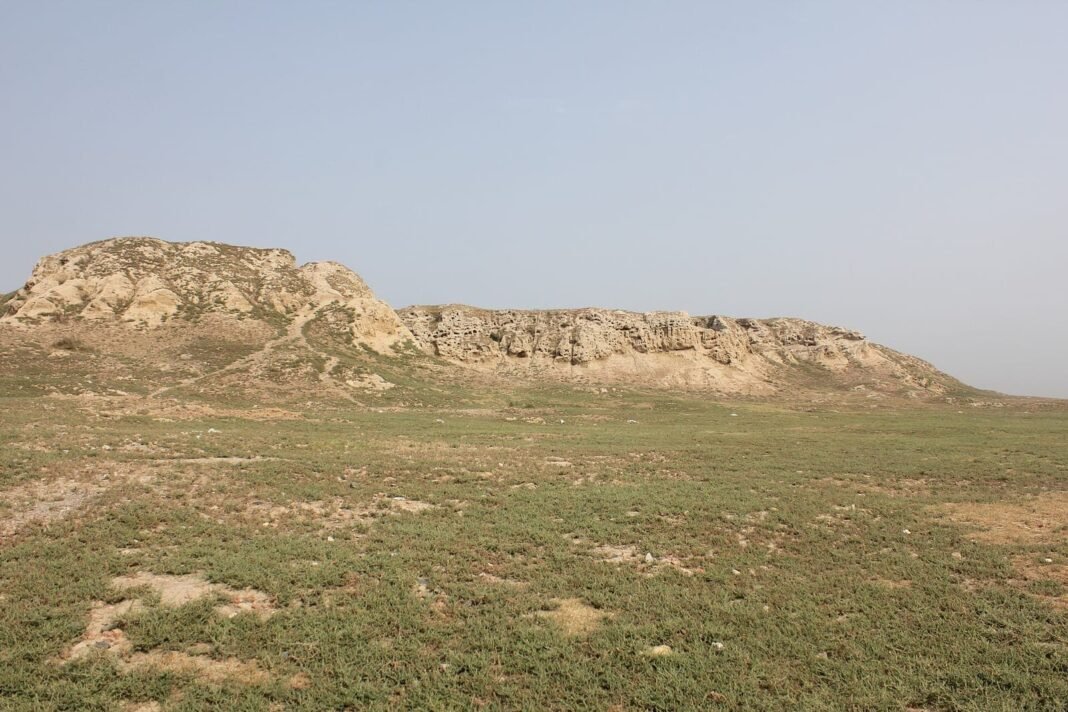
The setting adds to the experience. The mound rises about 20 metres above the flat Charsadda plain, with the little Shambor river at its foot and the green fields of the Peshawar valley spreading around it. From the top you can look across to Shaikhan Dheri, the second foundation of the city, and picture the whole urban landscape of ancient Gandhara. Pair the visit with the Gandhara collection at the Peshawar Museum — the sculptures there came out of ground exactly like this — and the mound stops being an empty hill and becomes one of the most meaningful places you can visit in Khyber Pakhtunkhwa.
History of Bala Hisar Mound (Pushkalavati), Charsadda
Pushkalavati — the name means “Lotus City” in Sanskrit, and the Greeks knew it as Peukelaotis — was the capital of the ancient region of Gandhara in what is now northwestern Pakistan. Its ruins lie on the outskirts of modern Charsadda, near the banks of the Jindi river and close to the junction of the Swat and Kabul rivers. The site consists of two main areas separated by the small Shambor river: to the south, Bala Hisar, with its eastern and western mounds; to the north, Shaikhan Dheri, wedged between the Shambor and Jindi rivers.
The deepest history belongs to Bala Hisar. The earliest archaeological remains in the mound date from roughly 1400 to 800 BCE, and the city’s historical period begins in the 6th century BCE, when the Achaemenid Persians held sway over Gandhara — Pushkalavati may have been incorporated as an Achaemenid regional settlement around 520 BCE. Its early history runs parallel to that of the Bhir Mound at Taxila, and it is no exaggeration to say that the story of urban civilisation in this part of South Asia is written in these two mounds.
The city’s most famous moment came in 327 BCE, when Alexander the Great marched on Gandhara. Pushkalavati put up a formidable resistance for about a month before surrendering — the Greek historian Arrian records it as a very large and populous city not far from the Indus, and Ptolemy places it precisely on the eastern bank of the Swat river. The celebrated Chinese pilgrim Xuanzang, who visited between 629 and 645 CE, also described the city, by which time its greatest days were behind it but its fame endured.
What followed Alexander is a roll call of the ancient world’s empires, all confirmed by the coin finds and structural remains from the site: the Bactrian Greeks, the Scythians, the Parthians and the Kushans ruled here in succession through the early centuries of the Common Era. The city’s prosperity dwindled when the Kushan emperor Kanishka transferred his capital from Pushkalavati to Peshawar (then Purushapura). The second foundation at Shaikhan Dheri, the Indo-Greek city across the Shambor, remained important into the early 3rd century CE, and Buddhist remains — including stupas and Gandhari manuscripts — show how central the area was to early Buddhism. Xuanzang even recorded a stupa here said to have been built by the emperor Ashoka.
Modern archaeology began early. Interest in the mound goes back to the 1830s, and Alexander Cunningham identified it as Pushkalavati in the 19th century — an identification confirmed in 1903 when Marshall’s discovery of an inscription at nearby Ghaz Dheri read “in the district of Puskala.” Small-scale excavations by Marshall and others were followed by the landmark 1958 excavation by Pakistan’s Department of Archaeology, which for the first time produced a complete chronological sequence for the region: fifty-two cultural layers from the 6th century BCE to the Muslim-period occupation of the 16th century CE. Later work by the University of Peshawar and others has continued to fill out the picture. Today the mound is protected under the Antiquities Act of 1975.
Top Things to Do in Bala Hisar Mound (Pushkalavati), Charsadda
Climb the Mound for the View
The essential activity is simply to climb Bala Hisar and look around. The mound rises some 20 metres above the plain, and from the top the whole geography of ancient Pushkalavati makes sense: the Shambor river below, the green fields of Charsadda, and the line of hills on the horizon. Walk slowly and look at the ground — the surface is scattered with potsherds and fragments of ancient brick, the visible skin of those fifty-two layers. Leave everything where it lies; this is a protected site.
Look Across to Shaikhan Dheri
From the top of Bala Hisar you can see across the Shambor river to Shaikhan Dheri, the second foundation of Pushkalavati — the Indo-Greek city that grew up beside the older settlement. The two mounds together tell the story of a city that moved and renewed itself over two thousand years. If you have transport, drive around to the Shaikhan Dheri side as well; the Indo-Greek, Indo-Scythian and Kushan material from this mound forms a large part of the region’s museum collections.
Visit Palatu Dheri
The third mound of the Pushkalavati complex, Palatu Dheri, has yielded stucco Buddhist statues and remains — a reminder that this was a major Buddhist centre as well as a political capital. It completes the trio of sites that make up ancient Pushkalavati, and together the three mounds give a full picture of the city’s religious and civic life.
Combine with the Peshawar Museum
The single best way to deepen a Pushkalavati visit is to see the Gandhara collection at the Peshawar Museum before or after the mound. The museum holds one of the world’s great collections of Gandharan sculpture — Buddhas, bodhisattvas and narrative panels — much of it excavated from sites exactly like Bala Hisar. Seeing the objects and then standing on the ground they came from is an experience no guidebook can replicate.
Photograph the Landscape
The mound is a landscape photographer’s subject: the eroded earthworks, the big Khyber Pakhtunkhwa sky, the patchwork of fields below. Morning and late afternoon give the best light, when the low sun rakes across the mound’s gullies and ridges and the colours of the earth come alive. There are no crowds to work around — on most days you will have the site entirely to yourself.
Famous Places In and Around Bala Hisar Mound (Pushkalavati), Charsadda
- Shaikhan Dheri: The Indo-Greek second city of Pushkalavati, across the Shambor river.
- Palatu Dheri: The third mound, with Buddhist stucco remains.
- Peshawar Museum: The great Gandhara sculpture collection, the essential companion visit.
- Takht-i-Bahi: The magnificent Buddhist monastery near Mardan, a UNESCO World Heritage Site and a natural day-trip pairing.
- Bala Hisar Fort, Peshawar: The historic fortress in Peshawar city — a different Bala Hisar, and worth the distinction.
- Charsadda town: The modern market town, useful for food and supplies.
- Swat and Kabul river junction: The river landscape that made Pushkalavati’s location so strategic.
How to Reach Bala Hisar Mound (Pushkalavati), Charsadda
The mound is on the outskirts of Charsadda, about 29 kilometres northeast of Peshawar, making it an easy half-day trip from the city. There is no public transport directly to the mound, so you will need a private car, a hired taxi or a ride arranged through your hotel. If you are figuring out how to reach Bala Hisar Mound at Pushkalavati, the simple formula is: get to Peshawar, drive to Charsadda, and follow local directions to the mound beside the Shambor river.
From Islamabad: Charsadda is around 210 kilometres from Islamabad via the M-1 motorway to Peshawar and then the road northeast to Charsadda — roughly 3 to 3.5 hours of driving. Most visitors base themselves in Peshawar and do Pushkalavati as a morning or afternoon excursion.
From Lahore: The drive from Lahore to Charsadda is around 510 kilometres via the M-2 and M-1 motorways, roughly 6 to 7 hours. As with Islamabad, the practical approach is to stay in Peshawar and visit the mound as a day trip.
From Karachi: Fly to Peshawar’s Bacha Khan International Airport (about two hours from Karachi), then drive the 45 minutes to Charsadda. The road journey from Karachi is around 1,500 kilometres and not practical for a short trip.
Route Details
Step 1: Arrive in Peshawar by road, rail or air, and arrange a car with a driver for the Charsadda excursion — your hotel can help.
Step 2: Drive northeast from Peshawar to Charsadda town (about 45 minutes), then continue to the outskirts where the Bala Hisar mound rises above the plain beside the Shambor river.
Step 3: Park near the mound and climb on foot. There are no facilities, so bring water, sun protection and good shoes.
Step 4: Return via the Peshawar Museum (for the Gandhara collection) or continue to Takht-i-Bahi near Mardan for a full Gandhara day.
Roads from Peshawar to Charsadda are paved and fine in all seasons. The mound itself is an open site with no paths or railings — wear sturdy shoes, watch your footing on the eroded slopes, and avoid the site during or just after heavy rain, when the earth is slippery.
Where to Stay in Bala Hisar Mound (Pushkalavati), Charsadda
There is no accommodation at the mound, and Charsadda town has only simple local hotels, so virtually all visitors stay in Peshawar, 29 kilometres away. Peshawar offers the full range: comfortable mid-range hotels in the cantonment area, budget hotels near the old city and bus terminals, and guesthouses in University Town and Hayatabad. For a Pushkalavati trip, a cantonment-area hotel is the most convenient base — quiet, central, and well placed for hiring a car to Charsadda.
If you are doing a wider Gandhara circuit — Pushkalavati, Takht-i-Bahi, the Peshawar Museum — consider two nights in Peshawar. That gives you one day for the museum and the city, and one day for the Charsadda mounds and Takht-i-Bahi near Mardan. Budget travellers can manage the whole circuit cheaply: Peshawar’s budget hotels are inexpensive, car hire for the day is affordable when shared, and entry to the open mound is free.
Book ahead in winter, Peshawar’s peak season, and confirm heating for cold nights. In summer, make sure your hotel has reliable air-conditioning — the Peshawar valley gets very hot, and you will appreciate a cool room after a morning on the shadeless mound.
Where to Eat: Local Foods of Bala Hisar Mound (Pushkalavati), Charsadda
Charsadda district is Pashtun country, and the food is the hearty cuisine of the Peshawar valley. The essential dish is chapli kebab — Peshawar’s famous flat minced-meat kebab — available at kebab houses throughout Charsadda town and incomparably good when eaten fresh from the pan. Seekh kebabs, mutton karahi and Kabuli pulao (rice with carrots, raisins and meat) are the other staples, served at dhabas and restaurants along the main roads.
For breakfast, try paye (slow-cooked trotters) or a simple halwa puri from a local shop, washed down with doodh patti. The drink of the region is qehwa, the light green tea served everywhere in small cups — refreshing after a dusty morning on the mound, and offered as a matter of course by shopkeepers. In winter, the bazaars sell roasted peanuts, dried fruits and chilgoza (pine nuts).
Eating in Charsadda is very affordable — a full kebab meal at a local restaurant costs a few hundred rupees per person. There are no restaurants at the mound itself, so eat in Charsadda town before or after your visit, or carry snacks and water. As always, drink bottled or filtered water.
Weather in Bala Hisar Mound (Pushkalavati), Charsadda
The mound sits on the open Charsadda plain with no shade whatsoever, so Bala Hisar Mound weather is the deciding factor in your visit. The Peshawar valley has hot summers, a monsoon peak in July and August, and mild, pleasant winters. Because the site is entirely outdoors and involves climbing an exposed earthwork, heat and sun exposure matter more here than at a walled monument.
| Season | Temperature Range | Conditions |
|---|---|---|
| Winter (Dec–Feb) | 4°C to 20°C | Cool, dry and clear; the most comfortable season for the mound. |
| Spring (Mar–Apr) | 14°C to 31°C | Mild and green; very pleasant, especially March. |
| Summer (May–Jun) | 25°C to 42°C | Very hot and shadeless; visit only in the early morning. |
| Monsoon (Jul–Sep) | 26°C to 39°C | Hot, humid, with the year’s heaviest rain; the mound can be slippery. |
| Autumn (Oct–Nov) | 15°C to 31°C | Dry and comfortable; excellent for archaeology trips. |
October to March is the recommended window, and for the same reasons the Green Tourism guides give: from May to September the plain is very hot, with highs of 36–40°C, and the shadeless mound is punishing at midday. November through February offers the classic combination of cool air, clear skies and good light for photography.
Language and Culture of Bala Hisar Mound (Pushkalavati), Charsadda
Charsadda is a Pashtun district, and Pashto is the everyday language. Urdu is widely understood, and English will get you through hotels and the museum in Peshawar. A Pashto greeting goes a long way in the villages around the mound.
The culture here is the culture of the Peshawar valley: Pashtun hospitality under the code of Pashtunwali, where guests are honoured and protected. Do not be surprised if a farmer near the mound walks over to ask where you are from and offers you tea — this is normal, and accepting graciously is the right response. The district is also deeply agricultural; the fields around the mound grow sugarcane, wheat and vegetables, and village life moves at the pace of the seasons.
For visitors, the etiquette is the standard respectful code for rural Khyber Pakhtunkhwa: dress modestly, ask before photographing people, and treat the archaeological site with care — do not climb on exposed ancient brickwork, do not remove potsherds or artefacts, and take all litter away with you. The mound is protected under the Antiquities Act, and keeping it that way is a shared responsibility.
Shopping in Bala Hisar Mound (Pushkalavati), Charsadda
There are no souvenir shops at the mound — and that is part of the point. Shopping happens in Charsadda town and, better, in Peshawar. Charsadda’s bazaars sell everyday goods, fresh produce and local sweets; it is a working market town rather than a tourist market, which makes it an honest place to see local life.
For Gandhara-themed souvenirs, Peshawar is the place: the shops around the museum and in the old city sell replica Gandharan sculptures, traditional Peshawari chappals, brass work, shawls and dry fruits. If you want a meaningful keepsake of Pushkalavati, a good book on Gandharan art from a Peshawar bookshop will outlast any trinket. As in all traditional bazaars, bargaining is expected — be friendly, be patient, and settle on a price that respects the seller’s craft.
Travel Tips for Bala Hisar Mound (Pushkalavati), Charsadda
Packing Essentials
Water is the first essential — there are no facilities at the mound, so carry more than you think you need. Sun protection (hat, sunglasses, sunscreen) is critical on the shadeless slopes. Wear sturdy walking shoes with grip for the eroded earth, and long trousers against thorns and dust. A camera with a zoom lens is ideal for the landscape and for details of the eroded sections. In winter, add a warm layer for the wind on top of the mound.
Safety Tips
The mound is a quiet rural site and visits are generally trouble-free, but take standard precautions: visit in daylight, ideally in the morning; keep valuables out of sight; and let your hotel or driver know your plans. Watch your footing on the mound’s slopes, which are steep and crumbly in places, and keep children close. Do not attempt the site in heavy rain. Carry your CNIC or passport, as you should anywhere in Khyber Pakhtunkhwa.
Money & Connectivity
Bring cash — there are no ATMs or card facilities at the mound, and Charsadda town’s ATMs can be sporadic. Peshawar has plentiful ATMs; withdraw there before heading out. Mobile coverage from all major networks is good across the Charsadda plain, with 4G data in most areas, so navigation and communication are not a problem.
Best Time to Visit Bala Hisar Mound (Pushkalavati), Charsadda
Winter (November to February) — The Best Season
Cool, dry days between 10°C and 20°C, clear skies and low sun make winter the perfect season for the mound. You can climb and explore at any hour, the light is superb for photography, and the green winter fields of the plain are at their most beautiful. This is the season this Bala Hisar Mound Pushkalavati travel guide recommends without hesitation.
Spring (March to April) — Very Good
March is delightful — mild temperatures, green fields, and wildflowers on the plain. April warms up but remains workable if you visit in the morning. Spring is also a lovely time to combine the mound with the Peshawar valley’s orchards and gardens.
Summer and Monsoon (May to September) — Avoid
The plain bakes from May onward, with highs of 36–40°C and no shade on the mound, and July–August bring the monsoon rains that make the earthworks slippery. If you have no choice, go at dawn, carry abundant water, and keep the visit short.
Autumn (October) — Excellent
October brings the first relief from the heat: dry air, clear skies and comfortable temperatures. It is an excellent month for archaeology travel, with the added advantage of fewer visitors than the winter peak.
Final Thoughts
Bala Hisar Mound will not give you the instant gratification of a standing monument. It asks for something more — imagination, patience, and a willingness to read a landscape. But what it gives in return is extraordinary: the chance to stand on the capital of Gandhara, on ground where Persians, Greeks, Scythians, Parthians and Kushans all walked, and to see with your own eyes the fifty-two layers of a city that refused to die for two and a half thousand years.
Go in winter, go in the morning, and go after the Peshawar Museum, so the sculptures are fresh in your mind when the mound rises in front of you. Take water, take your time, and leave only footprints. For more journeys into Pakistan’s deep past, browse our Explore Pakistan collection — and if you want mountains after all this history, our Malam Jabba travel guide is the perfect change of pace.
FAQs
Where is Bala Hisar Mound (Pushkalavati) located?
On the outskirts of Charsadda in Khyber Pakhtunkhwa, about 29 km northeast of Peshawar, near the junction of the Swat and Kabul rivers. It is the great mound of Pushkalavati, the ancient capital of Gandhara.
What is Pushkalavati famous for?
It was the “Lotus City,” capital of ancient Gandhara, occupied for some 2,500 years. It resisted Alexander the Great for a month in 327 BCE, was ruled by Persians, Greeks, Scythians, Parthians and Kushans, and yielded 52 cultural layers in the 1958 excavations.
What is the best time to visit Bala Hisar Mound?
October to March, with November to February the most comfortable. Avoid May to September, when the shadeless plain reaches 36–40°C.
How do I reach Bala Hisar Mound from Peshawar?
Drive northeast from Peshawar to Charsadda (about 45 minutes), then to the mound on the outskirts beside the Shambor river. You will need a private car or hired taxi, as there is no public transport to the site.
Is there an entry ticket for Bala Hisar Mound?
No. It is an open archaeological mound with no ticketed complex or visitor facilities. It is protected under the Antiquities Act, so visitors should not remove artefacts or damage the site.
How is Bala Hisar Mound different from Bala Hisar Fort in Peshawar?
They are completely different places sharing a name. The mound at Charsadda is the 3,000-year-old ruin of the Gandharan capital Pushkalavati; the fort in Peshawar is a historic fortress and Frontier Corps headquarters. Both are worth visiting.
Where should I stay when visiting Pushkalavati?
Stay in Peshawar, 29 km away, which has hotels at every level. Charsadda town has only simple local hotels. Peshawar also gives you the museum and Takht-i-Bahi within easy reach.
What should I combine with a Pushkalavati visit?
The Peshawar Museum’s Gandhara collection is the essential pairing. Shaikhan Dheri and Palatu Dheri complete the Pushkalavati complex, and Takht-i-Bahi monastery near Mardan makes a superb full-day Gandhara circuit.