Quick Facts
- Location: On a rocky outcrop above Karimabad, the main town of Hunza Valley, Gilgit-Baltistan, Pakistan.
- Altitude: Karimabad sits at around 2,500 metres above sea level; the fort stands above the town on the moraine of the Ultar Glacier.
- Famous For: Being the ancestral seat of the Mirs (rulers) of Hunza for centuries; Tibetan-influenced architecture often compared to Lhasa’s Potala Palace; the award-winning restoration by the Aga Khan Trust for Culture; a place on Pakistan’s UNESCO World Heritage Tentative List since 2004.
- Nearest City: Gilgit, about 100 kilometres away (2 to 3 hours by road). The nearest town is Karimabad, a 15 to 20 minute uphill walk below the fort.
- Accessibility: Drive the Karakoram Highway to Karimabad, then walk uphill from the bazaar to the fort entrance. Entry is ticketed, with guided tours available.
- Known Landmarks: The royal chambers and audience hall, the wooden balconies, the rooftop with views of Ultar Sar and Ladyfinger Peak, and the fort museum’s collection of royal artefacts.
- Best For: History lovers, architecture and photography enthusiasts, culture travellers, families, and anyone visiting Hunza Valley.
Why Visit Baltit Fort
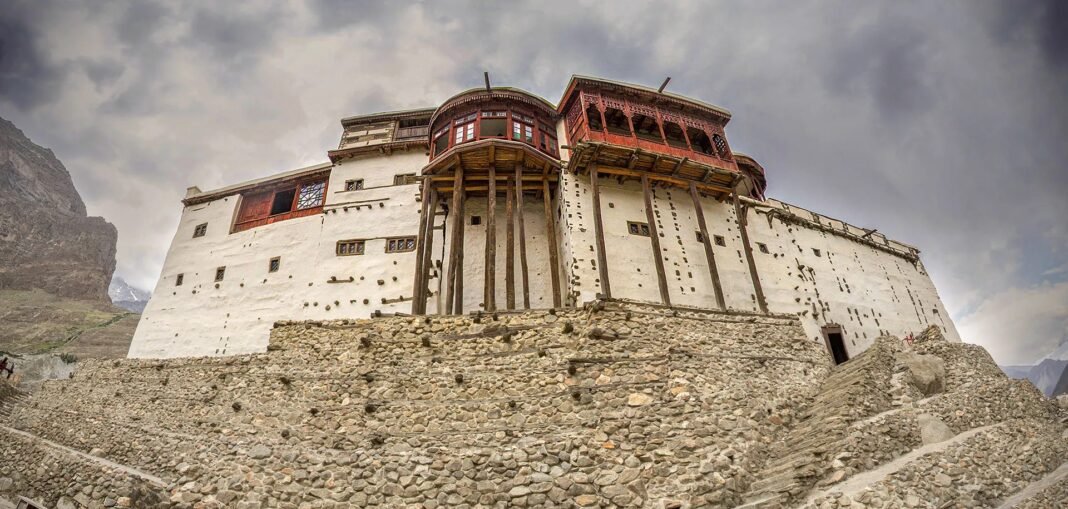
Every valley in the Karakoram has a landmark, and Hunza’s is Baltit Fort. It rises above Karimabad in tiers of whitewashed stone and dark timber, with carved wooden balconies that catch the mountain light — a building that looks as if it grew out of the cliff it stands on. For centuries this was the seat of the Mirs of Hunza, the rulers of one of the most storied mountain kingdoms of Central Asia. This Baltit Fort travel guide will take you through its 700-year history, show you what to see inside, and help you plan the journey up the Karakoram Highway.
What makes Baltit special is how much of the old Hunza survives inside it. The fort was abandoned in 1945 and left to decay for decades, until a landmark restoration by the Aga Khan Trust for Culture between 1990 and 1996 — the Trust’s first major project in Pakistan — brought it back as a museum. The guided tour walks you through royal reception rooms, the Mir’s living quarters, kitchens, dungeons and the rooftop, with the family’s own artefacts — weapons, clothing, documents, even old currency notes — displayed where they were used. Few museums in Pakistan feel this personal.
And then there is the setting, which no photograph quite prepares you for. From the fort’s rooftop, Karimabad’s terraced orchards fall away below, the Hunza River winds through the valley, and a wall of great peaks — Ultar Sar, Ladyfinger Peak, and on clear days the distant pyramid of Rakaposhi — fills the horizon. Whether you come for the history, the architecture or the views, Baltit Fort earns its reputation as the single essential stop in Hunza. Plan on one to two hours inside, and do not rush the rooftop.
History of Baltit Fort
Baltit Fort stands on the moraine of the Ultar Glacier above Karimabad, and its history runs deep. Conservation work carried out in the late 20th century showed that the core structures — including the defensive stone-and-timber tower — date back to around the 8th century CE, while local tradition traces the fort’s story back some 700 years. The architecture reflects strong Tibetan influences, a reminder that Hunza sat at the meeting point of Central Asian, Tibetan and South Asian worlds.
The fort’s most famous chapter begins with a marriage. In the 16th century, Ayasho II, the Mir (Tham) of Hunza, married Shah Khatoon, a princess from Baltistan — the granddaughter of Ali Sher Khan Anchan of Skardu. As part of her dowry, her father sent skilled Balti craftsmen who rebuilt the fort, giving it the Tibetan and Ladakhi touches that define it today: the tiered form, the carved wooden balconies, the great timber framework. The resemblance to the Potala Palace in Lhasa is often remarked on. A cannon sent in the same dowry bears the date 1539 CE, anchoring the story in hard evidence.
Before Baltit, the Mirs of Hunza lived at nearby Altit Fort. According to historical accounts, after a conflict between two sons of a ruler — Shah Abbas and Ali Khan — one brother moved to Baltit, making it the capital seat of Hunza. The power struggle ended with the younger brother’s death, and Baltit became the prime seat of power in the Hunza state. The Mirs ruled from here for centuries, through the era of the small independent mountain kingdoms of the Northern Areas, with Hunza and neighbouring Nagar as traditional rivals across the Hunza River.
The modern era brought decline and then rescue. The Mirs abandoned the fort in 1945, moving to a new palace down the hill, and the building began to decay badly enough that there were fears it might collapse entirely. Following a survey by the Royal Geographical Society of London, a restoration programme was initiated and supported by the Aga Khan Trust for Culture’s Historic Cities Support Programme. The Mir’s family donated the fort to the Baltit Heritage Trust in 1989, the restoration ran from 1990 to 1996, and the fort reopened as a museum in 1996. On 30 January 2004, Baltit Fort was placed on Pakistan’s UNESCO World Heritage Tentative List, where it remains today.
Top Things to Do in Baltit Fort
Take the Guided Tour of the Royal Chambers
The guided tour is the heart of the visit and is strongly recommended. Local guides walk you through the fort’s rooms in sequence — the audience hall where the Mir received visitors, the royal living quarters, the kitchen with its great hearths, the storage rooms and the dungeons below. The guides tell the stories of the Mirs with real affection, and the rooms are furnished with the family’s own artefacts: weapons, clothing, utensils, documents and photographs. Allow a full hour for the tour; it is included in the rhythm of the visit and makes the stones speak.
Stand on the Rooftop
The rooftop terrace is the most photographed spot in Hunza, and deservedly so. Karimabad’s apricot orchards and old houses spread directly below, and beyond them rises one of the great mountain panoramas of the Karakoram: Ultar Sar above the town, the slender spire of Ladyfinger Peak (Bublimotin), and the long white wall of Rakaposhi in the distance. Come in the morning for the clearest views, or in the late afternoon when the peaks turn gold.
Study the Tibetan-Style Architecture
Baltit is a masterclass in mountain building. Look for the massive sloping stone walls, the timber lacing that gives the structure its earthquake resistance, the carved wooden balconies and window frames, and the tiered, almost monastic massing that recalls Tibetan architecture. The fort was built and rebuilt in stages over centuries, and the guides can point out where the oldest 8th-century core meets the 16th-century Balti reconstruction.
Visit the Museum Collection
The fort functions as a museum of the Hunza state. The collection includes royal clothing and jewellery, arms and armour, household objects, old coins and currency notes, and documents from the Mirs’ administration. It is a small, focused collection, but it covers the daily life of a mountain kingdom in a way that large national museums rarely manage.
Walk Down Through Old Karimabad
The visit does not end at the fort gate. The steep lanes below the fort are the old town of Karimabad (once called Baltit), with traditional houses, small shops and the bazaar. Walking down through the old settlement after the tour — past the water channels, the apricot orchards and the wood-and-stone houses — completes the picture of how the fort and the town lived together for centuries.
Famous Places In and Around Baltit Fort
- Altit Fort: Hunza’s older fort, a short drive away, with the 1,100-year-old Shikari tower.
- Karimabad Bazaar: The lively market town below the fort, the base for Hunza sightseeing.
- Attabad Lake: The stunning turquoise lake formed by the 2010 landslide, a short drive up the valley.
- Passu Cones: The famous serrated peaks of the Passu valley, among the most photographed in Pakistan.
- Khunjerab Pass: The high border crossing with China at 4,693 metres, open seasonally.
- Hussaini Suspension Bridge: The vertiginous footbridge over the Hunza River, for the sure-footed.
- Rakaposhi Viewpoint: The classic viewpoint for the 7,788-metre peak, near Ghulmet.
- Eagle’s Nest (Duikar): The sunrise viewpoint above Altit, facing the great peaks.
How to Reach Baltit Fort
Baltit Fort is above Karimabad in Hunza Valley, and reaching it means first reaching Hunza. The valley is most commonly accessed via Gilgit, and the journey is half the adventure — the Karakoram Highway from Islamabad to Gilgit is one of the great road journeys of Asia. If you are working out how to reach Baltit Fort, plan the Hunza journey first; the fort itself is then a 15 to 20 minute uphill walk from the Karimabad bazaar.
From Islamabad: The classic route is the Karakoram Highway (N-35) north through Mansehra, Besham, Chilas and Gilgit to Hunza — around 600 kilometres to Karimabad, typically 14 to 18 hours of driving with stops. Most travellers break the journey overnight at Naran or Besham. NATCO and other bus services run from Islamabad and Rawalpindi to Gilgit and Hunza. The faster option is the roughly one-hour PIA flight from Islamabad to Gilgit, though it is weather-dependent and frequently delayed or cancelled — never plan a tight connection around it.
From Lahore: Lahore travellers join the same Karakoram Highway route via Islamabad, making the total road journey around 750 kilometres. The practical approach is to travel to Islamabad first (4–5 hours by motorway), then continue north as above. There are no direct commercial flights from Lahore to Gilgit.
From Karachi: The road journey from Karachi to Hunza is very long (over 1,500 kilometres) and best broken into stages. Flying is the sensible choice: Karachi to Islamabad, then the onward flight to Gilgit, then 2 to 3 hours by road from Gilgit to Karimabad. Book flights with flexible dates, because mountain weather disrupts schedules.
Route Details
Step 1: Travel from Islamabad to Gilgit by road (Karakoram Highway, 12–14 hours) or by air (about 1 hour, weather permitting).
Step 2: Drive from Gilgit to Karimabad on the Karakoram Highway — about 100 kilometres, 2 to 3 hours — passing the junction of the three great mountain ranges and the Rakaposhi viewpoint.
Step 3: In Karimabad, walk uphill from the bazaar to the fort entrance (15 to 20 minutes, steep but rewarding), or take a taxi part of the way and walk the final approach.
Step 4: Buy your entry ticket at the gate, join a guided tour, and allow one to two hours for the full visit.
The Karakoram Highway is paved throughout but is a mountain road: narrow in places, with rockfall zones and sheer drops. Travel in daylight, check conditions in winter (sections can close after heavy snow), and use an experienced local driver if you are not used to mountain driving. The highway is at its best from May to October.
Where to Stay in Baltit Fort
Karimabad has Hunza’s widest choice of accommodation, from comfortable hotels with mountain views down to family-run guesthouses in the old town. The mid-range hotels along the main road and on the slopes above the bazaar offer clean, heated rooms — heating matters, because Hunza nights are cold even in summer — and most have restaurants serving Pakistani, Chinese and continental food. Many have terraces facing the peaks, which is worth paying a little extra for.
At the top end, the valley has well-known luxury and heritage-style hotels, including properties run by national hospitality brands, offering the most comfortable base for travellers who want full service after a day of sightseeing. Budget travellers are well served by the guesthouses of old Karimabad and nearby Aliabad, where family-run places offer simple rooms, home-cooked food and genuine Hunza hospitality at very reasonable prices. Camping is possible at designated sites in the valley but not at the fort itself.
Book well ahead for the peak seasons — cherry-blossom time in April, summer (June–August) and autumn colours in October — when Karimabad fills completely. Confirm heating for spring and autumn visits, and hot water year-round. If you are visiting in winter, check that your chosen hotel is actually open, as many close in the deep off-season.
Where to Eat: Local Foods of Baltit Fort
Hunza’s food is distinct from the rest of Pakistan, shaped by the mountain climate and the valley’s famous apricot orchards. The dish to try first is chapshuro — the Hunza meat pie, a round of dough stuffed with minced beef or yak meat, onions and spices, baked on a hot plate. Daudo is the hearty local noodle soup, and mamtu are steamed dumplings filled with meat — warming, filling mountain food. Tumuro tea, brewed from wild thyme, is the traditional drink, and apricot juice — fresh in summer, from dried apricots in winter — is served everywhere.
The valley’s produce is the real star. Hunza apricots, dried on rooftops across Karimabad, are famous across Pakistan; walnuts, almonds, cherries (in season) and mulberries are other local staples. Many guesthouses serve home-style meals featuring these ingredients — molida (a festive dish of wheat, cheese and butter) and walnut cake are worth asking about. The Hunza people’s famed longevity is often credited to this diet of whole grains, dried fruits and glacial water, and eating the local food is part of the experience.
Karimabad’s bazaar and main road have restaurants at every level, from dhabas serving chapshuro and daudo for a few hundred rupees to hotel restaurants with fuller menus. Prices are higher than in the plains — everything travels up the Karakoram Highway — but still reasonable. Drink bottled or boiled water, and try the local apricot products to take home.
Weather in Baltit Fort
Karimabad’s mountain climate is the opposite of the plains: real winters with snow, short glorious summers, and two shoulder seasons — blossom and autumn — that draw travellers from across the world. Baltit Fort weather follows the valley closely, and because the fort visit involves an uphill walk and an exposed rooftop, the season shapes the experience. The fort is open year-round, but the journey and the views vary enormously by month.
| Season | Temperature Range | Conditions |
|---|---|---|
| Winter (Dec–Feb) | -8°C to 8°C | Cold with snow; crisp clear days, freezing nights. Few visitors. |
| Spring (Mar–May) | 5°C to 22°C | Cherry and apricot blossom (April); warming days, cool nights. |
| Summer (Jun–Aug) | 14°C to 30°C | Pleasant and green; warm days, cool nights. Peak season. |
| Autumn (Sep–Nov) | 2°C to 20°C | Golden autumn colours (October); cooling rapidly by November. |
The classic visiting seasons are April (blossom), June to August (summer green) and October (autumn colours). Winter is starkly beautiful — snow on the fort, empty lanes — but very cold, and the Karakoram Highway can be affected by snow. Monsoon rains barely reach Hunza, which sits in the rain shadow, so July and August are reliably clear. Whatever the season, mountain weather changes fast: carry a warm layer even in summer.
Language and Culture of Baltit Fort
Hunza is linguistically rich. The main language of Karimabad is Burushaski, spoken by the Burusho people; Wakhi is spoken in upper Hunza, and Shina in neighbouring areas. Urdu is the common language for visitors, and English is widely understood in hotels and by guides. You will hear all of these in the Karimabad bazaar on a busy day.
Culturally, Hunza is distinct within Pakistan. The majority of the valley’s people are Ismaili Muslims, followers of the Aga Khan, and the community is known for its emphasis on education — Hunza has among the highest literacy rates in Pakistan — and for the legendary longevity of its people. Hospitality here is genuine and unforced; the valley has hosted travellers on the Silk Road for centuries, and visitors are welcomed as a matter of course. Women travellers will find Hunza one of the most comfortable places in Pakistan to travel.
For visitors, the etiquette is simple: dress modestly but practically for mountain walking, ask before photographing people, and respect the fort’s rules — stay with your guide, do not touch fragile artefacts, and keep voices down in the smaller chambers. The Aga Khan Trust’s restoration is a source of deep local pride; showing interest in the conservation story is always appreciated. Tipping guides is customary and welcomed.
Shopping in Baltit Fort
Karimabad Bazaar, below the fort, is one of the most enjoyable shopping streets in northern Pakistan. The signature products are the valley’s own: dried apricots in several varieties, apricot oil, walnuts and almonds, and cherry and mulberry preserves in season. Walnut-wood carvings — bowls, boxes and decorative pieces — are a Hunza speciality, made from the valley’s old walnut trees.
Textiles are the other highlight: hand-embroidered Hunza caps (topis), woollen shawls, and traditional waistcoats, many made by local women’s cooperatives. Gemstones from the Karakoram — aquamarine, topaz and tourmaline — are sold by dealers in the bazaar; buy from established shops and get proper documentation for expensive stones. There are no shopping malls in Karimabad — the bazaar itself, with its mountain backdrop and the fort above, is the experience. Bargaining is normal; be friendly and fair.
Local Events and Festivals
Hunza’s festival calendar is tied to the agricultural year, and the most important traditional celebration is Ginani, the harvest festival, held in July. Ginani marks the wheat harvest and is celebrated across the valley with traditional music, dancing and polo — the wild, fast mountain sport that is Hunza’s great passion. If your trip coincides with Ginani, you will see the valley at its most festive, though accommodation books out, so plan ahead.
Nowruz, the Persian new year on 21 March, is also widely celebrated in Hunza’s Ismaili community, marking the start of spring with special foods and gatherings. Various local polo tournaments run through the summer months at the valley’s polo grounds. Dates for village-level events can shift with the agricultural calendar, so confirm locally through your hotel or guide if you are timing a trip around a festival.
Travel Tips for Baltit Fort
Packing Essentials
Layers are the rule in Hunza: a warm fleece or jacket even in summer, sun protection (the mountain sun is fierce), and sturdy walking shoes with grip for the steep 15 to 20 minute climb to the fort. Carry water, a power bank (electricity can be intermittent), and any medications — pharmacies in Karimabad are basic. A camera is essential; the fort, the town and the peaks are relentlessly photogenic. In winter, pack full cold-weather gear: thermal layers, gloves, hat and a heavy jacket.
Safety Tips
Hunza is one of the safest tourist regions in Pakistan, with very low crime and a welcoming attitude to visitors. The main risks are environmental: altitude (Karimabad is at 2,500 metres — take it easy on the first day if you arrive from the plains), mountain roads, and weather. Do not attempt the Khunjerab Pass or high viewpoints without checking conditions, keep to marked paths on the fort’s rooftop and terraces, and hire local drivers for mountain roads. Keep your CNIC or passport with you, as checkpoints operate on the Karakoram Highway.
Money & Connectivity
ATMs exist in Karimabad and Aliabad but can run out of cash in peak season — carry enough rupees from Gilgit or Islamabad. Cards are accepted at larger hotels but not in the bazaar; cash is king. Mobile coverage is decent in Karimabad town (SCO/SCom has the strongest mountain network, with Jazz, Telenor and Zong also present), but data can be slow and signals vanish on the road. Download offline maps before leaving Gilgit.
Best Time to Visit Baltit Fort
Spring Blossom (April to May) — Magical
April is when Hunza turns white and pink with cherry, apricot and almond blossom, and the fort above a blossoming Karimabad is unforgettable. Temperatures are mild (10–20°C days), the crowds are thinner than summer, and photographers consider this the valley’s finest season. Book early — blossom season now draws visitors from across Pakistan and abroad.
Summer (June to August) — Peak Season
Summer brings green orchards, warm days (up to 30°C) and cool nights, with the clearest mountain views of the year. This is the busiest season: the Karakoram Highway is fully open, Khunjerab Pass is accessible, and all hotels and restaurants are running. It is also the season of the Ginani harvest festival in July. Expect company on the fort’s rooftop.
Autumn Colours (September to October) — Spectacular
October is the valley’s golden month, when the poplars and orchards turn yellow, orange and red against the snow-dusted peaks. The light is superb, the air is crisp, and the fort glows against the autumn valley. Many travellers rate October above even blossom season. By November the cold sets in and the valley quiets.
Winter (November to March) — For the Hardy
Winter in Hunza is stark and beautiful: snow on the fort, frozen waterfalls, empty trails and the clearest skies of the year. But it is very cold (nights well below freezing), some hotels close, and the Karakoram Highway can be disrupted by snow. Only attempt a winter trip with proper gear, flexible plans and a confirmed open hotel.
Final Thoughts
Baltit Fort is the rare heritage site that exceeds its photographs. The history — 700 years of Mirs, a Balti princess’s dowry, Tibetan craftsmen, abandonment and a world-class rescue — would be worth the journey on its own. But it is the combination that makes it unforgettable: the living museum inside, the old town below, and that rooftop view across one of the great mountain valleys of the earth.
Give Hunza at least three days: one for Baltit Fort and Karimabad, one for Altit Fort and the valley’s viewpoints, and one for Attabad Lake and the upper valley. Come in blossom season or October if you can, walk up to the fort in the morning light, and take the guided tour slowly. For more northern journeys, our Hunza Valley guide covers the wider valley in depth, and the Explore Pakistan collection has hundreds more destinations across the country.
FAQs
Where is Baltit Fort located?
Baltit Fort stands on a rocky outcrop above Karimabad, the main town of Hunza Valley in Gilgit-Baltistan, Pakistan — about 100 km from Gilgit on the Karakoram Highway.
What is the best time to visit Baltit Fort?
April (cherry blossom), June to August (summer) and October (autumn colours) are the best months. Winter is beautiful but very cold, with possible road disruptions.
How do I reach Baltit Fort from Islamabad?
Drive the Karakoram Highway from Islamabad to Gilgit (12–14 hours) and on to Karimabad (2–3 more hours), or fly Islamabad–Gilgit (about 1 hour, weather permitting) and drive to Karimabad. From the Karimabad bazaar it is a 15–20 minute uphill walk to the fort.
Is there an entry ticket for Baltit Fort?
Yes, entry is ticketed, with guided tours available at the gate. Ticket prices and timings can change, so confirm locally; allow one to two hours for the full visit.
What is the history of Baltit Fort?
The fort’s core dates back centuries (parts to the 8th century CE); it became the seat of the Mirs of Hunza, was rebuilt by Balti craftsmen in the 16th century after a royal marriage, was abandoned in 1945, restored by the Aga Khan Trust for Culture (1990–1996), and reopened as a museum in 1996. It has been on Pakistan’s UNESCO Tentative List since 2004.
Is Baltit Fort suitable for families and older visitors?
Yes, with one caveat: the 15–20 minute walk from the bazaar is steep. Take it slowly, rest as needed, and consider a taxi for part of the way. Inside, the tour involves stairs but is manageable at a gentle pace.
What food should I try in Hunza?
Chapshuro (meat pie), daudo (noodle soup), mamtu (dumplings), tumuro (wild thyme tea), fresh and dried apricots, and walnut cake. Karimabad’s bazaar has restaurants at every price level.
What else should I see near Baltit Fort?
Altit Fort, Karimabad Bazaar, Attabad Lake, Passu Cones, Hussaini Bridge, the Rakaposhi viewpoint and Eagle’s Nest at Duikar — and Khunjerab Pass if it is open and you have a full day.