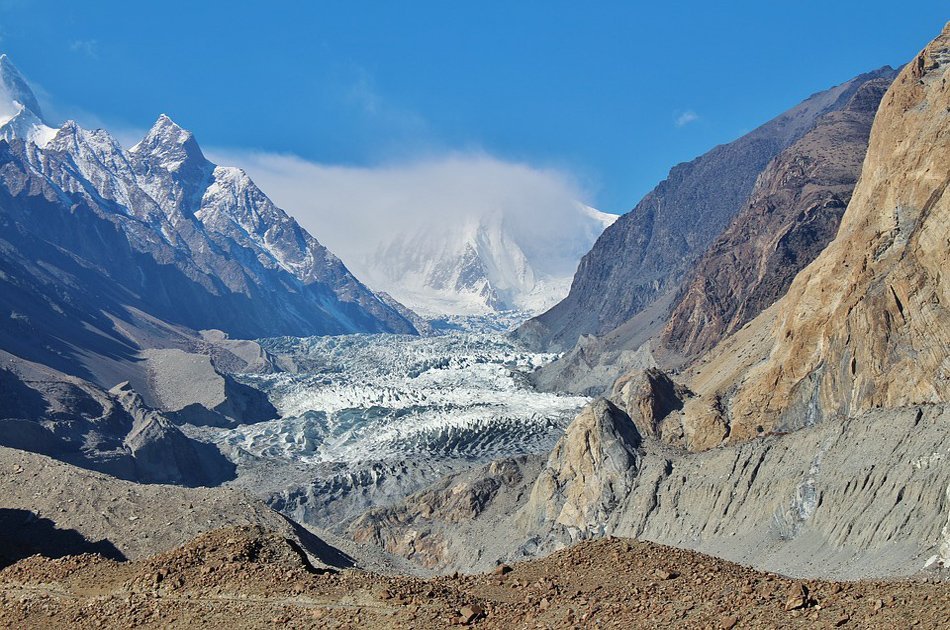
Rising above the Wakhi villages of Upper Hunza, the Batura Glacier is one of the longest glaciers on Earth outside the polar regions. Flowing westward for around 56 to 57 kilometres beneath a wall of 7,000-metre peaks, it is the beating ice heart of the Batura Muztagh, the westernmost subrange of the Karakoram. Trekkers come here to walk beside raw glacial ice, camp in flower-filled summer pastures, and share mountain life with the shepherds of Passu. If you have ever wondered where the Karakoram still feels wild and uncrowded, this batura glacier travel guide will show you the way.
Quick Facts
- Location: Upper Hunza (Gojal), Hunza District, Gilgit-Baltistan, Pakistan
- Length: Around 56 to 57 kilometres, one of the longest glaciers outside the polar regions
- Famous For: The great Batura Wall of peaks, summer pastures, and the Wakhi mountain culture of Passu
- Nearest City: Gilgit, about 3.5 to 4 hours by road; nearest village Passu on the Karakoram Highway
- Accessibility: Reachable by road via the Karakoram Highway, or fly to Gilgit and drive north
- Known Landmarks: Batura Sar (around 7,795 m), Passu Peak, Shispare, the Batura Wall, Patundas meadows
- Best For: Trekkers, photographers, adventure travellers, and anyone who wants a raw Karakoram experience away from crowds
Why Visit Batura Glacier
Most glaciers in the Karakoram require long, technical expeditions to see. Batura is different. The trek begins at Passu village, right on the Karakoram Highway, and within a day of walking you are camping at Yunzben with views of Batura I and II across the ice. That rare combination of easy access and genuine wilderness is why the Batura trek is often called one of the finest and most accessible giant-glacier treks in the Karakoram.
The glacier itself is astonishing in scale. From the trail you look across a river of grey moraine ice several kilometres wide, walled on the far side by the Batura Wall, a curtain of peaks rising between roughly 6,830 and 7,795 metres. In summer the lateral moraine blooms with wildflowers, juniper bushes and willow thickets, and the Ablation Valley trail runs beside the ice through green, flower-filled gullies. It is a landscape that changes every hour as the light moves.
Then there is the human side. The route passes the summer pastures of the Wakhi people of Passu, who bring their yaks, goats and sheep to high meadows like Yashpirt and Guchisham from June to September. Trekkers are welcomed at these seasonal settlements, where you can taste yak milk and butter, hear Wakhi songs, and see a mountain way of life that has barely changed in generations. Few places in Pakistan give you such an honest window into high-altitude culture.
Finally, Batura sits in the middle of the densest cluster of wonders in Gojal. The Passu Cones, Borith Lake, the Hussaini suspension bridges, Khunjerab Pass and the forts of Karimabad are all within a short drive of the trailhead. You can build a complete Hunza itinerary around the glacier, mixing hard trekking days with relaxed valley sightseeing.
History of Batura Glacier
The Batura Glacier is a natural feature rather than an archaeological site, so its “history” is really the history of the valley it dominates. Gojal, the upper part of Hunza, was for centuries part of the small mountain state of Hunza, ruled by the Mir of Hunza until the state’s accession to Pakistan in 1974. The Wakhi people who live in Passu and neighbouring villages are descendants of migrants from the Wakhan corridor of what is now Afghanistan and Tajikistan, who settled these high valleys centuries ago as herders and farmers.
The valley lay on a northern branch of the old Silk Route network, and passes above Gojal carried traders, Buddhist monks and armies between Central Asia and the subcontinent for two thousand years. The complex irrigation channels that still water Passu’s fields, held in place by dry-stone walls, are the product of generations of skill, and British-era explorers of the Great Game period mapped these ranges while charting the frontier between British India, Russia and China.
Modern trekking here grew slowly. While the Baltoro and Biafo glaciers drew climbers to the east, Batura remained quiet, known mainly to local herders and a handful of expeditions. That changed as the Karakoram Highway (built by Pakistan and China over roughly two decades, opening in the late 1970s) put Passu within reach of ordinary travellers. Local tour operators in Hunza began running the Batura trek in the 1990s and 2000s, and today it is a standard, well-established route with recognised campsites at Yunzben, Yashpirt, Kukhil and Guchisham.
Scientific interest in the glacier continues. Karakoram glaciers are unusual worldwide because many of them are stable or even advancing, a phenomenon sometimes called the Karakoram anomaly, and Batura’s great length makes it an important reference glacier for studying how high Asian ice responds to a changing climate. For the traveller, that history is visible in the ice itself: the crevasses, meltwater streams and towering seracs of the Batura Wall’s icefalls are the glacier writing its own ongoing story.
Top Things to Do in Batura Glacier
Trek the Batura Glacier Trail
The main event is the multi-day trek itself. The classic route starts at Passu, crosses to the glacier’s snout within an hour, and follows the lateral moraine westward to camps at Yunzben (around 2,800 m), Yashpirt (around 3,100 m) and Guchisham (around 3,400 m). Days are long but the walking is mostly gentle, with almost no steep sections, and the mountain views of Batura, Passu and Shispare peaks grow more spectacular the deeper you go. Most trekkers take six to ten days on the trail, and hiring yaks, porters and a local guide from Passu makes the journey safer and far more rewarding.
Camp at Patundas and the Summer Pastures
Above the glacier’s middle section lie some of the loveliest high meadows in Hunza. Patundas, a grassy shoulder with sweeping views across the ice to the Batura Wall, is a favourite rest-day camp. The Wakhi summer settlements at Yashpirt and Guchisham let you spend evenings with shepherd families, watching yaks graze at sunset while the 7,000-metre peaks turn gold. Bring small gifts or simply share tea and conversation; these encounters are the soul of the trek.
Photograph the Batura Wall and Icefalls
The Batura Wall, the great rampart of peaks between roughly 6,830 and 7,795 metres, is one of the most photogenic mountain faces in the Karakoram. The huge icefalls pouring from the six Batura peaks down to the glacier are especially dramatic in morning light. The Passu Cones across the highway also reward photographers, and the full-bleed views from the moraine crest at Yashpirt are the shots travellers come home with.
Visit Passu Village and its Orchards
Before or after the trek, spend time in Passu itself. The village is famous for its apricot orchards, its dry-stone terraces, and its warm, welcoming people. Walk through the lanes in the late afternoon, buy dried apricots and apricot oil directly from growers, and look back at the glacier you just walked beside. The village also has small shops for last-minute trek supplies.
Day Walks: Borith Lake and the Hussaini Bridges
On rest days around Passu you can visit Borith Lake, a calm high lake that hosts migratory birds including Siberian ducks in spring and autumn, and walk the famous Hussaini suspension bridges, the long, swaying footbridges over the Hunza River that local people still use daily. These easy half-day trips need no special gear.
Famous Places In and Around Batura Glacier
- Passu Cones – the serrated “Cathedral” ridge above Passu village, one of the most recognisable mountain sights in Pakistan
- Borith Lake – a serene lake near Passu, excellent for birdwatching, reflection photography and camping
- Hussaini Suspension Bridges – thrilling traditional bridges across the Hunza River, still in daily use
- Khunjerab Pass – the 4,730-metre border crossing with China, a spectacular day drive from Passu
- Baltit and Altit Forts – the historic forts of Karimabad in central Hunza, a few hours’ drive south
- Attabad Lake – the deep blue lake formed by a 2010 landslide, on the road between Hunza and Passu
How to Reach Batura Glacier
Batura is reached through Passu village in Upper Hunza, and the standard gateway is the Karakoram Highway (N-35). The most common approach is to drive the full length of the KKH from Islamabad, a journey of roughly 645 kilometres that takes about 14 to 16 hours of driving, usually split over two days with a night halt in Chilas or Gilgit. The faster option is to fly from Islamabad to Gilgit, a flight of about one hour, and then drive north to Passu in around 3.5 to 4 hours. From Lahore the road distance to Passu is roughly 980 kilometres, around 16 to 18 hours of driving, while travellers from Karachi generally fly to Islamabad and continue by road or air. There is no direct public transport to the glacier itself; from Passu village you walk, and local jeeps and taxis handle transfers along the highway.
Route Details
From Islamabad (by road): Take the Hazara Motorway (M-15) to Thakot, then join the Karakoram Highway (N-35) through Besham, Dassu and Chilas to Gilgit, and onward past Hunza to Passu. Plan two driving days with a night in Chilas or Gilgit. Road conditions are generally good on the motorway section but the KKH can be affected by landslides, especially during the July and August monsoon.
From Islamabad (by air): Fly Islamabad to Gilgit (about 1 hour, weather permitting), then hire a taxi or join a tour van for the 3.5 to 4 hour drive north to Passu via Karimabad and Attabad Lake.
From Lahore: Take the M-2 to Islamabad and continue as above, or fly Lahore to Gilgit where schedules allow. Expect a very long first day if driving the whole way.
From Karachi: Fly to Islamabad, rest overnight, then continue by road or air as above. The road distance from Karachi to Passu is well over 1,800 kilometres and is not practical as a single journey.
Transport options: Private car with driver, rented 4×4, NATCO and private coach services to Gilgit, tour company vans from Islamabad, and local taxis from Gilgit to Passu. For the trek itself, arrange a licensed local guide, porters and yaks through Passu-based operators. Foreign visitors should check current trekking permit requirements, which local operators in Gilgit can arrange.
Where to Stay in Batura Glacier
There are no hotels on the glacier itself; during the trek you sleep in tents at established campsites like Yunzben, Yashpirt and Guchisham, and your tour operator or guide will arrange the camping equipment. Before and after the trek, most travellers stay in Passu, where a handful of family-run guesthouses and small hotels serve trekkers, or in Gulmit, the larger village a short drive south with more comfortable mid-range hotels. Karimabad in central Hunza, about two to three hours from Passu, offers the widest choice, from simple guesthouses to comfortable hotels with valley views, and Gilgit has the full range of city hotels. Because Passu’s accommodation is limited, book ahead in the peak months of July and August, and confirm whether your trek package includes the pre- and post-trek hotel nights.
Where to Eat: Local Foods of Batura Glacier
The food of Gojal is Wakhi mountain food, built for cold weather and hard work. The signature dish is chapshuro, a hearty meat pie stuffed with minced yak or beef, onions and spices, baked until crisp. Mamtu are steamed dumplings filled with meat, while burus shapik is a warming dish of wheat-flour dumplings in a rich broth, and diram phitti is a thick, nourishing soup that appears on Hunza tables in the colder months. Dairy is everywhere: fresh yak milk, yak butter and salty butter tea are offered in the summer pastures. Apricots are the valley’s gold; in season you will eat them fresh by the handful, and dried apricots, apricot oil and mulberry products are sold in every bazaar. A simple meal in Passu is budget-friendly, and even the better hotel restaurants in Karimabad and Gilgit serve full meals at prices that are modest by city standards. Vegetarians should note that mountain menus lean heavily on meat and dairy, though daal, sabzi and fresh tandoori roti are always available.
Weather in Batura Glacier
Weather at Batura is high-mountain weather: cold even in summer, with conditions that can change within an hour. The village of Passu sits at roughly 2,500 metres, while the trek camps climb toward 3,400 metres and beyond, so nights are cold year-round and winter is severe. The trekking season runs from mid-June to late September, when the days are longest and the high pastures are snow-free. The table below gives approximate ranges; on the glacier itself it is always several degrees colder than in the village.
| Season | Temperature Range (Passu village, approx.) | Conditions |
|---|---|---|
| Winter (Dec-Feb) | -13°C to -21°C | Deep snow, frozen trails, glacier inaccessible; only for experienced winter mountaineers |
| Spring (Mar-May) | -6°C to 8°C | Snow melting, apricot blossom in the valley, trails still snowbound higher up |
| Summer (Jun-Aug) | 1°C to 12°C | Prime trekking season; long daylight, wildflowers on the moraine, occasional afternoon cloud |
| Autumn (Sep-Nov) | -7°C to 7°C | Clear, crisp days and golden light; excellent for photography, colder nights from October |
Language and Culture of Batura Glacier
The people of the Batura region are Wakhi, an ethnic group whose language, Wakhi, belongs to the Pamiri branch of the Iranian language family and is spoken across the Wakhan corridor in Afghanistan, Tajikistan, China and northern Pakistan. In Gojal you will hear Wakhi in the villages, while Burushaski is spoken in lower Hunza, and almost everyone involved in tourism also speaks Urdu and workable English. The population is predominantly Ismaili Muslim, followers of the Aga Khan, and Hunza is known across Pakistan for its high literacy, its schools, and its progressive attitude toward women’s education. Visitors are warmly welcomed, but standard mountain etiquette applies: dress modestly, ask before photographing people, accept offered tea when you can, and respect the summer pastures, which are working grazing lands, not empty wilderness. Friday is the main congregational day, and village life slows accordingly.
Shopping in Batura Glacier
Shopping here is about valley produce and handmade goods, not malls. Dried apricots, apricot kernels, apricot oil, walnuts, almonds and local honey are the classic Hunza souvenirs, sold in the small bazaars of Passu, Gulmit and Karimabad. Look for yak-wool handicrafts, handwoven shawls, traditional Wakhi caps and woodcarvings in Karimabad’s craft shops. There are no shopping malls anywhere near Batura; the nearest proper retail is in Gilgit, so buy trekking supplies, sunscreen and batteries in Islamabad, Gilgit or Karimabad before heading to Passu. Bargaining is gentle and expected in the bazaars, and buying directly from growers in Passu usually gets you the freshest apricot products at the fairest prices.
Travel Tips for Batura Glacier
Packing Essentials
Pack for four seasons in one day: a warm down or synthetic jacket, a waterproof shell, thermal base layers, a good sleeping bag rated for below freezing, sturdy broken-in trekking boots, a headlamp, sunglasses, strong sunscreen and a water bottle with purification tablets. A daypack, trekking poles and a basic first-aid kit with altitude-sickness medication complete the list. Even in August, nights at Guchisham can drop well below zero.
Safety Tips
Never attempt the glacier trek alone; hire a registered local guide and porters from Passu, and check in with your hotel about your route and expected return. The KKH is prone to landslides in the monsoon months of July and August, so build buffer days into your plan. Drink only treated water, walk at a steady pace to acclimatise, and turn back if weather closes in on the higher camps. Keep copies of your CNIC or passport and any trekking permits with you.
Money & Connectivity
Carry enough cash for the entire trek; there are no ATMs in Passu and the nearest reliable ATMs are in Karimabad and Gilgit. Mobile signals are patchy: SCOM and Telenor cover parts of Gojal, but expect no signal at the higher camps. Download offline maps before you leave Gilgit, inform family of your itinerary, and settle hotel and guide payments before heading onto the trail.
Best Time to Visit Batura Glacier
Summer (Mid-June to August)
This is the classic window for the Batura trek. The high pastures are open, the Wakhi shepherds are in residence, days are long, and temperatures at the camps are at their mildest. July and August bring the most trekkers, so book guides and Passu accommodation early, and watch for monsoon-related landslides on the KKH.
Autumn (September)
September is arguably the finest month for experienced walkers. The crowds thin, the skies clear to a deep blue, and the light on the Batura Wall is superb for photography. Nights are colder and the shepherds begin moving down, so carry warmer gear and confirm that camps are still serviced.
Spring (April to May)
Spring is for valley lovers rather than trekkers. Apricot blossom turns Passu and Gulmit white and pink, the weather is pleasant for day walks to Borith Lake and the Hussaini bridges, but the high trail remains snowbound. A good season for a relaxed Hunza trip without the full glacier trek.
Winter (October to March)
Winter at Batura is serious. Temperatures in Passu fall far below freezing, snow closes the high camps, and the glacier becomes a mountaineering objective. Only highly experienced winter travellers should consider it, and most visitors are better served by the valley’s winter scenery around Karimabad.
Final Thoughts
The Batura Glacier is the Karakoram at its most honest: enormous, demanding, beautiful, and still refreshingly free of crowds. It asks for fitness, warm clothing and respect for the mountain, and it repays those with some of the finest walking in Pakistan, from flower-strewn moraines to nights under the Batura Wall with Wakhi shepherds for company. Few treks anywhere give you so much wilderness so close to a road.
If you are planning your first great Karakoram trek, put Batura at the top of the list. Go in summer, hire local guides from Passu, give the mountain the days it deserves, and pair the trek with the lakes, bridges and forts of Gojal. For more northern Pakistan inspiration, browse our Hunza Valley guide and the Explore Pakistan collection.
FAQs
Where is Batura Glacier located?
Batura Glacier lies in Upper Hunza (Gojal), Gilgit-Baltistan, in the Batura Muztagh subrange of the Karakoram, with the trek starting at Passu village on the Karakoram Highway.
How long is Batura Glacier?
The glacier is around 56 to 57 kilometres long, making it one of the longest glaciers in the world outside the polar regions.
What is the best time to visit Batura Glacier?
Mid-June to September is the trekking season, with September offering the clearest skies. April and May suit valley sightseeing, while winter is for experienced mountaineers only.
How do I reach Batura Glacier?
Drive the Karakoram Highway from Islamabad to Passu (roughly 645 km, two driving days) or fly Islamabad to Gilgit and drive 3.5 to 4 hours north to Passu, then trek from the village.
Is the Batura trek safe for beginners?
It is moderate rather than technical, but it is a genuine multi-day mountain trek. Good fitness, warm gear and a local guide are essential; complete beginners should train first and consider a shorter Hunza trek.
Is Batura Glacier suitable for families?
The full trek is not suitable for small children, but families can enjoy Passu village, Borith Lake, the Hussaini bridges and the glacier viewpoint as day trips from a Passu or Gulmit hotel.
Where can I stay near Batura Glacier?
In tents at trail camps during the trek, and in family-run guesthouses in Passu or mid-range hotels in Gulmit, Karimabad and Gilgit before and after.
What food should I try in the Batura region?
Wakhi specialities like chapshuro (meat pie), mamtu dumplings, burus shapik, yak dairy products, and the valley’s famous fresh and dried apricots.