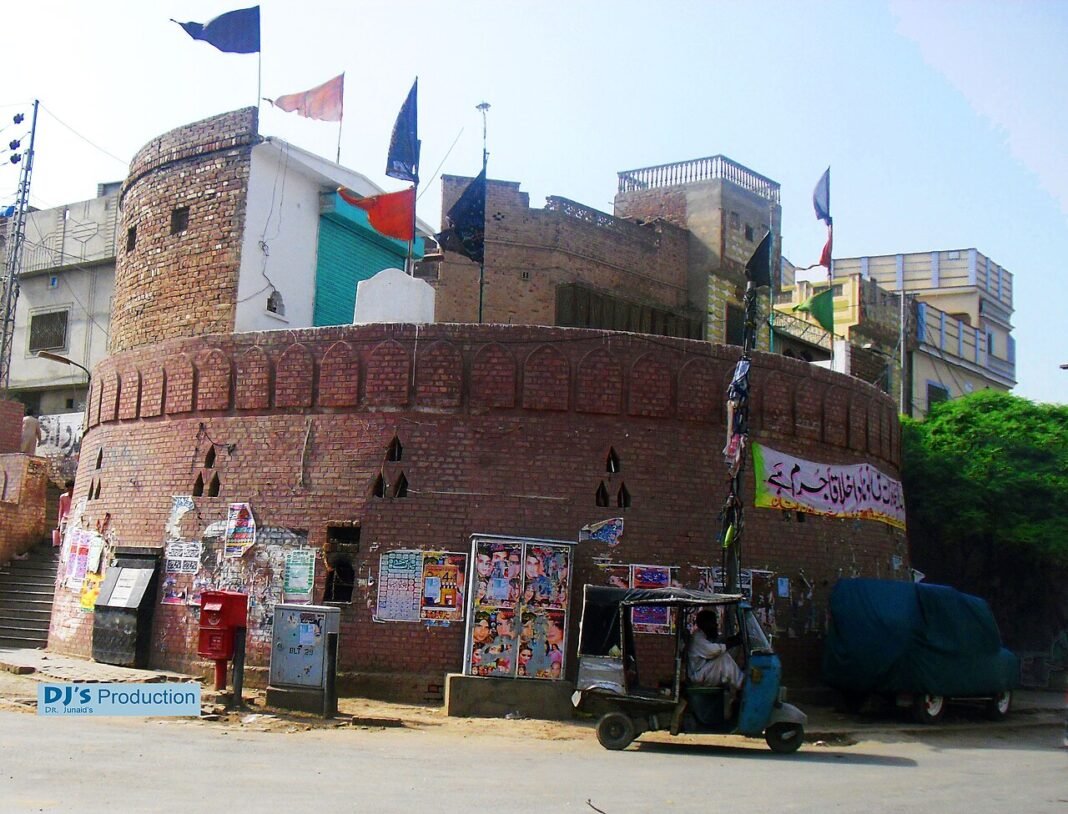
Multan is one of the oldest living cities in the world, and its old walled city still holds the scars of every army that ever tried to take it. The Bloody Bastion, known locally as Khooni Burj, is one of the last standing pieces of that wall. It is a short, weathered tower between Pak Gate and Delhi Gate on Alang Road, and its stones have soaked up more than two thousand years of violence — from Alexander the Great’s invasion to the British siege of 1849. This bloody bastion travel guide tells you the real history of the place, how to reach it, when to go, where to eat and stay in Multan, and what else to see around it.
Quick Facts
- Location: Alang Khooni Burj Street, on Alang Road between Pak Gate and Delhi Gate, inside the old walled city of Multan, Punjab, Pakistan.
- Altitude: Multan stands on the flat Punjab plains, so there is no high elevation to worry about.
- Famous For: A surviving bastion of Multan’s old city wall; the battle of 2 January 1849 during the Siege of Multan, when the 1st Bombay European Fusiliers stormed it; local tradition linking it to Alexander the Great.
- Nearest City: Multan itself — the bastion is in the heart of the old city.
- Accessibility: Easy to reach by car, auto-rickshaw or taxi from anywhere in Multan; Multan International Airport serves domestic and international flights.
- Known Landmarks Nearby: Qila Qasim Bagh (Multan Fort), the tombs of Shah Rukn-e-Alam and Shah Shams Sabzwari, Ghanta Ghar, Hussain Agahi bazaar.
- Best For: History lovers, cultural travellers, photographers, and anyone visiting Multan who wants to see the old city beyond the shrines.
Why Visit Bloody Bastion (Khooni Burj), Multan
Most visitors come to Multan for the Sufi shrines and stay in the newer parts of the city. The Khooni Burj is the opposite experience: a raw, unpolished piece of military history sitting in a working old-city neighbourhood. It is not a museum with ticket counters and gift shops. It is a brick-and-mud tower that survived the guns that flattened everything around it, and standing in front of it is the fastest way to understand what Multan has been through.
The name itself tells the story. Khooni Burj means “Bloody Tower”, and the blood in the name comes from at least two eras. Local tradition says Alexander the Great was wounded near this spot in 326 BCE and that his soldiers took terrible revenge on the people of Multan. More than two thousand years later, in 1849, British and Sikh forces fought hand to hand around this same bastion during the Second Anglo-Sikh War. The fighting here was so fierce that the tower earned its English name — the Bloody Bastion — from the men who stormed it.
A visit also gives you the old city itself. The walled city of Multan is a maze of narrow lanes, ancient gates, bazaars that have been running for centuries, and neighbourhoods where every street corner has a story. The bastion sits on Alang Road between two of the old city gates, Pak Gate and Delhi Gate, so a trip here naturally turns into a walking tour of one of Pakistan’s most atmospheric old quarters.
Finally, the Bloody Bastion pairs perfectly with the rest of Multan’s heritage. In a single day you can move from the bastion to the Qila Qasim Bagh fortress, the great blue-tiled tombs of the Sufi saints, the 1884 Ghanta Ghar clock tower, and the food streets of the inner city. For a traveller who wants substance rather than selfies, the Khooni Burj is one of the most rewarding stops in southern Punjab. If you enjoy heritage trips, you will find more ideas in our Explore Pakistan collection.
History of Bloody Bastion (Khooni Burj), Multan
Multan is among the oldest continuously inhabited cities of the subcontinent, and its fortifications grew layer by layer over centuries. The city wall that once ringed the old city, and the fort that crowned the Qasim Bagh mound, were rebuilt by successive rulers — the exact origins of the Khooni Burj are lost in that long history, but the bastion stands on ground that has been fought over since antiquity.
The oldest tradition tied to the site reaches back to 326 BCE, when Alexander the Great besieged the Mallians (the people of Multan). According to the histories written by his chroniclers, Alexander was badly wounded while storming the citadel — one account says he was struck in the chest — and his enraged Greek soldiers slaughtered the local population, soldiers and civilians alike, in revenge. Local memory in Multan has long connected the blood spilled in that ancient assault to the ground around the Khooni Burj.
The bastion’s documented history belongs to the 19th century. In April 1848, two British political agents, Patrick Vans Agnew and Lieutenant William Anderson, were murdered at Multan by Sikh rebels. Their killing was the spark of the Second Anglo-Sikh War. Multan’s governor, Diwan Mulraj, refused to surrender the city, and British forces under General Whish laid siege to Multan through the winter of 1848–49.
The siege came to its climax in late December 1848 and early January 1849. On 27 December, British columns drove Mulraj’s troops back into the city and set up batteries close to the walls. On 30 December a huge magazine explosion — one of the largest non-nuclear blasts in recorded history — killed hundreds of the defenders. On 2 January 1849, the 1st Bombay European Fusiliers stormed a breach in the city wall at the point known to the British as the “Koonee Boorg” — the Khooni Burj. The fighting around the bastion was brutal, and it is from this battle that the tower takes its English name, the Bloody Bastion. The fort itself fell the same day, and the city was in British hands.
The British found that the bodies of Vans Agnew and Anderson had been buried at the bastion by the Sikhs. After the capture, the two men were exhumed and reburied with honours at the site of the Multan Fort. The city walls and the fort were then largely demolished by the British in 1849 so they could never be used against them again. The Khooni Burj is one of the few fragments of those defences still standing — a survivor of the demolition that levelled its neighbours.
Today the bastion stands hemmed in by the old city’s later growth, on a street named after it. It is protected in memory more than by walls, and heritage writers in Pakistan have long called for proper conservation of Multan’s surviving fortifications, which are old and fragile. For visitors, the tower is best understood as part of the old city’s fabric: a place where you come to look, to photograph, and to remember what the stones have seen.
Top Things to Do in Bloody Bastion (Khooni Burj), Multan
See the Bastion Up Close
The main activity is simply to stand before the tower and take it in. The Khooni Burj is not tall or ornate — it is a solid, time-worn mass of brickwork that has outlasted the armies that broke the rest of the wall. Walk around it, look at the texture of the old masonry, and picture the morning of 2 January 1849 when soldiers climbed a breach right here. Come in the morning light for the best photographs; the lanes are quieter then, and the low sun shows the brickwork at its best.
Walk the Old City Wall Route
From the bastion you can trace the old city’s defences on foot. Walk towards Pak Gate in one direction and Delhi Gate in the other. Both gates are surviving features of the old walled city, and the streets between them are full of old houses, small mosques and shops that have barely changed in a century. This is Multan’s living history, and it costs nothing to explore.
Visit the Old Gates of Multan
Multan’s old city once had several gates; Pak Gate and Delhi Gate flank the Khooni Burj. Haram Darwaza is another historic gate worth a look. Each gate marked an entrance to the walled city and guarded a different trade route, and together they give you a sense of how the medieval city was sealed at night.
Climb Up to Qila Qasim Bagh
The mound of Qila Qasim Bagh, the site of the old Multan Fort, is a short ride from the bastion. The fort itself was destroyed in 1849, but the hilltop still holds the blue-tiled tombs of Shah Rukn-e-Alam and other saints, the Eidgah mosque, and wide views over the city. This is where the remains of Vans Agnew and Anderson were reburied after the siege — a direct link back to the Khooni Burj’s story.
Explore Hussain Agahi and the Bazaars
The lanes around the bastion feed into some of Multan’s oldest bazaars. Hussain Agahi is the place for traditional Multani khussas (embroidered shoes), Kolhapuri jootis, pottery and textiles. The bazaar streets are narrow and crowded, exactly as they have been for generations, and haggling politely is part of the experience.
Famous Places In and Around Bloody Bastion (Khooni Burj), Multan
Qila Qasim Bagh and the ruined Multan Fort mound; the tomb of Shah Rukn-e-Alam with its famous blue glazed tiles; the shrine of Shah Shams Sabzwari; the Damdama (a raised platform near the fort); Ghanta Ghar, Multan’s clock tower built in 1884; the Multan Museum; Pak Gate and Delhi Gate of the old city; Haram Darwaza; the shrine of Shah Yusuf Gardez; Hussain Agahi bazaar.
How to Reach Bloody Bastion (Khooni Burj), Multan
Multan is well connected to the rest of Pakistan by road, rail and air. The Khooni Burj is inside the old city on Alang Road, between Pak Gate and Delhi Gate — any rickshaw or taxi driver in Multan will know it as “Khooni Burj”.
- From Lahore: Around 356 km, roughly 4.5–5.5 hours by car via the M-3/M-4 motorway through Abdul Hakim. Daewoo and other bus services run frequently between the two cities.
- From Islamabad: Around 562 km, roughly 7–8 hours by road via the M-4 motorway. Direct flights to Multan cut the journey to about an hour.
- From Karachi: Around 966 km, roughly 12–13 hours by road via the N-5 or the M-9/M-5 corridor. Overnight buses and several daily flights connect Karachi and Multan; the flight takes about an hour and a half.
- Nearest airport: Multan International Airport, on the edge of the city, with domestic flights to Karachi, Lahore and Islamabad and some international routes.
- Road conditions: Motorways and highways to Multan are good all year. The lanes of the old city around the bastion are narrow and congested — park on a main road and walk, or take an auto-rickshaw to Alang Road.
- Transport options: Careem and inDrive operate in Multan; auto-rickshaws and motorcycle rickshaws are everywhere and are the easiest way into the old city; the Multan Metrobus covers the newer parts of the city.
Route Details
Once you are in Multan, head for the old city. From the city centre or your hotel, take a rickshaw or taxi towards Pak Gate. Enter the old city through Pak Gate and follow Alang Road towards Delhi Gate — the Khooni Burj stands on Alang Khooni Burj Street along this stretch. The whole ride from most parts of Multan takes 15–30 minutes depending on traffic. Because parking inside the walled city is very difficult, ask the driver to drop you near Pak Gate and walk the last few minutes; the bastion is unmistakable once you see it. Combine the visit with the gates, the bazaars and then a ride up to Qila Qasim Bagh to make a full morning of the old city.
Where to Stay in Bloody Bastion (Khooni Burj), Multan
There are no hotels right at the bastion — it sits in a residential old-city neighbourhood — but Multan has accommodation for every budget a short drive away. The best areas to base yourself are the newer parts of the city around Gulgasht Colony, Bosan Road and the roads near the airport, where mid-range and upscale hotels cluster with restaurants and shopping nearby.
Mid-range hotels in these areas offer comfortable rooms with air conditioning, Wi-Fi and in-house restaurants at reasonable rates, and they are the most practical choice for most travellers. Budget guesthouses and smaller hotels near the railway station and in the city centre are cheaper and put you close to the old city, though rooms are simpler. A few higher-end hotels serve business travellers and wedding guests with full facilities. For a first visit, stay in Gulgasht or on Bosan Road and take a rickshaw to the old city in the morning — the combination of modern comfort and old-city sightseeing works well. Book ahead in winter and during wedding season, when the better hotels fill up.
Where to Eat: Local Foods of Bloody Bastion (Khooni Burj), Multan
Multan is one of the great food cities of Pakistan, and no visit to the Khooni Burj is complete without eating your way through the old city afterwards. The city’s most famous export is Sohan Halwa — a dense, ghee-rich sweet studded with nuts that has been made in Multan for generations and is sold in boxes all over the old city as the classic gift to take home. Shops near Ghanta Ghar and in the bazaars sell it fresh.
For savoury food, Multani kebabs — beef and chicken, heavily spiced and eaten with hot naan — are famous across Punjab, and the best stalls are in Hussain Agahi and Kutchery Bazaar. Multani sajji, chicken roasted whole with local spices, and Multani pulao, fragrant rice cooked with meat, are other local signatures. In summer, cool off the Multani way with dahi bhallay and spicy street chaat, and if you visit in mango season (roughly May to July), the Sindhri and Chaunsa mangoes of Multan are among the best in the world.
Food streets and dhaba-style restaurants cluster around the old city gates and in the newer commercial areas. A full local meal at a mid-range restaurant is budget-friendly, and street food costs very little. Stick to busy stalls with high turnover, drink bottled water, and save room for sohan halwa — it is the one thing every Multani will insist you take home.
Weather in Bloody Bastion (Khooni Burj), Multan
Multan has a hot desert climate. Summers are among the hottest in Pakistan, with temperatures regularly crossing 40 degrees, while winters are short, dry and pleasant. The monsoon reaches Multan in July and August but brings less rain than in northern Punjab. For sightseeing around the bastion, the cool months are by far the best.
| Season | Temperature Range | Conditions |
|---|---|---|
| Winter (Dec–Feb) | Around 10°C to 27°C | Cool, dry and sunny. The best weather for walking the old city; light jackets needed on winter mornings. |
| Spring (Mar–Apr) | Around 18°C to 38°C | Warming up fast. March is still pleasant; by late April the heat builds. |
| Summer (May–Jul) | Around 29°C to 43°C | Extremely hot and dry; sightseeing on foot is hard at midday. Mango season makes up for it. |
| Autumn (Sep–Nov) | Around 17°C to 40°C | Heat fades through October; November is dry and comfortable — another good window. |
Language and Culture of Bloody Bastion (Khooni Burj), Multan
The old city around the Khooni Burj is a Saraiki-speaking neighbourhood — Saraiki is the mother tongue of most people in the walled city — while Urdu is understood everywhere and Punjabi is common too. English works in hotels and with younger people but less so in the old bazaars, where a few words of Urdu and a smile go a long way.
Multan is called the City of Saints, and Sufi culture shapes daily life here. The great shrines of Shah Rukn-e-Alam and Shah Shams Sabzwari draw devotees year-round, and the old city moves to the rhythm of shrine life — qawwali evenings, urs gatherings and langar meals. Visitors are welcome at the shrines but should dress modestly, remove shoes where required, and ask before photographing worshippers.
Around the bastion itself, the culture is that of a traditional Punjabi old city: neighbourhoods are close-knit, shopkeepers are proud of their history, and guests are treated with old-fashioned hospitality. Dress modestly (cover shoulders and knees), greet people politely, and accept the inevitable offer of tea — it is how conversations start here. Bargaining in the bazaars is expected but should stay friendly.
Shopping in Bloody Bastion (Khooni Burj), Multan
The bazaars near the Khooni Burj are some of the best shopping streets in southern Punjab. Hussain Agahi bazaar is the famous one — a centuries-old market selling Multani khussas (hand-embroidered leather shoes), Kolhapuri jootis, embroidered textiles, and Multan’s celebrated blue pottery, with its distinctive turquoise and cobalt designs. Camel-skin lamps, another Multani craft, are sold in the craft shops of the old city.
For food gifts, sohan halwa in decorative boxes is the standard souvenir — every sweet shop near Ghanta Ghar and in the bazaars sells it, and it travels well. Dried fruits and nuts are also widely sold. Prices in the old bazaars are reasonable and bargaining is normal; start at about two-thirds of the quoted price and meet in the middle. There are modern shopping areas and malls in the newer parts of Multan for branded goods, but for authentic Multani crafts, the old city bazaars are the place.
Travel Tips for Bloody Bastion (Khooni Burj), Multan
Packing Essentials
Light cotton clothes for most of the year; a light jacket and a shawl for December–January mornings. Comfortable walking shoes are essential — the old city lanes are uneven and you will be on foot. Carry sunscreen, a cap and sunglasses; Multan’s sun is harsh even in winter. A reusable water bottle helps, though bottled water is sold everywhere.
Safety Tips
Multan is generally safe for visitors, and the old city is busy and well-populated during the day. Visit the bastion and the bazaars in daylight hours; the lanes are quieter after dark and harder to navigate. Keep valuables out of sight in crowded bazaars, agree rickshaw fares before the ride (or use a ride-hailing app), and drink bottled or filtered water. Women travellers should dress modestly and will find the shrine and bazaar areas welcoming but conservative.
Money & Connectivity
Cash is king in the old city — small shops, rickshaws and street stalls do not take cards, so carry enough rupees for the day. ATMs are easy to find in the newer commercial areas, banks and along Bosan Road; withdraw before heading into the walled city. All major mobile networks (Jazz, Zong, Telenor, Ufone) have strong coverage in Multan, and 4G data works well. Hotels and most restaurants offer Wi-Fi.
Best Time to Visit Bloody Bastion (Khooni Burj), Multan
Winter (December to February) — Best
This is the ideal season for the Khooni Burj. Days are cool and sunny, perfect for walking the old city, exploring the gates and bazaars, and climbing up to Qila Qasim Bagh. Winter mornings can be foggy on the highways, so allow extra travel time if driving from Lahore or Islamabad.
Spring (March to April) — Good
March is still pleasant and the city is green. By April temperatures climb quickly, so plan old-city walks for the morning and evening and rest at midday.
Summer (May to August) — Avoid for sightseeing
Multan’s summer is brutally hot, often above 40 degrees, and walking the walled city at midday is miserable. If you must come in summer, visit the bastion early in the morning, stay hydrated, and console yourself with the season’s reward: Multan’s mangoes.
Autumn (October to November) — Good
The heat breaks in October and November is dry and comfortable — a second good window for heritage sightseeing, with fewer winter crowds.
Final Thoughts
The Khooni Burj will not impress you with size or decoration. It impresses you with survival. This is a tower that stood while Alexander’s soldiers raged through the city, that took the full weight of a 19th-century siege, and that outlived the great walls it belonged to. There are no ticket booths and no audio guides here — just old bricks, a bloody name, and a neighbourhood that has grown up around them. For travellers who want to feel history rather than just photograph it, that is more than enough.
Pair the bastion with the rest of Multan’s heritage — the fort mound, the blue-tiled tombs, the 1884 clock tower and the food streets — and you have one of the richest single-day heritage itineraries in Pakistan. Come in winter, walk the old city slowly, eat well, and leave with a box of sohan halwa. The Bloody Bastion will have told you its story the way Multan tells all its stories: plainly, and without asking for applause.
FAQs
Where is the Bloody Bastion (Khooni Burj) located?
It stands on Alang Khooni Burj Street on Alang Road, between Pak Gate and Delhi Gate in the old walled city of Multan, Punjab. It is a surviving bastion of the city’s old fortifications.
Why is it called the Bloody Bastion?
The Urdu name Khooni Burj means “Bloody Tower”. Local tradition links bloodshed here to Alexander the Great’s invasion in 326 BCE, and the English name comes from the fierce fighting around the bastion during the Siege of Multan in January 1849, when the 1st Bombay European Fusiliers stormed it.
What is the best time to visit the Bloody Bastion?
October to March, with December to February the best of all. Summers in Multan are extremely hot (often above 40°C), so avoid May to July for walking tours of the old city.
How do I reach the Khooni Burj?
Take a rickshaw or taxi to Pak Gate in Multan’s old city and walk along Alang Road towards Delhi Gate — the bastion is on this stretch. From Lahore it is about 356 km (4.5–5.5 hours by road); from Islamabad about 562 km; from Karachi about 966 km. Multan International Airport also serves the city.
Is the Bloody Bastion safe to visit?
Yes. It is in a busy residential area of the old city. Visit in daylight, keep valuables secure in the bazaars, and use ride-hailing apps or agree rickshaw fares in advance.
Is it suitable for families?
Yes, with common sense. The site itself needs only a short stop, but combine it with the fort mound, shrines and bazaars for a full family day. The old city lanes are uneven, so it is less easy for wheelchairs and very young children on foot.
Where should I stay near the Khooni Burj?
Stay in the newer parts of Multan — Gulgasht Colony, Bosan Road or near the airport — where mid-range and upscale hotels cluster, and take a rickshaw to the old city. There are no hotels right at the bastion.
What food should I try in Multan?
Sohan halwa (the city’s famous sweet), Multani kebabs, sajji, dahi bhallay and chaat, and in summer the Sindhri and Chaunsa mangoes. Hussain Agahi and Kutchery Bazaar have the best street food.