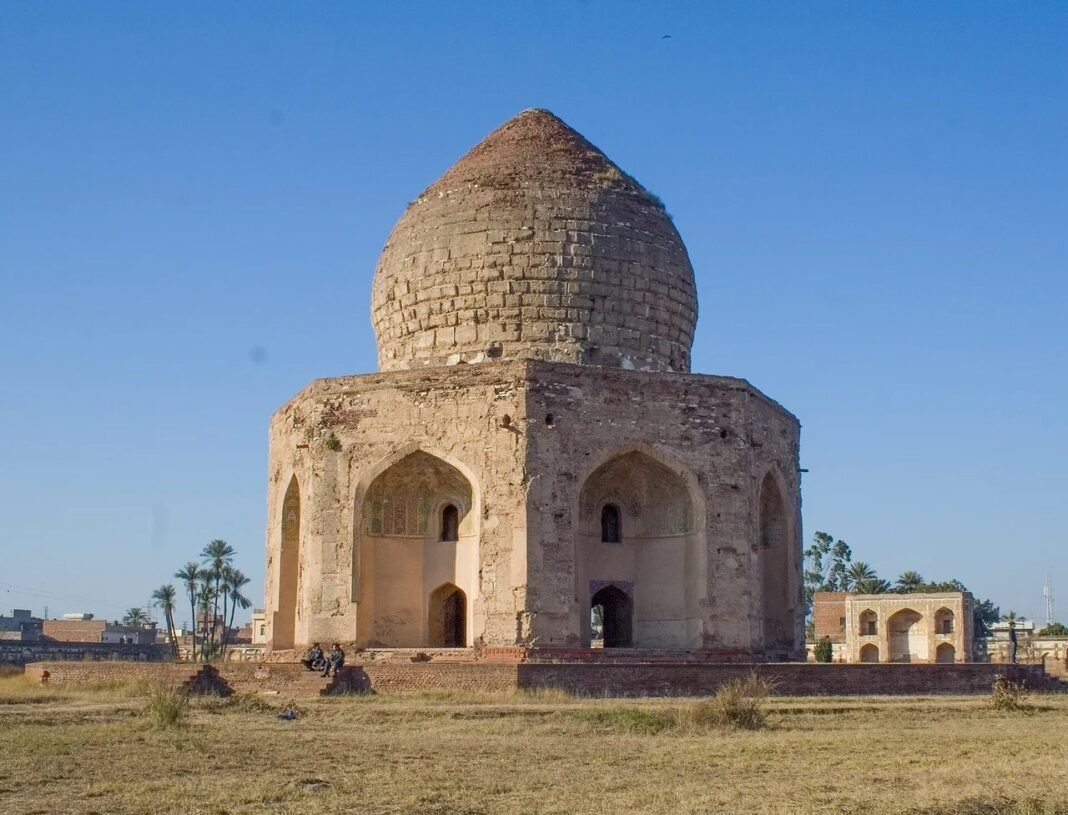
On the Punjab bank of the Indus, in the shadow of the great Attock Fort, stands a square of weathered Mughal masonry that once sheltered the merchants, couriers and armies of an empire. Begum ki Sarai is one of the surviving caravanserais of the Grand Trunk Road, the imperial highway that ran from Agra to Jalalabad, built in the early Mughal period to serve travellers crossing the Indus at Attock. Its exact builder and the identity of its Begum are lost to history, which only adds to its quiet mystery. This begum ki sarai travel guide covers its history, what you can see, and how to plan a visit around it.
Quick Facts
- Location: Near Attock Fort, across the Attock Bridge, Attock District, Punjab, Pakistan
- Built: Early Mughal period, 16th century (exact date not recorded)
- Famous For: A Mughal caravanserai on the Grand Trunk Road; three surviving corner bastions and a pillared baradari
- Nearest City: Attock city, a short drive away; Hasan Abdal is the nearest historic town
- Accessibility: Easy day trip from Islamabad (about 80 to 90 km); note the sarai itself is currently closed to public visitors
- Known Landmarks: The square enclosure (112 by 112 yards), three octagonal bastions, the central baradari, Attock Fort
- Best For: History lovers, Mughal architecture enthusiasts, photographers, and heritage day-trippers from Islamabad
Why Visit Begum ki Sarai
Pakistan’s Mughal monuments are usually palaces, forts and tombs, the architecture of emperors. Begum ki Sarai is something rarer: the architecture of the road itself. Caravanserais were the motorway service stations of the Mughal Empire, walled inns where traders could rest their animals, sleep in safety and continue at dawn, and this one served the most strategic river crossing in the empire’s north-west. To stand before its walls is to understand how the Grand Trunk Road actually worked, not as a line on a map but as a lived system of shelter, security and commerce.
The setting is dramatic. The sarai stands on the Punjab bank of the Indus at Attock, where the river squeezes between rocky hills, the very spot where Attock Fort was built to guard the crossing and where, centuries later, the British threw their great steel road and rail bridge across the water. History is layered thickly here: Mughal, Sikh and British engineering within a few hundred metres of each other, with the Indus flowing beneath.
For architecture lovers, the sarai rewards close looking. The square enclosure, measuring 112 by 112 yards, was ringed with arched compartments fronted by verandahs, and three of its four great octagonal corner bastions still stand. In the centre of the courtyard rises a baradari, a pillared pavilion, whose pillars carry some twenty Persian inscriptions studied by scholars since the 19th century. The mix of small Mughal brickwork and later 19th-century stone repairs tells the building’s long story in its very walls.
An honest note shapes any visit: because of its position beside Attock Fort, a sensitive military installation, Begum ki Sarai is currently closed to public visitors. You cannot walk its courtyard today. But the site is still worth the journey as part of a heritage day trip, viewed from outside and combined with the superb historic towns around it, Hasan Abdal, Taxila and the Attock Bridge viewpoint. Think of it as the anchor of a Grand Trunk Road itinerary rather than a standalone attraction.
History of Begum ki Sarai
The precise date of Begum ki Sarai’s construction is not known, but its fabric places it firmly in the early Mughal period of the 16th century. It belonged to the great chain of caravanserais built along the Grand Trunk Road, the imperial highway the Mughals maintained from Agra to Jalalabad, so that traders, imperial couriers and armies could halt each night behind walls. On the Lahore to Peshawar section, its surviving companions include Sarai Akbari, Rawat and Gor Khatri, and Begum ki Sarai served the most critical point on the whole route: the crossing of the Indus at Attock.
Who built it, and which Begum gave it her name, is not recorded in any surviving source. The Department of Archaeology and Museums, which protects the monument under the Antiquities Act of 1975, notes the early Mughal dating without naming a founder. The building’s ribs and dome profiles, and the Persian inscriptions on its central baradari, all point to the early years of Mughal rule. It is a reminder of how much of the empire’s everyday infrastructure was built by nobles and royal women whose names have not survived, even as their buildings have.
The sarai’s later history is written in its masonry. A major portion of the present boundary wall and the arched compartments were repaired in the closing years of the 19th century using semi-dressed stone, which is why stone and brick masonry sit side by side in different parts of the monument. The original construction was in small brick masonry set in lime and surkhi mortar. Of the four octagonal bastions that once guarded the corners, the south-western one has disappeared with time, and the main eastern gateway, with most of the compartments on that side, is also gone.
Today the sarai is a protected monument of the Federal Government, but its location beside Attock Fort means it sits within a restricted zone and is closed to visitors. Scholars continue to study it: the inscriptions on the baradari were published as early as 1964 in the Journal of the Research Society of Pakistan, and the monument features in studies of the Grand Trunk Road’s caravanserais as a Central Asian legacy. For the traveller, its story is best appreciated alongside the living history of the road it served.
Top Things to Do in Begum ki Sarai
View the Sarai’s Walls and Bastions from Outside
Although the interior is closed, the sarai’s great square walls and three surviving octagonal bastions can be viewed from the surrounding area. Bring binoculars and a zoom lens: the scale of the 112-yard square, the rhythm of the arched compartments along the walls, and the corner towers give a strong sense of the building even from a distance. Early morning light is kindest to the brickwork.
Trace the Grand Trunk Road Story
Use the sarai as the starting point for understanding the old imperial highway. From Attock, the GT Road (N-5) runs south-east through Hasan Abdal, with its Mughal-era associations, toward Taxila and Rawalpindi. Driving this stretch with the sarai’s story in mind turns an ordinary highway journey into a heritage trail, and the surviving sister sarais at Rawat and Gor Khatri can be visited on longer itineraries.
See the Attock Bridge over the Indus
Just downstream from the sarai stands the old Attock Bridge, the magnificent steel road and rail bridge the British built across the Indus, carried on massive masonry piers. The contrast between the Mughal crossing below and the Victorian engineering above is one of the great juxtapositions in Pakistani heritage travel, and the river gorge here is spectacular in its own right.
Visit Hasan Abdal
Fifteen minutes down the GT Road lies Hasan Abdal, one of Punjab’s most historic small towns. The Gurdwara Panja Sahib, one of Sikhism’s holiest shrines, and the Mughal-era Wah Gardens, with their terraced water channels, make it the natural companion to a Begum ki Sarai trip. The town’s dhabas are also the best lunch stop on this route.
Combine with Taxila
The ancient Gandharan city of Taxila, a UNESCO World Heritage site, lies about 40 kilometres south-east of Attock. A well-planned day can pair the Mughal heritage of the Attock crossing with the Buddhist ruins and museum of Taxila, covering two thousand years of history in a single outing from Islamabad.
Famous Places In and Around Begum ki Sarai
- Attock Fort – the great Mughal fortress guarding the Indus crossing (restricted military area, viewed from outside)
- Old Attock Bridge – the British-era steel road and rail bridge across the Indus gorge
- Gurdwara Panja Sahib, Hasan Abdal – one of the holiest Sikh shrines, with its sacred spring
- Wah Gardens, Hasan Abdal – Mughal terraced gardens with flowing water channels
- Taxila – UNESCO-listed Gandharan ruins and museum, about 40 km away
- Sarai Akbari and Rawat – sister caravanserais of the same Grand Trunk Road chain, for extended heritage tours
How to Reach Begum ki Sarai
Begum ki Sarai stands near Attock Fort, just across the Attock Bridge on the Punjab side of the Indus. From Islamabad the distance is about 80 to 90 kilometres, roughly 1 to 1.5 hours by car. The fastest route is the M-1 motorway west to the Attock interchange; the more historic alternative is the Grand Trunk Road (N-5) through Taxila and Hasan Abdal, about 90 kilometres and 1.5 to 2 hours, which suits the theme of the trip. From Lahore the journey is roughly 460 kilometres via the M-2 to Islamabad and onward, about 5.5 to 6.5 hours. Travellers from Karachi should fly to Islamabad and drive, as the road journey exceeds 1,400 kilometres. Local transport options include Daewoo and other coach services to Attock city, from where a taxi or rickshaw covers the short distance to the Attock Bridge area.
Route Details
From Islamabad (M-1): Take the M-1 motorway west toward Peshawar, exit at the Attock interchange, and follow local roads toward Attock Fort and the Attock Bridge. About 80 km, around 1 hour.
From Islamabad (GT Road): Take the N-5 through Taxila and Hasan Abdal, continuing to Attock. About 90 km, 1.5 to 2 hours, with the option to stop at Panja Sahib and Wah Gardens.
From Lahore: M-2 to Islamabad (about 375 km, 4 to 5 hours), then either route above. A long day trip, but doable with an early start.
From Karachi: Fly to Islamabad International Airport, then drive. Coaches connect Karachi with Rawalpindi and Islamabad for those combining the trip with a longer tour.
Important access note: The sarai lies beside a restricted military zone around Attock Fort and is closed to public entry. Plan your visit as an exterior viewing combined with Hasan Abdal and the Attock Bridge, and respect all restricted-area signage and instructions from security personnel.
Where to Stay in Begum ki Sarai
There is no accommodation at the sarai itself, and Attock city has only simple local hotels and guesthouses. Most visitors treat this as a day trip from Islamabad or Rawalpindi, where the full range of hotels is available, and that is the most comfortable option. If you want to linger in the area, Hasan Abdal has a few modest guesthouses, and Taxila, about 40 kilometres away, has mid-range hotels that serve the heritage-tourism traffic. For a two-day Grand Trunk Road itinerary, base yourself in Islamabad on night one and Taxila or Hasan Abdal on night two. Book ahead only in the sense of choosing a reliable Islamabad hotel; the local guesthouses rarely need advance booking.
Where to Eat: Local Foods of Begum ki Sarai
The food of this region is the robust Punjabi cuisine of the GT Road dhabas. Expect tandoori roti hot from the clay oven, daal fry, chicken and mutton karahi, mixed sabzi, and tall glasses of sweet or salted lassi. The dhabas between Hasan Abdal and Attock are institutions in their own right, serving truckers and travellers alike at very budget-friendly prices, and the food is honest, filling and flavourful. In Hasan Abdal town you will find proper restaurants alongside the dhabas, and Attock city’s bazaar has sweet shops selling local mithai. A full dhaba meal for two costs little by city standards, and the lassi alone is worth the drive.
Weather in Begum ki Sarai
Attock sits on the Punjab plains at the foot of the hills, so the climate is the classic hot-summer, cool-winter pattern of northern Punjab, far warmer than the mountain destinations elsewhere in this series. Summer afternoons are intensely hot, winter mornings can be foggy and crisp, and the pleasant windows are spring and autumn. Plan outdoor viewing for the cooler hours of the day in the warmer months.
| Season | Temperature Range (approx.) | Conditions |
|---|---|---|
| Winter (Dec-Feb) | 5°C to 18°C | Cool and often foggy in the mornings; pleasant afternoons for sightseeing |
| Spring (Mar-Apr) | 18°C to 32°C | Warm and pleasant; the best season for a heritage day trip |
| Summer (May-Aug) | 30°C to 42°C | Very hot; visit early morning or late afternoon; monsoon showers in July-August |
| Autumn (Sep-Nov) | 18°C to 33°C | Clearing skies and comfortable temperatures; excellent for photography |
Language and Culture of Begum ki Sarai
Attock district sits at a linguistic crossroads. Punjabi is the dominant everyday language, with Hindko widely spoken in the towns and Urdu understood everywhere. The culture is that of the Punjab frontier: warm, direct and hospitable, with a strong tradition of military service that shapes local pride. Visitors should dress modestly and behave with particular respect around the restricted zones near Attock Fort; photography of military installations is prohibited, and security personnel’s instructions should be followed promptly. The Sikh heritage of Hasan Abdal, centred on Gurdwara Panja Sahib, adds a layer of religious significance to the area, and visitors to the gurdwara should cover their heads and remove shoes as custom requires. Friday is the weekly holiday rhythm here as elsewhere in Pakistan.
Shopping in Begum ki Sarai
The bazaars of Attock city and Hasan Abdal are traditional Punjab market towns, selling everything from embroidered khussas (traditional shoes) to local pottery, sweets and everyday goods. Look for Attock’s sweet shops, the cloth merchants of the old bazaar, and the small handicraft stalls near the historic sites. There are no large shopping malls in the immediate area; the retail experience here is the classic Pakistani bazaar, which suits the heritage theme of the trip perfectly. Prices are modest, bargaining is expected, and the mithai shops near Hasan Abdal are worth a dedicated stop.
Travel Tips for Begum ki Sarai
Packing Essentials
For a day trip you need little: sun protection, a hat and water in the warmer months, a warm layer for winter mornings, and comfortable walking shoes. Bring a camera with a zoom lens for viewing the sarai’s bastions from outside the restricted zone, and carry your CNIC or passport, as identification may be checked near sensitive areas.
Safety Tips
The single most important tip is to respect the restricted zone. Begum ki Sarai sits beside Attock Fort, an active military installation; do not attempt to enter closed areas, do not photograph security installations, and follow the instructions of security personnel without argument. Stick to the public roads and viewpoints, keep your vehicle documents in order, and you will have a trouble-free visit.
Money & Connectivity
ATMs are available in Attock city and Hasan Abdal, but carry cash for dhabas, small shops and rickshaws. Mobile signals from all major networks are strong throughout the area, and the M-1 and GT Road corridors have good coverage. Fuel stations are frequent on both routes from Islamabad.
Best Time to Visit Begum ki Sarai
Spring (March to April)
The best season. Warm days, clear skies and green fields make the Attock crossing and its monuments look their finest, and the drive down the GT Road is a pleasure.
Autumn (October to November)
Nearly as good as spring, with crisp light that suits photography of the sarai’s brickwork and the Indus gorge. A fine time to combine with Taxila.
Winter (December to February)
Cool and often foggy in the mornings, but the afternoons are pleasant for sightseeing. The low winter sun gives the old masonry a beautiful warmth.
Summer (May to August)
The least comfortable season, with temperatures crossing 40 degrees. If you must come in summer, start at dawn, finish by midday, and spend the hot hours over lassi in Hasan Abdal.
Final Thoughts
Begum ki Sarai will not give you a courtyard to wander or a ticket counter to pass; what it gives you is rarer, a direct encounter with the working infrastructure of the Mughal Empire, set at one of the great river crossings of South Asia. Its closed gates are a reminder that history in Pakistan is not only in museums, it is still entangled with the present, guarded, lived-in and real.
Come for the sarai, stay for the Grand Trunk Road: the steel span of the Attock Bridge, the holy spring of Panja Sahib, the gardens of Wah, and the ancient streets of Taxila. For more heritage journeys, explore our Explore Pakistan collection and the Islamabad places guide for planning your base.
FAQs
Where is Begum ki Sarai located?
Begum ki Sarai is near Attock Fort, across the Attock Bridge on the Punjab bank of the Indus, in Attock District, Punjab, about 80 to 90 kilometres from Islamabad.
What is the history of Begum ki Sarai?
It is a caravanserai from the early Mughal period (16th century), built on the Grand Trunk Road to shelter travellers crossing the Indus at Attock. Its exact builder and the identity of its Begum are not recorded.
Can visitors enter Begum ki Sarai?
No. Because of its location beside Attock Fort, a sensitive military installation, the sarai is currently closed to public visitors. It can be viewed from outside as part of a heritage day trip.
What is the best time to visit?
March to April and October to November offer the most pleasant weather. Summer is very hot; winter mornings can be foggy.
How do I reach Begum ki Sarai from Islamabad?
Drive about 80 km via the M-1 motorway (around 1 hour) or about 90 km via the historic GT Road through Hasan Abdal (1.5 to 2 hours).
Is Begum ki Sarai suitable for families?
Yes, as a day trip combined with Hasan Abdal’s gurdwara and gardens or Taxila. The driving is easy and the stops are family-friendly.
Where can I stay near Begum ki Sarai?
Most visitors day-trip from Islamabad. Simple guesthouses exist in Attock and Hasan Abdal, and mid-range hotels in Taxila.
What food should I try in the area?
Classic GT Road dhaba food: tandoori roti, daal, chicken or mutton karahi, and thick Punjabi lassi, all at budget-friendly prices.