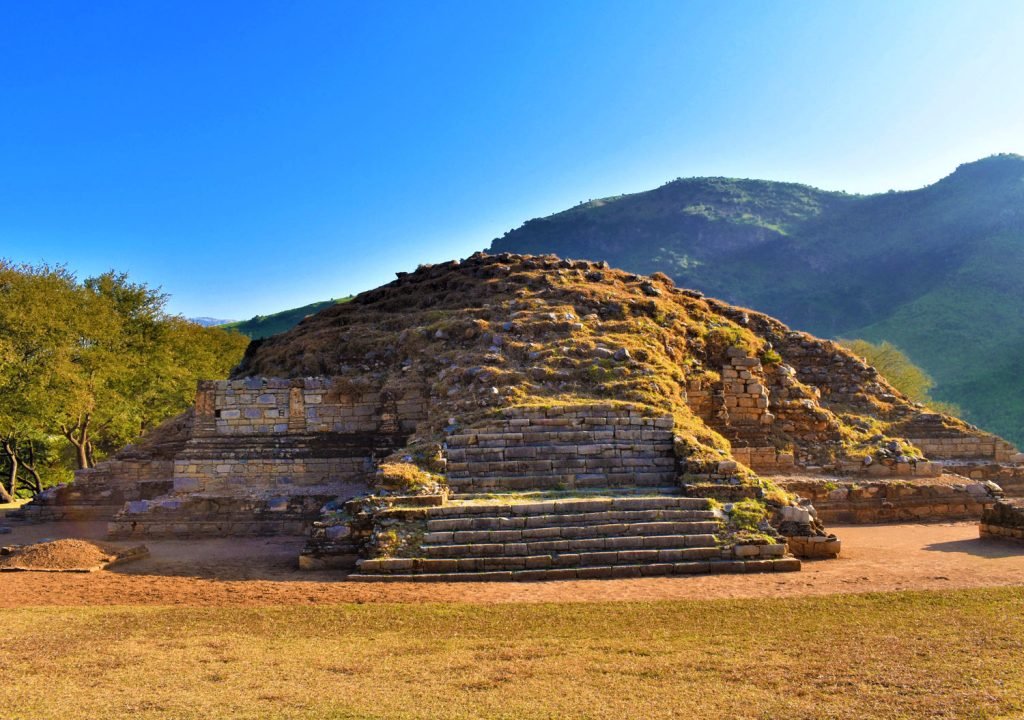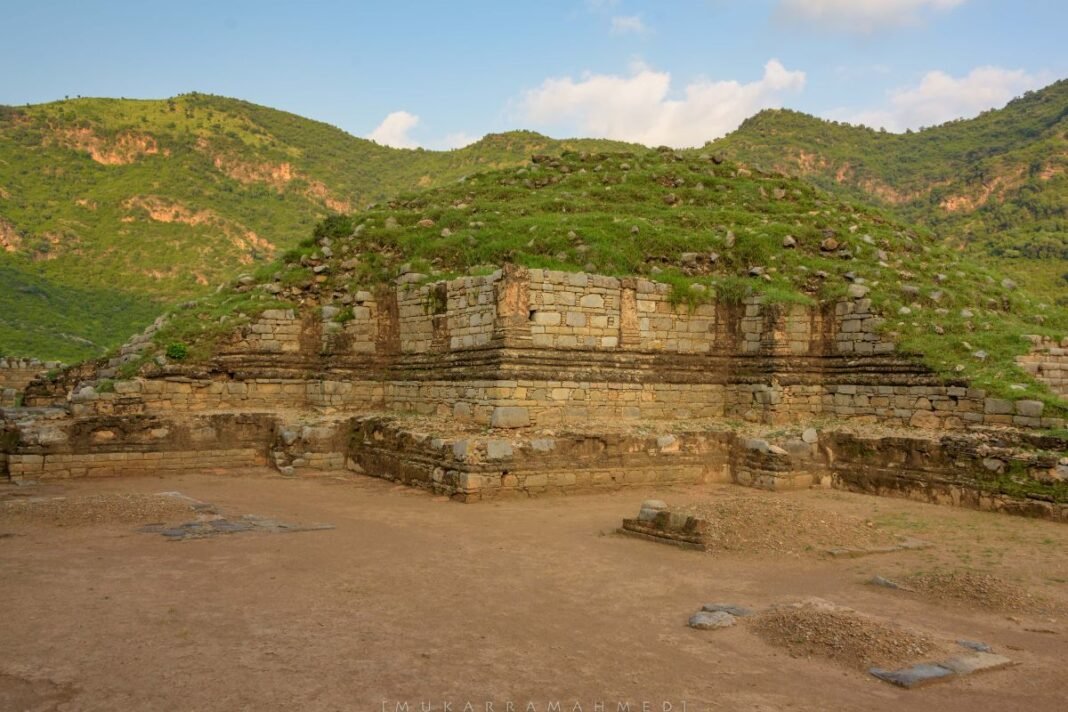
The Bhamala Stupa near Haripur is one of the great surviving monuments of the Gandhara civilisation. A ruined Buddhist stupa of the 2nd century CE, it stands on the banks of the Haro River by the Khanpur Dam, and it is famous for two things: a rare cruciform plan that marks a turning point in Buddhist architecture, and a 1,700-year-old statue of the Buddha attaining enlightenment that is considered the oldest of its kind in the world. First excavated in 1929 and dug again from 2017 onward, it is one of the best-preserved sites of the ancient Taxila valley. This Bhamala Stupa, Haripur travel guide gives you its full history, what to see, how to get there, the best time to visit and everything you need to plan the trip.
Quick Facts
- Location: Bhamala, near Khanpur in Haripur District, Khyber Pakhtunkhwa; on the Haro River, very close to Khanpur Dam.
- Altitude: Around 500 metres above sea level (approximate, Haripur valley).
- Famous For: The cruciform main stupa (the largest surviving example of this shape in the Taxila-Gandhara region); the world’s oldest statue of the Buddha attaining enlightenment; Kushan-period coins and sculptures found in recent digs; nomination for UNESCO World Heritage status.
- Nearest City: Haripur (about 25 km); nearest town is Khanpur (about 10 km).
- Accessibility: About 1.5 hours by road from Islamabad via the Haripur-Taxila road; nearest airport is Islamabad International Airport.
- Known Landmarks: Khanpur Dam, Haro River, Taxila Museum and ruins, Haripur city.
- Best For: Archaeology and history enthusiasts, Buddhist pilgrims and heritage travellers, students, photographers, and families looking for an educational day trip from Islamabad.
Why Visit Bhamala Stupa, Haripur
Gandhara was one of the great Buddhist civilisations of the ancient world, and its heartland is in what is now northern Pakistan. Taxila gets most of the attention, but Bhamala is where you can see Gandharan architecture at its most unusual. The main stupa is cruciform: a cross-shaped monument with staircases on all four sides. This was one of the final stages in the evolution of the Gandhara stupa, and Bhamala is the biggest surviving example of the form in the entire Taxila and Gandhara region. If you want to understand how Buddhist building changed over the centuries, this single monument teaches the lesson.
Then there is the human story in stone. The site has yielded a 1,700-year-old statue of the Buddha attaining enlightenment, described as the oldest such statue in the world, along with a remarkable double-halo Buddha figure, terracotta sculptures, carved heads and coins of the Kushan period. These are not copies in a museum; they come from the ground you walk on. The excavations that found them, resumed in 2017 after an eighty-year gap, are still part of the site’s life, with a field training school teaching a new generation of Pakistani archaeologists.
The landscape is the third reason. Bhamala sits where the Haro River meets the hills by the Khanpur Dam. The site is ringed by the river on its north-eastern and eastern sides and by green mountains to the north and north-west. The road to the complex runs along the western side of the dam, so the journey itself is scenic. It is a place where you can spend a morning among ruins and an afternoon by the water.
Finally, it is practical. Bhamala is about 90 minutes from Islamabad, which makes it one of the easiest major archaeological sites in Pakistan to visit. It combines naturally with Taxila’s museum and ruins or with a day at Khanpur Dam. For travellers based in the capital who want history without a long expedition, few options beat it.
History of Bhamala Stupa, Haripur
Bhamala belongs to the Gandhara civilisation, the Buddhist culture that flourished between roughly the 1st century BCE and the 5th century CE in the valleys around Peshawar and Taxila, reaching its height under the Kushan Empire. The stupa is dated to the 2nd century CE, with the wider complex in use through the 5th century. Its cruciform design places it near the end of the Gandhara stupa’s architectural evolution. Earlier forms include the Dharmarajika Stupa near Taxila, with its near-Indian hemispherical dome sitting almost directly on the ground; the elongated Loriyan Tangai stupa, rich with narrative reliefs; and the near-pyramidal stupa at Jaulian. Bhamala’s cross-shaped plan, with its four staircases, was the next step, and the design later grew into the towering form of the second stupa of Kanishka. Because of this position in the sequence, archaeologists treat Bhamala as a key site for reading the whole history of the Gandhara stupa.
The first scientific work at Bhamala was carried out in 1929 by Sir Sufian Malik and Sir John Marshall, the Director-General of the Archaeological Survey of India, with excavation continuing into the early 1930s. Marshall was already famous for his work at Harappa and Mohenjo-daro. His interest at Bhamala was the large, unusual cruciform stupa and the monastery beside it, including a chamber with the remains of the great reclining Buddha. After the early 1930s, the site was left largely unstudied for decades.
Work resumed in 2017. The Khyber Pakhtunkhwa Directorate of Archaeology and Museums, together with Hazara University Mansehra, reopened the dig, and the new excavations produced remarkable finds: Buddhist sculptures and heads of the 2nd to 5th century AD, mostly in terracotta, precious coins of the Kushan period from around the stupa, and the celebrated statue of the Buddha attaining enlightenment, some 1,700 years old and regarded as the oldest of its kind in the world. A rare double-halo Buddha figure was also found, a first for the site. The directorate set up a field training school at Bhamala, where more than fifty students and field staff learned modern excavation methods, with offers of help from foreign scholars in the United States and Britain.
Bhamala is a declared National Heritage Site, and its nomination for UNESCO World Heritage status led to conservation and partial restoration of the ruins, focused on the main stupa. Since June 2015 the site has been under the care of the Department of Archaeology and Museums of the Government of Khyber Pakhtunkhwa. The complex today includes the great cruciform stupa, about nineteen smaller votive stupas in the courtyard, monastery cells and shrines, and it is regarded as one of the best-preserved Buddhist sites in the Taxila valley.
Top Things to Do in Bhamala Stupa, Haripur
Study the Cruciform Plan Up Close
Start with the main stupa and walk its full circuit. The cross-shaped footprint, with a staircase on each of the four sides, is what makes Bhamala famous. From above, the plan reads clearly; from the ground, the stepped mass of the stupa has been compared by visitors to a stepped pyramid. Guides can explain how this form grew out of the earlier round and pyramidal stupas of Gandhara. Take photographs from each corner to capture the symmetry.
See the Great Reclining Buddha
The site’s signature monument is the monumental statue of the Buddha attaining enlightenment, about 1,700 years old. It is considered the oldest statue of the Buddha’s parinirvana in the world and the largest such figure ever found in Gandhara. Ask the site staff where the remains can best be viewed and listen to the story of its discovery and restoration, which involved traditionally trained Gandharan sculptors working with the archaeology department.
Walk the Courtyard of Votive Stupas
Nineteen smaller votive stupas surround the main monument in its courtyard. These were built by donors and pilgrims over the centuries, each one a personal act of devotion. Walking among them, with the great stupa rising behind, gives a vivid sense of what a living Buddhist complex felt like. Look for the remains of carved decoration on the smaller structures.
Visit the Monastery Area
Behind the stupas lie the monastery cells and shrines where monks lived, studied and meditated. The remains of living quarters remind you that Bhamala was not just a monument but a working religious community. One tradition associates the site with learned monks of the Gandharan period. Walk quietly here; it is the most contemplative part of the complex.
Combine the Ruins with Khanpur Dam
The stupa stands very near the Khanpur Dam, and the two belong together in a day plan. After the archaeology, drive to the dam for the views, a lakeside walk or a boat ride. The contrast between 1,700-year-old ruins and the blue reservoir is one of the most photogenic pairings in the region.
Famous Places In and Around Bhamala Stupa, Haripur
- Khanpur Dam: The reservoir on the Haro River, a popular weekend spot for boating, swimming areas and lakeside views.
- Taxila Museum and ruins: The great Gandharan sites of Dharmarajika, Jaulian and Sirkap, plus the museum’s sculpture collection.
- Haro River: The river that wraps around the site; its banks are good for short walks and photography.
- Khanpur town: The nearest town, about 10 km away, with markets and eateries.
- Haripur city: The district centre, about 25 km away, with hotels, restaurants and bazaars.
- Margalla Hills / Islamabad: The capital’s hills and museums make a natural bookend to the trip.
How to Reach Bhamala Stupa, Haripur
Bhamala is reached from the Haripur-Taxila road via Khanpur. The site is about 7 km from the main road, and the final stretch is a rural link road.
From Islamabad: Allow about 1.5 hours. Drive toward Taxila on the GT Road or motorway, then follow the Haripur road to Khanpur. At Khanpur, take the link road toward the Bhamala stupa, which runs along the western side of the Khanpur Dam for about 7 km to the site. Signboards for the stupa are limited, so navigate by GPS and confirm directions with locals in Khanpur. The total distance from central Islamabad is roughly 60-70 km.
From Lahore: Take the M-2 Motorway to the Islamabad/Rawalpindi area, then follow the Taxila-Haripur route to Khanpur. The total distance is around 430-450 km and the drive takes about 5.5 to 6.5 hours. This works best as an overnight trip, ideally combined with Taxila.
From Karachi: Fly to Islamabad International Airport (about 2 hours) and drive 1.5 hours to Bhamala. The road journey from Karachi is over 1,400 km and is not practical for a short trip.
Nearest airport: Islamabad International Airport.
Road conditions: Motorway, GT Road and the Haripur-Taxila road are all in good condition. The last 7 km from Khanpur is a narrow rural road along the dam; it is fine for cars in dry weather but needs care after rain. Avoid the link road during heavy monsoon downpours.
Transport options: A private car or hired car with driver is the best option, since no public transport reaches the site. Public vans connect Rawalpindi, Taxila, Khanpur and Haripur; from Khanpur you will need to hire a local taxi or rickshaw for the final 7 km.
Route Details
From Islamabad, head out on the GT Road (N-5) toward Taxila, or take the motorway and exit toward Taxila/Haripur. Continue on the Haripur road past Taxila toward Khanpur. In Khanpur town, turn onto the link road signposted (or locally known) for the Bhamala stupa and follow it along the western shore of the Khanpur Dam. The road is scenic, with the reservoir on one side and hills on the other. After about 7 km you arrive at the Bhamala Buddhist Complex on the bank of the Haro River. There is parking near the entrance; check in with the site staff before entering the protected area. Download the route offline, because mobile data can drop out near the dam.
Where to Stay in Bhamala Stupa, Haripur
There is no accommodation at the archaeological site, and the nearest options are in Khanpur town (small hotels and guesthouses, about 10 km away) and Haripur city (mid-range hotels and guesthouses, about 25 km away). The Khanpur Dam area also has a few resorts and guesthouses aimed at weekend visitors from Islamabad and Rawalpindi; these are popular on weekends, so book ahead.
Most travellers visit Bhamala as a day trip from Islamabad or Rawalpindi, where every category of hotel is available, from luxury five-stars to budget guesthouses. If you are combining Bhamala with the Taxila sites, Taxila’s PTDC motel and mid-range hotels are convenient. Staying overnight near the site is only worth it if you want sunrise photography at the dam or a slow two-day itinerary covering both Bhamala and Taxila.
Where to Eat: Local Foods of Bhamala Stupa, Haripur
The Hazara region’s food is simple, hearty and meat-centred. Around Khanpur and Haripur you will find chapli kebab, seekh kebab, mutton and chicken karahi, and daal with fresh tandoori naan at roadside dhabas. In the colder months, makai ki roti with sarson ka saag appears in village kitchens, and roasted corn is a favourite winter street snack in Haripur. Doodh patti and lassi are the standard drinks, and local honey is sold in the area’s markets.
There are no eateries at the stupa itself, so plan meals in Khanpur or Haripur, or bring a picnic to enjoy by the Haro River. Dhaba meals on the Haripur-Taxila road are fresh and budget-friendly; pick the busiest dhaba you can find. Haripur city has proper restaurants with wider menus at modest prices. Carry drinking water and snacks for the site visit, and carry your rubbish back out.
Weather in Bhamala Stupa, Haripur
Bhamala shares Haripur’s climate: hot summers with a monsoon peak, and cool, dry winters with plenty of sunshine. Because the site is entirely outdoors with almost no shade, the season you choose shapes the experience. October to March is the recommended window.
| Season | Temperature Range | Conditions |
|---|---|---|
| Winter (Dec-Feb) | 6°C to 19°C | Cool, dry and bright; ideal for walking the ruins; frosty mornings, so layer up. |
| Spring (Mar-Apr) | 15°C to 30°C | Mild with green hills; very pleasant for the site and the dam road. |
| Summer (May-Aug) | 30°C to 38°C | Hot and, in July-August, very wet; heavy monsoon rain (over 140 mm in August in Haripur); go at dawn and carry water. |
| Autumn (Sep-Nov) | 17°C to 29°C | Settled and comfortable; November is dry with low humidity; excellent for photography. |
Winter days at Bhamala are short but beautiful, with more than seven hours of sunshine even in December, and the low sun brings out the texture of the ancient brickwork.
Language and Culture of Bhamala Stupa, Haripur
Hindko is the first language of much of the Haripur area, with Urdu widely spoken and understood; Pashto and Punjabi are also heard, and English works in hotels and with educated guides. The local culture is Hazarewal: hospitable, traditional and conservative. Dress modestly and behave with restraint at the site. Remember that Bhamala is both an archaeological zone and a sacred Buddhist place: do not climb the stupas, do not sit on ancient walls, do not move stones, and never take “souvenirs”. Photography of the ruins is fine, but ask before photographing people in nearby villages. If excavation work is in progress during your visit, watch from the marked areas and do not enter the trenches.
Shopping in Bhamala Stupa, Haripur
There is nothing to buy at the site, which is as it should be for a protected monument. Khanpur town has small markets for daily goods and seasonal fruit. Haripur’s bazaars sell fabrics, footwear, dry fruits and local honey. For Gandhara-themed souvenirs, go to Taxila, where workshops produce replica sculptures, and the museum shop stocks books and postcards. A firm rule: never buy objects presented as genuine ancient artefacts. Pakistan’s antiquities laws prohibit their sale and export, and most such pieces are modern fakes. The nearest modern malls are back in Islamabad and Rawalpindi.
Travel Tips for Bhamala Stupa, Haripur
Packing Essentials
Sun protection is essential for most of the year: hat, sunscreen and sunglasses. Carry at least a litre of drinking water per person, sturdy walking shoes for uneven ground, and snacks, since there are no shops at the site. In winter add a warm jacket and in monsoon season add a rain cover. A pair of binoculars is a nice extra for the dam views.
Safety Tips
Visit in daylight and preferably with company or a guide. The ruins are fragile and the ground uneven, so watch every step and keep children close. The link road by the dam is narrow with blind turns; drive slowly and honk before bends. Do not swim in the dam’s restricted zones; use only designated safe spots. The area is generally peaceful, but standard travel caution applies.
Money & Connectivity
Carry enough cash for the whole trip: fuel, food, any site fees and the return journey. ATMs are in Khanpur and Haripur, not at the site. Mobile coverage is patchy around the dam and the river, so save maps and the site’s location offline. Fill the fuel tank in Taxila or Khanpur before the final stretch.
Best Time to Visit Bhamala Stupa, Haripur
Winter (December to February)
The prime season. Daytime temperatures of 6-19°C, dry air and clear light make this the perfect time to explore the stupas and monastery. December mornings can be misty over the river, which photographers love.
Spring (March to April)
Mild days, wildflowers on the hillsides and comfortable walking weather. Spring is ideal if you want to combine Bhamala with a longer stay around Khanpur Dam.
Summer (May to August)
Hot and humid, with the monsoon peaking in July and August. Visit at first light, finish by mid-morning, and spend the hot hours by the dam or back in town. Check weather warnings before driving the link road in heavy rain.
Autumn (September to November)
One of the finest windows: warm days, cool evenings, low rainfall and crisp views. October and November are superb for both the archaeology and the dam scenery.
Final Thoughts
Bhamala is where the Gandhara civilisation stops being a museum label and becomes a place you can walk through. The cruciform stupa, the oldest known statue of the Buddha attaining enlightenment, the Kushan coins still turning up in the soil: it is a site that keeps giving, from Marshall’s first trenches in 1929 to the training school’s new digs today. And it sits in a landscape of river, dam and hills that would be worth the drive even without the archaeology.
Make it a winter or autumn day trip from Islamabad, pair it with Taxila or Khanpur Dam, and give the stones the slow attention they deserve. Seventeen centuries of history are waiting on the banks of the Haro. For more heritage journeys, browse our Explore Pakistan section, plan a mountain escape with our Malam Jabba travel guide, or explore the north in our Hunza Valley guide.
FAQs
Where is Bhamala Stupa located?
Bhamala Stupa is near Khanpur in Haripur District, Khyber Pakhtunkhwa, on the Haro River close to Khanpur Dam, about 25 km from Haripur and 7 km off the main road at Khanpur.
How old is Bhamala Stupa?
It dates to the 2nd century CE, with the Buddhist complex in use into the 5th century, during the Gandhara civilisation under the Kushan Empire.
Who excavated Bhamala Stupa?
Sir Sufian Malik and Sir John Marshall first excavated it in 1929-1930s; excavations resumed in 2017 by the KP archaeology department and Hazara University Mansehra.
What is the famous statue at Bhamala?
A 1,700-year-old statue of the Buddha attaining enlightenment, considered the oldest of its kind in the world, plus a rare double-halo Buddha and Kushan-period coins and sculptures.
What is the best time to visit Bhamala Stupa?
October to March, especially winter (December-February), when days are cool, dry and clear. Summer is hot with monsoon rain.
How do I reach Bhamala Stupa from Islamabad?
Drive about 1.5 hours via Taxila/Haripur to Khanpur, then take the 7 km link road along the Khanpur Dam to the site. A private car is recommended.
Is Bhamala Stupa a UNESCO World Heritage Site?
It has been nominated for UNESCO World Heritage status, which led to restoration work; it is a declared National Heritage Site under the KP Department of Archaeology and Museums.
Can I combine Bhamala with other sights?
Yes. Khanpur Dam is minutes away, and the Taxila archaeological sites and museum are about an hour’s drive, making an easy combined day trip from Islamabad.