Quick Facts
- Location: Taxila, Punjab — the mound lies just south of the Taxila Museum, east of the Taxila railway station and west of Tamra Nala.
- Altitude: Taxila sits at about 549 metres above sea level, in a valley ringed by low hills.
- Famous For: The oldest of Taxila’s three successive cities — Achaemenid, Alexander-era, and Mauryan ruins stacked in four archaeological layers.
- Nearest City: Taxila town; Islamabad is about 32 kilometres to the southeast.
- Accessibility: An easy walk from the Taxila Museum; the site is open ground with uneven paths. Best reached by car via the GT Road.
- Known Landmarks: The excavated city foundations, ancient water conduits, narrow streets and courtyard houses, and the adjacent Taxila Museum.
- Best For: History lovers, archaeology enthusiasts, students, Buddhist heritage travelers, and photographers of ancient ruins.
Why Visit Bhir Mound, Taxila
Every great ancient city has a first chapter, and Bhir Mound is Taxila’s. Before the grand planned streets of the Greek city of Sirkap and before the stupas of the Buddhist age, there was this low, unassuming mound — the earliest urban settlement of one of the most famous cities of the ancient world. Walking across Bhir Mound is walking across the foundations of a city that was already old when Alexander the Great arrived in 326 BCE.
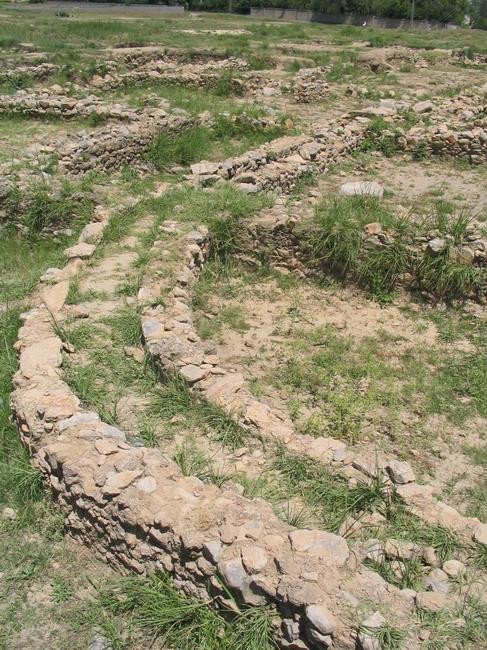
What makes Bhir Mound special is its honesty. Unlike reconstructed monuments, the mound shows you archaeology in the raw: four distinct layers of occupation, from Persian-era heavy masonry at the bottom to Mauryan-period construction at the top. You can see how a city was destroyed and rebuilt three times, each generation raising its streets a little higher on the ruins of the last. Few places in Pakistan let you read twenty-five centuries of urban history in a single glance across an excavation trench.
Bhir Mound is also the perfect anchor for a full Taxila day. The Taxila Museum stands a few minutes’ walk to the north, packed with the Gandharan sculptures, coins, and jewelry recovered from these very ruins. Combine the mound with Sirkap, the Dharmarajika Stupa, and the Jaulian monastery, and you have one of the richest heritage days in South Asia — all within a short drive of Islamabad. As part of the Taxila UNESCO World Heritage Site, inscribed in 1980, Bhir Mound carries a status few archaeological sites in the world can match.
History of Bhir Mound, Taxila
Bhir Mound contains the oldest ruins of Taxila, the ancient city the Greeks called Taxila and the Sanskrit texts called Takshashila. The settlement here developed from the 6th century BCE and remained occupied through the 2nd century BCE — roughly four hundred years of continuous urban life.
The archaeological story is told in four strata. The lowest and earliest layer, from the 6th and 5th centuries BCE, contains the heavy masonry buildings of the Achaemenid period. The Persian king Darius I conquered this region in 518 BCE, and Taxila is believed to have formed part of the Persian Empire’s eastern satrapy. Sir John Marshall, who excavated the site from 1913 to 1925, identified this heavy Achaemenid masonry as the foundation of it all.
The second layer belongs to the 4th century BCE — the age of Alexander. In 326 BCE Alexander the Great reached Taxila, where the local ruler Raja Ambhi surrendered and even supplied him with war elephants. The city passed through the hands of Alexander’s successors, and in 316 BCE it fell to Chandragupta Maurya, founder of the Mauryan dynasty, becoming a provincial capital of that great empire. The third stratum is Mauryan (3rd century BCE), the era when Buddhism took root here under Emperor Ashoka, who is said to have resided at Taxila as his father’s viceroy. The fourth and topmost layer holds post-Mauryan construction.
The mound’s excavations show the city was destroyed three times and rebuilt each time at a higher level — a cycle of catastrophe and renewal written in stone and mud-brick. Around 184 BCE, the Bactrian Greeks invaded Gandhara and Punjab, and the city’s life shifted to a new, carefully planned settlement east of the Tamra Nala: Sirkap, the second city of Taxila. Bhir Mound was left to the earth.
The modern rediscovery began with Sir John Marshall’s excavations (1913-1925, within his broader Taxila campaign of 1913-1934). Sir Mortimer Wheeler continued the work in 1944-1945, introducing modern stratigraphic methods; Dr. Mohammad Sharif excavated in 1966-1967; Bahadur Khan worked the site from 1998 to 2000; and Dr. Ashraf and Mahmud-al-Hassan dug in 2002. In recent years the Punjab Department of Archaeology has resumed excavations, reporting cultural deposits from the 2nd, 4th, and 6th centuries BCE — with deeper trenches possibly pushing the site’s story even earlier. The ruins measure roughly one kilometre from north to south and about 600 metres from east to west.
Taxila itself was far more than a trading post. In the ancient world it was celebrated as a great centre of learning — a place where princes and scholars came to study, centuries before the famous universities of the later age. The Chinese pilgrims Faxian and Xuanzang (Hieun Tsang) visited in the 5th and 7th centuries CE and left accounts of its monasteries. That long intellectual tradition began on ground like this.
Top Things to Do in Bhir Mound, Taxila
Read the Four Layers of the City
The single most rewarding thing to do at Bhir Mound is to understand what you are looking at. Ask the site staff or a guide to point out the stratigraphy: the heavy Achaemenid masonry at the lowest levels, the 4th-century BCE layer of Alexander’s time, the Mauryan construction above, and the post-Mauryan top. Once you can read the layers, the whole mound becomes a timeline you can walk through.
Study the Ancient Street Plan
Bhir Mound’s streets tell a story of organic growth. Unlike the grid-planned Greek city of Sirkap nearby, Bhir’s streets are narrow and haphazard, laid out like a village that grew into a city. The houses had no windows facing outward; instead they opened onto inner courtyards, with fifteen to twenty rooms arranged around each open court. Look for the ancient water conduits — remarkably practical engineering for the 6th century BCE.
Visit the Taxila Museum First (or Last)
The Taxila Museum, a few minutes’ walk north of the mound, holds the finds from Marshall’s and later excavations: Gandharan sculptures, coins of Greek, Scythian, and Kushan kings, jewelry, pottery, and household objects. Seeing the artifacts before or after the ruins transforms the experience — the museum gives the stones their people back. Note the museum typically closes by mid-afternoon in winter, so plan accordingly.
Photograph the Excavation Landscape
The mound is photogenic in the low light of early morning and late afternoon, when long shadows pick out the foundation walls and the surrounding valley glows. The contrast between the ancient foundations and the green fields and hills around Taxila makes for fine wide shots.
Combine with the Other Taxila Cities
Bhir Mound is the first of Taxila’s three cities — make it a trilogy. Sirkap, the planned Greek city across the Tamra Nala, shows the Hellenistic grid that replaced Bhir’s organic lanes. Sirsukh, the third city, is less excavated but completes the sequence. Together they trace a thousand years of urban evolution in one valley.
Famous Places In and Around Bhir Mound, Taxila
- Taxila Museum: The essential companion visit, minutes north of the mound, with Gandharan art and excavation finds.
- Sirkap: The fortified Greek-planned second city of Taxila, east of the Tamra Nala.
- Dharmarajika Stupa and Monastery: The great Buddhist stupa complex, traditionally linked to Emperor Ashoka, a few kilometres away.
- Jaulian Stupa and Monastery: A beautifully preserved 2nd-century CE hilltop monastery with votive stupas and stucco sculptures.
- Mohra Moradu: A stupa-monastery complex famous for its exquisite clay Buddha sculptures.
- Jandial, Kalawan, and Kunala: Further Buddhist complexes completing the UNESCO-listed Taxila ensemble of eighteen monuments.
How to Reach Bhir Mound, Taxila
Bhir Mound is one of the easiest major archaeological sites in Pakistan to reach. Taxila lies about 32 kilometres northwest of Islamabad on the historic Grand Trunk Road (N-5), and the drive from the capital takes roughly 45 minutes to an hour. From Lahore, follow the M-2 motorway toward Islamabad and then the GT Road to Taxila — about 375-380 kilometres in total, or four and a half to five hours. From Karachi or elsewhere in the south, fly to Islamabad International Airport and drive onward; the airport to Taxila run is roughly an hour.
Once in Taxila, the mound is just south of the Taxila Museum — about a five-minute walk from the museum gate. Local auto-rickshaws and vans move between the museum, Sirkap, Dharmarajika, and Jaulian, so you can cover the whole cluster without your own car, though having a car makes the day far more flexible. The last approach to the mound is on foot over open ground.
Route Details
- From Islamabad, take the GT Road (N-5) northwest toward Taxila — about 32 km.
- At Taxila, follow signs to the Taxila Museum; park there and buy your museum ticket.
- Walk south from the museum for about five minutes to reach Bhir Mound’s excavation area.
- After the mound, drive or take a rickshaw to Sirkap (across the Tamra Nala), then Dharmarajika, then Jaulian.
- Return to Islamabad by the same GT Road — an easy day trip with no night driving needed.
Where to Stay in Bhir Mound, Taxila
Taxila town has a handful of basic hotels and guesthouses used by business travelers and tour groups, but most heritage visitors stay in Islamabad and do Taxila as a day trip — the drive is short enough that an overnight is unnecessary. Islamabad offers the full range from budget guesthouses to five-star hotels. If you want to be close to the sites at dawn, a night in a Taxila guesthouse is workable; confirm the booking and location in advance, as options are limited and vary in quality.
Where to Eat: Local Foods of Bhir Mound, Taxila
Taxila and neighboring Wah Cantt run on classic Punjabi road food. Dhaba restaurants along the GT Road serve daal fry, chicken and mutton karahi, kebabs, fresh tandoori roti, and sweet lassi — hearty, budget-friendly meals that fuel a day of walking ruins. In Taxila town you will find the usual Pakistani staples: biryani, nihari at breakfast spots, and seasonal vegetables. For a wider choice, most visitors eat in Islamabad before or after the trip. Carry water and snacks for the sites themselves, as there are no restaurants inside the archaeological areas.
Weather in Bhir Mound, Taxila
Taxila sits at about 549 metres in a sheltered valley, giving it a slightly milder version of the Punjab plains climate: cold winters, pleasant springs and autumns, and hot summers with a monsoon spell. The mound is completely exposed, so winter and spring are the comfortable seasons for walking it. Approximate ranges:
| Season | Temperature Range | Conditions |
|---|---|---|
| Winter (Dec – Feb) | 2°C to 18°C | Cold mornings, occasional fog, crisp clear afternoons — excellent for ruins. |
| Spring (Mar – Apr) | 15°C to 28°C | Mild and green; the most pleasant season for long walks among the sites. |
| Summer (May – Jul) | 30°C to 40°C | Hot and dry; start at dawn and finish outdoor sites by late morning. |
| Monsoon (Jul – Aug) | 28°C to 36°C | Humid with rain spells; the valley turns lush but paths get muddy. |
| Autumn (Oct – Nov) | 14°C to 28°C | Clear, comfortable days — a fine second season for the Taxila circuit. |
Language and Culture of Bhir Mound, Taxila
The Taxila area speaks Punjabi and Pothohari, with Urdu understood everywhere and English spoken at the museum and by guides. The valley has a layered cultural identity — ancient Gandharan, Punjabi, and modern Pakistani — and locals are accustomed to visitors, including Buddhist pilgrims from East Asia. Dress modestly, as the Buddhist sites are places of worship for many visitors; keep noise down at the stupas and monasteries, and do not climb on the ancient walls. Ask before photographing people, and remove nothing from the site — even a potsherd is protected heritage.
Shopping in Bhir Mound, Taxila
The Taxila Museum shop sells books, postcards, and replica Gandharan-style souvenirs — the most authentic keepsakes of your visit. In Taxila town’s bazaars you can find everyday Punjabi goods, and some shops sell stone carvings and handicrafts inspired by Gandharan art; buy from established shops and treat “ancient coins” offered by touts with deep skepticism, as they are almost always fakes and trading real antiquities is illegal. There are no shopping malls at the archaeological sites; Wah Cantt and Islamabad cover modern retail needs.
Travel Tips for Bhir Mound, Taxila
Packing Essentials
Comfortable walking shoes with good grip are essential — the mound’s surface is uneven excavation ground. Bring sun protection (hat, sunscreen, sunglasses), at least two litres of water, and a camera with a wide-angle option for the foundation layouts. A printed or downloaded site map helps, since signage is limited.
Safety Tips
The site is safe and quiet, but watch your footing on loose stones and trench edges. Avoid the exposed mound in the peak heat of summer afternoons. In the monsoon, paths can be slippery — wear appropriate shoes. Stick to daylight hours; the site is not lit or staffed after dark.
Money & Connectivity
Entry tickets for the museum and the major sites cost only a small fee each, payable in cash at the gates — carry small notes. There are ATMs in Taxila town. Mobile signals from all major networks are strong across the valley, and data works well for navigation between the scattered sites.
Best Time to Visit Bhir Mound, Taxila
Winter (November to February)
The prime season. Cool, clear days are perfect for walking the exposed mound and combining it with Sirkap, Dharmarajika, and Jaulian. Mornings can be foggy and cold, so layer up.
Spring (March to April)
Wonderful weather — mild temperatures and a green valley. This is arguably the most beautiful time to photograph the ruins against the Margalla and Hazara hills.
Summer (May to July)
Hot and exposed. Visit only in the early morning, pair the mound with the air-conditioned museum at midday, and save other outdoor sites for late afternoon.
Autumn (September to November)
A comfortable shoulder season with clear skies and mild temperatures — excellent for the full Taxila circuit without winter’s fog.
Final Thoughts
Bhir Mound will not overwhelm you with spectacle, and that is precisely its power. It is a place for travelers who want to understand rather than just see — to stand on Persian masonry, walk streets that Alexander’s soldiers may have marched, and touch the Mauryan layer where Buddhism began its long flowering in Gandhara. Few travel experiences in Pakistan are this dense with meaning per square metre.
Pair it with the Taxila Museum and the later cities, and you will leave with something rare: a complete story of an ancient city from its first foundations to its Buddhist golden age. For the full heritage circuit around Islamabad, Bhir Mound is the essential first stop — because every story should start at the beginning.
FAQs
Where is Bhir Mound located?
Bhir Mound is in Taxila, Punjab, about 32 kilometres northwest of Islamabad — a five-minute walk south of the Taxila Museum, east of the railway station and west of the Tamra Nala.
Why is Bhir Mound important?
It holds the oldest ruins of Taxila: the first of the city’s three successive settlements, occupied from the 6th to the 2nd century BCE through Achaemenid, Greek, and Mauryan periods.
Did Alexander the Great come to Bhir Mound?
Yes — in 326 BCE Alexander reached Taxila, where Raja Ambhi surrendered to him. The second archaeological layer of Bhir Mound dates to exactly this period.
What is the best time to visit Bhir Mound?
November to February for cool, clear weather, with March-April as a beautiful spring alternative. Avoid summer afternoons, when the exposed mound is very hot.
How do I reach Bhir Mound from Islamabad?
Drive the GT Road (N-5) northwest for about 32 kilometres (45 minutes to an hour), head to the Taxila Museum, and walk five minutes south to the mound.
Is Bhir Mound suitable for families and students?
Absolutely — it is one of the best educational outings near Islamabad. The ground is uneven, so supervise small children, and carry water and sun protection.
What else should I see in Taxila?
The Taxila Museum, Sirkap (the Greek-planned second city), the Dharmarajika Stupa, and the Jaulian and Mohra Moradu monasteries — all part of the UNESCO World Heritage ensemble.
How much time do I need at Bhir Mound?
One to two hours for the mound itself, plus at least an hour at the museum. A full Taxila day covering the mound, museum, Sirkap, and one monastery takes six to eight hours.