Quick Facts
- Location: On the western side of the Walled City of Lahore, Punjab — the old city’s historic gateway toward the Sandal Bar.
- Famous For: Legendary Lahori food (siri paye, halwa puri, lassi, qatlamba), the Bazaar-e-Hakima, and a rich literary and wrestling heritage.
- Nearest City: Lahore itself — the gate sits inside the city, a few kilometres from the Lahore Fort and Badshahi Mosque.
- Accessibility: Reached by car, rickshaw, or ride-hailing through the old city; the last stretch is through narrow historic streets, best done on foot.
- Known Landmarks: The gate itself, Faqir Khana Museum (Faqir Haveli), Unchi Masjid, Bazaar-e-Hakima, and Data Darbar just outside.
- Best For: Food lovers, history buffs, photographers, culture seekers, and anyone wanting the real old-Lahore experience.
Why Visit Bhati Gate
If Lahore has a soul, it lives inside Bhati Gate. This is not a monument you admire from a distance — it is a living neighbourhood where history is served on breakfast plates. Bhati Gate is one of the oldest entry points of the Walled City, and the lanes inside it have been feeding, entertaining, and inspiring Lahoris for centuries. Writers called it the “Chelsea of Lahore” for its literary gentry; wrestlers made it famous for its akharas; and today, food lovers make the pilgrimage here for some of the finest siri paye, halwa puri, and lassi in Pakistan.
The gate opens onto a world that modern Lahore has mostly paved over elsewhere. Narrow bazaars, carved wooden balconies, havelis with fading frescoes, the aroma of desi ghee and spices — walking through Bhati Gate is like stepping into a Lahore that has resisted time. The famous Bazaar-e-Hakima, the market of traditional healers, still does brisk business in herbs and spices as it has for generations.
What makes a Bhati Gate visit unforgettable is how much fits into a small area. In one morning you can stand at the historic gate, tour the Faqir Khana Museum’s extraordinary private collection, eat the legendary breakfast of the walled city, visit the shrine of Data Ganj Bakhsh just outside, and walk lanes where Allama Iqbal once lived as a student. Few places in Pakistan pack that much culture into a few city blocks.
History of Bhati Gate
Bhati Gate is one of the thirteen historic gates of the Walled City of Lahore and ranks among the two oldest entry points into the old city. In the Ghaznavid period it controlled the main north-south thoroughfare through Lahore. The gate takes its name from the Bhatti Rajputs — one account says it was named after the Bhatti tribe who settled around it, while another says it opens in the direction of the Sandal Bar, the region associated with Rai Sandal Khan, a Bhatti Rajput of ancient times. The writer Hakeem Ahmed Shuja, in “Lahore ka Chelsea,” suggested the original name was “Bhutti Gate,” from the Bhutti warriors of Multan who camped here before the Mughal era, which later softened into “Bhati.”
When the Mughal emperor Akbar expanded Lahore eastward and divided the city into nine districts or guzars, Bhati Gate and its bazaar marked the boundary between Guzar Mubarak Khan to the east and Guzar Talwarra to the west. Akbar rebuilt and strengthened the city’s defenses, and the gate as it stands reflects that Mughal-era rebuilding.
The area earned its “Chelsea of Lahore” nickname from its polished, literary gentry. The national poet Allama Muhammad Iqbal lived inside Bhati Gate while studying at Government College, and the small spot in Bazaar-e-Hakima where he sat for his studies and meetings with colleagues is still pointed out. The neighbourhood was also a cradle of wrestlers — the famous pahalwan Kala Maro belonged to Bhati Gate — and during Muharram the Zul-Jinnah procession passes through this gate on its way to Karbala Gamay Shah. Just outside the gate stands Data Darbar, the mausoleum of the Sufi saint Ali Hajveri (Data Ganj Bakhsh), whose shrine has drawn pilgrims for nearly a thousand years.
Top Things to Do in Bhati Gate
Start at the Historic Gate
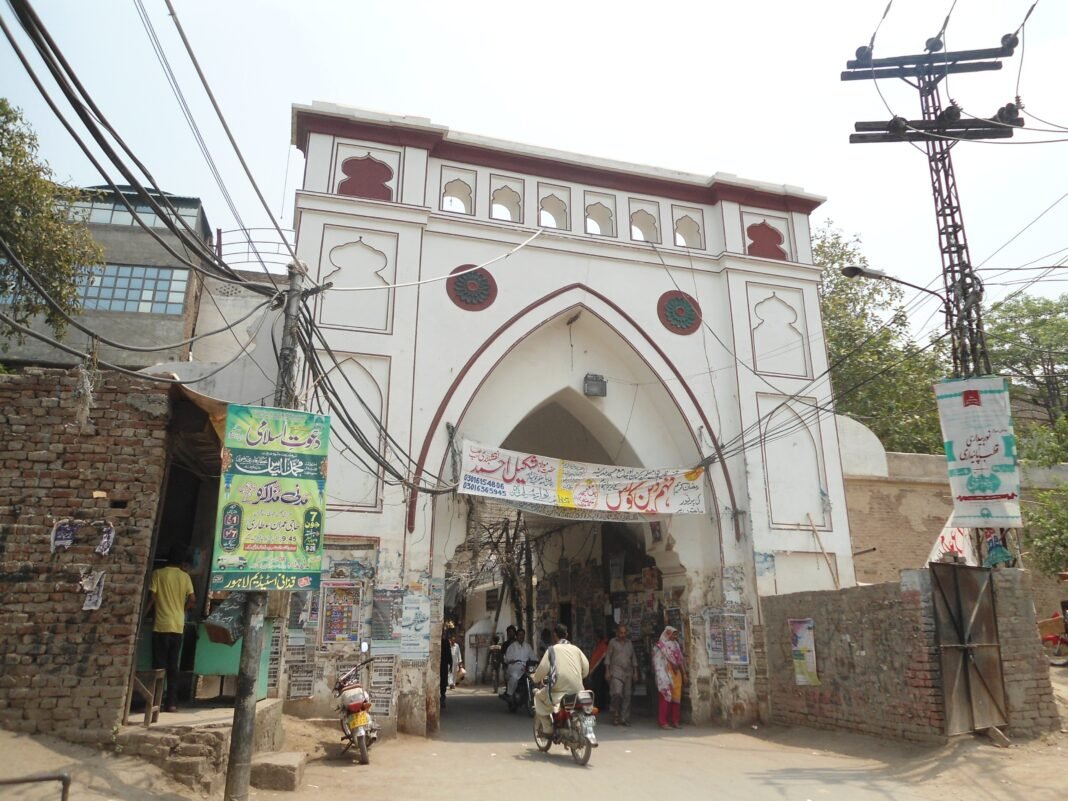
Begin at Bhati Gate itself on the western wall of the old city. The gate’s worn facade has seen centuries of traders, armies, and pilgrims pass beneath its arch. It is one of the few surviving gates of the walled city, and standing under it is the proper way to start your walk into old Lahore. Go in the morning, when the light is soft and the breakfast rush is at its peak.
Eat the Legendary Bhati Gate Breakfast
This is the heart of the Bhati Gate travel guide for food lovers. The lanes inside the gate are famous across Lahore for siri paye (slow-cooked trotters), halwa puri, lassi, and qatlamba — crisp fried pancakes that are a Bhatti-area specialty. The legendary Phajja Siri Paye, serving paye, maghaz (brain curry), and related dishes for generations, sits near the walled city by the Badshahi Mosque and Taxali side and is considered a rite of passage for visitors. Come hungry, sit at a roadside stall, and eat the way Lahoris do.
Wander Bazaar-e-Hakima
The Bazaar-e-Hakima — the market of the healers — runs through this area and is one of the most atmospheric markets in the walled city. Traditional hakims still sell herbs, spices, and remedies here, and the air smells of cardamom, saffron, and dried rose. Even if you buy nothing, the bazaar is a photographer’s dream of old Lahore commerce.
Visit the Faqir Khana Museum
Inside the historic Faqir Haveli, the Faqir Khana Museum houses one of the largest private collections in South Asia — Sikh-era artifacts, manuscripts, paintings, coins, and memorabilia from the era of Maharaja Ranjit Singh’s court, assembled by the Faqir family who served as his ministers. It is a hidden gem that most tourists miss, and it gives Bhati Gate a museum of genuine national importance.
Pay Respects at Data Darbar
Just outside Bhati Gate lies Data Darbar, the shrine of Hazrat Ali Hajveri, known as Data Ganj Bakhsh — one of the most revered Sufi shrines in South Asia. The complex is open around the clock, with its busiest hours in the evening. Thursday evenings traditionally drew qawwali gatherings; today the shrine hosts naats and religious gatherings. Dress modestly and cover your head as a mark of respect.
Soak in the Literary and Wrestling Heritage
Ask a local to point out the lanes associated with Allama Iqbal’s student years and the old akharas (wrestling gyms) that produced champions like Kala Maro. The living memory of the neighbourhood is part of the attraction — shopkeepers and elders here are proud of their history and happy to talk.
Famous Places In and Around Bhati Gate
- Data Darbar: The great Sufi shrine of Ali Hajveri, just outside the gate.
- Faqir Khana Museum (Faqir Haveli): A major private museum of Sikh-era art and history, inside the gate.
- Unchi Masjid: A historic mosque of the Bhati Gate quarter.
- Lahore Fort and Badshahi Mosque: The Mughal masterpieces a short drive to the north.
- Wazir Khan Mosque: The stunning tile-work mosque of the walled city, reachable through Delhi Gate side.
- Shahi Hammam: The restored Mughal royal baths inside Delhi Gate.
- Anarkali Bazaar: Lahore’s famous old shopping street, a short distance away.
How to Reach Bhati Gate
Bhati Gate is inside Lahore, so reaching it means reaching Lahore and then navigating the old city. From Islamabad, take the M-2 motorway to Lahore — about 375 kilometres and four and a half to five hours by car. From Karachi, the road journey is over 1,200 kilometres (fourteen to sixteen hours), so flying to Lahore’s Allama Iqbal International Airport is the sensible option; the airport is roughly 16-20 kilometres from the walled city, a 30-45 minute drive depending on traffic. Within Lahore, take a car, auto-rickshaw, or ride-hailing service (Careem, InDrive, Uber) to Bhati Gate, then explore the lanes on foot — the streets inside are too narrow for cars. The nearest metrobus and major road interchanges connect well with the old city approaches.
Route Details
- Arrive in Lahore via the M-2 motorway (from Islamabad) or Allama Iqbal International Airport.
- Head toward the Walled City — the Circular Road rings the old city.
- Approach Bhati Gate from the western side; Data Darbar’s minarets are your landmark just outside the gate.
- Park or end your ride near the gate and continue on foot through Bhati Gate into Bazaar-e-Hakima and the food lanes.
- Combine the walk with Data Darbar, then head north to the Fort and Badshahi Mosque if time allows.
Where to Stay in Bhati Gate
There are no major hotels right inside the gate’s lanes, but the area has small budget guesthouses used by traders and pilgrims visiting Data Darbar. Most travelers stay elsewhere in Lahore and visit Bhati Gate as a half-day excursion. Mid-range hotels cluster along Mall Road, in Gulberg, and around Fort Road near the old city — Fort Road puts you within easy reach of the walled city gates. Lahore’s luxury hotels are in Gulberg and DHA. For the most atmospheric option, a few heritage-style guesthouses have opened in restored havelis inside the walled city in recent years; book ahead and confirm the location, since old-city lanes can be hard for drivers to find.
Where to Eat: Local Foods of Bhati Gate
Bhati Gate is one of the great food destinations of Pakistan, and the local rule is simple: eat where the crowds are. Breakfast is the main event — siri paye (trotter curry), halwa puri (fluffy fried bread with semolina halwa and chickpeas), thick sweet or salty lassi served in clay cups, and qatlamba, the crisp fried pancakes that are a local specialty. Mutton chanay (chickpeas with mutton) is another famous morning dish here. The legendary Phajja Siri Paye near the Badshahi Mosque side has been serving paye, maghaz, zubaan (tongue), and khad (jaw) for generations, and locals consider a Lahore visit incomplete without it. For lunch and dinner, the area offers karahi, daal, and kebabs at dhaba prices — a full meal at a roadside stall is budget-friendly. Stick to busy stalls with high turnover for the freshest food, and drink bottled water.
Weather in Bhati Gate
Bhati Gate sits in the Lahore plains, with a classic Punjab climate: cold foggy winters, a glorious spring, scorching summers, and a humid monsoon. The lanes are narrow and mostly shaded, which helps in summer, but the best months for walking and eating your way through the area are the cool ones. Approximate ranges for Lahore:
| Season | Temperature Range | Conditions |
|---|---|---|
| Winter (Dec – Feb) | 5°C to 20°C | Cold mornings, frequent fog in December-January, crisp afternoons — excellent for food walks. |
| Spring (Feb – Mar) | 15°C to 28°C | Pleasant and green; the finest weather for exploring the walled city. |
| Summer (May – Jul) | 35°C to 45°C | Intensely hot; go out early morning or after sunset, and hydrate constantly. |
| Monsoon (Jul – Aug) | 30°C to 38°C | Hot and humid with heavy rain spells; lanes can flood briefly. |
| Autumn (Oct – Nov) | 18°C to 32°C | Warm days, pleasant evenings — a great second season for visiting. |
Language and Culture of Bhati Gate
The language of the gate is Lahori Punjabi — fast, warm, and full of humor — with Urdu spoken by everyone and some English in shops. Lahoris are famously hospitable; do not be surprised if a shopkeeper insists you taste something or an elder starts telling you the neighbourhood’s history. Dress modestly, especially when visiting Data Darbar and the mosques — women should carry a headscarf. Ask before photographing people in the bazaars. The area is religiously mixed in its heritage but predominantly Muslim in practice; Friday midday is quiet as shops close for Jummah prayers. Bargaining is expected in the bazaars but keep it friendly.
Shopping in Bhati Gate
Shopping here is old-Lahore style. Bazaar-e-Hakima is the place for traditional herbs, spices, dried fruits, and herbal remedies — saffron, cardamom, and rose water bought the way they have been for centuries. The surrounding old-city markets sell khussa (embroidered traditional footwear), bangles, fabrics, and wedding goods. Anarkali Bazaar, a short ride away, is the broader shopping destination for clothes, electronics, and street food. There are no modern shopping malls inside the walled city; for those, head out to the newer commercial areas of Lahore.
Travel Tips for Bhati Gate
Packing Essentials
Wear comfortable walking shoes — the lanes are uneven and you will walk a lot. Carry a water bottle, hand sanitizer, and a small backpack for purchases. A headscarf for women is useful for the shrine and mosques. In winter, bring a warm jacket for foggy mornings; in summer, a cap and sunglasses are essential.
Safety Tips
The area is busy and generally safe during the day, but it is crowded — keep valuables secure and be alert for pickpockets in packed bazaars, as in any old city worldwide. Avoid the narrowest lanes late at night unless you are with a local guide. Eat at busy stalls, drink bottled water, and go easy on the desi-ghee-heavy food if your stomach is not used to it. The traffic around the Circular Road is chaotic; use pedestrian crossings and stay alert.
Money & Connectivity
Cash is king in the old city — small stalls and bazaars do not take cards, though mobile payment apps are increasingly accepted. ATMs are available on the main roads outside the walled city. All major mobile networks (Jazz, Telenor, Zong, Ufone) have strong signals here; data works well for maps and ride-hailing.
Best Time to Visit Bhati Gate
Winter (November to February)
The best season. Cool, crisp weather is made for morning food walks — siri paye tastes even better on a foggy Lahore morning. December and January can be foggy, which adds atmosphere but slows traffic.
Spring (February to March)
Arguably the finest weather: warm days, cool evenings, and the city at its greenest. Basant is no longer officially celebrated, but the season itself remains lovely for old-city exploration.
Summer (May to August)
The hardest season for walking tours — extreme heat and monsoon humidity. If you visit, go at dawn for breakfast and retreat by late morning, or come out after sunset when the food streets come alive.
Autumn (September to November)
A strong second choice. The monsoon clears, evenings turn pleasant, and the pre-winter food season begins. October and November are excellent for combining Bhati Gate with the rest of Lahore’s sights.
Final Thoughts
Bhati Gate is where Lahore stops performing and starts being itself. The gate, the healers’ bazaar, the museum, the shrine, and above all the food make it the single most rewarding old-city walk in Punjab. It deserves a place on every explore Pakistan itinerary — not as a quick photo stop, but as a slow morning of eating, wandering, and listening.
Come hungry, walk slowly, and let the neighbourhood tell its stories. From Iqbal’s student days to the wrestlers’ akharas to the paye pots that never seem to empty, Bhati Gate is living history — and it tastes wonderful.
FAQs
Where is Bhati Gate located?
Bhati Gate stands on the western side of the Walled City of Lahore, Punjab — inside Lahore city, a short distance from Data Darbar, the Lahore Fort, and Badshahi Mosque.
Why is Bhati Gate famous?
It is one of the oldest gates of the walled city, famous for its legendary food (siri paye, halwa puri, lassi, qatlamba), the Bazaar-e-Hakima, its literary heritage, and its wrestling tradition.
What is the best time to visit Bhati Gate?
November to March, when Lahore’s weather is cool and pleasant for walking and food tours. Summer afternoons are extremely hot; visit early morning or evening instead.
How do I reach Bhati Gate from Islamabad?
Drive the M-2 motorway to Lahore (about 375 km, four and a half to five hours), then take a car, rickshaw, or ride-hailing service to the walled city and explore the gate area on foot.
Is Bhati Gate safe for tourists and families?
Yes, during the day it is busy and safe, though crowded. Keep valuables secure in packed bazaars, eat at busy stalls, and avoid unfamiliar narrow lanes late at night.
Where can I stay near Bhati Gate?
Most visitors stay in other parts of Lahore — mid-range hotels near Mall Road, Fort Road, or Gulberg — and visit Bhati Gate as a half-day trip. Budget guesthouses exist near the gate itself.
What food must I try at Bhati Gate?
Siri paye, halwa puri, lassi, qatlamba, and mutton chanay. The legendary Phajja Siri Paye near the Badshahi Mosque side is the classic stop for paye and maghaz.
What else is near Bhati Gate?
Data Darbar (just outside), the Faqir Khana Museum (inside), Lahore Fort, Badshahi Mosque, Wazir Khan Mosque, Shahi Hammam, and Anarkali Bazaar are all close by.