Quick Facts
- Location: Danyore (Danyor), Gilgit District, Gilgit-Baltistan, Pakistan, spanning the Hunza River
- Altitude: Around 1,500 m, on the valley floor near Gilgit city
- Famous For: Being one of the oldest suspension bridges in Gilgit, built 1957-1960 by a self-taught engineer
- Nearest City: Gilgit, a short drive away across the river
- Accessibility: Very easy; a short drive from Gilgit city on paved road, open to pedestrians and motorcyclists
- Known Landmarks: The hand-dug curved tunnel on the Danyore side, the shrine of Syed Shah Sultan Ali Arif, the Buddhist rock carvings on the Gilgit side
- Best For: Families, history lovers, photographers, and anyone visiting Gilgit
Why Visit Bireno Suspension Bridge
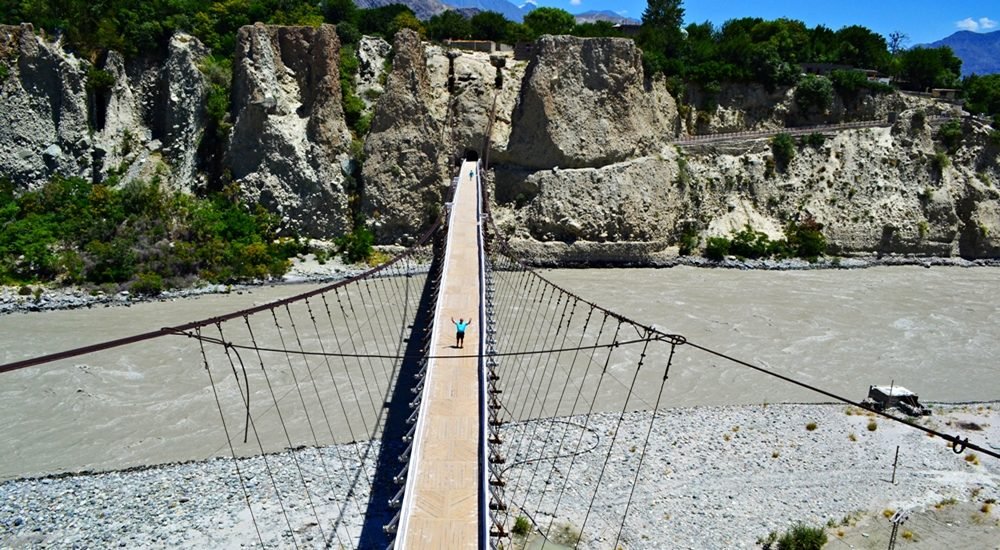
Some landmarks impress with size, and some with story. Also, the Bireno Suspension Bridge, 510 feet of wooden deck and steel rope swaying gently over the grey-green Hunza River, has both. In fact, it is one of the oldest suspension bridges in Gilgit-Baltistan. It was built between 1957 and 1960 by a man with no engineering degree, no heavy machinery, and no fear: Ahmad Ali Bireno of Hunza, a self-taught builder whose bridge carried an entire region’s traffic for half a century. This bireno suspension bridge travel guide explains why this modest-looking bridge deserves a place on every Gilgit itinerary.
A Small Adventure on Foot
Walking the bridge is a small adventure in itself. Also, the wooden planks shift underfoot, the steel cables hum, and strong northwesterly winds can set the whole span swaying. In fact, this is exactly why vehicles are no longer allowed on it. Below you the Hunza River rushes toward its meeting with the Gilgit River, and around you the mountains that make this region famous rise on every side. It is thrilling without being dangerous for careful walkers. It gives you a physical sense of what travel in these mountains meant before modern roads.
The bridge is also a doorway into layers of history. At one end, a short curved tunnel was dug by hand through the rock by local people, without machines, to connect the bridge to the road. Above it sits the shrine of Syed Shah Sultan Ali Arif. On the Gilgit side, near the bridge, ancient Buddhist rock carvings are preserved, reminders that this valley was on the old Silk Road centuries before the bridge existed. In one short visit you can touch the 1960s, the medieval period, and the ancient past.
Best of all, it is easy. If you are wondering where is Bireno Suspension Bridge and how much effort it takes, the answer is: minutes from Gilgit city, no trekking, no permits, no altitude. Also, families with children, elderly travellers, and photographers all find it rewarding. It pairs perfectly with a day exploring Gilgit’s bazaar, the Kargah Buddha, and the riverside. It is heritage you can walk across.
History of Bireno Suspension Bridge
Before the bridge, the Hunza River at Danyore was crossed the hard way. Also, travellers, traders, and whole caravans used a goatskin raft called a jaalo, an unreliable and dangerous crossing on a fast, cold river. The need for a proper bridge was obvious to everyone in Danyore, whose traffic moved toward Hunza, Nagar. China on one side and toward Bagrot, Jalalabad, Chamogarh, and Skardu on the other.
The man who answered was Ahmad Ali, known as Bireno, a contractor and builder from Hunza. Also, with no formal engineering education, he took on the project in the late 1950s using traditional methods, local labour, and remarkable ingenuity. In fact, construction ran from about 1957 to 1960. The completed bridge stretched 510 feet long and 8 feet wide, a wooden span hung on metallic ropes, with a single lane and a single span. It was an extraordinary achievement for its time and place. The bridge was named for its builder: Bireno Pul, the Bireno Bridge, also known locally as Pul-e-Sirat.
For decades the bridge carried Danyore’s traffic, at first everything, and later mini vehicles, until a modern two-lane concrete bridge was built alongside it in 2013 to take the vehicular load. Also, the old bridge was renovated in 2018, with the road sections on both ends refurbished and decorated. It was developed as a tourist attraction and protected heritage site. Today it is closed to cars and open to pedestrians and motorcyclists, swaying in the wind as it has for over sixty years, a monument to what determined people can build with their hands.
Top Things to Do in Bireno Suspension Bridge
Walk Across the Bridge
The main event is the crossing itself. The 510-foot walk takes only a few minutes, but take it slowly: feel the sway, look down at the Hunza River through the planks, and stop midway for the view up and down the valley. The bridge moves in strong wind, which is part of the experience, but hold the handrails, wear sensible shoes. It do not cross in very high winds or storms. Motorcyclists also use the bridge; give them space.
Explore the Hand-Dug Tunnel
On the Danyore side, the bridge connects to a short, curved, single-lane tunnel that was dug by hand through solid rock by local people, without any machines. For example, walking through it is like stepping into the construction story of the bridge itself. In fact, the tunnel leads toward the Karakoram Highway. It is unlined and atmospheric; a phone torch helps in its darker stretches.
Visit the Shrine of Syed Shah Sultan Ali Arif
Above the bridge on the Danyore side stands the shrine of Syed Shah Sultan Ali Arif. Visitors are welcome, but observe the etiquette of a religious site: dress modestly, remove shoes where indicated, keep voices low, and ask before photographing worshippers. The shrine adds a spiritual layer to the visit and is an important place for local people.
See the Buddhist Rock Carvings
On the Gilgit side of the river, near the bridge, a significant site of ancient Buddhist rock carvings is preserved for visitors. These carvings date back to the era when Buddhism travelled the Silk Road through these valleys, centuries before Islam arrived. The most famous such site in the area is the Kargah Buddha, a 7th-century rock relief a short drive away. The carvings near the bridge belong to the same ancient heritage. Treat them as the protected archaeology they are: look, photograph, but never touch or scratch the rock.
Photography at Golden Hour
The bridge photographs beautifully in the soft light of early morning and late afternoon. Also, the steel cables catch the sun and the river glows below. The classic shot is from the riverbank, framing the full 510-foot span against the mountains. Drones are increasingly restricted in Gilgit-Baltistan, so check current local rules before flying one.
Famous Places In and Around Bireno Suspension Bridge
- Danyore Town – The historic town on the east bank, with the tunnel, the shrine, and traditional streets.
- Karakoram International University (KIU) – The university campus on the west bank, connected by the bridge.
- Kargah Buddha – The 7th-century rock-carved Buddha a short drive from the bridge, Gilgit’s most famous ancient site.
- Gilgit City Bazaar – The lively market a few minutes away, for food, dry fruits, and handicrafts.
- Hunza-Gilgit River Confluence – The meeting of the two great rivers, about 2 km downstream from the bridge.
- Naltar Valley – A popular day-trip valley from Gilgit, known for its lakes and pine forests.
How to Reach Bireno Suspension Bridge
Getting to the bridge is straightforward because it sits at Gilgit’s doorstep. From Islamabad, Gilgit is reached by the Karakoram Highway, around 600 kilometres and 14 to 18 hours of driving, usually with an overnight stop, or by the roughly one-hour flight from Islamabad to Gilgit Airport. This operates in good weather. From Lahore, the road distance to Gilgit is around 850 kilometres or more, so most travellers break the journey in Islamabad. From Karachi, fly to Islamabad and continue north by air or road.
The nearest airport is Gilgit Airport. Also, From Gilgit city centre, the bridge at Danyore is a short drive of a few kilometres, around 10 to 20 minutes depending on traffic, across the Hunza River toward the Karakoram International University side. In fact, the road is paved and usable year-round. Any taxi, rented car, or hotel-arranged vehicle in Gilgit can take you there, and many city tours include it as a stop.
Winter can bring ice on shaded stretches.. Still, Road conditions around Gilgit are good on the main roads in all seasons, Transport options include private taxis and rented cars with drivers, which are inexpensive by the hour or day in Gilgit, hotel shuttles, and local ride-hailing where available. Public vans run between Gilgit and Danyore. If you are asking how to reach Bireno Suspension Bridge independently, simply tell any Gilgit driver “Danyore pul” or “Bireno Bridge” and you will get there.
Route Details
- Travel from Islamabad to Gilgit by air (about 1 hour) or by road on the Karakoram Highway (14-18 hours).
- From Gilgit city centre, head east across the Hunza River toward Danyore and Karakoram International University.
- Follow the riverside road to the old suspension bridge, a 10-20 minute drive from the city centre.
- Park at the bridge entrance; the modern concrete bridge runs alongside for vehicles.
- Cross on foot, explore the tunnel on the Danyore side and the carvings on the Gilgit side, and allow under an hour for the full visit.
Where to Stay in Bireno Suspension Bridge
The bridge is a short visit, not an overnight destination, so travellers stay in Gilgit city. Gilgit has the full range of accommodation: comfortable hotels along the main roads and the river, mid-range hotels around the city centre and bazaar, and budget guesthouses and hostels for backpackers. Because the bridge is only minutes from the city, any Gilgit hotel works as a base.
For a more upscale stay, the better-known hotels on the outskirts offer mountain views and gardens. Also, mid-range options near the bazaar put you within walking distance of restaurants and shops. Budget travellers will find clean, simple guesthouses throughout the city. Book ahead in the May to October high season. The town has basic guesthouses if you prefer to be on the quieter side of the river.. Still, there is no need to stay in Danyore itself,
Where to Eat: Local Foods of Bireno Suspension Bridge
Eat in Gilgit, minutes from the bridge. Also, the city’s food reflects its mountain location and its position on the Karakoram Highway. In fact, local staples include wheat flatbreads, hearty meat and lentil dishes, and barbecue. The bazaar area is full of small restaurants, dhabas, bakeries, and tea houses. Dried apricots, mulberries, and nuts from the region’s orchards are sold everywhere and make excellent snacks for the road.
Restaurant options range from simple local eateries, where a filling meal is budget-friendly, to hotel restaurants serving Pakistani, Chinese, and continental food. Also, fresh trout from mountain streams appears on many menus. Near the bridge itself there are small tea stalls and snack shops rather than full restaurants, so plan your main meals in Gilgit or Danyore town. As everywhere in the region, drink bottled or boiled water.
Weather in Bireno Suspension Bridge
The bridge sits on the Gilgit valley floor at around 1,500 metres. Also, its climate is the classic Gilgit climate: hot summers, cold winters, and very little rain. In fact, summer days are hot, with highs commonly in the 30s Celsius. In addition, the low humidity and the river breeze make it pleasant, and evenings cool down comfortably. This is the most popular time to visit. The bridge is at its liveliest. Winter brings cold days and freezing nights. The bridge remains accessible since the city roads stay open. Spring and autumn are mild and lovely, with spring blossom and autumn colours in the surrounding orchards.
The wind that sways the bridge blows year-round and is strongest on clear, gusty days.
| Season | Temperature Range | Conditions |
|---|---|---|
| Winter (Dec-Feb) | Around -5°C to 10°C | Cold, crisp days; bridge open; occasional frost |
| Spring (Mar-May) | Around 10°C to 25°C | Mild and green; blossom season; ideal for visiting |
| Summer (Jun-Aug) | Around 20°C to 36°C | Hot days, cool evenings; peak tourist season |
| Autumn (Sep-Nov) | Around 5°C to 25°C | Clear skies, golden colours; excellent for photography |
Language and Culture of Bireno Suspension Bridge
The language of Gilgit and Danyore is Shina. You will also hear Burushaski, Balti, and other languages of the region’s mix of communities. Urdu is widely spoken, and English is understood in hotels, restaurants, and by guides. The population is predominantly Muslim, with a mix of sects living side by side. The culture is hospitable but conservative.
Visitors should dress modestly, particularly when visiting the shrine near the bridge. Ask permission before photographing people. The bridge is treated as protected heritage, so follow the caretakers’ instructions: do not scratch the woodwork, climb the cables, or remove anything. Friday is the weekly holiday, and some shops in the bazaar close for prayers; plan meals accordingly. Respect for elders is deeply valued; a greeting and a smile open many doors.
Shopping in Bireno Suspension Bridge
The bridge has no shops of its own. Also, Gilgit’s bazaar, minutes away, is one of the most interesting markets in the north. In fact, look for dried apricots, apricot oil, mulberries, walnuts, and almonds from local orchards. Traditional woollen shawls, caps, and socks; gemstones from the region’s mines; and woodwork and handicrafts. Small souvenir stalls near the bridge sell snacks and simple mementoes.
Gilgit has regular markets and small commercial centres for everyday shopping, but no large modern shopping malls near the bridge, and travellers should not expect one. Bargaining is normal in the bazaar and is done politely. If you buy gemstones, buy from reputable dealers and ask for certification for expensive pieces.
Travel Tips for Bireno Suspension Bridge
Packing Essentials
This is an easy sightseeing stop, so pack light: comfortable walking shoes with good grip for the wooden planks, sun protection (hat, sunglasses, sunscreen), a light jacket for the river breeze, and your camera. In summer, carry water. In winter, bring a warm jacket and gloves, since the wind on the bridge is biting.
Safety Tips
The bridge is safe for careful pedestrians but demands respect. Hold the handrails, do not run or jump on the deck, and keep children close and supervised at all times. Do not cross in storms or very high winds. Stay on the walkway and do not climb the cables or towers. The bridge is closed to cars. If you arrive by vehicle, use the modern concrete bridge alongside. As in all of Gilgit-Baltistan, the region is generally safe for tourists, but keep valuables secure in the bazaar crowds.
Money & Connectivity
Bring Pakistani rupees in cash, though Gilgit city has ATMs and banks. Small vendors near the bridge may not accept cards, so keep small notes handy. Mobile coverage in Gilgit city is good: SCO (Scom), Jazz. Telenor all work in the city, and 4G data is available. Signals are reliable at the bridge itself since it is within the city area.
Best Time to Visit Bireno Suspension Bridge
Spring (April to May)
Arguably the loveliest time. Also, mild temperatures, green valley, blossom in the orchards, and comfortable walking weather on the bridge. Crowds are smaller than in summer.
Summer (June to August)
Peak season. Hot days but the river breeze helps, and the long daylight hours give you flexible timing. Also, visit early morning or late afternoon to avoid the midday heat and to get the best light for photographs.
Autumn (September to October)
Clear skies, golden poplars, and crisp air make this a photographer’s favourite. Also, the bridge is quiet on weekdays. By November it is getting cold, but still perfectly visitable.
Winter (November to March)
Cold but open. Also, the bridge sees few tourists, the mountains wear snow, and the light is sharp and clear. Dress warmly against the wind on the deck.
Final Thoughts
The Bireno Suspension Bridge is proof that you do not need altitude or endurance to touch the soul of Gilgit-Baltistan. Also, in under an hour, on an easy walk from the city, you can stand on a bridge built by hand and courage, pass through a tunnel dug without machines, visit a shrine, and look at rock carvings a thousand years old. Few places pack so much story into so short a visit.
Pair it with the bazaar, the Kargah Buddha, and a riverside evening, and you have a perfect Gilgit day. Also, for more ideas, browse the Explore Pakistan collection, the Malam Jabba guide for a different mountain experience. In fact, the Hunza Valley guide for the road that Bireno’s bridge once served. Some bridges just cross rivers; this one crosses time.
FAQs
Where is Bireno Suspension Bridge located?
The bridge is at Danyore, Gilgit District, Gilgit-Baltistan, spanning the Hunza River between Danyore and the Karakoram International University side, a few minutes’ drive from Gilgit city.
Who built the Bireno Suspension Bridge and when?
It was built between about 1957 and 1960 by Ahmad Ali Bireno, a self-taught contractor and builder from Hunza with no formal engineering education. It is 510 feet long and 8 feet wide.
Is the Bireno Suspension Bridge open to vehicles?
no. It is closed to vehicular traffic and open to pedestrians and motorcyclists. Also, a modern two-lane concrete bridge built alongside in 2013 carries vehicles.
What is the best time to visit Bireno Suspension Bridge?
April to October is ideal, with spring and autumn offering the mildest weather. Also, the bridge is accessible year-round from Gilgit city.
How do I reach Bireno Suspension Bridge?
Travel to Gilgit by air or road from Islamabad, then take a 10-20 minute taxi or car ride to Danyore. Any Gilgit driver knows the bridge.
Is the bridge safe for families and children?
Yes, for careful visitors. Hold handrails, supervise children closely, wear grippy shoes, and avoid crossing in high winds or storms.
Where can I stay near the bridge?
Stay in Gilgit city, which has hotels, guesthouses, and hostels of all levels, all within a short drive of the bridge.
What else is near the Bireno Suspension Bridge?
The hand-dug tunnel, the shrine of Syed Shah Sultan Ali Arif, ancient Buddhist rock carvings, the Kargah Buddha, Gilgit bazaar. Also, the Hunza-Gilgit river confluence are all nearby.