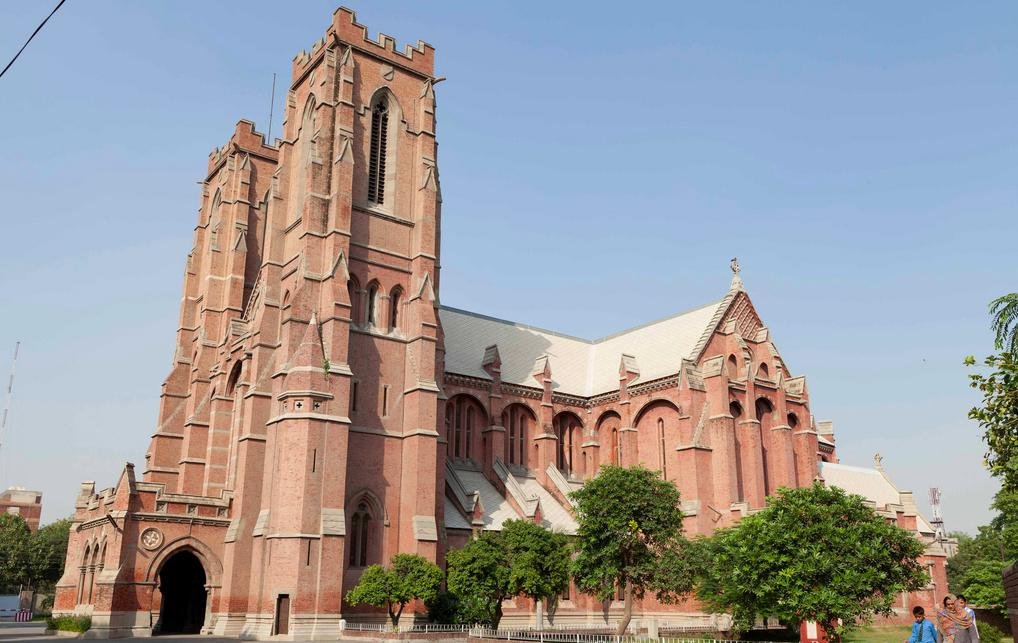
On The Mall, Lahore’s grandest colonial boulevard, directly opposite the Lahore High Court, stands one of the finest Gothic buildings ever raised in South Asia. The Cathedral Church of the Resurrection is a pink-sandstone cathedral consecrated in 1887, and for nearly a century and a half it has been the beating heart of the Diocese of Lahore. Lahoris know it affectionately as Kukar Girja, and architecture experts call it the finest of Pakistan’s colonial-era churches. If your Lahore itinerary includes the Lahore Fort, Badshahi Mosque, and Anarkali Bazaar, this cathedral deserves a quiet hour between them. This Cathedral Church of the Resurrection Lahore travel guide covers everything you need: the cathedral’s real history, what to see inside, how to reach it, and when to plan your visit.
Quick Facts
- Location: The Mall, Lahore, directly opposite the Lahore High Court; the compound is bounded by The Mall, Hall Road, Abbott Road, and Begum Salma Tassaduq Road
- Famous For: Neo-Gothic architecture, 19th-century stained glass, the 1862 clock, the Taxila Cross, and its nickname Kukar Girja
- Nearest City: Lahore itself; the cathedral sits in the city’s historic centre
- Accessibility: Easy; right on The Mall with taxis, rickshaws, and ride-hailing apps serving the area
- Known Landmarks: The twin entrance towers, the six British bells, the memorial wall, and the vaulted cross-shaped interior
- Best For: Architecture lovers, photographers, heritage walkers, and anyone exploring Lahore’s colonial-era landmarks
Why Visit Cathedral Church of the Resurrection, Lahore
There are buildings you walk past and buildings that stop you in your tracks. The Cathedral Church of the Resurrection belongs firmly in the second group. Rising from The Mall in warm pink brick and sandstone, with its twin towers and cross-shaped plan, it looks like it could have been lifted from an English shire, yet it shares its skyline with Mughal domes and minarets. That is exactly its magic: this is Lahore’s layers of history made visible in a single frame, Victorian Gothic standing shoulder to shoulder with Mughal and Sikh heritage.
The cathedral rewards those who look closely. Step inside and the light changes everything: sunbeams filter through 19th-century stained glass onto choir stalls and memorial plaques, while the tall vaulted ceiling lifts your eyes upward. The building measures 225 feet long and 152 feet wide, with gable roofs rising 65 feet, and it can hold 800 worshippers at a time. It is a working cathedral, not a museum, and the sense of living history is everywhere, from the baptismal font to the pipe organ that once accompanied services.
Then there are the details that make it genuinely unique in Pakistan. The clock in the northern tower was made in 1862, older than the cathedral itself. The southern tower holds six bells sent from Britain, one short of the intended seven because funds ran out. The cathedral keeps one of the prized relics of Christianity in the region, the Taxila Cross, unearthed in 1935 excavations near the ancient city of Sirkap. Few heritage sites in Lahore pack this much story into one visit.
Practically speaking, this is one of the easiest heritage stops in Lahore. It sits in the middle of the city’s historic circuit, minutes from Anarkali Bazaar, the Lahore Museum, and the Walled City. Come in the morning light when the stained glass is at its best, dress modestly, and give yourself an unhurried hour. Whether you come for faith, photography, or pure curiosity about Lahore’s colonial architecture, the cathedral repays the visit.
History of Cathedral Church of the Resurrection, Lahore
The story of this cathedral begins not in 1887 but much earlier. Historians note that the first church in Lahore was built near the Lahore Fort in 1595, during the Mughal era. Two centuries later, under British rule, the Protestant congregation of Lahore had grown so large that a proper cathedral was needed, and the vision came from Thomas Valpy French, who became the first Bishop of the newly created Diocese of Lahore in 1877. He wanted a cathedral worthy of Lahore.
Construction began in 1877 and ran for a full decade. The work was halted twice, once for shortage of funds and once because of the Afghan wars of 1879 and 1880, which diverted money and manpower. The entire project was funded by donations, and costs eventually rose above 50,000 pounds, a fortune at the time. The architect was John Oldrid Scott, son of the celebrated George Gilbert Scott, who designed the building in the Neo-Gothic style, the Early English variant of the medieval Gothic revival, all pointed arches, vaults, and buttresses. The cathedral was consecrated on 25 January 1887, and it became the seat of the Diocese of Lahore in the Church of Pakistan, as it remains today.
Within a decade of completion, the building was given two towers with tall steeples, added in 1898. Those steeples were taken down after the earthquake of 1911, which is why the towers look the way they do now, substantial but truncated. The cathedral’s famous weathercock, which gave it the nickname Kukar Girja (girja being the Urdu word for church, from the Portuguese igreja), was removed as a precaution after the 1935 Quetta earthquake. It no longer stands on the central lantern, but the nickname has stuck for generations of Lahoris.
The interior grew its own layers of memory. A memorial wall was dedicated to the officers of the 5th King Edward VII’s Own Probyn’s Horse cavalry regiment, men of Punjabi Muslim, Sikh, and Dogra backgrounds who served from 1857 to 1947. The stained-glass windows, made by Unard Walker, and the pipe organ belong to the cathedral’s working life. The Taxila Cross, also called the Saint Thomas Cross, excavated in 1935 near Sirkap, is kept here as evidence that Christianity in this region long predates the British, a tradition traced to Saint Thomas, one of the twelve disciples, in the first century AD. The cathedral conducts services daily, with an English service on Sunday mornings and an Urdu service later in the day, and it marks occasions such as Independence Day, Defence Day, and Pakistan Resolution Day with special observances.
Top Things to Do in Cathedral Church of the Resurrection, Lahore
Admire the Neo-Gothic Architecture
Start with the outside. Walk the perimeter of the compound and study the cross-shaped plan, the pointed arches, the pink brick and sandstone, and the twin towers that flank the entrance. The building is a textbook example of the Early English Gothic revival, and seeing it against the traffic and banyan trees of The Mall is one of Lahore’s great architectural contrasts. Photographers should come in the soft morning light, when the sandstone glows.
See the 1862 Clock and the Six British Bells
The two entrance towers each hold a treasure. The northern tower carries a clock made in 1862, a quarter of a century older than the cathedral itself, still keeping time. The southern tower holds six bells sent from Britain; church records note that there should have been seven, but the seventh could not be purchased for lack of funds. Ask the staff if you can learn more about the towers during your visit.
Stand Inside the Vaulted Nave
The interior is the quiet heart of the visit. The tall vaulted ceiling, the choir stalls, and the memorial plaques create a cool, dim sanctuary from Lahore’s heat. The dean has described the baptismal area as one of the building’s most beautiful portions, interpreted as the fountain of life and purity. Remember this is an active place of worship: keep your voice low and avoid visiting during services unless you intend to attend respectfully.
Study the Stained-Glass Windows
The cathedral’s windows are decorated with stained glass made by Unard Walker, and sunlight passes through them in soft, coloured rays that shift through the day. These gem-like panels are among the finest details in the building and reward slow looking. Mid-morning is the best time to catch the light at its richest.
See the Taxila Cross
Ask about the cathedral’s most storied relic: the ancient Saint Thomas Cross, also known as the Taxila Cross, excavated in 1935 near the site of the ancient city of Sirkap. Though its exact antiquity is debated by scholars, it is kept here as a symbol of the deep roots of Christianity in the region, a tradition the cathedral traces back to the first century AD. It is a small object with an enormous story.
Read the Memorial Wall
The memorial wall dedicated to the officers of the 5th King Edward VII’s Own Probyn’s Horse is an important document of British India in itself, naming Punjabi Muslim, Sikh, and Dogra cavalrymen who served the Crown from 1857 to 1947. It is a reminder that the cathedral’s history is woven into the military and social history of Punjab.
Famous Places In and Around Cathedral Church of the Resurrection, Lahore
- Lahore High Court — Directly opposite the cathedral, another landmark of colonial Lahore.
- Anarkali Bazaar — One of South Asia’s oldest surviving markets, a short walk away for shopping and street food.
- Lahore Museum — Pakistan’s largest museum, on The Mall, home to the Fasting Buddha and Gandhara art.
- Lahore Fort and Badshahi Mosque — The Mughal showpieces of the Walled City, an easy taxi ride away.
- Minar-e-Pakistan — The national monument in Greater Iqbal Park, near the fort.
- Fort Road Food Street — Rooftop dining with views of Badshahi Mosque, ideal for an evening meal after sightseeing.
- Shalimar Gardens — The Mughal garden complex built by Shah Jahan, about 25 minutes by car.
How to Reach Cathedral Church of the Resurrection, Lahore
The cathedral could hardly be easier to reach: it stands on The Mall in central Lahore, opposite the Lahore High Court. If you are staying anywhere in Lahore, a taxi or ride-hailing app (Uber and Careem both operate in the city) will know the location instantly. Tell the driver “Mall Road, High Court ke samne wala Cathedral” and you will have no trouble.
From Islamabad: Lahore is about 375 kilometres from Islamabad via the M-2 motorway, a drive of roughly four to five hours depending on traffic. The Daewoo and other intercity bus services run frequently between the two cities, and the train is a comfortable alternative. From Lahore’s bus terminals or railway station, it is a 20 to 30 minute taxi ride to The Mall.
From Karachi: Karachi to Lahore is about 1,200 kilometres, so flying is the sensible option: the flight takes around two hours, with frequent daily departures. From Allama Iqbal International Airport, the cathedral is roughly 30 to 45 minutes by car depending on traffic.
Nearest airport: Allama Iqbal International Airport, Lahore.
Local transport: Once in Lahore, ride-hailing apps, auto-rickshaws, and Qingqi rickshaws all serve The Mall. Lahore’s Metrobus runs along a different corridor, so a taxi is the simplest last-mile option. Parking near the cathedral can be tight during court hours, so it is often easiest to be dropped off.
Route Details
Step 1: Make your way to The Mall (Shahrah-e-Quaid-e-Azam), Lahore’s main colonial-era avenue.
Step 2: Head for the Lahore High Court, the cathedral stands directly opposite it and is visible from the road.
Step 3: Enter through the compound gates; the church compound is bounded by The Mall, Hall Road, Abbott Road, and Begum Salma Tassaduq Road.
Step 4: Visit during daylight hours for the best light on the stained glass, and check with staff about service timings so your visit does not clash with worship.
Where to Stay in Cathedral Church of the Resurrection, Lahore
The cathedral is in central Lahore, so you have the full range of the city’s accommodation within a short drive. For luxury, the established five-star hotels of Gulberg and the Cantonment, such as Pearl Continental and Avari, are the classic choices, about 20 to 30 minutes from The Mall depending on traffic. Mid-range hotels cluster along The Mall itself and in Gulberg, and there are numerous well-reviewed guesthouses and boutique stays in DHA and Model Town for travellers who prefer a quieter base.
Budget travellers will find economical hotels and guesthouses around the railway station area and in the old city, though these are basic. If your focus is the Walled City and heritage Lahore, staying near Fort Road or in a guesthouse in the old city puts the fort, the mosque, and the food street within walking distance, with the cathedral a short taxi ride away. Book ahead during the winter tourist season (November to February), when Lahore’s hotels fill up.
Where to Eat: Local Foods of Cathedral Church of the Resurrection, Lahore
The cathedral sits at the edge of one of the great food cities of the world, so eat well while you are here. The Fort Road Food Street, near Badshahi Mosque, is the classic evening choice: rooftop tables, views of the illuminated mosque, and the full Lahori repertoire. Restaurants like Haveli and Cuckoo’s Den are the well-known names. For street-level authenticity, walk into Anarkali Bazaar and try dahi bhallay from the street vendors, a local rite of passage.
The dishes to seek out are the Lahori signatures: nihari, the slow-cooked beef or mutton stew; paya, the rich trotter curry; halwa puri for breakfast; and a tall glass of sweet or salted lassi to finish. Around The Mall itself there are old colonial-era cafes and bakeries, plus the standard desi restaurants serving karahi, kebabs, and biryani. A filling meal at a local restaurant is budget-friendly, while the food street rooftops cost more for the view. For the full cathedral day, plan lunch near Anarkali and dinner on Fort Road.
Weather in Cathedral Church of the Resurrection, Lahore
Lahore has a classic Punjab climate: fiercely hot summers, a monsoon interlude, and cool, pleasant winters. The cathedral is an indoor-outdoor visit, so weather matters mostly for your comfort walking the compound and the surrounding Mall. Winters are the sweet spot for sightseeing; summers demand an early-morning or late-afternoon schedule.
| Season | Temperature Range | Conditions |
|---|---|---|
| Winter (Dec-Feb) | 5-20 C | Cool, often foggy mornings; the most pleasant season for sightseeing |
| Spring (Mar-Apr) | 20-35 C | Warm and lovely; gardens in bloom, ideal for heritage walks |
| Summer (May-Jun) | 35-45 C | Intensely hot; visit early morning or late afternoon, stay hydrated |
| Monsoon (Jul-Aug) | 30-38 C | Humid with heavy downpours; dramatic skies, occasional waterlogging |
| Autumn (Sep-Nov) | 20-35 C | Cooling down; October and November are excellent for sightseeing |
Language and Culture of Cathedral Church of the Resurrection, Lahore
The working languages of the cathedral are English and Urdu: the church holds an English service on Sunday mornings and an Urdu service later in the day, and the congregation is part of the Church of Pakistan. Around the cathedral, the street languages are Punjabi and Urdu, and you will get by easily with Urdu or English in central Lahore.
Culturally, remember you are entering an active place of worship in a Muslim-majority country where the Christian community is a small minority. Dress modestly: cover shoulders and knees, and women may wish to carry a scarf. Speak quietly inside, switch your phone to silent, and ask before photographing people or during any service. Visitors of all faiths are welcome, and the staff are generally happy to share the cathedral’s story. Remove any hesitation about asking: respectful curiosity is appreciated far more than tiptoeing silence.
Shopping in Cathedral Church of the Resurrection, Lahore
Anarkali Bazaar, one of the oldest surviving markets in South Asia, is practically next door and is the natural shopping companion to a cathedral visit. It sells everything from textiles and jewellery to spices and street snacks, and it stays lively from late morning to late evening. Hall Road, which bounds the cathedral compound, is Lahore’s famous electronics market if you need gadgets or accessories.
For a more curated experience, head to Liberty Market in Gulberg for clothes and shoes, or Ichhra Bazaar for bargain fabrics. Handicrafts worth picking up include blue Multani pottery, camel-skin lamps, embroidered khussas (traditional shoes), and Punjabi phulkari textiles. Bargaining is expected in the bazaars; fixed prices are the norm in malls and branded stores.
Local Events and Festivals
The cathedral’s calendar follows the Christian liturgical year, and its two great annual celebrations are Christmas and Easter. Christmas services on 25 December are the highlight: the cathedral is decorated, special services are held, and the congregation gathers in full strength. Easter, in March or April depending on the year, marks the Resurrection, the very dedication of this cathedral, with its own special services. Visitors are generally welcome at these services, but arrive early, dress your best, and expect larger crowds than usual. The cathedral also observes national occasions such as Independence Day (14 August), Defence Day (6 September), and Pakistan Resolution Day (23 March) with special prayers, a distinctive Pakistani-Christian tradition worth witnessing if your visit coincides.
Travel Tips for Cathedral Church of the Resurrection, Lahore
Packing Essentials
Bring a scarf or shawl for modesty, comfortable walking shoes for the compound and the Mall, and sun protection (cap, sunglasses, water) if visiting in the warmer months. A camera is a must, but keep the flash off inside. Carry small change for donations, which are customary and appreciated.
Safety Tips
The Mall is a busy, well-policed thoroughfare and the cathedral compound itself is calm and secure. The main safety concern is traffic: The Mall is one of Lahore’s busiest roads, so cross carefully and use pedestrian crossings. Keep valuables secure in crowded bazaars nearby. Check service timings before visiting so you do not arrive in the middle of a service or a closed compound.
Money & Connectivity
ATMs and banks line The Mall and the surrounding commercial areas, and mobile signals from all major networks (Jazz, Telenor, Zong, Ufone) are strong throughout central Lahore. Most restaurants and hotels accept cards, but keep cash for bazaars, rickshaws, and small vendors. Free Wi-Fi is common in cafes and hotels.
Best Time to Visit Cathedral Church of the Resurrection, Lahore
Winter (November-February): The Best Season
This is Lahore at its finest: cool, crisp days, clear skies, and comfortable walking weather. The stained glass glows in the low winter sun, and the gardens around The Mall look their best. This is also when Lahore’s tourist season peaks, so expect more visitors at the major monuments. Christmas services in December make this an especially atmospheric time to see the cathedral.
Spring (March-April): Lovely and Lively
Warm days and blooming gardens make spring the second-best season. Easter services fall in this window, and the weather is ideal for combining the cathedral with the Walled City on foot. Mornings are the best time to visit before the afternoon warmth builds.
Summer (May-June): Visit Early
Lahore’s summer is brutal, with temperatures pushing toward 45 degrees. The cathedral’s cool interior is actually a refuge, but plan your visit for early morning or late afternoon, and pair it with indoor stops like the Lahore Museum during the midday heat. Carry water and wear a hat.
Monsoon (July-August): Dramatic but Damp
Monsoon brings heavy showers and humidity. The rain-washed sandstone looks beautiful, but downpours can disrupt plans and waterlog streets. If you visit now, keep the schedule flexible and carry an umbrella.
Final Thoughts
The Cathedral Church of the Resurrection is one of those places that quietly exceeds expectations. You arrive for the architecture and leave with a sense of Lahore’s layered soul: a British cathedral on a Mughal-era road, a Taxila cross inside a Gothic nave, a congregation that has worshipped here since 1887. It is a working church, a heritage monument, and a peaceful pause in one of Pakistan’s busiest cities, all at once.
Pair it with Anarkali’s bazaars, the Lahore Museum, and the Walled City, and you have the makings of a perfect heritage day. For more ideas on exploring the country, browse our Explore Pakistan collection, plan a northern escape with our Hunza Valley guide, or start a capital-city trip with places to visit in Islamabad. Lahore rewards the curious, and this cathedral is one of its quietest rewards.
FAQs
Where is the Cathedral Church of the Resurrection located?
It stands on The Mall in central Lahore, directly opposite the Lahore High Court. The compound is bounded by The Mall, Hall Road, Abbott Road, and Begum Salma Tassaduq Road.
What is the best time to visit the Cathedral Church of the Resurrection?
November to February offers the most pleasant weather for sightseeing. Visit in the morning for the best light on the stained-glass windows.
How do I reach the cathedral from Islamabad or Karachi?
From Islamabad, take the M-2 motorway (about 375 km, 4-5 hours) or a bus or train to Lahore, then a 20-30 minute taxi to The Mall. From Karachi, fly to Lahore (about 2 hours) and drive 30-45 minutes from the airport.
Is the cathedral open to visitors of all faiths?
Yes. It is an active place of worship and welcomes respectful visitors of all faiths. Dress modestly, keep quiet inside, and avoid visiting during services unless you plan to attend.
Is the Cathedral Church of the Resurrection safe for families?
Yes. The compound is calm and secure, and the visit is easy walking on flat ground. The main caution is The Mall’s heavy traffic when arriving and leaving.
Where can I stay near the cathedral?
Central Lahore offers everything from five-star hotels in Gulberg and the Cantonment to mid-range hotels on The Mall and budget guesthouses near the railway station and old city.
What food should I try near the cathedral?
Head to Fort Road Food Street for rooftop dining with Badshahi Mosque views, try dahi bhallay in Anarkali Bazaar, and sample Lahori signatures like nihari, paya, halwa puri, and lassi.
Why is it called Kukar Girja?
Lahoris nicknamed it Kukar Girja because of the weathercock (kukar) that once stood on the central lantern to show the wind’s direction. The weathercock was removed after the 1935 Quetta earthquake, but the name stuck.