There is a place in Pakistan where the mountains stop being scenery and become something closer to gods. The Central Karakoram National Park is Pakistan’s largest protected area, covering more than 10,500 square kilometres of the Karakoram range in Gilgit-Baltistan, and it holds the greatest concentration of the tallest mountains on Earth. Four peaks above 8,000 metres, including K2, the world’s second-highest mountain. Sixty peaks above 7,000 metres. The Baltoro, Godwin-Austen, Biafo, and Hispar glaciers, the largest glacial systems outside the polar regions. This is the park that serious mountaineers call the Throne Room of the Mountain Gods, and the K2 base camp trek through it is counted among the greatest treks on the planet. This Central Karakoram National Park travel guide is your honest introduction: why it deserves the hardest journey you will ever make, when to go, what to do, and exactly how to reach it.
Quick Facts
- Location: Gilgit-Baltistan, Pakistan, mostly in Skardu district, spanning four administrative districts
- Altitude: From around 2,000 metres in the valleys to over 8,000 metres at the summits
- Famous For: K2 (8,611 m), Concordia, the Baltoro Glacier, and the densest cluster of 7,000 and 8,000-metre peaks on Earth
- Nearest City: Skardu, the gateway town for most expeditions and treks
- Accessibility: Fly or drive to Skardu, then jeep to Askole, the last village; beyond that, everything is on foot
- Known Landmarks: K2, Gasherbrum I and II, Broad Peak, Concordia, Baltoro Glacier, Trango Towers, Mitre Peak
- Best For: Experienced trekkers, mountaineers, adventure photographers, and travellers chasing the ultimate mountain journey
Why Visit Central Karakoram National Park
Let us be honest about what this park is and is not. The Central Karakoram National Park is not a weekend getaway. It is not a place you tick off between brunch and a museum. It is one of the last truly wild places on Earth, a realm of ice and granite so vast and so vertical that the numbers stop sounding real: the park’s glaciers cover nearly 40 percent of its area, and its peaks include four of the world’s fourteen 8,000-metre mountains. If you have ever looked at a photograph of K2 rising over Concordia and felt your chest tighten, this is where that photograph was taken.
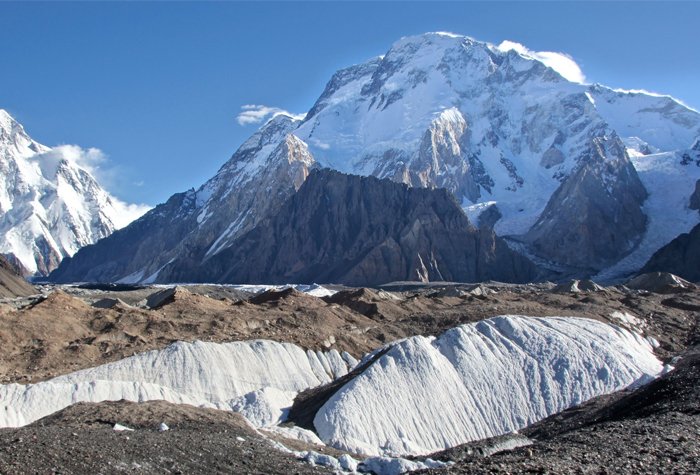
The park’s signature experience is the trek to Concordia and K2 base camp, and it deserves its legend. The route follows the Baltoro Glacier, one of the world’s largest non-polar glaciers, past the granite cathedrals of the Trango Towers, to Concordia, the great glacial junction at around 4,650 metres where the Baltoro meets the Godwin-Austen Glacier. Stand at Concordia on a clear morning and you can see K2, Broad Peak, and the Gasherbrum group in a single panorama. Mountaineers who have stood everywhere on Earth call it the finest mountain viewpoint on the planet. It is not hyperbole. It is geography.
But the park is more than one trek. It holds the Biafo and Hispar glaciers, which together form one of the longest glacial traverses outside the poles, via the legendary Snow Lake. It holds the Hushe valley and the Gondogoro La pass at 5,585 metres. It shelters snow leopards, markhors, Himalayan ibex, and brown bears in valleys that have barely changed in a thousand years. And around its edges live the Balti people, whose villages, apricot orchards, and thousand-year-old forts give the journey its human warmth.
This is a trip for the fit, the prepared, and the patient, and it is not cheap or quick: the classic K2 base camp trek takes 18 to 22 days door to door. But for those who go, it is the journey they measure every other journey against for the rest of their lives. If the mountains are calling you at their loudest, answer here.
History of Central Karakoram National Park
For most of human history, the Central Karakoram was simply too high, too cold, and too remote to belong to anyone’s empire in any meaningful way. The valleys at its feet, though, have deep histories. Baltistan, the region the park rises above, was known for centuries as Little Tibet, and its Buddhist past is carved into rocks like the famous Buddha carvings near Skardu. The Maqpon dynasty ruled Baltistan for nearly 700 years from Skardu Fort, the Kharphocho, and the valleys served as corridors of the old Silk Route, carrying goods, ideas, and religions between Central Asia, Tibet, and the subcontinent.
The great peaks entered recorded history through exploration and tragedy. The most famous date in the park’s story is 31 July 1954, when Achille Compagnoni and Lino Lacedelli of an Italian expedition led by Ardito Desio made the first successful ascent of K2, the world’s second-highest mountain at 8,611 metres. The 50th anniversary of that ascent was celebrated in Skardu in August 2004, when thousands of mountaineers, trekkers, and tourists gathered, and it was on that occasion that Italy, through the Ev-K2-CNR scientific association, offered funding to finally implement the park’s management plan.
The park itself was declared the Central Karakoram National Park in 1993, but for years it remained largely a park on paper. Real management began after 2004 with the involvement of the Government of Pakistan, WWF-Pakistan, IUCN-Pakistan, and Italian research agencies, and in 2009 the Ev-K2-CNR launched the SEED research programme for the park. Today the park is managed through a zoning system with a Buffer Zone and a Core Zone, balancing ecological protection with the needs of local communities and visitors. In 2016, the park was placed on the World Heritage Site Tentative List, a recognition of its outstanding universal value. It remains, as ever, a fragile ecosystem under pressure from climate change and growing tourism, which is why every visitor is asked to tread lightly.
Top Things to Do in Central Karakoram National Park
Trek to Concordia and K2 Base Camp
This is the trek, and there is nothing else in Pakistan quite like it. The standard route runs from Skardu by jeep to Askole, the last village at about 2,850 metres, then on foot: Julla, Paiyu (with an acclimatisation rest day), Khuburse, Urdukas, Goro, and finally Concordia at around 4,650 metres. From Concordia, trekkers make the day trip to K2 base camp at about 5,150 metres, standing beneath the great pyramid of the world’s second-highest mountain. The full journey, including travel to and from Islamabad, takes 18 to 22 days, with 14 to 16 days of walking at 5 to 8 hours a day. The best season is mid-June to early September, with July and August the prime months. This is a strenuous, high-altitude trek for experienced trekkers only, and it requires a trekking permit arranged through a licensed operator.
Stand at Concordia, the Throne Room of the Mountain Gods
Even if K2 base camp is the goal, Concordia is the soul of the trek. This vast glacial amphitheatre, where the Baltoro and Godwin-Austen glaciers meet, offers the single greatest mountain panorama many travellers will ever see: K2, Broad Peak, the Gasherbrums, Mitre Peak, and the granite spires of the Cathedrals. Trekkers typically spend a rest and exploration day here. On a clear dawn, the peaks turn gold and then white, and photographers run out of superlatives before they run out of light.
Cross the Gondogoro La
For trekkers who want the grand circuit, the return from Concordia can go over the Gondogoro La pass at 5,585 metres, descending into the Hushe valley. The pass offers arguably the finest single viewpoint of the entire Karakoram, with four 8,000-metre peaks visible at once. It is a serious high crossing that requires ropes, crampons, and an experienced team, and it is only attempted in good conditions. The 20 to 23 day itineraries that include the pass are the ultimate Karakoram trekking experience.
Trek the Biafo-Hispar and Snow Lake Traverse
The park’s western glaciers offer another legendary journey: the Biafo and Hispar glaciers meet at Snow Lake, a vast basin of ice at the top of the world, forming one of the longest continuous glacial traverses outside the polar regions. This is wilder and less travelled than the Baltoro route, and it demands full expedition support. For serious trekkers seeking solitude among the giants, it is unmatched.
Climb and Photograph the Trango Towers
The granite towers of Trango, rising above the Baltoro, are among the most famous big walls in world climbing. Even for non-climbers, the towers are a highlight of the trek, their sheer faces catching the evening light above the glacier. The base camp meadows below the towers are among the most beautiful campsites in the park.
Wildlife Watching: Snow Leopard Country
The park’s fragile ecosystem shelters the snow leopard, the Himalayan ibex, the markhor, the brown bear, and the Marco Polo sheep. Sightings are never guaranteed, and the high glacial zones are not the best place to look, but the lower valleys and buffer zones, visited with local guides, offer real chances, especially in winter when ibex descend. Your permit fees and guide fees directly support the community conservation programmes that protect these species.
Famous Places In and Around Central Karakoram National Park
- Concordia — The great glacial junction at around 4,650 m, the finest mountain viewpoint in the Karakoram.
- K2 Base Camp — At about 5,150 m, beneath the world’s second-highest mountain (8,611 m).
- Baltoro Glacier — One of the world’s largest non-polar glaciers, the highway of the K2 trek.
- Broad Peak (8,051 m), Gasherbrum I (8,068 m), Gasherbrum II (8,035 m) — The park’s other three 8,000-metre giants.
- Trango Towers and Mitre Peak (6,010 m) — Granite icons above the Baltoro.
- Askole — The last village before the wilderness, at about 2,850 m, where treks begin.
- Skardu — The gateway town, with Kharphocho Fort, Satpara Lake, and Shangri-La.
- Hushe Valley — The traditional exit of the Gondogoro La circuit, with its own great peaks.
How to Reach Central Karakoram National Park
Every journey into the park begins in Skardu. From Islamabad to Skardu: the fastest way is the roughly one-hour flight from Islamabad to Skardu, but it is famously weather-dependent and cancellations are common, so keep buffer days. The road alternative follows the Karakoram Highway via Chilas, a spectacular but very long drive that most travellers break with an overnight stop in Chilas. From Lahore: fly or take the motorway to Islamabad, then continue as above. From Karachi: fly to Islamabad and connect to Skardu, or fly to Lahore or Islamabad and join an organised trek from there. Almost all foreign trekkers and most Pakistani groups do this journey through a licensed tour operator, which is effectively required: the K2 region is a restricted zone, and you need a trekking permit from the Ministry of Tourism plus the CKNP park fee, both arranged by your operator.
From Skardu into the park: trekkers drive by 4×4 jeep from Skardu to Askole, the last village, a full day’s bone-rattling but beautiful drive. Beyond Askole there are no roads, only trails, glaciers, and your own feet. Porters, guides, and all supplies are organised in Skardu before departure.
Nearest airport: Skardu International Airport, with flights from Islamabad (and seasonal connections).
Route Details
Step 1: Fly or drive from Islamabad to Skardu; build in buffer days for flight cancellations.
Step 2: Spend at least a day in Skardu for porter hiring, supplies, acclimatisation, and the trek briefing.
Step 3: Drive by 4×4 jeep from Skardu to Askole (about 2,850 m), the last village.
Step 4: Trek Askole to Julla to Paiyu (rest day for acclimatisation), then onto the Baltoro via Khuburse, Urdukas, and Goro to Concordia (about 4,650 m).
Step 5: Day trip from Concordia to K2 base camp (about 5,150 m), then trek back the same way or exit over the Gondogoro La to Hushe.
Where to Stay in Central Karakoram National Park
There are no hotels inside the park’s core zone: on the trek, you sleep in expedition tents at established campsites, and your operator provides everything. Before and after the trek, Skardu has grown into a proper tourist town with options at every level. At the top end, the Shangri-La Resort on Lower Kachura Lake and the Serena hotel are the well-known luxury choices. The mid-range is served by established hotels such as the Baltistan Continental Hotel, and there is a wide spread of guesthouses, boutique stays, and family-run lodges around the town. Budget travellers will find simple hotels and hostels near the main bazaar. Book early for July and August, when the trekking season fills the town, and confirm heating for spring and autumn nights, which are cold even in Skardu.
Where to Eat: Local Foods of Central Karakoram National Park
On the trek, your cook team feeds you well: expect hearty daal, rice, pasta, soups, and endless chai, the fuel of high-altitude walking. In Skardu, eat Balti. The soul food of Baltistan is mamtu, steamed dumplings filled with spiced meat, and every household makes them differently. Skyu is the mountain stew of wheat pasta pieces, vegetables, and meat, perfect after a cold day. Balti yakhni, the slow-cooked meat broth, prapu noodles, buckwheat roti baked in stone ovens, and gur gur chai, the salty butter tea that polarises outsiders and sustains locals, complete the classic table. Do not miss fresh trout grilled whole at the lakeside restaurants near Satpara and Kachura, and take home dried apricots, apricot oil, and apricot jam, the valley’s famous produce. Meals at local restaurants are budget-friendly; the resort restaurants cost more.
Weather in Central Karakoram National Park
Weather here is not a backdrop, it is the main character. The park spans from warm valleys at 2,000 metres to an 8,000-metre world of permanent ice, so conditions depend entirely on altitude. Skardu town has a mountain-desert climate with hot summer days and bitterly cold winters, while Concordia and base camp stay below freezing for most of the year. The only sensible trekking window is summer, and even then, storms can close in fast.
| Season | Temperature Range | Conditions |
|---|---|---|
| Winter (Dec-Feb) | Valleys well below freezing; high zones extreme cold | Trekking impossible; heavy snow; only for the hardiest winter expeditions |
| Spring (Mar-May) | Valleys cool to mild; high zones still frozen | Blossom season in Skardu’s valleys; glaciers not yet accessible |
| Summer (Jun-Sep) | Skardu 15-27 C; Concordia around -5 to 10 C | The trekking season; mid-June to early September, with July-August prime |
| Autumn (Oct-Nov) | Valleys cooling fast; high zones freezing | Golden autumn colours in the valleys; trekking season over by October |
Language and Culture of Central Karakoram National Park
The gateway valleys speak Balti, a Tibetan dialect known for its musical richness, a reminder that Baltistan was historically called Little Tibet. You will also hear Shina, Urdu, and English in Skardu’s tourist areas, and your trekking team will typically include Balti porters and guides whose mountain knowledge is encyclopaedic. The culture is deeply hospitable: Baltistan’s Buddhist past, its centuries under the Maqpon dynasty, and its Silk Route history have left a layered heritage of forts, mosques, music, and craft. Visitors should dress modestly in villages, ask before photographing people, and respect the conservative norms of these mountain communities. Learning a few words of Balti, even just a greeting, earns enormous goodwill.
Shopping in Central Karakoram National Park
There is no shopping on the trek, so buy in Skardu. The main bazaar is the place for Balti handicrafts: handwoven pattu shawls, woollen caps with the traditional feather, turquoise and silver jewellery, and woodwork. The food souvenirs are the real prize: dried apricots, apricot oil, apricot jam, and local honey, all produced in the surrounding valleys. Prices are reasonable and bargaining is gentle rather than aggressive. Avoid buying anything made from wildlife products, and leave the high-altitude shopping to the valley crafts that genuinely support local families.
Local Events and Festivals
The most colourful time to be in the gateway valleys is Nawroz, the Persian New Year, celebrated across Gilgit-Baltistan on 21 March each year, with festivities in Baltistan running for three days. It marks the beginning of spring and the new year in the Persian calendar: congregations and special prayers, polo matches, traditional music programmes, special dishes shared among relatives and friends, and children and women in new clothes visiting each other’s homes. Celebrations are held across the region’s districts, including Skardu and Shigar, and the government declares a local holiday. If your plans are flexible, timing a Skardu stopover for late March adds a wonderful cultural layer to the mountain journey. Note that Nawroz falls well before the trekking season, so it suits valley touring rather than the Concordia trek itself.
Travel Tips for Central Karakoram National Park
Packing Essentials
This is expedition packing, not holiday packing. Your operator will give you a full kit list, but the non-negotiables include: broken-in trekking boots, a four-season sleeping bag, layered clothing including a down jacket, waterproof shell, sun protection (the high-altitude sun is brutal), a headlamp, water purification, and personal medications. Bring a power bank; there is no charging on the glacier. Pack light but complete: porters carry the group gear, but your daypack is yours.
Safety Tips
Altitude is the real danger here, not crime. Acute mountain sickness can affect anyone above 2,500 metres: ascend slowly, respect the rest day at Paiyu, hydrate constantly, and tell your guide immediately about headaches, nausea, or dizziness. Never trek without a licensed guide and team; the glacier is crevassed and the weather turns in minutes. Get comprehensive travel insurance that explicitly covers high-altitude trekking and helicopter evacuation. Leave a detailed itinerary with someone at home.
Money & Connectivity
Carry all the cash you will need in Pakistani rupees before leaving Skardu: there are no ATMs and no card machines beyond the town, and certainly none on the trek. Mobile signals in Gilgit-Baltistan are served mainly by SCO (Special Communications Organization) with limited coverage from other networks; expect no signal at all once you leave Askole. Download offline maps, carry a satellite communicator if you have one, and embrace the disconnection: it is part of the point.
Best Time to Visit Central Karakoram National Park
Summer (Mid-June to Early September): The Only Trekking Season
This is it: the window when the Baltoro is passable, the passes are open, and the weather is at its most stable. July and August are the prime months, with the longest days and the warmest temperatures at altitude. Expect company on the trail: this is when the world’s trekkers and expeditions converge. Book operators and Skardu accommodation well ahead.
Spring (March-May): Valleys in Bloom
The high park is still locked in snow, but the gateway valleys are glorious: apricot and cherry blossom in March and April, mild weather, and Nawroz festivities in late March. Come now for Skardu, Shigar, and Khaplu at their prettiest, not for the glaciers.
Autumn (September-October): Golden and Quiet
Early September can still work for the trek in a good year, but by October the season is over. The valleys, though, turn gold and crimson, the crowds vanish, and photographers get the Karakoram at its most dramatic. Cold nights, clear days.
Winter (November-February): For Mountaineers Only
Winter in the Central Karakoram is one of the harshest environments on Earth, attempted only by elite winter expeditions. For everyone else, this is the season to stay in the valleys or stay home.
Final Thoughts
The Central Karakoram National Park is not a destination you visit; it is an ordeal you earn and a memory you keep forever. The statistics, four 8,000-metre peaks, sixty above 7,000, the largest glaciers outside the poles, only hint at what it feels like to walk the Baltoro toward Concordia as K2 grows on the horizon. It is the hardest, highest, most humbling journey in Pakistan, and those who complete it join a small fellowship of people who have seen the roof of the world from the inside.
Go prepared, go with a licensed operator, go in season, and go with respect for the mountains and the Balti communities at their feet. For more northern inspiration, see our Hunza Valley guide and Malam Jabba, or browse the full Explore Pakistan collection. The mountains will wait. The only question is when you will answer.
FAQs
Where is Central Karakoram National Park located?
It lies in Gilgit-Baltistan, Pakistan, mostly in Skardu district, covering more than 10,500 square kilometres of the Karakoram range with altitudes from about 2,000 metres to over 8,000 metres.
What is the best time to visit Central Karakoram National Park?
Mid-June to early September is the trekking season, with July and August the prime months for the Concordia and K2 base camp trek. Spring is best for blossom in the gateway valleys.
How do I reach the park from Islamabad?
Fly or drive from Islamabad to Skardu (flights are about an hour but weather-dependent; the Karakoram Highway road route goes via Chilas). From Skardu, jeeps go to Askole, the last village, and the trek begins on foot from there.
Do I need a permit to trek in the park?
Yes. The K2 region is a restricted zone. You need a trekking permit from the Ministry of Tourism and the CKNP park fee, both arranged through a licensed tour operator. Independent trekking is not practical.
How difficult is the K2 base camp trek?
It is strenuous and high-altitude: 18 to 22 days door to door, 14 to 16 days of walking at 5 to 8 hours a day, reaching about 5,150 metres at base camp. Prior high-altitude trekking experience and strong fitness are strongly recommended. It is not suitable for beginners.
Is the park suitable for families?
The Concordia and K2 treks are not family trips. Families can, however, enjoy the gateway valleys: Skardu, Shigar, Khaplu, and the lakes, forts, and orchards around them, especially in spring and summer.
Where can I stay near the park?
On the trek you camp in expedition tents. In Skardu there are luxury options like Shangri-La Resort and Serena, mid-range hotels such as Baltistan Continental, and many guesthouses and lodges.
What food should I try in the region?
Balti classics: mamtu dumplings, skyu stew, Balti yakhni, prapu noodles, buckwheat roti, salty gur gur chai, fresh grilled trout, and dried apricots and apricot oil to take home.