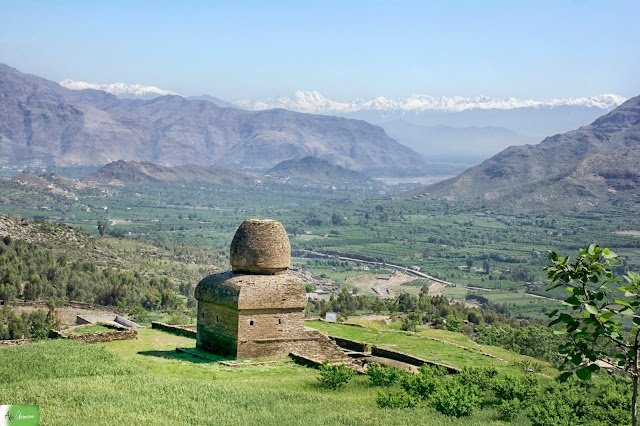
Two thousand years ago, the valleys of what is now Lower Dir rang with monastery bells. Buddhist monks studied, meditated, and built in these green hills, leaving behind stupas and monasteries that still shape the landscape today. Chatpat Stupa, Lower Dir is one of those places — a large stupa and monastery complex dating from the 1st to 5th century CE, excavated and published by the renowned historian Ahmad Hassan Dani, sitting quietly near Chakdara while its excavated treasures rest in the nearby Chakdara Museum. This Chatpat Stupa, Lower Dir travel guide will help you plan a visit that pairs the site with one of Pakistan’s finest Gandhara museums.
Let us set expectations honestly: Chatpat is not Takht-i-Bahi. The site stands on private, unprotected land, its remains are vulnerable and partly disturbed, and there is no visitor centre. What it offers is something the big sites cannot: the chance to stand at a genuine Gandharan monastery — stupa, monks’ cells, and votive stupas — with no crowds, no fences, and no filter, and then drive a few minutes to the Chakdara Museum to see the sculptures that were pulled from this very soil. For heritage travelers, history lovers, and anyone tracing the Buddha’s footprint through Pakistan, that combination is worth the trip.
Quick Facts
- Location: Near Chakdara, Lower Dir district, Malakand Division, Khyber Pakhtunkhwa, Pakistan — about 1.4 km from the Dir (Chakdara) Museum
- Altitude: Valley-floor site; Chakdara sits at roughly 700 metres above sea level
- Famous For: Large 1st–5th century CE Buddhist stupa and monastery with monks’ cells and votive stupas; excavated and published by Ahmad Hassan Dani
- Nearest City: Chakdara (minutes away); Timergara is the district headquarters of Lower Dir
- Accessibility: Road only. About 140–150 km from Islamabad via the M-1 and Swat Expressway; the site is on private land — visit respectfully
- Known Landmarks: Dir Museum (Chakdara Museum), Andan Dheri, the Panjkora River valley, Churchill Post at Chakdara
- Best For: Heritage travelers, Buddhist-history enthusiasts, archaeology buffs, photographers, and school or university groups studying Gandhara
Why Visit Chatpat Stupa, Lower Dir
The first reason is the history under your feet. Chatpat is not a reconstruction or a guess — it is a documented Buddhist monastic complex from the great age of Gandhara, the 1st to 5th century CE, when this region was one of the beating hearts of the Buddhist world. The site held a large stupa and a monastery with small cells for monks and votive stupas, spread across an area of about 30 by 20 metres. Its findings were documented in Ahmad Hassan Dani’s “A Survey of Lower Dir,” published in the Pakistan Heritage journal in 2010 — which means when you stand here, you are standing in a place the scholarship knows by name.
The second reason is the pairing. Chatpat’s excavated artifacts — the sculptures and architectural pieces recovered from its soil — are housed in the Dir Museum at Chakdara, barely a kilometre and a half away. Few heritage experiences in Pakistan are this neatly arranged: see the empty monastic shell in the morning, then see its treasures in the museum’s galleries in the afternoon. The museum’s Buddha section holds narrative relief panels depicting the Buddha’s life — the dream of Queen Maya, the birth of Siddhartha, the renunciation, the enlightenment — carved in schist by Gandharan craftsmen some two thousand years ago. Chatpat gives those sculptures their home address.
The third reason is Dir itself. Lower Dir is one of Khyber Pakhtunkhwa’s most historically layered districts — Aryan burial sites at Timergara, Buddhist stupas and monasteries across the valleys, the colonial-era Churchill Post at Chakdara, and a living Pashtun culture along the Panjkora River. Visitors who come only for the stupa miss the point: this is a whole landscape of history, and Chatpat is your doorway into it.
Finally, there is the cause. Chatpat is unprotected and privately owned, and researchers openly warn that its in-situ remains are vulnerable to neglect and looting. Visiting respectfully — with a local guide, leaving everything untouched — is a small act of witness. Heritage survives when people care that it exists. Your visit is a vote for Chatpat’s future.
History of Chatpat Stupa, Lower Dir
The story of Chatpat begins with Gandhara, the ancient civilization that flourished in the Peshawar valley and its surrounding hills — including Dir, Swat, and Buner — from roughly the 6th century BCE. Gandhara sat at the crossroads of empires: Achaemenid Persians, Alexander’s Greeks, Mauryans, Indo-Greeks, Scythians, and Parthians all passed through, each leaving a layer. But it was under the Kushan Empire, the great Central Asian power of the early centuries CE, that Gandhara became a Buddhist golden age. Kushan patronage — above all under Emperor Kanishka in the 1st century CE — filled the valleys with stupas and monasteries and gave the world the Greco-Buddhist art we call Gandharan.
Chatpat belongs to that world. The complex — a large stupa with an attached monastery of small cells and votive stupas — dates from the 1st to 5th century CE, spanning the Kushan height and the centuries that followed. Monasteries like this were the universities of their day: monks studied, copied manuscripts, debated philosophy, and guided the lay community, while pilgrims circumambulated the stupa earning merit. The site’s position near Chakdara, a natural crossing point of the valley routes, made it accessible to travelers moving between the religious centres of the region.
Buddhism’s decline in the region came gradually, as new political and religious orders reshaped the valleys over the late first millennium CE. The stupas crumbled, the monasteries emptied, and their sculptures slept underground for centuries — some unearthed by 19th-century British officers during campaigns like Chitral 1895, many finding their way to museums abroad, until scientific archaeology arrived after independence.
The modern chapter belongs to Pakistani archaeology. Excavations in Dir began in 1966–1969 under the Department of Archaeology, University of Peshawar, and the great historian Ahmad Hassan Dani surveyed and published sites including Chatpat — his “A Survey of Lower Dir” (2005, published in Pakistan Heritage in 2010) put Chatpat on the scholarly map. The recovered sculptures joined the collection of the Dir Museum at Chakdara, established on 30 May 1979 in a fort-like building of local Malakandi stone, which today holds 2,161 objects — over 1,444 of them Gandharan sculptures — gathered from Chatpat, Andan Dheri, Ramora, Bambolai, Nasafa, and other Dir sites. Politically, Dir’s own journey ran in parallel: the princely state of Dir, ruled by its Nawabs, was fully integrated into Pakistan in 1969, and the valleys have been writing their modern story ever since.
Top Things to Do in Chatpat Stupa, Lower Dir
Explore the Chatpat stupa and monastery remains
The heart of the visit. The site preserves the footprint of a large stupa with its monastery — look for the outlines of the monks’ small cells and the smaller votive stupas that pilgrims added over the centuries. Because the site is on private land and unprotected, go with a local guide who can show you the significant features and introduce you to the landowners. Walk gently, photograph freely, and touch nothing: every fragment in the soil is archaeological evidence.
Visit the Dir Museum (Chakdara Museum)
Non-negotiable — this is the second half of the Chatpat story. The museum’s Buddha section displays the Gandharan sculptures excavated from Chatpat and sister sites: narrative reliefs of the Buddha’s life story, standing Buddhas and bodhisattvas, atlantes and decorative fragments, all carved in schist. The Book Gallery holds Quranic and Hadith manuscripts for Islamic-history lovers, and the Ethnological Gallery (established 1977) shows the weapons, jewelry, dresses, and household goods of Dir’s people. The building itself — Malakandi stone, arched entrance, corner towers — is worth the visit alone.
See Andan Dheri and Dir’s other Buddhist sites
Chatpat is one node in a whole network. Andan Dheri, Baghrajai, Ramora, Bambolai, and Nasafa are among the documented Buddhist sites of Dir — ask at the museum or through a local guide which are accessible, and build a half-day Buddhist-heritage circuit around Chakdara.
Walk the Panjkora riverbanks at Chakdara
The Panjkora River gives Lower Dir its green character. An evening walk along the river near Chakdara — with the valley hills turning gold — is the perfect soft landing after a day of archaeology.
Visit the Churchill Post
History buffs should ask about the Churchill Post at Chakdara, the colonial-era relic named for Winston Churchill’s service on the frontier in 1897 during the siege of Malakand. It is a tangible thread connecting Dir’s ancient past to its imperial chapter.
Famous Places In and Around Chatpat Stupa, Lower Dir
- Dir Museum, Chakdara — 2,161 artifacts including 1,444+ Gandharan sculptures; 1.4 km from Chatpat.
- Andan Dheri — another major Buddhist site of Dir, represented in the museum’s collection.
- Churchill Post, Chakdara — colonial-era relic from the 1897 Malakand campaign.
- Timergara — district headquarters; nearby Aryan-era burial sites.
- Panjkora River valley — the green lifeline of Lower Dir.
- Ramora, Bambolai, Nasafa — further documented Buddhist sites of the district.
- Swat Valley — the great neighbouring valley of Gandharan heritage, an easy extension.
How to Reach Chatpat Stupa, Lower Dir
Chatpat is one of the most accessible Gandharan sites in Pakistan. From Islamabad, take the M-1 Motorway toward Peshawar and continue onto the Swat Expressway toward Chakdara — the total distance is roughly 140–150 km and the drive typically takes about two and a half to three and a half hours depending on traffic. Chakdara sits at the junction of the roads to Swat, Dir, and Bajaur, which makes it a natural base. From Peshawar, the drive to Chakdara is shorter — roughly an hour and a half to two hours via the motorway network.
The nearest airport is Bacha Khan International Airport, Peshawar; Islamabad International is the main gateway for visitors from Punjab and beyond. Roads to Chakdara are good year-round — this is settled valley country, not high mountain terrain — and the site itself, about 1.4 km from the Dir Museum, is reached by local road. Because Chatpat stands on private land, do not just wander in: arrange the visit through a local guide or ask at the museum, who can connect you with the right contacts. Public vans and coasters run regularly from Peshawar, Mardan, and Mingora to Chakdara and Timergara.
Route Details
- From Islamabad: M-1 Motorway toward Peshawar, then the Swat Expressway to the Chakdara interchange. Roughly 140–150 km; about 2.5–3.5 hours by car.
- From Lahore: M-2 to Islamabad, then follow the Islamabad route above. Total roughly 470–490 km; about 7–8 hours. An overnight trip works well.
- From Karachi: Fly to Islamabad (about 2 hours) and continue by road as above.
- Chakdara to Chatpat: From Chakdara town, the site lies about 1.4 km from the Dir Museum. Visit the museum first, arrange a local guide, and go with the landowners’ knowledge — the site is on private property.
Planning a wider heritage tour? Browse our Explore Pakistan destination guides.
Where to Stay in Chatpat Stupa, Lower Dir
Base yourself in Chakdara or Timergara. Chakdara, minutes from the site, has simple hotels and guesthouses aimed at travelers and officials — clean, functional mid-range rooms with attached bathrooms and on-site restaurants. Timergara, the district headquarters, offers a slightly wider choice of hotels at similar levels. Do not expect luxury resorts: this is practical, budget-friendly accommodation, typically costing a few thousand rupees per night, and it is perfectly comfortable for a heritage trip.
For a wider selection of hotels, many visitors stay in Mingora/Saidu Sharif in Swat (about an hour away) and do Chatpat and the Chakdara Museum as a day trip — Swat’s hotel market is far deeper. Whichever you choose, book ahead on weekends and holidays. Camping is not established around the site; stick to hotels and guesthouses.
Where to Eat: Local Foods of Chatpat Stupa, Lower Dir
Lower Dir eats in the hearty Pashtun tradition. In Chakdara’s bazaar and Timergara’s restaurants you will find chapli kebab — crisp-edged, tomato-studded, and best eaten hot from the karahi — alongside seekh kebabs, chicken tikka, mutton karahi, and fresh tandoori roti. Over plates of chapli kebab and cups of green tea (qahwa), locals will happily tell you the valley’s stories; food here is inseparable from hospitality.
Everyday meals run on rice, lentils, seasonal vegetables, and dairy, with doodh patti (milk tea) as the all-day drink. In fruit season, the bazaars fill with local produce. A full meal at a local hotel is budget-friendly — a few hundred rupees per person at a simple spot. There are no food stalls at the Chatpat site itself, so eat in Chakdara before or after your visit, and carry water for the walk around the ruins.
Weather in Chatpat Stupa, Lower Dir
Lower Dir’s valley climate is moderate — warmer than the high north, cooler than the plains. Chakdara sits at a comfortable elevation, which makes the region visitable for much of the year. Spring and autumn are the sweet spots for walking an open archaeological site; summer is warm but manageable; winter is cool and quiet.
| Season | Temperature Range | Conditions |
|---|---|---|
| Winter (Dec–Feb) | 3°C to 16°C | Cool and mostly dry; chilly mornings, occasional fog. Site visits fine on sunny days. |
| Spring (Mar–May) | 14°C to 30°C | Green valley, blossom, ideal walking weather. The best season for Chatpat. |
| Summer (Jun–Aug) | 24°C to 38°C | Warm; visit the site early morning or late afternoon. Monsoon showers possible. |
| Autumn (Sep–Nov) | 12°C to 30°C | Clear skies and harvest colours; excellent second window for heritage visits. |
Language and Culture of Chatpat Stupa, Lower Dir
Pashto is the language of Lower Dir, with Urdu widely understood in Chakdara, Timergara, and the bazaars. The culture is Pashtun — hospitality (melmastia) is sacred, elders are respected, and guests are treated as a trust. If a shopkeeper or guide invites you for tea, accept graciously; it is the valley’s way of welcoming you.
Dress modestly (covered shoulders and knees; women should carry a scarf), ask before photographing people, and remember that you are visiting a place where Buddhism once flourished and Islam has deep roots — both histories deserve respect. At the Chatpat site itself, the rule is absolute: look, photograph, and leave everything exactly as you found it. Removing even a potsherd is illegal and destroys archaeological evidence.
Shopping in Chatpat Stupa, Lower Dir
Shop in Chakdara bazaar and Timergara, the district’s commercial centres. Expect everyday bazaar goods: fabrics, Peshawari chapals, embroidered items, dry fruits and nuts, and local honey in season. The region’s agricultural markets are good for fresh and dried fruit. Prices are local — bargain politely. There is no souvenir shop at the Chatpat site or the museum (though the museum visit itself is the real takeaway); the nearest modern retail is in Mingora, Swat, or Mardan.
Travel Tips for Chatpat Stupa, Lower Dir
Packing Essentials
Comfortable walking shoes (uneven ground at the site), hat, sunscreen, water bottle, and snacks. A light jacket for spring/autumn mornings; warm layers in winter. Camera, power bank, and a notebook if you are the studious type — the museum’s galleries reward slow looking.
Safety Tips
Lower Dir is settled valley country with regular domestic tourism; standard precautions apply. Travel in daylight, keep to known routes, and visit the site with a local guide arranged through the museum or your hotel. Carry your CNIC. The site ground is unmaintained — watch your footing among the mounds.
Money & Connectivity
Carry cash: ATMs exist in Chakdara and Timergara, but small vendors, guides, and transport deal in cash. Mobile networks (Jazz, Telenor, Zong, Ufone) cover the towns well; signals thin out in side valleys. Download offline maps before heading to the site.
Best Time to Visit Chatpat Stupa, Lower Dir
Spring (March to May) — the best season
Mild temperatures, a green Panjkora valley, and perfect conditions for walking the open site and combining it with the museum. This is the window the guides recommend.
Autumn (September to November) — the clear season
Crisp air, clear skies, harvest colours — the second-best time, with beautiful light for photographing both ruins and museum pieces.
Winter (December to February) — quiet and cool
Entirely possible on sunny days; the museum is the main attraction in colder weather. Fewer visitors, more solitude among the ruins.
Summer (June to August) — warm but workable
Visit Chatpat early in the morning, spend the hot midday hours in the air-conditioned calm of the Dir Museum, and finish with an evening walk by the Panjkora.
Final Thoughts
Chatpat Stupa will not overwhelm you with scale, and it will not entertain you with facilities. What it does is rarer: it lets you stand, quietly and without crowds, in a Buddhist monastery that scholars know by name — and then walk into a museum and meet the sculptures that once watched over it. In a world of over-interpreted heritage, that directness is precious.
Pair the site with the Dir Museum, give Chakdara’s bazaar an evening, and let Lower Dir show you how much history fits into one green valley. For more heritage journeys across the country, explore our Explore Pakistan guides — and come back to Dir in spring, when the Panjkora valley is at its greenest and Chatpat at its most evocative.
FAQs
Where is Chatpat Stupa, Lower Dir?
Near Chakdara in Lower Dir district, Khyber Pakhtunkhwa — about 1.4 km from the Dir (Chakdara) Museum, roughly 140–150 km from Islamabad.
What is the best time to visit Chatpat Stupa?
Spring (March–May) and autumn (September–November) offer the best weather for visiting the open site; the museum is rewarding year-round.
How do I reach Chatpat Stupa, Lower Dir?
Drive from Islamabad via the M-1 and Swat Expressway to Chakdara (2.5–3.5 hours). Arrange a local guide through the Dir Museum — the site is on private land.
Is Chatpat Stupa safe for tourists?
Lower Dir is settled valley country with regular domestic tourism. Visit in daylight with a local guide and follow standard travel precautions.
Is Chatpat Stupa suitable for families?
The museum is excellent for families and school groups; the site itself is uneven open ground, best for older children and adults. The combination makes a great educational day trip.
Where can I stay near Chatpat Stupa?
In Chakdara or Timergara — simple, budget-friendly hotels and guesthouses. Many visitors base in Mingora/Saidu Sharif (Swat) and visit as a day trip.
What will I see at the Dir Museum?
Over 2,100 artifacts including 1,444+ Gandharan sculptures — Buddha life-story reliefs, standing Buddhas, coins, jewelry — plus Quranic manuscripts and an ethnological gallery of Dir’s culture.
Who excavated Chatpat Stupa?
The site was surveyed, excavated, and published by the renowned historian Ahmad Hassan Dani; his findings appeared in “A Survey of Lower Dir” in the Pakistan Heritage journal (2010).