Quick Facts
- Location: Shah Latif Town area, about 29 km east of Karachi on the National Highway, Sindh, Pakistan
- Altitude: near sea level, on the arid coastal plains of lower Sindh
- Famous For: centuries-old sandstone tombs with elaborate carvings, built 15th to 18th centuries
- Nearest City: Karachi (about 30–45 minutes by road)
- Accessibility: reached by road via the National Highway; local guides available at the site
- Known Landmarks: the carved sandstone sarcophagi, step-pyramid graves, turban-topped male graves
- Best For: history lovers, archaeology fans, photographers, and travelers interested in Sindh’s tribal heritage
Why Visit Chaukhandi Tombs
Just half an hour from the traffic of Karachi lies one of the most extraordinary graveyards in South Asia — and almost nobody goes there. The Chaukhandi Tombs are not a single shrine or a famous mausoleum. They are a whole necropolis of sandstone graves, some five centuries old, carved with horsemen, hunters, swords, shields, and jewelry so finely detailed that archaeologists still study them for clues about the lives of the people they honor. This is a place where the dead wear their stories on stone.
Chaukhandi is perfect for the traveler who wants to see the real Sindh beyond the city. The tombs belong to the Jokhio tribe and other Sindhi and Baloch clans, and every grave tells you something: a warrior’s grave carries his sword and his horse, a woman’s grave carries her bracelets and necklaces, and the size of the sarcophagus tells you the standing of the person inside. A local guide at the site can read these symbols for you like pages from a history book, and the visit becomes a journey through the warrior culture of lower Sindh.
The site is also a photographer’s gift. The buff-colored sandstone, quarried near Thatta and carved in the funerary style of lower Sindh, glows in the morning light, and the geometric patterns and figural scenes give you compositions in every direction. Because the necropolis is spread over a wide area and receives few visitors, you will often have the whole place to yourself — a rare luxury at any heritage site in Pakistan.
Perhaps most compellingly, Chaukhandi is a site with a future at stake. It sits on UNESCO’s Tentative List for World Heritage recognition, yet it faces weathering and neglect, and visitors themselves note the access roads need improvement. To visit now is to see it in its raw, authentic state — and to add your voice, however quietly, to the case for protecting it. For anyone building an itinerary of Pakistan’s hidden heritage, Chaukhandi belongs near the top.
History of Chaukhandi Tombs
The Chaukhandi Tombs form an early Islamic cemetery situated in the eastern part of Karachi, in what is now the Shah Latif Town area near Landhi. They were mainly built during Mughal rule, sometime between the 15th and 18th centuries, when Islam became dominant in lower Sindh. The name “Chaukhandi” is often taken to mean “four corners,” though some scholars treat it as an old place name and others as an architectural term — the origin of the name is itself part of the site’s mystery.
The tombs are generally attributed to the Jokhio tribe (also spelled Jokhiya) and are known as the family graveyard of the Jokhios, who belong to the Samma lineage said to descend from Rajputs. Other Sindhi tribes — the Burfat, Jakhra, and Shaikh — also have graves here, and members of the Kalmati Baloch tribe were buried here too. The more influential the person, the higher and more elaborate the grave, so the necropolis reads as a social map of the tribal world of medieval Sindh.
The carving style reveals a remarkable cultural blend. The graves follow Islamic burial customs — most are oriented north to south — yet their decoration carries strong Rajput and Hindu artistic influences: monumental pedestals, figural scenes, and Hindu-style pillar canopies over a few privileged graves. Some tombs show simple decoration, while others lack human figures entirely, reflecting Islamic beliefs. The step-shaped graves thus showcase a fusion of cultures that is found nowhere else in quite the same form, linking Chaukhandi stylistically to the great Makli Necropolis near Thatta, one of Pakistan’s UNESCO World Heritage Sites.
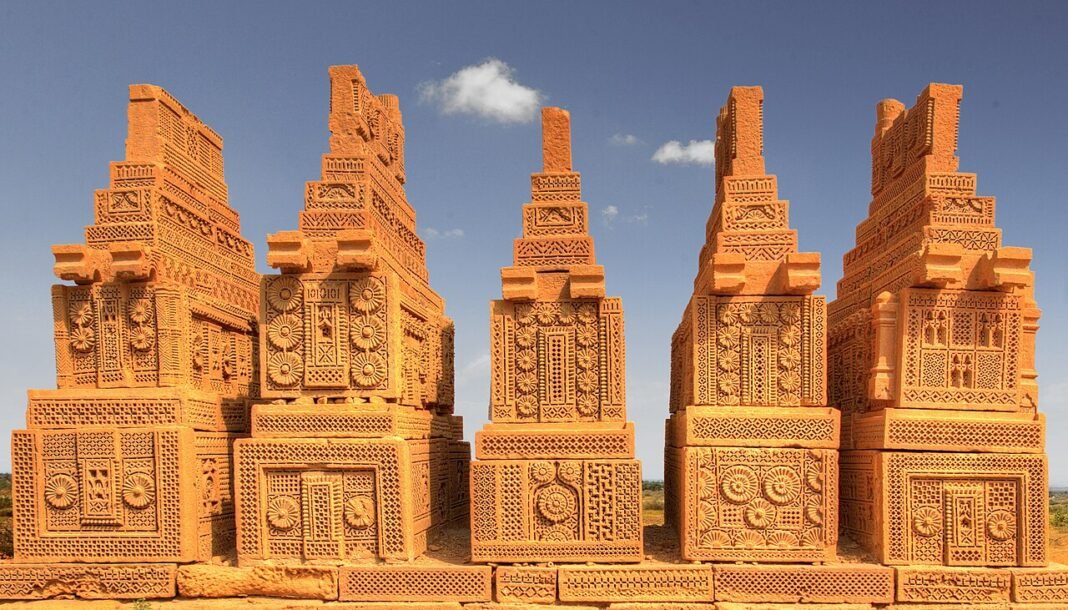
The sandstone itself tells a story of trade and craft. The buff-colored slabs were transported from Jung Shahi, a railway station near Thatta, and master carvers shaped them into a distinctive funerary architecture: a sarcophagus of six vertical slabs covered by a second, smaller sarcophagus, giving the grave a pyramid shape, topped with horizontal slabs and finally a vertical headstone — carved into a turban knob on male graves. Today the site is recognized for its cultural value and sits on UNESCO’s Tentative List, though preservation remains a challenge.
Top Things to Do in Chaukhandi Tombs
Study the Carved Sarcophagi
The heart of a Chaukhandi visit is slow looking. Walk among the graves and study the carved panels: mounted horsemen with bows and arrows, hunting scenes, shields and swords, and delicate geometric borders. Each carving was chosen to honor the person buried below — weapons and horses for warriors, floral and jewelry motifs for others. The craftsmanship is exquisite up close, and the arid climate has preserved the buff sandstone remarkably well. Give yourself at least an hour for this alone.
Read the Graves Like Biographies
Hire one of the local guides who wait near the site entrance. Visitors consistently recommend them, and they transform the visit: they will show you how to tell a male grave from a female grave (the turban-shaped knob at the northern end marks a man; jewelry carvings of bracelets, necklaces, rings, and anklets mark a woman), how the number of stacked slabs reflects the person’s status, and how the rare pillar-canopy graves signal the most honored dead. There is no entrance fee, so a small payment to a guide is money well spent.
Compare Chaukhandi with Makli
If your Karachi trip allows a second day, pair Chaukhandi with the Makli Necropolis near Thatta, about two hours away. The two sites share the same funerary architectural tradition of lower Sindh, and seeing them together — Chaukhandi the tribal family graveyard, Makli the royal necropolis — gives you a complete picture of Sindh’s carved-stone heritage. It is one of the great heritage pairings in Pakistan.
Photograph the Necropolis at Morning Light
The tombs face the morning sun beautifully, and the low light rakes across the carvings, bringing out every chisel mark. Arrive soon after sunrise for the best photographs and the coolest air. The necropolis is spread over roughly two square miles, so you will find compositions without other visitors in frame. Remember the local guidance: visit in daylight. The site has a reputation among locals as a haunted place at night, and there are no lights or facilities after dark.
Explore the Surrounding Heritage Belt
Chaukhandi sits on the historic corridor between Karachi and Thatta. The Shah Jahan Mosque in Thatta, with its 93 domes and blue tilework, makes a superb combination visit, as does the Banbhore archaeological site — the subject of our own Banbhore travel guide. Together these three sites trace two thousand years of Sindh’s history from the Indus port cities to the Mughal age.
Famous Places In and Around Chaukhandi Tombs
- Makli Necropolis, Thatta — the UNESCO World Heritage necropolis sharing Chaukhandi’s carving tradition.
- Shah Jahan Mosque, Thatta — the 17th-century mosque with 93 domes and masterful tilework.
- Banbhore — the ancient Indus port city and archaeological site.
- Quaid-e-Azam’s Mausoleum, Karachi — the national monument of Pakistan’s founder.
- Clifton Beach and Bagh Ibne Qasim — Karachi’s seafront for an evening walk after the tombs.
- Mohatta Palace, Karachi — the museum palace of pre-partition Karachi.
How to Reach Chaukhandi Tombs
Chaukhandi lies about 29 kilometres east of Karachi, near the National Highway in the Shah Latif Town / Bin Qasim Town area, close to Quaidabad and Malir. From central Karachi (Clifton, DHA, Saddar), the drive takes roughly 45 minutes to an hour depending on traffic; from the airport side of the city it is about 30 minutes. The site sits opposite a Total petrol pump at Shah Latif Town, which makes it easy to locate on maps.
From Hyderabad, the tombs are about 150 kilometres southwest via the M-9 motorway and National Highway — a drive of roughly two hours. From Thatta, it is about 100 kilometres north, making Chaukhandi a natural stop on the Karachi–Thatta heritage route. The nearest airport is Jinnah International Airport in Karachi.
The final approach roads to the cemetery are reported to be in poor condition — visitors consistently advise a car with decent clearance and a driver who knows the area. Transport options include a hired car with driver (the most comfortable choice), ride-hailing for the highway leg, or a guided tour arranged through a Karachi-based operator. Public transport does not reach the site directly. Visit in daylight; there are no facilities at the necropolis, so carry water and sun protection.
Route Details
- From central Karachi: take Shahrah-e-Faisal east toward Malir and Quaidabad, continue onto the National Highway (N-5) toward Shah Latif Town. The necropolis is on the highway near the Total petrol pump — about 45 minutes from Saddar in normal traffic.
- From Jinnah International Airport: head east on the airport road to join the National Highway at Quaidabad, then continue toward Shah Latif Town — roughly 30 minutes.
- From Hyderabad: take the M-9 motorway to Karachi, exit toward the National Highway east, and follow it to Shah Latif Town — about two hours.
- From Thatta: drive north on the N-5 National Highway toward Karachi; Chaukhandi is on the highway about 100 kilometres from Thatta — roughly 90 minutes.
Where to Stay in Chaukhandi Tombs
Chaukhandi is a day trip from Karachi, so you will stay in the city, which offers Pakistan’s widest range of hotels. Luxury travelers can choose five-star landmarks like the Pearl Continental Karachi or the Avari Towers on Fatima Jinnah Road, both with pools, restaurants, and business facilities. Mid-range hotels and serviced apartments cluster in DHA, Clifton, and Gulshan-e-Iqbal, offering comfortable rooms at moderate prices.
Budget guesthouses and family-run hotels are plentiful around Saddar, Burns Road, and near the airport. If you plan to combine Chaukhandi with Thatta and Makli, consider staying near Shahrah-e-Faisal or the airport side of the city to shorten your morning drive east. Book ahead during winter (November to February), Karachi’s peak tourist season. Since the tombs are a half-day visit, pick your hotel for its comfort and your wider Karachi plans — the necropolis itself has no accommodation, food, or shops.
Where to Eat: Local Foods of Chaukhandi Tombs
A Chaukhandi trip is best paired with Karachi’s legendary food scene. The city is Pakistan’s culinary capital, and the drive back from the tombs gives you the perfect excuse for a food tour. Start with Karachi’s icons: biryani (the city’s signature dish, fiercely debated between rival shops), bun kebab from Burns Road, and nihari for the meat lovers. The Burns Road food street, a short drive from the highway return route, is where old Karachi eats — seekh kebabs, gola kebabs, fresh tandoori naan, and falooda for dessert.
Near the tombs themselves, options are limited to highway dhabas serving chai, parathas, and simple rice and curry meals — fine for a tea break but not a destination. Plan your main meal back in the city. A dhaba meal is budget-friendly; a sit-down dinner at a popular Karachi restaurant is moderate by Pakistani standards. Seafood lovers should note that Karachi’s coastal restaurants serve excellent fresh fish and prawns, a fitting end to a day that began among the sandstone graves of Sindh’s coast.
Weather in Chaukhandi Tombs
Chaukhandi shares Karachi’s hot, arid coastal climate, with one important difference: the necropolis is fully exposed, with no shade, no trees, and reflective sandstone underfoot. Timing your visit for the cooler months is not a luxury — it is the difference between a pleasant morning and a punishing one. The ideal window is October to March, when mornings are cool and the light is perfect for the carvings.
| Season | Temperature Range | Conditions |
|---|---|---|
| Winter (Dec–Feb) | 12–28°C | Cool mornings, sunny days; the best season for the tombs |
| Spring (Mar–Apr) | 22–36°C | Warming up; visit before 10 a.m. for comfort |
| Summer (May–Aug) | 30–40°C | Hot and humid; sea breezes help in the city but not at the exposed site |
| Autumn (Sep–Nov) | 25–38°C | Cooling from October; November mornings are ideal |
Language and Culture of Chaukhandi Tombs
The tombs belong to the cultural world of Sindh. Sindhi is the language of the tribes buried here — the Jokhio, Burfat, Jakhra, and Shaikh — and you will hear it in the surrounding villages. Urdu is the shared language of Karachi and works everywhere, including with the guides at the site. English is understood in the city’s hotels and by many guides.
This is a Muslim cemetery, and visitors should treat it with the respect a graveyard deserves: keep voices low, do not climb on the tombs, do not sit on the graves, and do not remove stones or attempt rubbings that could damage the carvings. Dress modestly. Photography is welcome, and the guides are generally happy to be photographed, but ask first. The tribal heritage here is a living culture — the Jokhio and Baloch communities of the area are the descendants of the people buried in these graves, and a respectful visit is a small act of honoring that continuity.
Shopping in Chaukhandi Tombs
There are no shops at the necropolis itself, so plan your shopping in Karachi. For crafts connected to Sindh’s heritage, the best hunting grounds are the city’s traditional markets: Zainab Market and the shops around Burns Road for ajrak (the block-printed shawls of Sindh), ralli quilts, and embroidered caps; Tariq Road and Hyderi for modern shopping. Ajrak in deep indigo and crimson is the single most fitting souvenir of a Chaukhandi visit — it is the textile signature of Sindh.
Karachi also has major malls — Dolmen Mall Clifton, Lucky One, and Ocean Mall — for fixed-price, air-conditioned shopping. Prices in traditional markets are negotiable; in malls they are fixed. If you visit Thatta on the same trip, look for the blue-glazed pottery and woodwork of the old city. Avoid buying “antique” stone carvings from roadside sellers anywhere near heritage sites — genuine artifacts belong in museums, and the trade damages sites like Chaukhandi.
Travel Tips for Chaukhandi Tombs
Packing Essentials
Sun protection is non-negotiable: a wide hat, sunglasses, sunscreen, and at least a litre of water per person, because there is no shade and no shop at the site. Sturdy walking shoes handle the uneven, sandy ground. A camera with a good zoom lets you capture carving details without touching the stones. In winter, a light jacket for the early morning drive is enough.
Safety Tips
Visit only in daylight — the site has no lighting, no staff after hours, and local tradition strongly advises against night visits. Go with a companion or a guide rather than alone. Keep valuables out of sight in the car, and be cautious on the poor approach roads. The necropolis itself is peaceful; the main risks are heat, dehydration, and the drive.
Money & Connectivity
There is no entrance fee at Chaukhandi, but carry cash for the local guide and for highway dhaba stops. ATMs are plentiful in Karachi but not near the site, so withdraw before you leave the city. Mobile signals from all major networks work along the National Highway, though coverage at the necropolis itself can be patchy — download offline maps before you go.
Best Time to Visit Chaukhandi Tombs
Winter (November–February)
The perfect season. Cool mornings around 12–20°C, clear skies, and golden light on the sandstone make this the time the tombs were made to be seen in. This is also Karachi’s most pleasant season overall, so combine the tombs with the city’s beaches and food streets.
Spring and Autumn (March–April, October)
Good shoulder seasons. Visit early in the morning — arrive by 8 a.m. — and you will have comfortable light and temperatures. October in particular offers lovely post-monsoon clarity.
Summer (May–September)
The least comfortable season for Chaukhandi. If you must go, make it a dawn visit and be back in the city by 10 a.m. The heat on the exposed stone is intense, and the monsoon months bring humidity that makes the carvings harder to enjoy.
Final Thoughts
Chaukhandi Tombs are the kind of place that changes how you see a region. Before visiting, Sindh’s tribal history can feel abstract; after walking among graves that wear swords, horses, and jewelry in stone, it becomes vivid and personal. The necropolis asks for nothing more than an hour of your attention and a respectful eye — and it repays that attention with some of the finest funerary art in South Asia.
If Karachi is on your itinerary, do not let this site slip past. It pairs beautifully with Makli and Thatta for a full heritage circuit, and it stands as a quiet counterpoint to the city’s modern energy. For more journeys into Pakistan’s lesser-known heritage, explore our Explore Pakistan collection — and when you are ready for the mountains, Hunza Valley awaits.
FAQs
Where are the Chaukhandi Tombs located?
About 29 kilometres east of Karachi, near the National Highway in the Shah Latif Town area, close to Landhi and Quaidabad in Sindh.
How old are the Chaukhandi Tombs?
They were mainly built between the 15th and 18th centuries during Mughal rule in Sindh — roughly 300 to 500 years old.
Who is buried at Chaukhandi?
Primarily members of the Jokhio tribe, whose family graveyard this is, along with the Burfat, Jakhra, Shaikh, and Kalmati Baloch tribes.
How do I reach the Chaukhandi Tombs from Karachi?
Drive east on Shahrah-e-Faisal and the National Highway toward Shah Latif Town — about 45 minutes from central Karachi. A hired car with driver is the most comfortable option; the final approach roads are rough.
Is there an entrance fee?
No. There is currently no entrance fee, though visitors recommend hiring one of the local guides at the site for a small payment.
Are the Chaukhandi Tombs safe to visit?
Yes, in daylight. Go with a companion or guide, carry water, and avoid night visits — the site has no lighting and local tradition advises against it.
Are the Chaukhandi Tombs suitable for families?
Yes, for a half-day outing. Children often enjoy the carved animals and horsemen, but keep them from climbing on the fragile stones and bring sun protection.
What makes the carvings special?
The graves blend Islamic burial customs with Rajput and Hindu artistic traditions — male graves carry weapons and horses, female graves carry jewelry motifs, and the stacked sandstone slabs reflect the status of the deceased. The site is on UNESCO’s Tentative List.