Quick Facts
- Location: rocky Chenab hills at Chenab Nagar, Chiniot District, Punjab, Pakistan
- Altitude: low rocky hills on the Punjab plains
- Famous For: ancient petroglyphs — horsemen, stupas, Sun deity, and Zoroastrian symbols carved in stone
- Nearest City: Chiniot (about 30–45 minutes); Faisalabad is the nearest large city
- Accessibility: reached by road from Chiniot; the sites are unprotected hillside locations best visited with a local guide
- Known Landmarks: the Gorakh Nath Astan rock shelter (eastern site) and Kot Amir Shah (western site)
- Best For: archaeology enthusiasts, history travelers, photographers, and offbeat explorers
Why Visit Chenab Nagar Rock Art, Chiniot
Long before the Mughals built their gardens and long before the British drew their maps, travelers were carving their stories into the rocks of Chiniot. The rock art of Chenab Nagar is Punjab’s forgotten open-air museum: hillsides covered in petroglyphs of horsemen standing on horseback, tower-like stupas, a Sun deity, and the ringed symbols of Ahura Mazda — the fingerprints of Buddhists, Zoroastrians, and Central Asian horsemen who passed through this land over two thousand years. Almost no tourists come here. That is exactly why you should.
This destination is perfect for the traveler who has seen the forts and wants the deeper story. Where else in Punjab can you stand in front of carvings that link to the White Huns, the Kushans, and the Achaemenid Persians in a single afternoon? The petroglyphs at the two main sites — Gorakh Nath Astan in the east and Kot Amir Shah in the west — show riders standing on their horses in a style peculiar to the Hepthalites, horses decorated in the Achaemenid and Sassanian manner, and stupas that announce a Buddhist presence. Similar motifs appear in the rock art of Chilas and Hodur in Gilgit-Baltistan and in the Khirthar hills of Sindh, making Chenab Nagar a missing chapter in Pakistan’s great rock-art story.
There is also an urgency to this visit that makes it special. The sites are unprotected and have been badly damaged by stone-crushing and quarrying; heritage surveys warn that the petroglyphs are disappearing. To walk these hills now is to see history while it is still visible — and to understand, viscerally, why archaeological heritage needs guardians. For photographers, the contrast of ancient carvings against the rugged Chenab hills is striking, and the soft winter light from November to February is ideal.
Finally, Chenab Nagar lets you pair deep history with one of Punjab’s most characterful small cities. Chiniot itself is famous for its woodwork, its 1923–1935 Omar Hayat Mahal, and its beloved Chinioti kuna. A rock-art morning followed by a wood-carver’s workshop afternoon and a kuna dinner is a day no standard Punjab itinerary can match.
History of Chenab Nagar Rock Art, Chiniot
The hills around Chiniot host a number of archaeological sites, of which the most prominent are the rock art sites lying to the west and east of the hills. The eastern site, locally called Gorakh Nath Astan, features a rock shelter at the top of the hill containing engravings from different periods; on the way to the shelter, another site holds numerous petroglyphs of horse riders. The western site is known locally as Kot Amir Shah. Both sites have suffered severe damage from stone-crushers and quarrying, and neither enjoys formal protection as a heritage site.
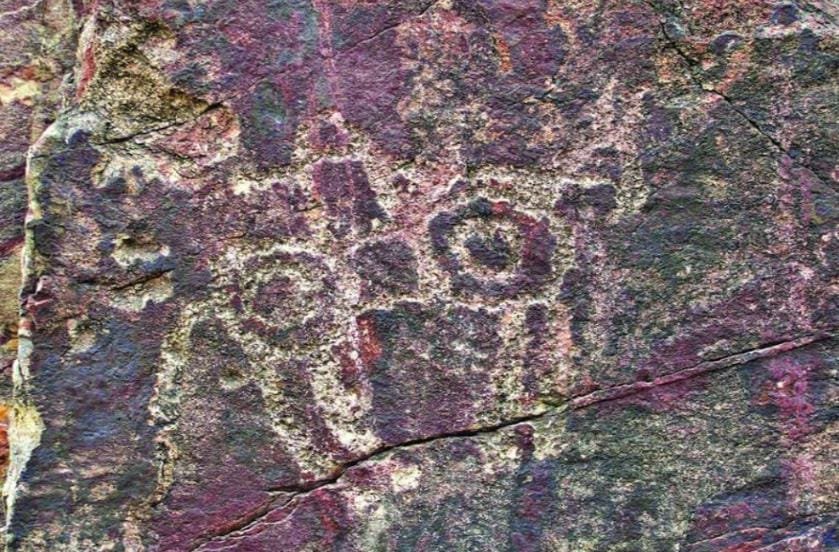
The carvings span many centuries. The most striking are the horsemen shown standing — not seated — on horseback, a style identified as peculiar to the White Huns (Hepthalites) who swept through the region in late antiquity. The horses carry decorative markings on their bodies, a hallmark of Achaemenid and Sassanian art, suggesting strong Iranian cultural influence on the carvers. Engravings of tower-like stupas clearly indicate a Buddhist historical presence, and the discovery of Kushan-period coins in the area — the Kushans were great patrons of Buddhism — supports that connection. At Gorakh Nath Astan, rings of Ahura Mazda, the Zoroastrian symbol, are carved into the rock shelter itself.
Modern rediscovery of Chiniot’s ancient past owes much to local effort. The Lok Baithak, a local heritage group, has been working on the remains in Chiniot since 2005, and its convener Umar Daraz reported the discovery of a gold Kushan-period coin — depicting a goddess feeding a child — from one of the area’s mounds. In 2011, the Archaeology Department announced a survey and excavation of Chiniot sites in collaboration with Lok Baithak, after examining rock platforms at the Kirana Hills (locally known as Punj Peer) that appeared to be the walls of a stupa. Officials dated the carvings across a wide range: some fine, intricate combat and horseman scenes were speculated to date from the time of Alexander the Great’s invasion, while the latest carvings are as recent as 300 years old. Three overlapping circles carved abundantly on the Kirana rocks were identified as Buddhist symbols.
Today the rock art of Chenab Nagar remains unprotected, with no active conservation or management by archaeological authorities — a status that heritage writers describe with alarm, urging travelers to visit before quarrying erases what remains. The best time to see the petroglyphs is now, in the cool months, with a knowledgeable local guide who knows which boulders still carry the clearest carvings.
Top Things to Do in Chenab Nagar Rock Art, Chiniot
Explore Gorakh Nath Astan
Begin at the eastern rock art site, Gorakh Nath Astan, the richer of the two locations. Climb to the rock shelter at the top of the hill, where engravings from different periods overlap on the stone. On the way up, stop at the horse-rider panels — the riders standing on horseback are the site’s signature images — and look for the Sun deity engraved close beside them. Inside the shelter, find the rings of Ahura Mazda and the tower-like stupas that mark the Buddhist layer of the site’s history. A local guide is invaluable here; the carvings are scattered and easy to miss.
Visit Kot Amir Shah
The western site, Kot Amir Shah, holds its own collection of petroglyphs, including more of the standing horsemen and combat-related images. The horse decorations here — body markings in the Achaemenid and Sassanian style — are among the clearest evidence of Iranian artistic influence in Punjab’s rock art. Walking between the boulders, you can trace how different eras of carvers reused the same stones, layering their symbols over centuries.
Read the Symbols
Bring the site’s iconography to life by learning its vocabulary before you go: standing horsemen (Hepthalite/White Hun style), decorated horses (Persian influence), tower stupas (Buddhist), Ahura Mazda rings (Zoroastrian), the Sun deity, lions, hands, chess-board patterns, ships, and flowers. Spotting each motif in the field turns a walk among boulders into a treasure hunt through two millennia of belief systems.
Photograph the Petroglyphs
The carvings photograph best in raking light — early morning or late afternoon — when the low sun throws the shallow engravings into relief. Midday light flattens them. A polarizing filter helps cut glare on the stone. Never chalk, wet, or trace the carvings to make them photograph better; oils and abrasion damage the very art you came to admire.
Combine with Chiniot’s Woodwork Heritage
After the hills, spend your afternoon in Chiniot town. Visit the Omar Hayat Mahal (Gulzar Manzil), the 1923–1935 wooden palace built by Sheikh Omar Hayat that showcases the city’s legendary woodcarving, and walk through the furniture bazaars where artisans still practice the manabat kari carving style. The contrast — stone carvings two thousand years old in the morning, wood carvings two hundred years in the making in the afternoon — is the essence of Chiniot.
Famous Places In and Around Chenab Nagar Rock Art, Chiniot
- Omar Hayat Mahal (Gulzar Manzil), Chiniot — the 1923–1935 carved-wood palace, now a library.
- Shahi Masjid, Chiniot — the historic Mughal-era mosque of the old city.
- Kirana Hills (Punj Peer) — the stupa-platform and mound area northwest of Chiniot.
- Chenab River banks — riverside scenery near the city.
- Faisalabad — the nearest large city, with its colonial clock tower and bazaars.
How to Reach Chenab Nagar Rock Art, Chiniot
Chenab Nagar lies in the rocky hills of Chiniot District in central Punjab. The practical base is Chiniot city, which sits on the main road network: from Lahore, Chiniot is roughly 180 kilometres northwest via the M-2 motorway and connecting roads, a drive of about three to three and a half hours. From Faisalabad, it is roughly 40 kilometres north — under an hour. From Islamabad, the journey is roughly 300 kilometres via the M-2, about four to five hours.
The nearest airport is Faisalabad International Airport, with Lahore’s Allama Iqbal International Airport the better-connected alternative. From Chiniot town, the rock art hills at Chenab Nagar are a short drive, but the sites are unmarked and spread across quarried hillsides — arrange a local guide in Chiniot before heading out, ideally through a local contact or your hotel. A car with decent ground clearance is advisable for the hill tracks.
Road conditions on the motorways and main roads are good year-round. Transport options include your own car, a hired car with driver from Lahore or Faisalabad, or public buses to Chiniot followed by a locally hired vehicle. Because the sites are unprotected and unstaffed, visit in daylight, carry water and sun protection, and let someone in town know your plans.
Route Details
- From Lahore: take the M-2 motorway toward Islamabad, exit for Chiniot via the connecting roads, and reach Chiniot city in about three to three and a half hours. From Chiniot, head to the Chenab Nagar hills with a local guide.
- From Faisalabad: drive north on the Faisalabad–Chiniot road — under an hour to Chiniot city.
- From Islamabad: take the M-2 motorway south toward Lahore, exit for Chiniot — roughly four to five hours to Chiniot city.
- At the site: the two main clusters are Gorakh Nath Astan (eastern hills) and Kot Amir Shah (western hills); a Chiniot-based guide knows the current access tracks, which shift as quarrying changes the landscape.
Where to Stay in Chenab Nagar Rock Art, Chiniot
Stay in Chiniot city or Faisalabad — there is no accommodation at the rock art hills themselves. Chiniot has simple, budget-friendly hotels and guesthouses suited to an overnight heritage trip; they are basic but clean, and the town’s hospitality is genuine. For more comfort, Faisalabad (under an hour away) offers mid-range hotels and better-known chains, making it a practical base if you are combining the rock art with a wider Punjab itinerary.
Luxury travelers should base in Lahore or Faisalabad and visit as a long day trip. Whatever you choose, book the night before your hill visit so you can start early — the petroglyphs are best seen in morning light, and the hills are hot by midday even in winter. Ask your hotel to help arrange a local guide; Chiniot’s hoteliers generally know who can take you to the sites.
Where to Eat: Local Foods of Chenab Nagar Rock Art, Chiniot
Chiniot has one dish that alone justifies the trip: Chinioti kuna. This is beef or mutton sealed in a mud pot (the kuna) with spices, the pot sealed with flour dough so no steam escapes, then slow-cooked buried under embers and soil. The result is meltingly tender meat in a rich gravy, and people travel to Chiniot from other cities specifically to eat it. Ask locals for the best kuna shops — every Chinioti has an opinion, and Friday, the weekly holiday for the furniture-market workers, is the traditional kuna day.
Beyond kuna, Chiniot shares the hearty food culture of central Punjab: spicy biryani and rice dishes are everyday favorites, and the town’s roadside kheer (rice pudding) is locally famous. Meals at local dhabas and small restaurants are budget-friendly. For breakfast, try halwa puri with lassi at a busy morning shop. As always with street food, choose busy stalls with high turnover and drink bottled water.
Weather in Chenab Nagar Rock Art, Chiniot
The Chenab Nagar hills share the climate of central Punjab: hot summers, a monsoon, and cool, pleasant winters. Heritage surveys specifically recommend November to February for the rock art, when the rocky hills are cool and the low sun brings out the carvings. Summer visits are possible but uncomfortable on the exposed, reflective stone.
| Season | Temperature Range | Conditions |
|---|---|---|
| Winter (Dec–Feb) | 5–22°C | Cool, clear, ideal; the recommended season for the rock art |
| Spring (Mar–Apr) | 18–36°C | Pleasant in March; hot by late April; visit in the morning |
| Summer (May–Jul) | 32–45°C | Very hot on exposed rock; monsoon rains from July |
| Autumn (Aug–Nov) | 24–38°C | Humid in August–September; November brings ideal cool, clear days |
Language and Culture of Chenab Nagar Rock Art, Chiniot
Punjabi is the mother tongue of Chiniot, spoken in the bazaars, workshops, and villages around the hills; Urdu is the shared language of education and visitors and works everywhere. The people of Chiniot are known across Punjab for their hospitality — heritage travelers consistently report being welcomed with tea and conversation — and for their pride in the city’s craft traditions. English is understood in hotels and by educated younger people.
Culturally, Chiniot is a craft city: generations of woodcarvers have shaped its identity, and the same respect for handmade skill extends to the ancient stone carvings in the hills. Treat the petroglyphs as the fragile heritage they are — do not climb on carved boulders, make rubbings, or add graffiti. Dress modestly, greet people warmly, and accept the inevitable offer of chai; in Chiniot, hospitality is not a performance but a habit.
Shopping in Chenab Nagar Rock Art, Chiniot
Chiniot is one of Pakistan’s great craft-shopping destinations, and the rock art trip pairs perfectly with it. The city is famous nationwide for its hand-carved wooden furniture — sheesham-wood beds, tables, and cabinets with intricate floral carving — and the furniture bazaars let you watch artisans at work and buy pieces directly. Smaller carved items (boxes, frames, trays) make practical souvenirs.
The old city’s bazaars also sell everyday Punjabi goods: fabrics, khussas, and brassware at negotiable prices. There are no shopping malls in Chiniot itself — for mall shopping, Faisalabad is under an hour away. Bargaining is expected in the bazaars; start below the quoted price and settle with good humor. If you are buying furniture, arrange transport before you commit — Chinioti shops regularly ship pieces across Pakistan.
Travel Tips for Chenab Nagar Rock Art, Chiniot
Packing Essentials
Sturdy walking shoes with grip for the rocky hillsides, a hat, sunscreen, and plenty of water — there is no shade and no shop at the sites. A camera with a polarizing filter helps with the glare on stone. In winter, a light jacket for early mornings. A small notebook is handy for sketching or noting the motifs you spot.
Safety Tips
The main risks are the terrain and the quarrying activity, not crime. Stay on stable ground, watch for loose rock on slopes, and keep clear of active quarry areas and stone-crushers — they are the reason the sites are endangered, and they are dangerous to approach. Go with a local guide who knows which areas are safe, visit in daylight, and let someone in Chiniot know your plans.
Money & Connectivity
Carry cash — Chiniot’s bazaars, dhabas, and guides operate on cash, and while the town has ATMs, the hills have none. Mobile signals from the major networks cover Chiniot town; coverage in the hills can be patchy, so download offline maps. Your guide’s fee and any driver costs are cash transactions — agree on the amount beforehand.
Best Time to Visit Chenab Nagar Rock Art, Chiniot
Winter (November–February)
The recommended season. Cool air, clear skies, and low-angled sunlight that makes the shallow petroglyphs stand out on the stone. Mornings are crisp and perfect for climbing to the Gorakh Nath Astan shelter. This is when heritage surveys advise visiting.
Spring (March–April)
A good shoulder season if you start early. March mornings are pleasant; by April the heat builds, so plan hill visits before 10 a.m. and spend afternoons in Chiniot’s workshops and the Omar Hayat Mahal.
Summer and Monsoon (May–September)
The least comfortable season — the exposed rock radiates heat and temperatures can cross 40°C. If you must visit, go at dawn. The monsoon also makes hill tracks slippery. Winter remains the wise choice for this destination.
Final Thoughts
The rock art of Chenab Nagar is a reminder that Pakistan’s history did not begin with empires — it began with travelers, horsemen, and pilgrims scratching their beliefs into stone. In an age of crowded heritage sites, these quiet, quarried hills offer something rare: the chance to read two thousand years of human movement in a single afternoon, with no ticket queue and no rope barrier between you and the past.
Go soon, go in winter, and go with a guide who loves these stones. Pair the hills with Chiniot’s living craft heritage and a pot of kuna, and you will have one of the most original days any Punjab itinerary can offer. For more offbeat heritage journeys, browse our Explore Pakistan collection — from the carved necropolises of Sindh to the valleys of Hunza.
FAQs
Where is the Chenab Nagar rock art located?
In the rocky Chenab hills at Chenab Nagar, in Chiniot District of Punjab, a short drive from Chiniot city. The two main sites are Gorakh Nath Astan (east) and Kot Amir Shah (west).
How old are the petroglyphs?
They span many centuries: some carvings are speculated to date from Alexander the Great’s era, the Buddhist and Hepthalite images belong to late antiquity and the early medieval period, and the latest carvings are as recent as 300 years old.
What do the carvings depict?
Standing horsemen, decorated horses, tower-like stupas, the Sun deity, Ahura Mazda rings, lions, combat scenes, hands, chess-board patterns, ships, and flowers — reflecting Buddhist, Zoroastrian, Iranian, and Central Asian influences.
How do I reach the rock art from Chiniot?
Drive from Chiniot city to the Chenab Nagar hills with a local guide — the sites are unmarked and access tracks shift with quarrying activity. Arrange the guide in Chiniot before heading out.
Is there an entrance fee?
No. The sites are unprotected and unstaffed, so there is no ticket — but hiring a local guide is strongly recommended and worth the small fee.
Are the sites safe to visit?
Yes, in daylight with a guide. Keep clear of active quarry areas, watch your footing on the rocky slopes, and carry water — there is no shade or shop at the sites.
When is the best time to visit?
November to February, when the hills are cool and the low winter sun brings out the carvings. Avoid the May–July heat.
What else can I see in Chiniot?
The Omar Hayat Mahal (1923–1935 carved-wood palace), the Shahi Masjid, the famous furniture and woodwork bazaars, and the Chenab riverbanks — plus a meal of Chinioti kuna.