Quick Facts
- Location: Karakoram range, Gilgit-Baltistan, Pakistan — near the head of the Baltoro Glacier in the Concordia region
- Altitude: 7,665 metres (25,148 feet) at the southwest summit (Chogolisa I); the northeast summit (Chogolisa II, “Bride Peak”) reaches 7,654 metres
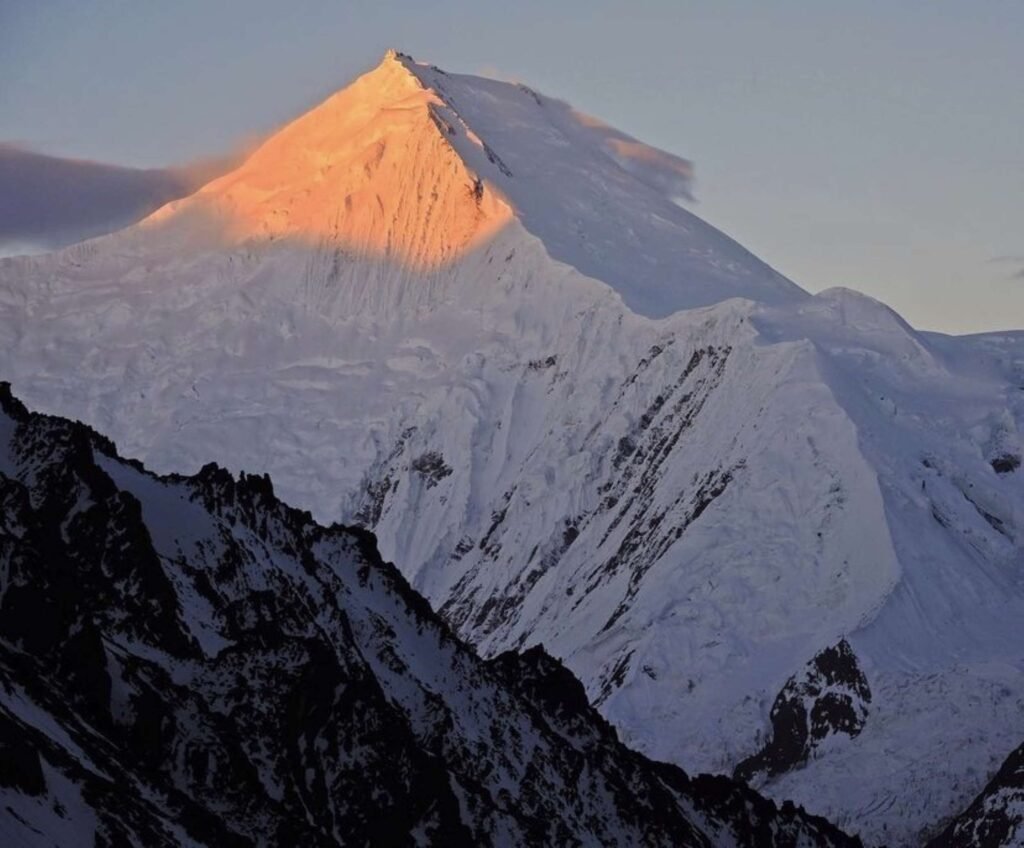
- Famous For: Its perfect trapezoidal snow pyramid — one of the most beautiful mountains in the Karakoram — and a climbing history marked by both triumph and tragedy, including the death of legendary Austrian climber Hermann Buhl in 1957
- Nearest City: Skardu, the expedition hub of Baltistan, from where the Baltoro trek begins at Askole
- Accessibility: Only reachable on foot — a 6 to 8 day trek from Askole to Concordia, then an expedition approach. This is a serious 7,000-metre climbing objective, not a tourist viewpoint
- Known Landmarks: Concordia (the meeting point of the Baltoro and Godwin-Austen glaciers), K2, Broad Peak and the Gasherbrums in the same amphitheatre
- Best For: Experienced mountaineers on expedition, serious trekkers walking the Concordia route, and armchair adventurers who want to stand beneath one of mountaineering’s great stories
Why Visit Chogolisa
Chogolisa is not a mountain you tick off on a holiday — it is a mountain you commit to. Rising 7,665 metres above the Baltoro Glacier, its huge white trapezoid dominates the Concordia region, and it is widely considered one of the most beautiful peaks in the entire Karakoram. For the climber, it is one of the great remaining challenges of Pakistan’s high mountains, with just over thirty recorded ascents. For the trekker, the approach alone — walking the length of the Baltoro Glacier to Concordia — is one of the finest journeys on earth. And for the dreamer, Chogolisa carries one of the most haunting stories in all of mountaineering.
In June 1957, Hermann Buhl — the Austrian genius who had made the first solo ascent of Nanga Parbat four years earlier — stood on this mountain’s slopes with Kurt Diemberger, just weeks after the two had climbed Broad Peak. A sudden snowstorm forced them to retreat less than two thousand feet from the summit, and on the descent a cornice collapsed beneath Buhl. He fell into the mountain’s near-vertical north face, and his body has never been found. To stand at Concordia and look up at Bride Peak is to look at the last mountain one of history’s greatest climbers ever touched. Few places in Pakistan concentrate that much story into a single view.
But Chogolisa is not only a monument to tragedy. A year after Buhl’s death, a Japanese expedition succeeded where he had failed, making the first ascent of the northeast summit. In 1975, Austrians finally climbed the higher southwest summit. In 1986, a British team completed the first traverse linking both summits along a ridge more than a kilometre long. The mountain’s history reads like a condensed history of Himalayan climbing itself — and you can walk through the same camps, under the same seracs, that those expeditions used.
This chogolisa travel guide is written for two kinds of reader. If you are an experienced mountaineer planning an expedition, the sections on access, seasons and logistics are for you — Chogolisa remains an attainable 7,665-metre objective for a strong, well-organised team. And if you are a trekker or a dreamer, know this: you do not need to climb Chogolisa to have it change you. Walk the Baltoro to Concordia, sleep in its shadow, and watch the evening light turn its trapezoid gold. That alone is worth the journey.
History of Chogolisa
The name “Chogolisa” comes from the Balti words Chogo Ling Sa, meaning “Great Hunt” — a reminder that long before climbers arrived, these mountains were the domain of Balti herders and hunters. The peak’s second name, “Bride Peak,” was given by the British explorer and politician William Martin Conway in 1892, during his pioneering exploratory journey through the Karakoram. Conway was struck by the mountain’s elegant, bridal-veil-like appearance — always clad entirely in white — and the name has stuck to the 7,654-metre northeast summit ever since.
The first serious attempt came in 1909, when Luigi Amedeo, the Duke of the Abruzzi, led an expedition to Chogolisa from a base camp on the northern side, with a high camp on the Chogolisa saddle at 6,335 metres. The Duke and his party reached 7,498 metres before bad weather stopped them — but their climb established a new world altitude record, one that stood for thirteen years until the 1922 British Everest expedition pushed past 8,200 metres. In that moment, Chogolisa entered the history books as the highest point any human had ever reached.
1957 brought the mountain’s darkest chapter. Austrian mountaineers Hermann Buhl and Kurt Diemberger, fresh from the first ascent of Broad Peak a few weeks earlier, attempted Chogolisa’s northeast summit. On June 25 they left Camp I and bivouacked in a saddle at 6,706 metres on the southeast ridge. On June 27 a sudden snowstorm forced them to retreat, and on the descent Buhl broke through a snow cornice and fell into the mountain’s near-vertical north face. His body was never recovered. Buhl — who had climbed Nanga Parbat alone and without oxygen in 1953 — remains one of the immortals of mountaineering, and Chogolisa is where his story ended.
Triumph followed tragedy. On August 4, 1958, a Japanese expedition from the Academic Alpine Club of Kyoto University, led by Takeo Kuwabara, made the first ascent of the northeast summit (Chogolisa II), placing Masao Fujihira and Kazumasa Hirai on top. The slightly higher southwest summit waited until August 2, 1975, when Fred Pressl and Gustav Ammerer of an Austrian expedition led by Eduard Koblmueller reached it — Koblmueller himself nearly sharing Buhl’s fate when he fell through a cornice, saved only because he was roped to his team. Finally, in 1986, a British expedition led by Andy Fanshawe completed the first traverse connecting both summits along the mountain’s long summit ridge, approaching from the Baltoro Glacier with base camp near the junction of the Vigne and Upper Baltoro glaciers. With just over thirty ascents in total, Chogolisa remains one of the least-climbed great peaks of the Karakoram — a fact that only adds to its pull.
Top Things to Do in Chogolisa
Trek to Concordia and Gaze at Bride Peak
You do not need a climbing permit to experience Chogolisa. The classic Baltoro trek from Askole runs through Paiju, Urdukas and Goro II to Concordia — the great glacial amphitheatre where the Baltoro and Godwin-Austen glaciers meet, ringed by K2, Broad Peak, the Gasherbrums and Chogolisa. Standing at Concordia at sunrise, watching light crawl across the peaks, is one of the great moments in world trekking. Chogolisa’s trapezoid is unmistakable, and from Concordia you are looking at the same faces that Buhl, the Duke of the Abruzzi and the Japanese team climbed.
Attempt the Expedition (Experienced Climbers Only)
For serious mountaineers, Chogolisa is a legitimate 7,665-metre expedition objective. The mountain’s four ridges — three of which have been climbed — offer serious high-altitude climbing on snow and ice, with the notorious cornices that gave the peak its fearsome reputation. Expeditions typically approach via the Baltoro and establish base camp near Concordia, then work up the glacier toward the peak’s flanks. This is a full expedition requiring a climbing permit, a liaison officer, high-altitude porters and a complete siege or alpine-style plan — absolutely not a first 7,000-metre peak.
Photograph the Karakoram Giants
The Concordia region is arguably the finest mountain photography location on the planet. Chogolisa photographs best in the early morning and late evening, when the low sun sculpts its trapezoid and the cornices glow. The classic shot frames the peak above the Baltoro Glacier’s icefalls. Bring more batteries and memory cards than you think you need — the cold drains batteries fast, and you will shoot far more than you planned.
Walk the Baltoro Glacier
The journey is the destination. The trek from Askole to Concordia crosses one of the world’s great glaciers, with lateral moraine camps, granite towers like Trango and Uli Biaho, and the company of Balti porters whose strength and cheer on this route are legendary. Even without touching Chogolisa itself, this trek earns its place on every serious hiker’s list — and you will find our broader Explore Pakistan guides useful for planning the northern areas.
Famous Places In and Around Chogolisa
- Concordia: The glacial junction and base-camp area, about two hours from the Chogolisa base camp sites, with the finest mountain panorama in Pakistan
- K2 (8,611 m): The world’s second-highest mountain, looming over the same glacier system
- Broad Peak (8,051 m): The mountain Buhl and Diemberger climbed weeks before their Chogolisa attempt
- Gasherbrum IV: The “Shining Wall,” one of the most beautiful and difficult faces in the Karakoram
- Askole: The last village on the Baltoro approach and the traditional start of the trek
- Skardu: The expedition capital of Baltistan, where permits, porters and supplies are organised
- Shigar Valley: The gateway valley below Skardu, with its historic fort and orchards
How to Reach Chogolisa
There is no road, no shortcut and no easy way to Chogolisa — the mountain is reached by a week-long walk up one of the world’s great glaciers. The journey begins in Skardu, the main town of Baltistan. From Islamabad, the most popular option is the spectacular 45-minute flight to Skardu, which threads between Nanga Parbat and the Karakoram peaks (weather permitting — flights are frequently cancelled, so build in buffer days). The road alternative runs from Islamabad via the Karakoram Highway and Babusar or via Chilas to Skardu, a long two-day drive through some of Pakistan’s most dramatic mountain scenery. From Lahore, connect through Islamabad; from Karachi, fly to Islamabad and onward to Skardu.
From Skardu, expeditions and treks drive by jeep to Askole, the last village of the Braldu Valley — a full day’s rough jeep journey. The trek then follows the classic Baltoro stages: Askole to Paiju, Paiju to Urdukas (or Khoburtse), on to Goro II, and finally to Concordia at about 4,650 metres — roughly 6 to 8 walking days from Askole. Chogolisa’s base camp areas lie on the glaciers near Concordia, within sight of the peak’s great flanks.
For a climbing expedition, the paperwork matters as much as the fitness. Foreign teams need a climbing permit arranged through a licensed Pakistani tour operator, processed via the Alpine Club of Pakistan, plus a liaison officer who accompanies the expedition. Permits, royalties and logistics should be arranged months in advance through an experienced operator. Trekkers heading only to Concordia need no climbing permit but should still travel with a registered guide or trekking company, as the glacier travel and high altitude demand local knowledge. The nearest airport is Skardu Airport, with Islamabad International as the international gateway.
Route Details
- Islamabad to Skardu: Fly (about 45 minutes, weather dependent) or drive the Karakoram Highway route via Chilas (two long days). Spend a day or two in Skardu organising supplies, porters and briefing.
- Skardu to Askole: Full-day jeep ride up the Braldu Valley to Askole, the last village. Porters are traditionally hired here.
- Askole to Paiju: First trekking day along the Braldu River and onto the Baltoro Glacier’s snout.
- Paiju to Urdukas: A long day on the glacier with the first great views of the Trango Towers and Cathedral peaks.
- Urdukas to Goro II: Deeper into the glacier, camping on the moraine beneath towering granite walls.
- Goro II to Concordia: Arrival at the great amphitheatre — K2, Broad Peak, the Gasherbrums and Chogolisa all in view. Expedition base camps are established on the glaciers near here.
Where to Stay in Chogolisa
There are no hotels beyond Skardu on the Chogolisa approach — from Askole onward, you sleep in tents, full stop. Expedition teams carry complete camp systems: base camp tents, high-altitude tents, sleeping bags rated for extreme cold, and full kitchen setups. Trekkers to Concordia typically travel with an organised group that provides tents, or carry their own. Camping on the Baltoro’s lateral moraines, with the glacier rumbling below and 7,000-metre peaks overhead, is one of the great sleeping experiences in mountaineering.
In Skardu, a good range of hotels and guesthouses serves expedition teams — from budget lodges to comfortable mid-range hotels with hot water and reliable meals. Many expeditions use Skardu for several days of organisation, and the town’s bazaar is the last place to buy forgotten gear, from batteries to sunglasses. Askole has basic rest houses and camping space used by trekking groups. Do not expect luxury anywhere past Skardu; do expect some of the most memorable nights of your life.
Where to Eat: Local Foods of Chogolisa
On the mountain, you eat what your expedition cooks — and Balti high-altitude porters and cooks are justly famous for producing astonishing meals at 5,000 metres. Expect hearty staples: rice, lentils, pasta, soups and endless chai, with fresh bread baked in camp ovens. Expedition food planning is a serious business, and experienced operators in Skardu know exactly how many calories a team burns on the Baltoro.
In Skardu, sample real Balti cuisine before you head up. The region’s food reflects its Tibetan heritage: try mamtu (steamed dumplings), phal and other local breads, apricot-based dishes, and butter tea. The bazaar area has restaurants serving Pakistani staples — karahi, daal, grilled meats — alongside Balti specialities. Stock up on dry fruits: Baltistan’s apricots, dried and fresh in season, are famous across Pakistan and make perfect trekking fuel. Carry energy bars, nuts and dried fruit from Skardu; beyond Askole there is nothing to buy.
Weather in Chogolisa
Chogolisa’s weather is classic high Karakoram: the climbing and trekking season is short, storms arrive with terrifying speed, and the mountain’s cornices and ice slopes are at their most dangerous in bad weather — a fact written into the peak’s history in 1957 and 1975. The practical window for both treks to Concordia and climbing expeditions is the summer months, when the Baltoro is passable and high camps are (relatively) stable. Even in summer, temperatures at Concordia hover near freezing and high camps are far colder.
| Season | Temperature Range (Concordia ~4,650 m) | Conditions |
|---|---|---|
| Winter (Nov–Mar) | Around -30°C to -15°C | Extreme cold, deep snow, no access; expeditions impossible |
| Spring (Apr–May) | Around -20°C to -5°C | Still winter conditions at altitude; approach routes closed |
| Summer (Jun–Aug) | Around -10°C to 5°C | Climbing and trekking season; stable-ish weather but storms possible any day |
| Autumn (Sep–Oct) | Around -15°C to 0°C | Short late window; colder, emptier, higher storm risk |
June to August is the expedition season — this is when the historic ascents happened (the Japanese summited on August 4, 1958; the Austrians on August 2, 1975). Trekkers to Concordia use the same window. September can work for strong teams but brings colder nights and a higher chance of early winter storms sweeping in off the high Karakoram.
Language and Culture of Chogolisa
The approach to Chogolisa runs through the heart of Baltistan, home of the Balti people. The Balti language, a Tibetic language related to Tibetan, is what you will hear in Askole and the porter villages; most porters and guides also speak Urdu, which is your working language on the trek. Baltistan is predominantly Muslim — largely Shia and Noorbakhshi communities — with a culture shaped by centuries of Tibetan, Central Asian and Islamic influence.
Balti porters are the backbone of every Karakoram expedition, and treating them with respect is both a moral duty and practical wisdom: fair treatment, proper equipment and agreed wages are non-negotiable for a responsible expedition. Dress modestly in villages, ask before photographing people, and accept the offer of butter tea when it comes — hospitality here is generous and genuine. The region’s culture of mountain craft runs deep; many of Pakistan’s finest high-altitude workers come from these valleys.
Shopping in Chogolisa
There is no shopping on the mountain, so Skardu is your marketplace. The Skardu bazaar is famous for gemstones — aquamarine, topaz and tourmaline from the surrounding valleys — sold in shops that will happily explain what you are looking at. Traditional Balti handicrafts, woollen shawls and caps, and wood carvings make excellent souvenirs. Dried apricots, apricot oil and other dry fruits are the edible souvenirs of choice.
For expedition supplies, Skardu’s shops stock the basics — batteries, sunglasses, snacks, rope and hardware — though serious teams bring specialist climbing gear from home. Bargain politely, as everywhere in Pakistan. Buy any last-minute personal kit here; once the jeeps leave for Askole, the shops are behind you.
Travel Tips for Chogolisa
Packing Essentials
For trekkers to Concordia: a sturdy tent or a place in an organised group, a sleeping bag rated to at least -15°C, an insulated mat, broken-in trekking boots, crampon-compatible boots if crossing icy sections, layered clothing with a waterproof shell, glacier glasses, high-SPF sunscreen and lip balm, a headlamp, water bottles and purification, and a comprehensive first-aid kit. For climbers: full expedition kit — technical ice tools, ropes, high-altitude boots, down suits, tents, stoves and oxygen strategy planned with your operator. Everyone: a satellite communicator or phone, since there is no mobile signal on the Baltoro.
Safety Tips
The Baltoro is a serious glacier environment: crevasses, stonefall, altitude and weather are all real hazards. Never travel on the glacier without a knowledgeable local guide. Altitude gains are large — Concordia sits at about 4,650 metres — so build acclimatisation days into your itinerary and know the symptoms of altitude sickness. Chogolisa’s cornices are genuinely lethal; the mountain’s history is a warning written in lives. Weather windows close fast in the Karakoram; be prepared to wait, and be prepared to turn back. Travel insurance covering helicopter evacuation is essential.
Money & Connectivity
Carry all cash from Skardu — Pakistani rupees for porters, tips and incidentals. There are no ATMs or card facilities beyond Skardu town. Expedition costs (permits, liaison officer, porters, food, transport) are arranged in advance through your operator. Mobile networks do not reach the Baltoro; some satellite coverage exists but plan to be fully offline from Askole onward. Inform family of your itinerary and expected return date before you leave Skardu.
Best Time to Visit Chogolisa
Summer (June to August) — Expedition Season
This is when Chogolisa is climbable and Concordia is reachable. The glacier is passable, high camps can be established, and the long daylight hours give teams the time they need. All the historic ascents happened in this window. For trekkers, July and August offer the most reliable conditions and the finest views — and the company of expedition teams from around the world at Concordia.
Early Autumn (September)
A shorter, colder shoulder season. The crowds thin, the light is beautiful, but storms become more likely and nights at Concordia drop hard. Only for experienced, self-sufficient teams willing to accept higher risk.
Winter and Spring (October to May) — Closed
Extreme cold, deep snow and impassable approaches. No expeditions, no treks. The mountain belongs to the wind.
Final Thoughts
Chogolisa stands apart from almost every other destination in this series. You cannot drive to it, you cannot day-trip it, and you certainly cannot take it lightly. What it offers instead is rarer: one of the most beautiful mountain forms in the Karakoram, a front-row seat at Concordia’s amphitheatre of giants, and a story — Buhl’s last climb, the Duke’s altitude record, the Japanese triumph, the British traverse — that gives every step on the Baltoro a deeper meaning.
Whether you come as a climber with a permit and a plan, or as a trekker walking to Concordia to stand in the mountain’s shadow, Chogolisa rewards the journey with interest. Go in summer, go with experienced local support, and give the mountain the respect its history demands. For more high-mountain inspiration, explore our Explore Pakistan collection, the valleys of Hunza, and our alpine lake guide to Chitta Katha Lake — written for trekkers who earn their views.
FAQs
Where is Chogolisa located?
Chogolisa is in the Karakoram range of Gilgit-Baltistan, Pakistan, near the head of the Baltoro Glacier in the Concordia region, surrounded by K2, Broad Peak and the Gasherbrums.
What is the height of Chogolisa?
The highest point, the southwest summit (Chogolisa I), is 7,665 metres (25,148 feet). The northeast summit, known as Bride Peak, is 7,654 metres.
Why is it called Bride Peak?
British explorer William Martin Conway named the northeast summit “Bride Peak” in 1892 because the mountain’s elegant, entirely white appearance reminded him of a bridal veil.
How do I reach Chogolisa?
Fly or drive from Islamabad to Skardu, jeep to Askole, then trek 6 to 8 days up the Baltoro Glacier to Concordia. Climbing expeditions need a permit, a liaison officer and a licensed operator.
What happened to Hermann Buhl on Chogolisa?
In June 1957, Buhl and Kurt Diemberger attempted the peak weeks after climbing Broad Peak. A snowstorm forced their retreat, and on the descent Buhl fell through a snow cornice into the mountain’s north face. His body was never found.
When was Chogolisa first climbed?
The northeast summit was first climbed on August 4, 1958 by Masao Fujihira and Kazumasa Hirai of a Japanese Kyoto University expedition. The higher southwest summit was first climbed on August 2, 1975 by Fred Pressl and Gustav Ammerer of an Austrian expedition.
Is Chogolisa suitable for beginner trekkers?
The Concordia trek is demanding and suited to fit, experienced trekkers with a guide. Climbing Chogolisa itself is an expert-level expedition objective, not a beginner mountain.
What is the best time to visit Chogolisa?
June to August is the season for both Concordia treks and climbing expeditions. September is a colder shoulder option; the mountain is inaccessible in winter.