If Lahore is a book, everyone reads the first chapters — the Badshahi Mosque, the Lahore Fort, the Minar-e-Pakistan. But the best pages are often the ones nobody opens. The Cypress Tomb, tucked away in the old Begumpura neighbourhood just off the Grand Trunk Road, is one of those hidden pages: a strange, beautiful, tapering tower from the dying days of the Mughal era that most Lahoris have never visited. This cypress tomb travel guide will convince you that it deserves a place on your next trip — and tell you exactly how to find it.
History lovers, this one is for you. If you chase the quiet, forgotten monuments rather than the crowded postcard ones, the Cypress Tomb is your kind of place. It is the tomb of a remarkable woman, Sharf-un-Nisa Begam, sister of the powerful Nawab Zakariya Khan, who governed Lahore in the reign of Mughal emperor Muhammad Shah. Built between 1735 and 1740 as her private meditation chamber, it became her resting place after her death — placed high above the ground so that she could remain in purdah even in death. There is no other tomb in Lahore quite like it.
Quick Facts
- Location: Begumpura, on the Grand Trunk Road, Lahore, Punjab, Pakistan
- Nearest City: Lahore city centre, a short drive away
- Famous For: A unique tapering tower-tomb with cypress-tree tile motifs; the meditation chamber of Sharf-un-Nisa Begam
- Accessibility: Road — easy to reach by car or rickshaw, though the final approach winds through narrow neighbourhood lanes
- Known Landmarks: The tomb of Sharf-un-Nisa Begam (1735–1740); north of the Tomb of Dai Anga (Gulabi Bagh)
- Best For: History lovers, heritage photographers, architecture students, and travellers hunting hidden gems
Why Visit Cypress Tomb
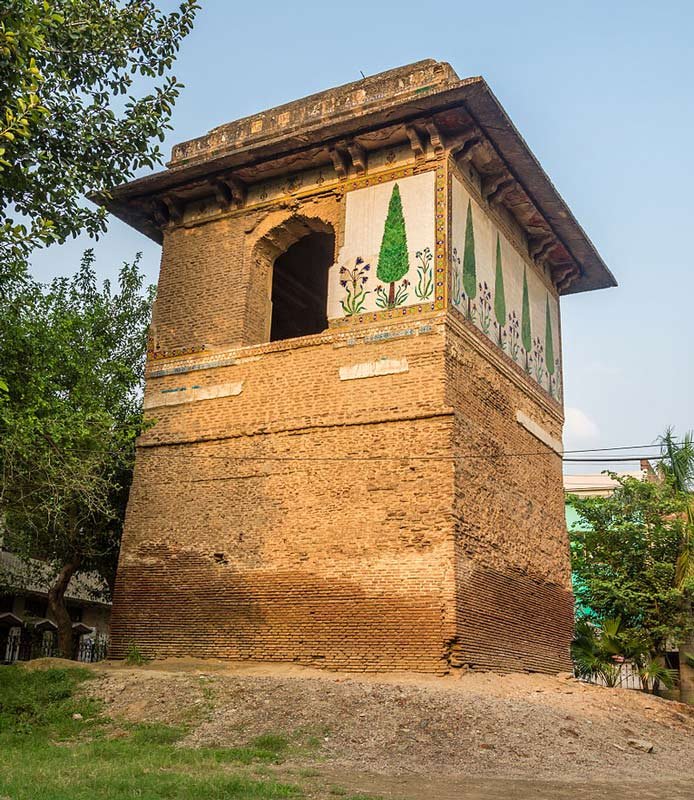
Let us be honest: you will not find the Cypress Tomb on most “top 10 things to do in Lahore” lists, and that is precisely its charm. In a city where every monument competes for attention, this one keeps its silence. Standing before it feels like discovering a secret that Lahore kept for you — a tall, tapering tower wrapped in faded tilework where cypress trees climb the walls in glazed ceramic, as if the garden that once surrounded it has pressed itself into the brickwork forever.
The story behind it is what truly sets it apart. Sharf-un-Nisa Begam was no ordinary noblewoman. Sister of Nawab Zakariya Khan, the governor of Lahore province under Emperor Muhammad Shah, she was a deeply pious woman who had this tower built as her meditation chamber — a place to climb up each morning with her Quran, reached only by a wooden ladder. After her death, the chamber became her tomb, and her body was placed high above the ground — about 25 feet up — so that even in death she would remain in purdah, out of the sight of unrelated men. How many tombs in the world can tell you a story like that?
For heritage lovers, there is another compelling reason. The renowned historian Catherine Blanshard Asher has described the Cypress Tomb as “Lahore’s best preserved monument from the post-Aurangzeb period.” The great Mughal age had ended; the empire was fraying at the edges; and yet this small, strange, beautiful structure rose in Begumpura with tilework as fine as anything the earlier emperors had left behind. Visiting it is like meeting the last chapter of a golden age, told not by kings but by a pious woman who only wanted a quiet place to read her Quran.
And then there is the photograph waiting for you. The pyramidal vault, the tapering silhouette against the Lahore sky, the cypress and floral motifs on the exterior tiles — it is one of the most unusual monuments you will ever frame. Bring a friend, bring your curiosity, and give yourself an hour. This is the Lahore that the tour buses drive past, and it is all the more precious for it.
History of Cypress Tomb
The Cypress Tomb belongs to the late Mughal period, when the empire of Akbar and Shah Jahan had shrunk into a shadow of itself. It was built between 1735 and 1740, during the reign of Mughal emperor Muhammad Shah — the ruler history remembers as Muhammad Shah Rangeela. Lahore’s governor at the time was Nawab Zakariya Khan, a powerful figure whose name still echoes in the history of the Punjab, not least for his campaigns against the rising Sikh power after the death of Banda Singh Bahadur.
Sharf-un-Nisa Begam was Zakariya Khan’s sister, and by all accounts a woman of unusual piety and independence of spirit. Rather than commissioning a conventional tomb, she had this structure built in her lifetime as a meditation chamber. Each morning she would climb up to it by means of a wooden ladder to read the Quran in seclusion. When she died, her wishes were honoured: the chamber was converted into her tomb, and she was buried within it at a great height — roughly 25 feet above the ground, according to historian accounts — so that she would remain in purdah even after death, hidden from the gaze of unrelated men.
The building came to be known locally as the Cypress Tomb — in Punjabi, the “Saruwala Maqbara,” the tomb with the cypresses — on account of the tile motifs depicting cypress trees, alongside other floral designs, that decorate the exterior walls. In Persian and Mughal symbolism the cypress, or sarv, stands for eternity and immortality, a fitting emblem for a house of the dead. The tomb was originally surrounded by a garden and a pool, which likely joined the gardens that once surrounded the nearby Tomb of Dai Anga.
The centuries were not kind. During Sikh rule in the 18th century, treasure hunters believed the tomb concealed riches; Sharf-un-Nisa Begam’s Quran and her jewelled sword were plundered and the tomb was desecrated. In the centuries since, the surrounding gardens have been swallowed by the growing city. Today the tomb stands in a small remaining garden where local boys play cricket, and reaching it requires threading through narrow lanes — the price of being a survivor in a city that never stops building. Yet it survives, and thanks in part to the conservation interest championed by former British High Commissioner Sir Nicholas Barrington, many experts regard it as the best preserved monument of its era in Lahore.
Top Things to Do in Cypress Tomb
The Cypress Tomb is a compact site — you will spend an hour or two here, not a day — but every minute rewards the visitor who looks closely.
Admire the Tapering Tower
Stand back and take in the silhouette. Unlike the domed mausoleums of Lahore, the Cypress Tomb rises as a tapering tower crowned by a pyramidal vault — a form so unusual that historian Catherine Blanshard Asher called the structure “unique.” Walk around it slowly and let the strangeness of its proportions sink in: this was never meant to be a conventional tomb, because it was never meant to be a tomb at all.
Study the Cypress Tile Motifs
Move in close to the exterior walls and look for the glazed tile motifs that gave the tomb its name. Cypress trees climb the walls in faded blues and greens alongside floral designs, remnants of the tilework that once covered far more of the structure. Each panel is a small lesson in Mughal decorative art from the empire’s last creative decades — the same tradition that covered the Wazir Khan Mosque in its prime.
Trace the Story of Sharf-un-Nisa Begam
Find the spot, high on the tower, where the lady’s chamber once held her Quran and her sword. Picture her climbing the wooden ladder each morning for her recitation, and remember that she chose to be buried at that height so she could remain in purdah forever. It is a story of piety and modesty that no guidebook can do justice to — standing in its shadow brings it alive.
Photograph a Hidden Monument
Heritage photographers: this is one of Lahore’s least photographed monuments, which means your shots will stand out. The best light falls in the late afternoon, when the sun warms the tiles and lengthens the tower’s shadow across the little garden. Frame it against the surrounding rooftops to tell the story of an old monument swallowed — and surviving — inside a modern city.
Combine with the Tomb of Dai Anga
The Cypress Tomb stands just to the north of the Tomb of Dai Anga, better known as Gulabi Bagh. The two monuments were built a century apart but their gardens once adjoined, and visiting both together gives you a beautiful contrast: the grand 17th-century tomb of Shah Jahan’s wet nurse beside the eccentric 18th-century tower of a pious noblewoman. Few visitors make this pairing, which makes it feel like a private discovery.
Famous Places In and Around Cypress Tomb
- Tomb of Dai Anga (Gulabi Bagh): The grand Mughal tomb just south of the Cypress Tomb — visit both in one trip.
- Dai Anga Mosque: The 1635 mosque built by Shah Jahan’s wet nurse, southeast of Lahore Railway Station.
- Badshahi Mosque: Lahore’s great Mughal showpiece, a short drive across the city — pair the hidden gem with the famous one.
- Lahore Fort and Sheesh Mahal: The imperial fortress complex, essential for any heritage itinerary.
- Wazir Khan Mosque: The tilework masterpiece of the walled city, to compare with the Cypress Tomb’s faded tiles.
How to Reach Cypress Tomb
The Cypress Tomb sits in Begumpura, east of the Grand Trunk Road in Lahore, about 200 metres north of the Tomb of Dai Anga. It is inside the city, so reaching Lahore is the journey — the tomb itself is a short local ride away. Since it stands in a dense old neighbourhood, the last stretch runs through narrow lanes; a rickshaw or a small car handles it best, and locals can point you to the “Saruwala Maqbara.”
From Islamabad: About 375 km via the M-2 motorway, roughly 4.5 to 5 hours by car. Take the motorway to Lahore, then follow the Grand Trunk Road toward Begumpura. Daewoo and other bus services run frequently between Islamabad and Lahore.
From Lahore (within the city): The tomb is a short drive from the city centre — ask your driver for Begumpura on GT Road, near the Gulabi Bagh / Tomb of Dai Anga. From Lahore Railway Station it is only a few kilometres east. Careem, Uber, and auto-rickshaws all serve the area.
From Karachi: Around 1,200 km by road (15–17 hours), so flying is the sensible option — Lahore’s Allama Iqbal International Airport has frequent flights of about 1 hour 45 minutes from Karachi, and the tomb is roughly 30–40 minutes from the airport by road.
The nearest airport is Allama Iqbal International Airport, Lahore. Road conditions within Lahore are generally good on main routes; only the final neighbourhood lanes around the tomb are narrow. There is no entry fee culture like the big monuments — this is a quiet heritage spot, so dress modestly, ask before photographing local residents, and consider bringing a local guide who knows the lanes.
Route Details
- Reach Lahore via M-2 (from Islamabad) or by flight/rail (from Karachi and elsewhere).
- Head for the Grand Trunk Road (GT Road) on the eastern side of the city.
- At Begumpura, look for the Tomb of Dai Anga (Gulabi Bagh) — a well-known landmark.
- The Cypress Tomb stands about 200 metres north of it; ask locals for “Saruwala Maqbara” and follow the lanes into the small garden.
Where to Stay in Cypress Tomb
The Cypress Tomb is inside Lahore, so you stay in Lahore — no one sleeps in Begumpura’s lanes. The good news is that Lahore has one of Pakistan’s widest ranges of accommodation, and the tomb is a short ride from most of the city’s hotel districts.
Luxury: Lahore’s five-star hotels cluster around Gulberg and the Mall Road area — full-service properties with pools, spas, and in-house dining, ideal if you want to pair heritage hunting with comfort.
Mid-range: The Gulberg, Model Town, and Johar Town areas are full of well-regarded three- and four-star hotels and serviced apartments at sensible prices, most within a 20–30 minute drive of Begumpura.
Budget and guesthouses: Around the railway station and in the old city you will find budget hotels and family-run guesthouses — basic but convenient for travellers who plan to spend their days, not their evenings, exploring. If you want to be closest to the Mughal monuments, look for guesthouses near the walled city.
For heritage travellers, staying near the old city or Gulberg puts the Cypress Tomb, the Tomb of Dai Anga, the Badshahi Mosque, and the Lahore Fort all within easy reach of a single day’s itinerary.
Where to Eat: Local Foods of Cypress Tomb
You are in Lahore, the food capital of Pakistan — eating well here requires no effort at all. The Begumpura area itself is a working-class neighbourhood with humble local eateries serving daal, sabzi, and fresh tandoori roti at very budget-friendly prices. But the real culinary adventure lies a short drive away.
Head to the Fort Road Food Street near the Badshahi Mosque for the full Lahori spread: nihari, paya, chanay, seekh kebabs, and mutton karahi, eaten with a view of the illuminated mosque. Lakshmi Chowk is the old city’s legendary food square, famous for its dahi bhallay, gol gappay, and late-night halwa puri breakfasts. For dessert, Lahori kulfi, rabri, and gulab jamun are unmissable. A full meal at a local eatery is budget-friendly; mid-range restaurants in Gulberg cost more but still far less than equivalent dining abroad. Wash it all down with a tall glass of lassi — Lahore’s signature.
Weather in Cypress Tomb
The Cypress Tomb shares Lahore’s climate: blazing summers, a dramatic monsoon, and mild, foggy winters. Since the tomb is best explored on foot in its little garden, the cool months are by far the most comfortable time to visit.
| Season | Temperature Range | Conditions |
|---|---|---|
| Winter (Dec–Feb) | 7°C – 22°C | Mild days, cool nights, occasional fog in the mornings; the best season for heritage walks. |
| Spring (Mar–Apr) | 15°C – 34°C | Warming up; pleasant in March, hot by late April. Good for early-morning visits. |
| Summer (May–Jun) | 26°C – 40°C+ | Intensely hot and dry, with occasional dust storms. Visit only at dawn or dusk. |
| Monsoon (Jul–Sep) | 27°C – 36°C | Heavy rain, especially in July and August; humid. Tiles look vivid when wet, but lanes get muddy. |
| Autumn (Oct–Nov) | 14°C – 34°C | Dry and gradually cooling; October is one of the most pleasant months in Lahore. |
Language and Culture of Cypress Tomb
The Cypress Tomb stands in a Punjabi-speaking neighbourhood of Lahore, where Punjabi is the language of the street and Urdu is universally understood and spoken. English is widely understood in hotels, restaurants, and among educated guides.
Lahore’s culture is famously warm — the city calls itself the heart of Pakistan, and its people live up to it. Visitors to a quiet residential monument like this should dress modestly (covering shoulders and knees is a good rule), greet elders with an “Assalam-o-Alaikum,” and ask permission before photographing people or entering any prayer space. Remove your shoes if you step into the chamber area out of respect, and keep voices low — this is a tomb, and for the neighbourhood it is also a place of quiet dignity. A small tip to a local youngster who shows you the way is always appreciated.
Shopping in Cypress Tomb
There is no souvenir market at the tomb itself — the nearest shopping is in Lahore’s famous bazaars, all a short drive away. Anarkali Bazaar, one of South Asia’s oldest markets, is the place for traditional khussay (embroidered shoes), shawls, and Mughal-inspired handicrafts. Ichhra and Liberty Market offer fabrics, ready-made clothes, and jewellery at bargain prices, while Fort Road near the Badshahi Mosque has stalls selling miniature paintings, camel-skin lamps, and other heritage crafts that make perfect mementos of a history-themed trip. Bargaining is expected in the bazaars — start at about two-thirds of the asking price and smile through it.
Travel Tips for Cypress Tomb
Packing Essentials
Comfortable walking shoes (the lanes are uneven), a sun hat and sunscreen for daytime visits, a water bottle, and a camera with a good zoom for the tile details. In winter, carry a light jacket for the mornings; in summer, visit at dawn. A power bank helps — you will take more photos than you expect.
Safety Tips
Begumpura is a busy, working-class neighbourhood. Visit during daylight hours, keep valuables out of sight, and consider hiring a local guide through your hotel — they know the lanes and the etiquette. The structure itself is old: do not attempt to climb the tower or lean on fragile sections. Travel in pairs if possible, as with any off-the-beaten-path site.
Money & Connectivity
ATMs are plentiful in Lahore’s commercial areas but not in the lanes around the tomb — withdraw cash beforehand. Mobile signals are strong across Lahore on all major networks (Jazz, Zong, Telenor, Ufone), and 4G data works fine at the site. Small shops nearby accept cash only.
Best Time to Visit Cypress Tomb
Winter (November to February) — The Ideal Season
Cool, clear, and perfect for walking. This is the best time to visit the Cypress Tomb: mild afternoons, golden light on the tiles, and comfortable lanes. If you are planning a Lahore heritage trip, winter is when the city shows its best face.
Spring (March to April) — Pleasant Mornings
March is lovely; by April the heat builds. Visit early in the morning and pair the tomb with the Tomb of Dai Anga before the sun climbs.
Summer and Monsoon (May to September) — For the Hardy
Lahore’s summer is punishing, and the monsoon turns the lanes muddy. If you must visit then, go at dawn, carry water, and combine it with indoor attractions like the Lahore Museum for the rest of the day.
Autumn (October) — The Sweet Spot
October brings dry, warm, golden days — arguably the single best month for photography at the tomb, with clear skies and soft evening light.
Final Thoughts
The Cypress Tomb will never have the crowds of the Badshahi Mosque, and that is exactly why you should go. In its tapering tower and fading cypress tiles you can read the whole arc of the Mughal story — not in imperial bombast, but in the quiet piety of a woman who asked for nothing more than a high, secluded chamber to read her Quran. Standing in the little garden where children now play cricket, with a 300-year-old monument rising above the rooftops, you feel Lahore’s history not as a museum piece but as a living thing.
So when you plan your Lahore itinerary, leave an hour for the forgotten lady of Begumpura. Find the lanes, look up at the tower, and trace the cypresses on the wall. Some destinations you visit; this one you discover. For more heritage inspiration across the country, explore our Explore Pakistan collection — and if the mountains are calling too, our Hunza Valley guide shows you where to go next.
FAQs
Where is the Cypress Tomb located?
The Cypress Tomb is in Begumpura, on the Grand Trunk Road in Lahore, Punjab — about 200 metres north of the Tomb of Dai Anga (Gulabi Bagh).
What is the Cypress Tomb famous for?
It is the unique tapering tower-tomb of Sharf-un-Nisa Begam (built 1735–1740), decorated with cypress-tree tile motifs, and notable for being her meditation chamber before it became her tomb.
When is the best time to visit the Cypress Tomb?
November to February, when Lahore’s weather is cool and pleasant for walking through the old neighbourhood lanes.
How do I reach the Cypress Tomb?
Fly or drive to Lahore, then take a car or rickshaw to Begumpura on GT Road. Ask locals for the “Saruwala Maqbara” near the Tomb of Dai Anga.
Is the Cypress Tomb safe to visit?
Yes, during daylight hours. It sits in a busy residential area — visit in the daytime, dress modestly, and consider a local guide for the lanes.
Is the Cypress Tomb suitable for families?
Yes. It is a short, easy visit with no difficult terrain, though the narrow lanes are best navigated with older children rather than toddlers in strollers.
Where should I stay to visit the Cypress Tomb?
Stay in Lahore — Gulberg, Model Town, or near the old city all put the tomb within a short drive.
What food should I try near the Cypress Tomb?
Lahore’s classics: nihari, paya, chanay, and seekh kebabs at Fort Road Food Street or Lakshmi Chowk, finished with kulfi or a tall lassi.
Why is it called the Cypress Tomb?
Because of the glazed tile motifs of cypress trees (sarv, a Mughal symbol of eternity) decorating its exterior walls — locally it is the “Saruwala Maqbara.”