Quick Facts
- Location: Bhuman Shah village, 24 km from Dipalpur on the Dipalpur–Haveli Lakha road, Okara District, Punjab
- Altitude: Around 180 metres — the flat plains of central Punjab
- Famous For: The 1910 double-storey darbar with vivid frescoes, built for Baba Sri Chand inside the historic Dera Baba Bhuman Shah
- Nearest City: Dipalpur (24 km); Okara and Lahore are the main bases
- Accessibility: Easy day trip by car on paved country roads; no trekking involved
- Known Landmarks: Diwan hall frescoes (peacocks, tigers, elephants), domed Prakashasthan, samadhs of Udasi sadhus, fort-like dera walls
- Best For: Heritage lovers, photographers, Sikh-history travellers, architecture enthusiasts and quiet day-trippers from Lahore
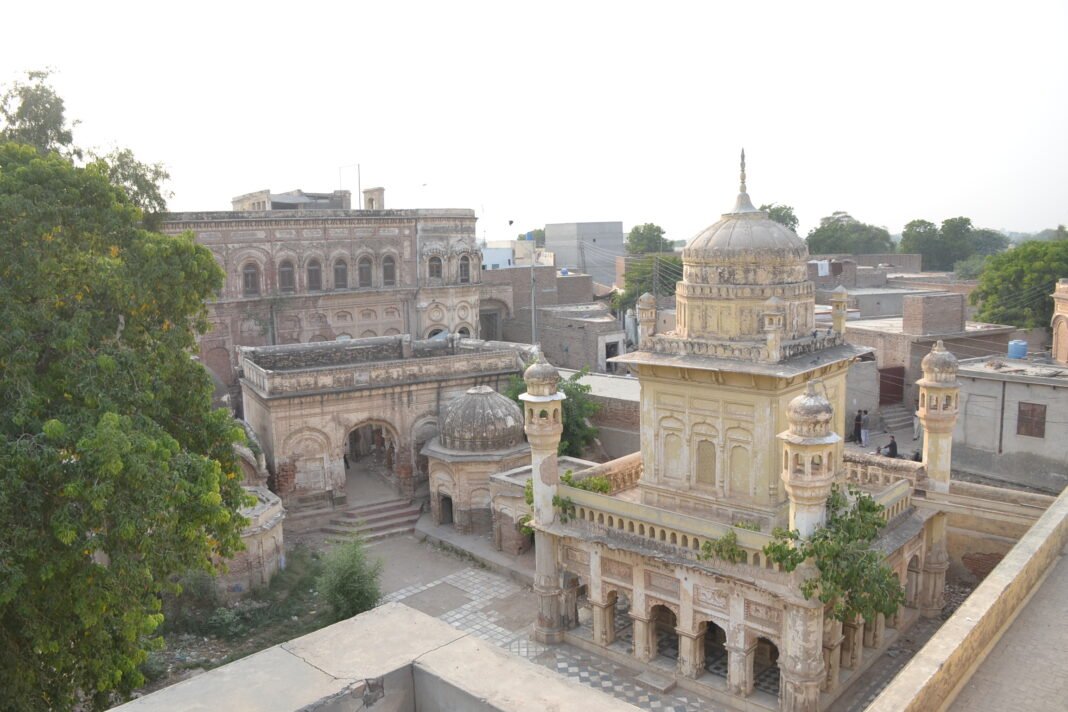
In a Punjab village most Pakistanis have never heard of stands one of the country’s most evocative forgotten monuments: a double-storey darbar built in 1910, its diwan hall blazing with frescoes of peacocks, tigers and elephants, raised in honour of Baba Sri Chand — the elder son of Guru Nanak and founder of the Udasi sect. It sits inside the crumbling fort-like complex of Dera Baba Bhuman Shah, and visiting it feels less like tourism and more like rescue archaeology. This darbar baba sri chand bhuman shah travel guide is your invitation to see it before time finishes what neglect began.
Why Visit Darbar Baba Sri Chand, Bhuman Shah
You should visit because this is one of the last great Udasi monuments in Pakistan, and it is fading. The Darbar of Baba Sri Chand is not a polished, ticketed heritage site — it is a living ruin, a 1910 building of genuine architectural ambition whose painted walls still hold frescoes of peacocks, birds, tigers, elephants, sarangis and tablas, with rhymes from the Guru Granth Sahib inscribed between them. For anyone interested in the shared spiritual history of Punjab, standing in that diwan hall is a powerful experience. Few places in Pakistan let you feel the Udasi tradition — the ascetic Sikh order founded by Guru Nanak’s own son — so directly.
The setting multiplies the impact. The darbar stands inside Dera Baba Bhuman Shah, a fort-like complex of haveli quarters, samadhs of Udasi sadhus, a langar khana and a tank, entered through four big gates. Around the darbar lie the samadhs of generations of Udasi sadhus, and opposite them the darbar of Guru Gobind Singh Ji, where the Dassam Granth used to be recited. It is an entire spiritual landscape in one compound — and almost all of it is decaying: cracked walls, collapsed roofs, murals vandalised and neglected. Visitors consistently describe the visit as moving and urgent in equal measure.
It is also one of the easiest heritage trips you can make from Lahore. Bhuman Shah village lies about 24 km from Dipalpur on a scenic country road through potato and maize fields — a couple of hours’ drive from Lahore, all on the plains, no mountains, no special gear. Go in daylight, take a camera, look from the doorways rather than under damaged ceilings, and you will have seen something most heritage guides never mention.
Perfect for? Students of Sikh and Punjabi history, photographers of decaying architecture, and travellers who prefer their history raw rather than restored. If you have visited Nankana Sahib or Kartarpur, Bhuman Shah completes the picture — it shows you the Udasi strand of the tradition, the ascetic order that once commanded vast estates and the devotion of Punjab.
History of Darbar Baba Sri Chand, Bhuman Shah
The story of this darbar begins with Baba Sri Chand (1494–1629), the elder son of Guru Nanak, the founder of the Sikh faith. Sri Chand chose the path of ascetic renunciation rather than household life, and founded the Udasi sect of celibate sadhu-ascetics — a tradition that would spread across Punjab and far beyond, establishing deras, akharas and shrines that commanded enormous followings and landholdings through the 18th and 19th centuries.
The dera at Bhuman Shah belongs to a later chapter: Baba Bhuman Shah (1702–1747), a prominent Udasi sadhu whose haveli in Depalpur became the seat of the Dera Baba Bhuman Shah. The dera grew into one of the great Udasi institutions — during the tenure of the sixth mahant, Baba Darshan Das (1836–1868), a British Divisional Commissioner, impressed by the dera complex and its free-kitchen langar service, attached 3,000 acres of agricultural land to the shrine; the dera’s total landed property eventually grew to well over 18,000 acres. A succession of mahants — Nirmal Chand, Bhawani Das, Darshan Das, Harbhajan Das and others — maintained the institution through the 19th and 20th centuries.
The Darbar of Baba Sri Chand itself is precisely dated: it was constructed in Samvat 1967, corresponding to 1910 AD, by Mahant Harbhajan Das. The plaque inscription records that it was built at his proposal in honour of Baba Sri Chand. After 1947 the dera, like many Sikh and Hindu shrines left behind, passed into the care of the Evacuee Trust Property Board, and its vast estates and buildings entered a long decline. Today the complex stands in a miserable, dilapidated state — cracked walls, collapsed roofs — and heritage writers have warned that without preservation, an invaluable treasure of Punjabi fresco art will be lost.
Top Things to Do in Darbar Baba Sri Chand, Bhuman Shah
Stand in the Diwan Hall
The double-storey darbar’s diwan hall is the centrepiece: walls decorated with captivating frescoes of peacocks, birds, tigers and elephants, musical instruments — sarangis and tablas — painted among them, and verses from the Guru Granth Sahib inscribed at intervals. Look up at the domed Prakashasthan inside the hall; it is the most photogenic interior in the complex.
Read the 1910 Plaque
Find the inscription commemorating Mahant Harbhajan Das’s initiative — the plaque reads (in essence) that the Darbar of Baba Sri Chand was built at the proposal of the honourable Mahant. It is a small, concrete link to the exact moment of the building’s creation.
Walk the Samadhs of the Udasi Sadhus
A number of samadhs (memorial shrines) of Udasi sadhus surround the dera. They vary in age and condition and give the complex its layered, cemetery-like solemnity. In front of the samadhs stands the darbar of Guru Gobind Singh Ji, where the Dassam Granth Ji used to be recited — a site of deep significance for Sikh visitors.
Explore the Fort-Like Dera Complex
The shrine is built in the style of a big fort, with four large gates, residential quarters (haveli), hundreds of rooms once used by visitors and devotees, the langar khana and the tank. Walk the outer walls and the courtyards to grasp the scale of what this institution once was — a self-contained spiritual township.
Photograph the Frescoes Responsibly
The murals are the artistic treasure here and they are deteriorating. Photograph them for the record, but do not touch the walls or lean on fragile plaster. Daylight through the doorways gives the best, most honest light.
Famous Places In and Around Darbar Baba Sri Chand, Bhuman Shah
- Dipalpur (24 km): The historic tehsil town with the ancient Depalpur Fort area and old bazaars.
- Okara City: The district headquarters, a major agricultural market town.
- Haveli Lakha: The town on the road beyond Bhuman Shah, with its own old-town character.
- Lahore: The natural base for this trip — combine it with the city’s Sikh heritage sites.
- Nankana Sahib: The birthplace of Guru Nanak, the essential companion pilgrimage for Sikh-history travellers.
Heritage travellers will also enjoy our other Punjab features in the Explore Pakistan series — the province’s history rewards slow travel.
How to Reach Darbar Baba Sri Chand, Bhuman Shah
Getting here is straightforward. From Lahore, drive south-west toward Okara and Dipalpur — the journey to Dipalpur takes about 2 to 2.5 hours by car. From Dipalpur, take the Dipalpur–Haveli Lakha road for 24 km through farmland to Bhuman Shah village; the dera complex is in the village itself. The roads are paved country roads, easily managed by any car in dry weather.
From Islamabad, the drive to Dipalpur via the motorway is roughly 4–5 hours, making this a long day trip or, better, an overnight excursion combined with Okara or Lahore. From Karachi, fly to Lahore and drive from there — the road distance is over 1,000 km. The nearest airport is Lahore’s Allama Iqbal International Airport.
There is no public transport directly to the village; hire a car or rickshaw from Dipalpur, or drive yourself. Visit in daylight — the complex is in poor structural condition, so plan to look from courtyards and doorways rather than entering rooms with cracked or collapsed roofs. November to March is the recommended season; the Okara plains approach 39 °C in May and June.
Route Details
- Lahore → Okara/Dipalpur (about 2–2.5 hours by car) via the national highway.
- Dipalpur → Bhuman Shah village (24 km) on the Dipalpur–Haveli Lakha road, through potato and maize fields.
- Enter the dera complex through the main gates; the Darbar of Baba Sri Chand stands inside the fort-like walls.
- Tour the diwan hall, the samadhs and the courtyards on foot; allow 1–2 hours.
- Return to Dipalpur or Okara for meals — there are no restaurants at the village.
Where to Stay in Darbar Baba Sri Chand, Bhuman Shah
This is a day-trip destination, not an overnight one. The dera’s hundreds of pilgrim rooms are in no condition for tourists, and Bhuman Shah village has no hotels. Base yourself in Dipalpur (basic guesthouses), Okara (mid-range hotels serving the agricultural trade) or, best of all, Lahore — which offers everything from budget hostels to five-star hotels and puts you within easy reach for a morning departure and evening return.
If you are touring Punjab’s Sikh heritage more broadly — Nankana Sahib, Kartarpur, Lahore’s gurdwaras — plan a multi-day circuit with Lahore as your hub and Bhuman Shah as one of the day excursions. Book Lahore accommodation in advance during winter, the peak heritage-tourism season.
Where to Eat: Local Foods of Darbar Baba Sri Chand, Bhuman Shah
There are no restaurants at Bhuman Shah village, so eat in Dipalpur or Okara — and eat well, because this is the heart of Punjab’s agricultural belt. The region’s food is classic central-Punjabi: desi ghee parathas, saag and makai di roti in winter, chana and daal dishes, fresh lassi, and seasonal produce straight from the surrounding fields. Dipalpur’s small dhabas serve hearty, honest meals at very budget-friendly prices.
Okara, a major dairy and agricultural market, is known for fresh milk, desi ghee and sweets. If your trip extends to Lahore, the city’s food streets need no introduction. Carry water and snacks for the village visit itself, and if you are offered food by local residents — as often happens at shrines — accept graciously.
Weather in Darbar Baba Sri Chand, Bhuman Shah
The Okara plains have a classic Punjab climate: pleasant winters, scorching summers. The heritage guidance is explicit — visit between November and March, in daylight, and skip May and June when the plains approach 39 °C. The complex offers little shade and no facilities, so heat matters.
| Season | Temperature Range | Conditions |
|---|---|---|
| Winter (Dec–Feb) | 5 to 20 °C | Cool, clear, ideal for exploring the ruins. Mornings can be foggy. |
| Spring (Mar–Apr) | 15 to 32 °C | Warming up; still comfortable for a morning visit. |
| Summer (May–Jul) | 30 to 44 °C | Extreme heat; avoid. The plains near 39 °C even in May. |
| Autumn (Sep–Nov) | 18 to 34 °C | Cooling down; late October–November is excellent. |
Language and Culture of Darbar Baba Sri Chand, Bhuman Shah
This is central Punjab: Punjabi is the mother tongue, Urdu is universally understood. The village culture is agricultural and conservative — dress modestly, greet elders respectfully, and ask permission before photographing people or entering any occupied part of the complex (local families now live in some of the dera’s residential quarters).
Remember what this place is: a sacred site of the Udasi Sikh tradition, still revered by Sikhs and Hindus. Behave as you would in any place of worship — remove shoes where appropriate, keep your voice low in the prayer halls, do not deface or remove anything, and treat the samadhs with the reverence of a graveyard. The site’s decay is heartbreaking; be a witness, not a contributor.
Shopping in Darbar Baba Sri Chand, Bhuman Shah
There is no souvenir trade at the dera — buy supplies and gifts in Dipalpur or Okara. The region’s markets sell fresh dairy, desi ghee, seasonal fruit and everyday Punjabi goods. Okara’s grain and produce markets are worth a wander for a taste of small-city Punjab commerce. For handicrafts and proper souvenirs, Lahore’s Ichhra, Anarkali and Liberty markets remain the best bet on the way home. No malls are needed for this trip — and none exist near the village.
Travel Tips for Darbar Baba Sri Chand, Bhuman Shah
Packing Essentials
Sun hat, sunscreen and water (no shade or shops at the site), sturdy closed shoes for rubble and uneven floors, a camera with a good low-light lens for the diwan hall, and a light shawl for modesty at the shrine.
Safety Tips
The complex is structurally unsound in places — cracked walls, collapsed roofs. Stay in courtyards and doorways; do not enter rooms with damaged ceilings or climb on walls. Visit in daylight only, ideally with a local companion from Dipalpur who knows the site. Keep valuables minimal.
Money & Connectivity
Carry cash — small notes for the drive, meals and any donations. Mobile signals are generally fine on the plains (all major networks). There are no ATMs in the village; withdraw in Dipalpur or Okara.
Best Time to Visit Darbar Baba Sri Chand, Bhuman Shah
Winter (November to March) — The Right Season
Cool, clear days on the plains, comfortable for walking the ruins, and the best light for photography. This is when heritage travellers should come.
Spring (March to April) — Still Good
Warming but manageable; morning visits are pleasant and the surrounding fields are green.
Summer (May to August) — Avoid
Extreme heat makes the exposed complex miserable and potentially unsafe. Heritage surveys explicitly advise skipping May–June.
Autumn (September to October) — The Shoulder
Cooling down; late October onward is fine and the harvest fields around the village are at their most scenic.
Final Thoughts
The Darbar of Baba Sri Chand at Bhuman Shah is not a comfortable tourist attraction — it is a monument asking to be remembered. In its frescoed diwan hall, in the samadhs of the Udasi sadhus, in the sheer scale of the dera that once fed travellers from its langar and farmed eighteen thousand acres, you can read the whole story of a spiritual tradition that shaped Punjab and is now slipping from view.
Go in winter, go in daylight, go gently — and go soon. Places like this do not wait. Whether you come as a pilgrim, a photographer or simply a curious traveller from Lahore, Bhuman Shah will give you one of the most thought-provoking day trips in Punjab. This darbar baba sri chand bhuman shah travel guide has shown you the way; the frescoes are waiting.
FAQs
Where is Darbar Baba Sri Chand, Bhuman Shah located?
Inside the Dera Baba Bhuman Shah complex in Bhuman Shah village, 24 km from Dipalpur on the Dipalpur–Haveli Lakha road, in Okara District, Punjab.
What is the best time to visit?
November to March, in daylight. Avoid May and June, when the Okara plains approach 39 °C and the exposed complex is punishing.
How do I reach it from Lahore?
Drive to Dipalpur (about 2–2.5 hours), then 24 km on the Dipalpur–Haveli Lakha road to Bhuman Shah village. Any car can manage the paved country roads.
Who was Baba Sri Chand?
The elder son of Guru Nanak (1494–1629), founder of the Udasi sect of ascetic Sikh sadhus. The darbar was built in his honour in 1910 by Mahant Harbhajan Das.
Is the site safe to visit?
Yes with caution: the complex is dilapidated, so stay in courtyards and doorways, avoid rooms with cracked or collapsed roofs, and visit in daylight.
Is it suitable for families?
Yes as a day trip — there is no climbing or rough terrain, just uneven floors. Keep children close to you in the ruined sections.
Where can I stay nearby?
Nowhere at the village itself — base yourself in Dipalpur, Okara or Lahore and visit as a day trip.
What will I actually see there?
The 1910 double-storey darbar with its frescoed diwan hall and domed Prakashasthan, the samadhs of Udasi sadhus, the darbar of Guru Gobind Singh Ji, and the vast fort-like dera complex with its four gates.